Adhyaya 23
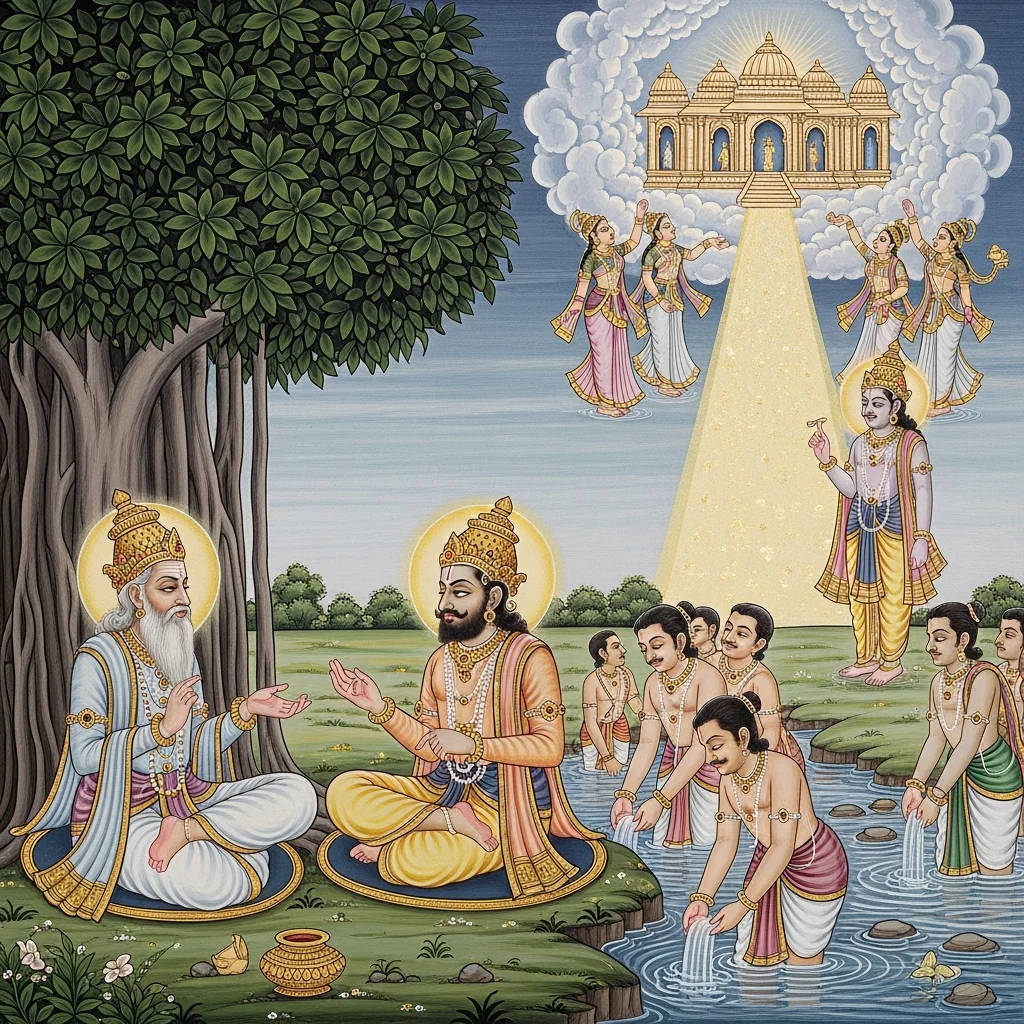
Mārkaṇḍeya instructs a king on the saving power of relinquishing life with devotion at a sacred sangama (confluence), and extols the unmatched purificatory status of Revā (Narmadā) water. The chapter sets forth graded fruits: dying at the sangama with supreme bhakti grants the highest destiny; a renunciant’s death, with all intentions abandoned, leads to heavenly residence after approaching Amareśvara; and relinquishing the body at Śailendra brings ascent in a sun-hued vimāna to Amarāvatī, amid celestial scenes where apsarases praise the fallen devotee. It then ranks holy waters: though some learned authorities speak of Sarasvatī and Gaṅgā as equal, experts place Revā-water above them and discourage dispute over its superiority. The Revā region is portrayed as inhabited by vidyādharas and kinnara-like beings, and those who reverently bear Revā-water upon the head are said to draw near to Indra’s domain. Ethical counsel follows: continual service to Narmadā is urged for those who wish never again to behold the terrifying ocean of saṃsāra; the river purifies the three worlds, and even death anywhere within its sphere yields a gaṇeśvarī (divine attendant) destiny. The riverbank is further described as densely ringed with sacrificial sites, so that even sinners who die there reach heaven. Finally, Kapilā and Viśalyā are named as earlier creations of Īśvara for universal welfare, and bathing with fasting and sense-control is prescribed, promising Aśvamedha-like merit. An anāśaka observance (hungerless discipline) at this tīrtha removes all sins and leads to Śiva’s abode, and a single bath at the Viśalyā-sangama is equated with the fruit of bathing and gifting across the whole earth up to the ocean.
Shlokas
Verse 1
मार्कण्डेय उवाच । तत्रैव सङ्गमे राजन्भक्त्या परमया नृप । प्राणांस्त्यजन्ति ये मर्त्यास्ते यान्ति परमां गतिम्
Mārkaṇḍeya said: O king, O ruler—those mortals who, at that very confluence, with supreme devotion, relinquish their life-breath attain the highest state.
Verse 2
संन्यस्तसर्वसंकल्पो यस्तु प्राणान्परित्यजेत् । अमरेश्वरमासाद्य स स्वर्गे नियतं वसेत्
But one who has renounced all intentions and, having reached Amareśvara, relinquishes the life-breath—he will certainly dwell in heaven.
Verse 3
शैलेन्द्रं यः समासाद्य आत्मानं मुञ्चते नरः । विमानेनार्कवर्णेन स गच्छेदमरावतीम्
The man who reaches Śailendra and then relinquishes his body is borne in a sun-hued aerial car and goes to Amarāvatī.
Verse 4
नरं पतन्तमालोक्य नगादमरकण्टकात् । ब्रुवन्त्यप्सरसः सर्वा मम भर्ता भवेदिति
Seeing a man falling from the mountain called Amara-kaṇṭaka, all the Apsarases exclaim, “May he become my husband!”
Verse 5
समं जलं धर्मविदो वदन्ति सारस्वतं गाङ्गमिति प्रबुद्धाः । तस्योपरिष्टात्प्रवदन्ति तज्ज्ञा रेवाजलं नात्र विचारणास्ति
The knowers of dharma declare the waters of Sarasvatī and Gaṅgā to be equal; yet the truly discerning proclaim the water of Revā (Narmadā) to be superior to them—of this there is no doubt.
Verse 6
अनेकविद्याधरकिन्नराद्यैरध्यासितं पुण्यतमाधिवासैः । रेवाजलं धारयतो हि मूर्ध्ना स्थानं सुरेन्द्राधिपतेः समीपे
That region is frequented by Vidyādharas, Kinnaras, and other dwellers of the most holy abodes; for one who bears the water of Revā upon his head attains a place near Indra, the sovereign lord of the gods.
Verse 7
नर्मदा सर्वदा सेव्या बहुनोक्तेन किं नृप । यदीच्छेन्न पुनर्द्रष्टुं घोरं संसारसागरम्
Narmadā should ever be served and revered—what need is there for many words, O king? For one who wishes never again to behold the dreadful ocean of saṃsāra.
Verse 8
त्रयाणामपि लोकानां महती पावनी स्मृता । यत्र तत्र मृतस्यापि ध्रुवं गाणेश्वरी गतिः
She is remembered as a mighty purifier of all the three worlds; and wherever one may die (in the sphere of her sanctity), a Gaṇeśvara-like destiny is assured—attainment among Śiva’s Gaṇas.
Verse 9
अनेकयज्ञायतनैर्वृताङ्गी न ह्यत्र किंचिद्यदतीर्थमस्ति । तस्यास्तु तीरे भवता यदुक्तं तपस्विनो वाप्यतपस्विनो वा
Encircled by many seats of sacrifice, there is no spot here that is not a tīrtha. Therefore, what you have said about her bank—whether for ascetics or for those who are not ascetics—indeed holds true.
Verse 10
म्रियन्ति ये पापकृतो मनुष्यास्ते स्वर्गमायान्ति यथाऽमरेन्द्राः
Even those men who have committed sins—if they die there, within the sphere of that tīrtha—go to heaven, like the lords of the immortals.
Verse 11
एवं तु कपिला चैव विशल्या राजसत्तम । ईश्वरेण पुरा सृष्टा लोकानां हितकाम्यया
Thus, O best of kings, both Kapilā and Viśalyā were formerly created by the Lord, out of the desire to bring welfare to the worlds.
Verse 12
तत्र स्नात्वा नरो राजन्सोपवासो जितेन्द्रियः । अश्वमेधस्य महतोऽसंशयं फलमाप्नुयात्
O King, a man who bathes there, fasting and self-controlled, undoubtedly attains the fruit of a great Aśvamedha sacrifice.
Verse 13
अनाशकं च यः कुर्यात्तस्मिंस्तीर्थे नराधिप । सर्वपापविनिर्मुक्तो याति वै शिवमन्दिरम्
O lord of men, whoever performs the anāśaka observance at that tīrtha becomes freed from all sins and indeed goes to Śiva’s abode.
Verse 14
पृथिव्यां सागरान्तायां स्नानदानेन यत्फलम् । विशल्यासङ्गमे स्नात्वा सकृत्तत्फलमश्नुते
Whatever fruit is gained on the earth, bounded by the oceans, through bathing and giving—by bathing just once at the confluence of Viśalyā, one enjoys that very fruit.
Verse 15
एवं पुण्या पवित्रा च कथिता तव भूपते । भूयो मां पृच्छसि च यत्तच्चैव कथयाम्यहम्
Thus, O king, the meritorious and purifying tīrtha has been described to you. And whatever else you ask me again, that too I shall tell.
Verse 23
। अध्याय
Adhyāya marker: end/heading indication of the chapter.