Adhyaya 93
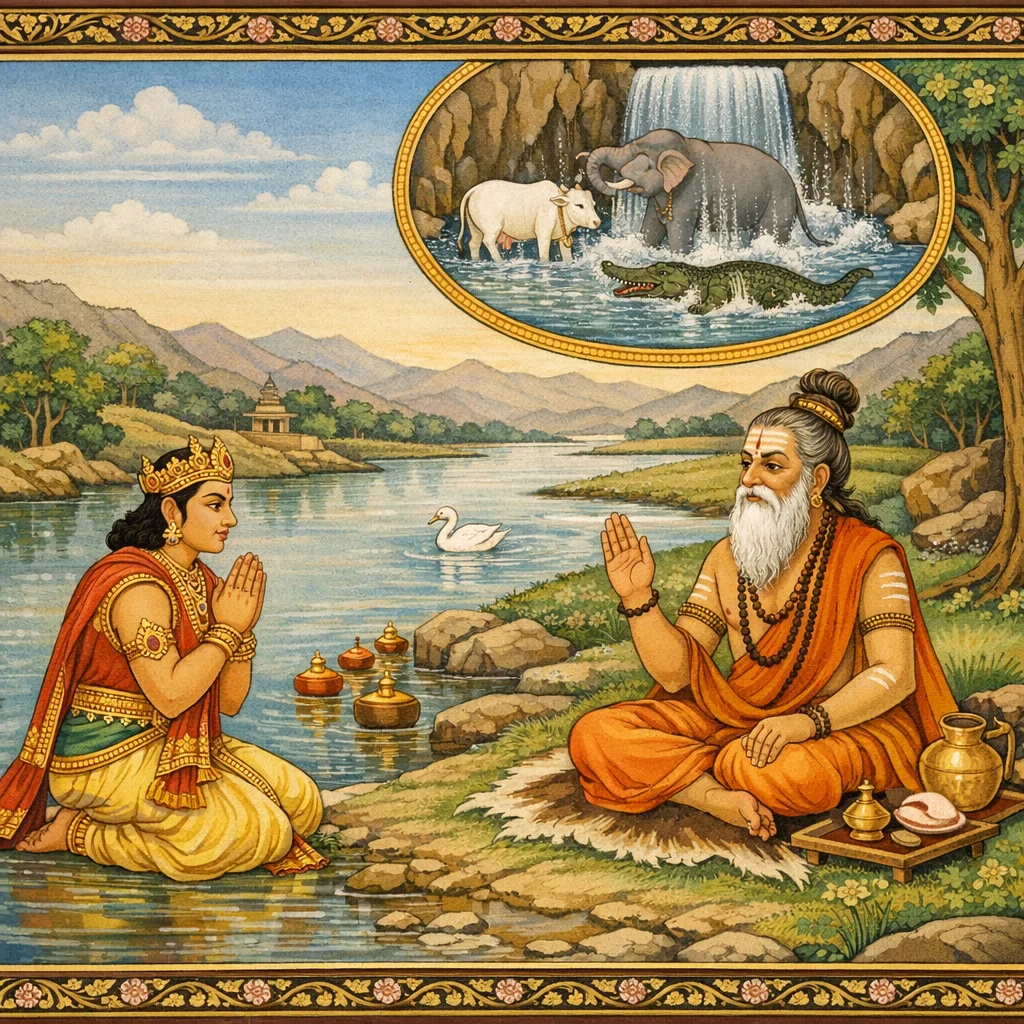
This chapter records Mārkaṇḍeya’s instruction to Yudhiṣṭhira about the eminent pilgrimage ford called Kalhoḍī-tīrtha on the bank of the Revā (Narmadā). It is famed throughout Bhārata as a remover of sin, its purifying power likened to the Gaṅgā, and it is said to be difficult for ordinary people to reach, highlighting its exceptional sanctity. Its authority is affirmed as Śūlin (Śiva)’s own declaration—“this is a holy tīrtha”—and an origin-tale adds that Jāhnavī (Gaṅgā) once came there to bathe in an animal form, explaining the site’s renown. A discipline is prescribed: a three-night observance at the full moon, together with the deliberate abandonment of inner faults—rajas, tamas, anger, hypocrisy/ostentation, and envy. The devotional rite includes bathing the deity three times daily for three days with cow’s milk from a cow with a calf, in a copper vessel mixed with honey, while reciting the Śaiva mantra “oṃ namaḥ śivāya.” The promised fruits are heavenly attainment (companionship of divine women) and, for those who bathe properly and give gifts on behalf of the departed, the satisfaction of the ancestors. A specific dāna is emphasized: gifting a white cow with calf, adorned with cloth and set upon gold, to a purified brāhmaṇa devoted to household fidelity, granting access to Śāmbhava-loka, a realm associated with Śiva.
Shlokas
Verse 1
श्रीमार्कण्डेय उवाच । ततो गच्छेत्तु राजेन्द्र कल्होडीतीर्थमुत्तमम् । विख्यातं भारते लोके गङ्गायाः पापनाशनम्
Śrī Mārkaṇḍeya said: Then, O king, one should go to the supreme Kalhoḍī Tīrtha—renowned throughout Bhārata, a destroyer of sins comparable to the Gaṅgā.
Verse 2
दुर्लभं मनुजैः पार्थ रेवातटसमाश्रितम् । प्राणिनां पापनाशाय ऊषरं पुष्करं तथा
O Pārtha, this good fortune is hard for humans to obtain, for it rests upon the bank of the Revā. For the destruction of the sins of living beings, it holds the sacred waters called Ūṣara and also Puṣkara.
Verse 3
तत्तु तीर्थमिदं पुण्यमित्येवं शूलिनो वचः । जाह्नवी पशुरूपेण तत्र स्नानार्थमागता
“Truly, this tīrtha is holy,” declared the Trident-bearer (Śiva). And Jāhnavī (Gaṅgā), taking the form of an animal, came there for the sake of bathing.
Verse 4
अतस्तद्विश्रुतं लोके कल्होडीतीर्थमुत्तमम् । त्रिरात्रं कारयेत्तत्र पूर्णिमायां युधिष्ठिर
Therefore, that excellent Kalhoḍī Tīrtha became renowned in the world. O Yudhiṣṭhira, one should observe a three-night vow there on the full-moon day.
Verse 5
रजस्तमस्तथा क्रोधं दम्भं मात्सर्यमेव च । एतांस्त्यजति यः पार्थ तेनाप्तं मोक्षजं फलम्
O Pārtha, whoever abandons rajas and tamas, along with anger, hypocrisy, and envy—by that very renunciation attains the fruit that leads to liberation.
Verse 6
पयसा स्नापयेद्देवं त्रिसन्ध्यं च त्र्यहं तथा । पयो गोसम्भवं सद्यः सवत्सा जीवपुत्रिणी
One should bathe the Deity with milk at the three junctions of the day, and do so for three days. The milk should be freshly obtained from a cow with her calf, blessed with living offspring.
Verse 7
कृत्वा तत्ताम्रजे पात्रे क्षौद्रेण चैव योजिते । ॐ नमः श्रीशिवायेति स्नानं देवस्य कारयेत्
Having prepared it in a copper vessel and mixed it with honey, one should perform the Deity’s ritual bathing while reciting: “Oṃ namaḥ Śrīśivāya.”
Verse 8
स याति त्रिदशस्थानं नाकस्त्रीभिः समावृतः । यस्तत्र विधिवत्स्नात्वा दानं प्रेतेषु यच्छति
He goes to the abode of the Thirty Gods, encompassed by celestial maidens—he who, having bathed there according to rule, bestows charity and offerings for the departed.
Verse 9
शुक्लां गां दापयेत्तत्र प्रीयतां मे पितामहाः । ब्राह्मणे शौचसम्पन्ने स्वदारनिरते सदा
There one should have a white cow given in charity, thinking, “May my forefathers be pleased,” to a Brāhmaṇa pure in conduct and ever faithful to his own wife.
Verse 10
सवत्सां वस्त्रसंयुक्तां हिरण्योपरि संस्थिताम् । सत्त्वयुक्तो ददद्राजञ्छाम्भवं लोकमाप्नुयात्
O King, if one—endowed with purity of heart—gives a cow with her calf, adorned with cloth and set upon a gift of gold, he attains the world of Śambhu.
Verse 93
। अध्याय
Adhyāya: Chapter— a colophon marker indicating the close or heading of an adhyāya.