Adhyaya 27
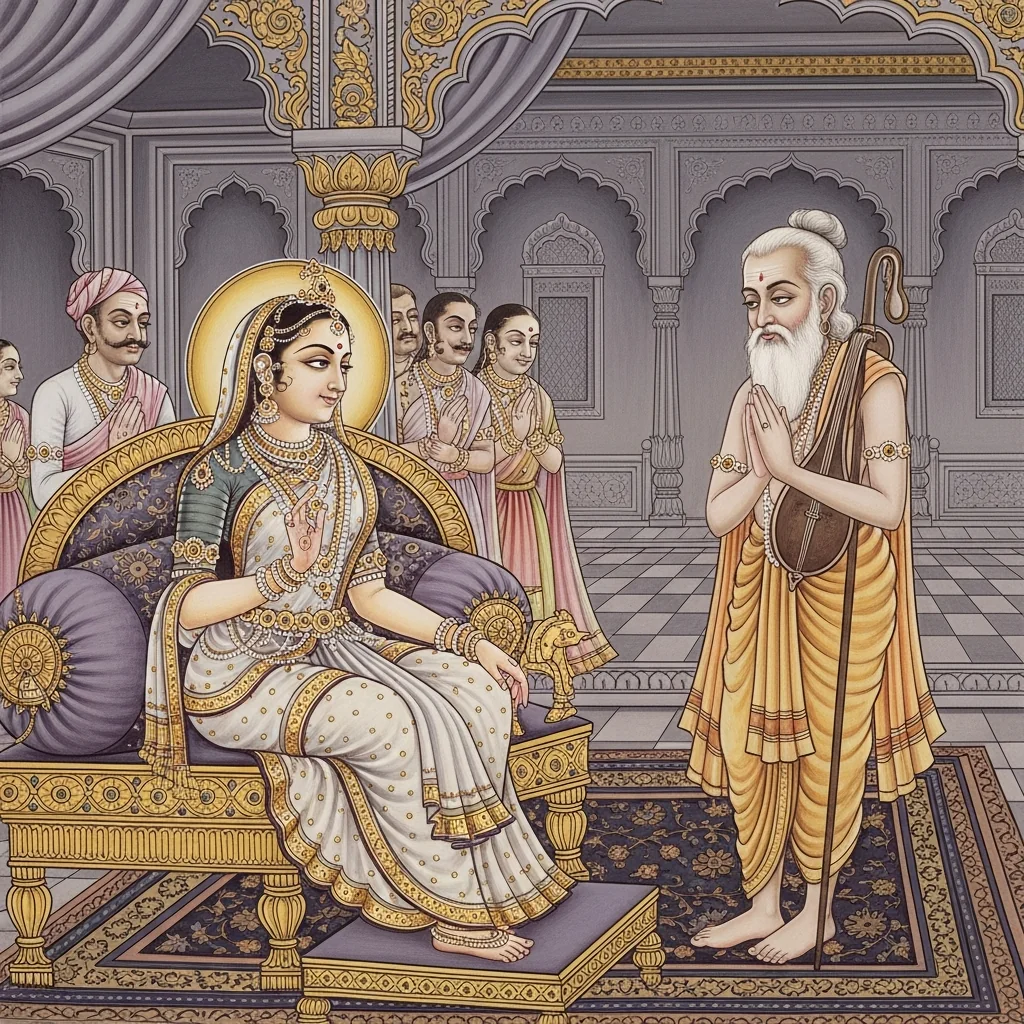
After hearing Nārada’s words, the queen offers him lavish gifts—gold, gems, fine garments, even rare items. Nārada refuses personal enrichment and redirects the giving toward needy Brahmins (kṣīṇa-vṛttayaḥ), declaring that sages are sustained by devotion, not by hoarding wealth. The queen then summons impoverished Brahmins skilled in the Veda and Vedāṅga and gives as Nārada advises, stating that the charity is meant to please Hari and Śaṅkara. Immediately afterward she asserts her marital vow: her husband Bāṇa is her sole deity, and she prays for his long life and continued companionship across births, while noting she has still followed Nārada’s instruction in dāna. Nārada takes leave and departs; the women are then described as turning pale and losing their lustre, as if “bewildered” by him—an ending that signals a narrative turn and highlights the power of sage-mediated discourse to reshape minds and social outcomes.
Shlokas
Verse 1
श्रीमार्कण्डेय उवाच । नारदस्य वचः श्रुत्वा राज्ञी वचनमब्रवीत् । प्रसादं कुरु विप्रेन्द्र गृह्ण दानं यथेप्सितम्
Śrī Mārkaṇḍeya said: Hearing Nārada’s words, the queen spoke: “Be gracious, O best of brāhmaṇas; accept the gift as you desire.”
Verse 2
सुवर्णमणिरत्नानि वस्त्राणि विविधानि च । तत्ते दारयामि विप्रेन्द्र यच्चान्यदपि दुर्लभम्
“Gold, pearls and gems, and garments of many kinds—I offer these to you, O best of brāhmaṇas, and whatever else is rare as well.”
Verse 3
राज्ञ्यास्तु वचनं श्रुत्वा नारदो वाक्यमब्रवीत् । अन्येषां दीयतां भद्रे ये द्विजाः क्षीणवृत्तयः
Hearing the queen’s words, Nārada replied: “O noble lady, let it be given to others—those brāhmaṇas whose livelihood has grown meager.”
Verse 4
वयं तु सर्वसम्पन्ना भक्तिग्राह्याः सदैव हि । इत्युक्ता सा तदा राज्ञी वेदवेदाङ्गपारगान्
“But we are fully provided for; indeed, we are always to be received through devotion alone.” Thus addressed, the queen then turned toward those who were masters of the Vedas and the Vedāṅgas.
Verse 5
आहूय ब्राह्मणान्निःस्वान्दातुं समुपचक्रमे । यत्किंचिन्नारदेनोक्तं दानसौभाग्यवर्धनम्
Summoning poor brāhmaṇas, she began to give them gifts—doing whatever Nārada had prescribed, a charity that increases good fortune and auspicious prosperity.
Verse 6
तेन दानेन मे नित्यं प्रीयेतां हरिशङ्करौ । ततो राज्ञी च सा प्राह नारदं मुनिपुंगवम्
“By that charity, may Hari and Śaṅkara always be pleased with me.” Then the queen spoke to Nārada, the foremost among sages.
Verse 7
राज्ञ्युवाच । दानं दत्तं त्वयोक्तं यद्भर्तृकर्मपरं हि तत् । आजन्मजन्म मे भर्ता भवेद्बाणो द्विजोत्तम
The queen said: “The gift I have given, as you instructed, is indeed devoted to my husband’s welfare and sacred duty. May Bāṇa be my husband, birth after birth, O best of brāhmaṇas.”
Verse 8
नान्यो हि दैवतं तात मुक्त्वा बाणं द्विजोत्तम । तेन सत्येन मे भर्ता जीवेच्च शरदां शतम्
Truly, dear sir, I have no other deity apart from Bāṇa, O best of brāhmaṇas. By that truth, may my husband live for a hundred autumns—a full hundred years.
Verse 9
नान्यो धर्मो भवेत्स्त्रीणां दैवतं हि पतिर्यथा । तथापि तव वाक्येन दानं दत्तं यथाविधि
For women there is no dharma like revering the husband as one’s deity. Yet, by your counsel, I have still given charity according to proper rule.
Verse 10
स्वकं कर्म करिष्यामो भर्तारं प्रति मानद । ब्रह्मर्षे गच्छ चेदानीं त्वमाशीर्वादः प्रदीयताम्
We shall now perform our own duty toward our husband, O giver of honor. O brahmarṣi, please go now—and grant us your blessing.
Verse 11
तथेति तामनुज्ञाप्य नारदो नृपसत्तम । सर्वासां मानसं हृत्वा अन्यतः कृतमानसः
Saying, “So be it,” Nārada gave her leave, O best of kings; having drawn away the minds of them all, he turned his attention elsewhere.
Verse 12
जगामादर्शनं विप्रः पूज्यमानस्तु खेचरैः । ततो गतमनस्कास्ता भर्तारं प्रति भारत
The brāhmaṇa vanished from sight, being honored by celestial beings. Then, their minds unsettled, those women turned back toward their husband—O Bhārata.
Verse 13
विवर्णा निष्प्रभा जाता नारदेन विमोहिताः
Deluded by Nārada, they became pale and bereft of luster.
Verse 27
। अध्याय
“Chapter” — a colophon or section marker.