Adhyaya 192
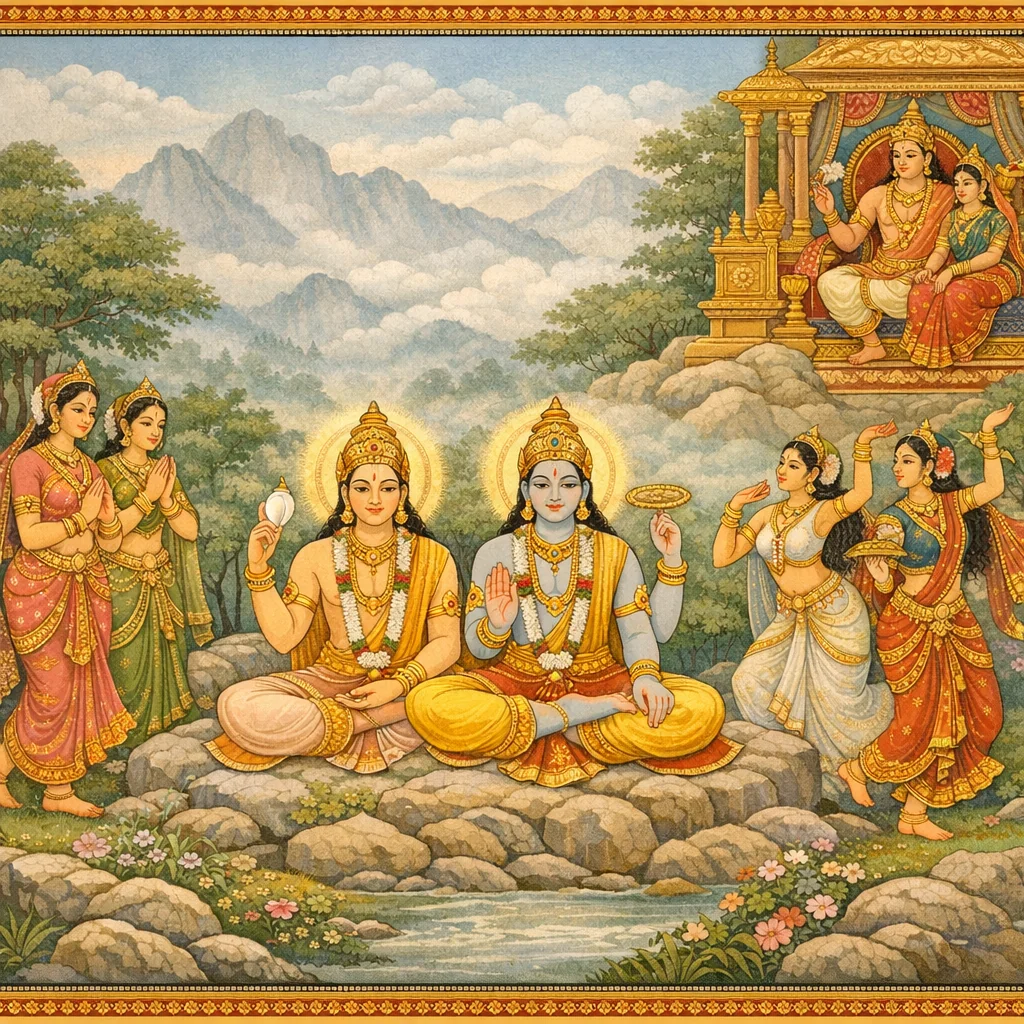
Chapter 192 begins with Mārkaṇḍeya pointing out an exalted Devatīrtha, whose very sight is said to cleanse sin. In response to Yudhiṣṭhira’s question, he explains who “Śrīpati” (the Lord of Śrī) is and how Keśava is connected with Bhṛgu’s lineage, then turns to a cosmogonic genealogy: Brahmā arises from Nārāyaṇa, and the line proceeds through Dakṣa to Dharma. Dharma’s ten wives (the Daśa-dharmapatnīs) are named, and from them the Sādhyas beget sons known as Nara, Nārāyaṇa, Hari, and Kṛṣṇa—declared to be portions of Viṣṇu. Nara and Nārāyaṇa undertake fierce tapas at Gandhamādana, stirring cosmic disturbance. Alarmed, Indra sends apsarases along with Kāma and Vasantā to distract them through dance, music, beauty, and sensory allure. The stratagem fails: the sages remain steady like a windless lamp and a tranquil ocean. Nārāyaṇa then manifests from his thigh an incomparable woman, Urvaśī, whose beauty surpasses the apsarases. The celestial visitors praise Nara–Nārāyaṇa, and Nārāyaṇa teaches a broad, non-divisive vision: since the Supreme Self pervades all beings, rāga–dveṣa (attachment and aversion) and other separating passions find no foothold in one established in right discernment. He instructs that Urvaśī be taken to Indra, affirming that their tapas is for showing the right path and protecting the world, not for sensual enjoyment or rivalry with the gods.
Shlokas
Verse 1
मार्कण्डेय उवाच । तस्यैवानन्तरं तात देवतीर्थमनुत्तमम् । दृष्ट्वा तु श्रीपतिं पापैर्मुच्यते मानवो भुवि
Mārkaṇḍeya said: “Immediately after that, dear one, there is the unsurpassed Devatīrtha. By merely beholding Śrīpati there, a human being on earth is freed from sins.”
Verse 2
महर्षेस्तस्य जामाता भृगोर्देवो जनार्दनः
That great sage’s son-in-law is Janārdana—the divine one—who is related to Bhṛgu.
Verse 3
युधिष्ठिर उवाच । कोऽयं श्रियः पतिर्देवो देवानामधिपो विभुः । कथं जन्माभवत्तस्य देवेषु त्रिषु वा मुने
Yudhiṣṭhira said: “Who is this lord of Śrī—this divine, all-pervading ruler of the gods? And how did his birth occur—among the three classes of gods, or otherwise, O sage?”
Verse 4
सम्बन्धी च कथं जातो भृगुणा सह केशवः । एतद्विस्तरतो ब्रह्मन् वक्तुमर्हसि भार्गव
“And how did Keśava come to be related to Bhṛgu? Explain this in detail, O venerable sage—O Bhārgava.”
Verse 5
मार्कण्डेय उवाच । संक्षेपात्कथयिष्यामि साध्यस्य चरितं महत् । न हि विस्तरतो वक्तुं शक्ताः सर्वे महर्षयः
Mārkaṇḍeya said: “In brief I shall recount the great sacred account of Sādhya, for not all the great sages are able to narrate it in full detail.”
Verse 6
नारायणस्य नाभ्यब्जाज्जातो देवश्चतुर्मुखः । तस्य दक्षोऽङ्गजो राजन् दक्षिणाङ्गुष्ठसम्भवः
From the lotus of Nārāyaṇa’s navel was born the four-faced god Brahmā. From him, O king, Dakṣa was born, arising from the right thumb.
Verse 7
धर्मः स्तनान्तात्संजातस्तस्य पुत्रोऽभवत्किल । नारायणसहायोऽसावजोऽपि भरतर्षभ
O bull among the Bhāratas, it is said that Dharma was born from the end of the breast; and Aja became his son—he who was aided by Nārāyaṇa.
Verse 8
मरुत्वती वसुर्ज्ञाना लम्बा भानुमती सती । संकल्पा च मुहूर्ता च साध्या विश्वावती ककुप्
Marutvatī, Vasu, Jñānā, Lambā, Bhānumatī, Satī, Saṃkalpā, Muhūrtā, Sādhyā, Viśvāvatī, and Kakup—these are the names (of the consorts).
Verse 9
धर्मपत्न्यो दशैवैता दाक्षायण्यो महाप्रभाः । तासां साध्या महाभागा पुत्रानजनयन्नृप
These ten illustrious Dākṣāyaṇī maidens are the wives of Dharma. Among them, the greatly fortunate Sādhyā bore sons, O king.
Verse 10
नरो नारायणश्चैव हरिः कृष्णस्तथैव च । विष्णोरंशांशका ह्येते चत्वारो धर्मसूनवः
Nara and Nārāyaṇa, and likewise Hari and Kṛṣṇa—these four are indeed partial manifestations of Viṣṇu, and they are the sons of Dharma.
Verse 11
तथा नारायणनरौ गन्धमादनपर्वते । आत्मन्यात्मानमाधाय तेपतुः परमं तपः
Thus Nārāyaṇa and Nara, on Mount Gandhamādana, fixing the Self within the Self, performed supreme austerity.
Verse 12
ध्यायमानावनौपम्यं स्वं कारणमकारणम् । वासुदेवमनिर्देश्यमप्रतर्क्यमनन्तरम्
They meditated upon Vāsudeva—peerless, their own first cause yet beyond causation; indescribable, beyond reasoning, and without end.
Verse 13
योगयुक्तौ महात्मानावास्थितावुरुतापसौ । तयोस्तपःप्रभावेण न तताप दिवाकरः
Established in yoga, those two great-souled ascetics stood firm; by the power of their austerity, the Sun did not burn with heat.
Verse 14
ववाह शङ्कितो वायुः सुखस्पर्शो ह्यशङ्कितः । शिशिरोऽभवदत्यर्थं ज्वलन्नपि विभावसुः
The wind blew as if timid, yet it touched pleasantly without fear; and even the blazing fire became exceedingly cool.
Verse 15
सिंहव्याघ्रादयः सौम्याश्चेरुः सह मृगैर्गिरौ । तयोर्गौरिव भारार्ता पृथिवी पृथिवीपते
Lions, tigers, and the rest became gentle and roamed the mountain together with deer. Yet the Earth, O lord of the earth, was distressed by their weight, like a cow burdened by a load.
Verse 16
चेरुश्च भूधराश्चैव चुक्षुभे च महोदधिः । देवाश्च स्वेषु धिष्ण्येषु निष्प्रभेषु हतप्रभाः । बभूवुरवनीपाल परमं क्षोभमागताः
Even the mountains moved, and the great ocean was thrown into turmoil. The gods, their own abodes grown lusterless, became dimmed in splendor; and, O protector of the earth, they fell into extreme agitation.
Verse 17
देवराजस्तथा शक्रः संतप्तस्तपसा तयोः । युयोजाप्सरसस्तत्र तयोर्विघ्नचिकीर्षया
Then the king of the gods—Śakra (Indra)—distressed by the austerity of those two, stationed the celestial nymphs there, intending to create an obstacle to their penance.
Verse 18
इन्द्र उवाच । रम्भे तिलोत्तमे कुब्जे घृताचि ललिते शुभे । प्रम्लोचे सुभ्रु सुम्लोचे सौरभेयि महोद्धते
Indra said: “O Rambhā, Tilottamā, Kubjā, Ghṛtācī, Lalitā, auspicious one; O Pramlocā, Subhru, Sumlocā, Saurabheyī, and Mahoddhatā—”
Verse 19
अलम्बुषे मिश्रकेशि पुण्डरीके वरूथिनि । विलोकनीयं बिभ्राणा वपुर्मन्मथबोधनम्
“O Alambuṣā, Miśrakeśī, Puṇḍarīkā, Varūthinī—bearing a form delightful to behold, a beauty that awakens Kāma (desire).”
Verse 20
गन्धमादनमासाद्य कुरुध्वं वचनं मम । नरनारायणौ तत्र तपोदीक्षान्वितौ द्विजौ
Having reached Gandhamādana, carry out my command. There the two brāhmaṇa sages, Nara and Nārāyaṇa, are engaged in the consecrated discipline of austerity.
Verse 21
तेपाते धर्मतनयौ तपः परमदुश्चरम् । तावस्माकं वरारोहाः कुर्वाणौ परमं तपः
Those two sons of Dharma are practicing an austerity exceedingly difficult to perform. O fair-limbed ones, they are undertaking the highest tapas, to our very concern.
Verse 22
कर्मातिशयदुःखार्तिप्रदावायतिनाशनौ । तद्गच्छत न भीः कार्या भवतीभिरिदं वचः
They are destroyers of the long-drawn afflictions and sufferings produced by excessive karmic consequence. Therefore go—do not be afraid; this is my instruction to you.
Verse 23
स्मरः सहायो भविता वसन्तश्च वराङ्गनाः । रूपं वयः समालोक्य मदनोद्दीपनं परम् । कन्दर्पवशमभ्येति विवशः को न मानवः
Smara (Kāma) will be your ally, and Spring too, O noble ladies. Seeing beauty and youth—supreme kindlers of desire—what human would not, helplessly, come under Kandarpa’s sway?
Verse 24
मार्कण्डेय उवाच । इत्युक्त्वा देवराजेन मदनेन समं तदा । जग्मुरप्सरसः सर्वा वसन्तश्च महीपते
Mārkaṇḍeya said: “Thus addressed by the king of the gods, then all the apsarases departed together with Madana (Kāma), and Spring as well, O king.”
Verse 25
गन्धमादनमासाद्य पुंस्कोकिलकुलाकुलम् । चचार माधवो रम्यं प्रोत्फुल्लवनपादपम्
Reaching Gandhamādana—filled with the calls of male cuckoos—Mādhava wandered through that charming forest, whose trees were bursting into bloom.
Verse 26
प्रववौ दक्षिणाशायां मलयानुगतोऽनिलः । भृङ्गमालारुतरवै रमणीयमभूद्वनम्
A breeze blew from the southern quarter, following the fragrance-laden Malaya winds; with the humming of swarming bees, the forest became exceedingly delightful.
Verse 27
गन्धश्च सुरभिः सद्यो वनराजिसमुद्भवः । किन्नरोरगयक्षाणां बभूव घ्राणतर्पणः
At once a sweet, fragrant scent arose from the forest-groves; it became a delight to the sense of smell for the Kinnaras, Nāgas, and Yakṣas.
Verse 28
वराङ्गनाश्च ताः सर्वा नरनारायणावृषी । विलोभयितुमारब्धा वागङ्गललितस्मितैः
Then all those exquisite women set about trying to entice the two bull-like sages, Nara and Nārāyaṇa, with charming smiles and playful, alluring speech and gestures.
Verse 29
जगौ मनोहरं काचिन्ननर्त तत्र चाप्सराः । अवादयत्तथैवान्या मनोहरतरं नृप
One sang sweetly; there the Apsarās danced; and another likewise played music even more captivating—O King.
Verse 30
हावैर्भावैः सृतैर्हास्यैस्तथान्या वल्गुभाषितैः । तयोः क्षोभाय तन्वङ्ग्यश्चक्रुरुद्यममङ्गनाः
With coquettish gestures, emotive expressions, rippling laughter, and sweet words, the slender-limbed women strove to agitate the minds of those two.
Verse 31
तथापि न तयोः कश्चिन्मनसः पृथिवीपते । विकारोऽभवदध्यात्मपारसम्प्राप्तचेतसोः
Yet, O lord of the earth, no alteration arose in the minds of those two, whose consciousness had reached the far shore of inner realization.
Verse 32
निवातस्थौ यथा दीपावकम्पौ नृप तिष्ठतः । वासुदेवार्पणस्वस्थे तथैव मनसी तयोः
As two lamps standing in a windless place remain unshaken, O King, so too were their minds—steadied through dedication to Vāsudeva.
Verse 33
पूर्यमाणोऽपि चाम्भोभिर्भुवमन्यां महोदधिः । यथा न याति संक्षोभं तथा तन्मानसं क्वचित्
Just as the great ocean, though filled by waters from other lands, does not become agitated, so their mind never fell into disturbance.
Verse 34
सर्वभूतहितं ब्रह्म वासुदेवमयं परम् । मन्यमानौ न रागस्य द्वेषस्य च वशंगतौ
Holding as their conviction the supreme Brahman—beneficial to all beings and pervaded by Vāsudeva—they did not come under the sway of attachment or aversion.
Verse 35
स्मरोऽपि न शशाकाथ प्रवेष्टुं हृदयं तयोः । विद्यामयं दीपयुतमन्धकार इवालयम्
Even Smara (Kāma) could not enter their hearts—like darkness unable to enter a house filled with light and made radiant by knowledge.
Verse 36
पुष्पोज्ज्वलांस्तरुवरान् वसन्तं दक्षिणानिलम् । ताश्चैवाप्सरसः सर्वाः कन्दर्पं च महामुनी
The great sages also beheld radiant trees bright with blossoms, the season of spring, the gentle southern breeze—and all those Apsarās, and even Kandarpa, the god of love.
Verse 37
यच्चारब्धं तपस्ताभ्यामात्मानं गन्धमादनम् । ददर्शातेऽखिलं रूपं ब्रह्मणः पुरुषर्षभ
O bull among men, when those two began their austerity, they beheld within themselves the entire form of the Supreme Brahman—the Self, lofty as Gandhamādana, immovable like a mountain.
Verse 38
दाहाय नामलो वह्नेर्नापः क्लेदाय चाम्भसः । तद्द्रव्यमेव तद्द्रव्यविकाराय न वै यतः
Fire is not, merely by its name, for burning, nor is water for wetting; for the substance itself is not truly the cause of the substance’s modification.
Verse 39
ततो विज्ञाय विज्ञाय परं ब्रह्म स्वरूपतः । मधुकन्दर्पयोषित्सु विकारो नाभवत्तयोः
Therefore, having fully understood the Supreme Brahman as it truly is, no disturbance or alteration arose in them, though temptations appeared in the forms of Madhu, Kāma, and alluring women.
Verse 40
ततो गुरुतरं यत्नं वसन्तमदनौ नृप । चक्राते ताश्च तन्वङ्ग्यस्तत्क्षोभाय पुनःपुनः
Then, O king, Vasanta (Spring) and Madana (Love) exerted an even greater effort; and those slender-limbed women repeatedly sought to agitate them.
Verse 41
अथ नारायणो धैर्यं संधायोदीर्णमानसः । ऊरोरुत्पादयामास वराङ्गीमबलां तदा
Then Nārāyaṇa, composing his courage and lifting his mind into firm resolve, at that time brought forth from his thigh a beautiful-limbed woman.
Verse 42
त्रैलोक्यसुन्दरीरत्नमशेषमवनीपते । गुणैर्लाघवमभ्येति यस्याः संदर्शनादनु
O lord of the earth, she was the jewel among the beauties of the three worlds; and upon merely seeing her, all others seemed to lose their excellence and the weight of their merit by comparison.
Verse 43
तां विलोक्य महीपाल चकम्पे मनसानिलः । वसन्तो विस्मयं यातः स्मरः सस्मार किंचन
Seeing her, O king, the wind of the mind trembled; Vasanta fell into astonishment, and Smara (Kāma) recalled something, as though recognizing his own defeat.
Verse 44
रम्भातिलोत्तमाद्याश्च वैलक्ष्यं देवयोषितः । न रेजुरवनीपाल तल्लक्ष्यहृदयेक्षणाः
Rambhā, Tilottamā, and the other celestial women were put to shame, O king; with their eyes fixed on her, they no longer shone in the heart’s appraisal.
Verse 45
ततः कामो वसन्तश्च पार्थिवाप्सरसश्च ताः । प्रणम्य भगवन्तौ तौ तुष्टुवुर्मुनिसत्तमौ
Then Kāma and Vasanta, together with those apsarases, bowed down and praised those two venerable ones—the foremost of sages.
Verse 46
वसन्तकामाप्सरस ऊचुः । प्रसीदतु जगद्धाता यस्य देवस्य मायया । मोहिताः स्म विजानीमो नान्तरं विद्यते द्वयोः
Vasanta, Kāma, and the apsarases said: “May the Creator of the world be gracious; by the māyā of that very Deity we were deluded. Now we understand: between the two there is no difference.”
Verse 47
प्रसीदतु स वां देवो यस्य रूपमिदं द्विधा । धामभूतस्य लोकानामनादेरप्रतिष्ठतः
May that God be gracious to you both—He whose single reality appears here in a twofold form, the beginningless One who is the very abode of the worlds, yet Himself without any fixed resting-place.
Verse 48
नरनारायणौ देवौ शङ्खचक्रायुधावुभौ । आस्तां प्रसादसुमुखावस्माकमपराधिनाम्
May the two gods, Nara and Nārāyaṇa—both bearing the conch and discus—remain before us with faces turned to mercy, though we are offenders.
Verse 49
निधानं सर्वविद्यानां सर्वपापवनानलः । नारायणोऽतो भगवान् सर्वपापं व्यपोहतु
Nārāyaṇa, the Blessed Lord, is the treasury of all true knowledges and the wildfire that burns the forest of all sins—therefore may He drive away every sin.
Verse 50
शार्ङ्गचिह्नायुधः श्रीमानात्मज्ञानमयोऽनघः । नरः समस्तपापानि हतात्मा सर्वदेहिनाम्
Nara—glorious, bearing the marks and weapons of Śārṅga, formed of self-knowledge, stainless—destroys all sins, subduing the lower self in every embodied being.
Verse 51
जटाकलापबद्धोऽयमनयोर्नः क्षमावतोः । सौम्यास्यदृष्टिः पापानि हन्तुं जन्मार्जितानि वै
Bound with a mass of matted locks, these two—ever-forgiving toward us—may their gentle-faced glance indeed destroy the sins accumulated over lifetimes.
Verse 52
तथात्मविद्यादोषेण योऽपराधः कृतो महान् । त्रैलोक्यवन्द्यौ यौ नाथौ विलोभयितुमागताः
And whatever grave offense was committed through the fault of our self-knowledge, may it be forgiven—for the two Lords, worshipped by the three worlds, have come here to bestow their favor.
Verse 53
प्रसीद देव विज्ञानधन मूढदृशामिव । भवन्ति सन्तः सततं स्वधर्मपरिपालकाः
Be gracious, O God—treasure of true discernment—for to the dim-sighted, the saints ever appear as those who constantly uphold their own dharma.
Verse 54
दृष्ट्वैतन्नः समुत्पन्नं यथा स्त्रीरत्नमुत्तमम् । त्वयि नारायणोत्पन्ना श्रेष्ठा पारवती मतिः
Seeing this arise among us—like the finest jewel among women—O Nārāyaṇa, in you has arisen the supreme, Pārvatī-like resolve of auspicious wisdom.
Verse 55
तेन सत्येन सत्यात्मन्परमात्मन्सनातन । नारायण प्रसीदेश सर्वलोकपरायण
By that truth—O Truth-Souled One, O Supreme Self, O Eternal—O Nārāyaṇa, be gracious, O Lord, refuge and goal of all worlds.
Verse 56
प्रसन्नबुद्धे शान्तात्मन्प्रसन्नवदनेक्षण । प्रसीद योगिनामीश नर सर्वगताच्युत
O serene-souled One, whose mind is clear, whose face and gaze are gracious—be pleased, O Lord of yogins; O Nara, all-pervading Acyuta.
Verse 57
नमस्यामो नरं देवं तथा नारायणं हरिम् । नमो नराय नम्याय नमो नारायणाय च
We bow to the divine Nara, and to Hari—Nārāyaṇa. Salutation to Nara, the ever-venerable; salutation also to Nārāyaṇa.
Verse 58
प्रसन्नानामनाथानां तथा नाथवतां प्रभो । शं करोतु नरोऽस्माकं शं नारायण देहि नः
O Lord—gracious to the contented, the helpless, and even to those who have protectors—may Nara bring us auspiciousness; and O Nārāyaṇa, grant us well-being.
Verse 59
मार्कण्डेय उवाच । एवमभ्यर्चितः स्तुत्या रागद्वेषादिवर्जितः । प्राहेशः सर्वभूतानां मध्ये नारायणो नृप
Mārkaṇḍeya said: Thus worshipped with hymns, free from passion and aversion and the like, the Lord of all beings spoke: “O King, Nārāyaṇa abides in the midst of all beings.”
Verse 60
नारायण उवाच । स्वागतं माधवे कामे भवत्वप्सरसामपि । यत्कार्यमागतानां च इहास्माभिस्तदुच्यताम्
Nārāyaṇa said: Welcome, O Mādhava; welcome, O Kāma—and welcome to you Apsarases as well. Whatever task has brought you here, let it be stated to us now.
Verse 61
यूयं संसिद्धये नूनमस्माकं बलशत्रुणा । संप्रेषितास्ततोऽस्माकं नृत्ययोगादिदर्शनम्
Surely you have been sent by our powerful adversary, intending to disrupt our accomplishment—so as to display before us dance, allurements, and the like.
Verse 62
न वयं गीतनृत्येन नाङ्गचेष्टादिभाषितैः । लुब्धा वै विषयैर्मन्ये विषया दारुणात्मकाः
We are not enticed by song and dance, nor by gestures of the body and coquettish speech. I hold that sense-objects are truly fierce in their nature.
Verse 63
शब्दादिसङ्गदुष्टानि यदा नाक्षाणि नः शुभाः । तदा नृत्यादयो भावाः कथं लोभप्रदायिनः
When our senses are not auspicious—tainted by contact with sound and the rest—how could states like dance and similar displays ever become givers of craving?
Verse 64
ते सिद्धाः स्म न वै साध्या भवतीनां स्मरस्य च । माधवस्य च शाक्रोऽपि स्वास्थ्यं यात्वविशङ्किताः
We are already accomplished; we are not to be ‘conquered’ by you, nor by Smara (Kāma). And let Mādhava be at ease; even Śakra (Indra) may depart, free of anxiety.
Verse 65
योऽसौ परश्च परमः पुरुषः परमेश्वरः । परमात्मा समस्तस्य स्थावरस्य चरस्य च
He indeed is the transcendent and supreme Puruṣa, the Highest Lord—the Paramātman of all that exists, of the immovable and the moving alike.
Verse 66
उत्पत्तिहेतुरेते च यस्मिन्सर्वं प्रलीयते । सर्वावासीति देवत्वाद्वासुदेवेत्युदाहृतः
He is the cause of the arising of all these, and into Him everything dissolves. Since, as God, He is the indweller of all, He is therefore proclaimed as Vāsudeva.
Verse 67
वयमंशांशकास्तस्य चतुर्व्यूहस्य मानिनः । तदादेशितवार्त्मानौ जगद्बोधाय देहिनाम्
“We are but minute portions of that Lord’s fourfold manifestation (the Caturvyūha). We walk only the path ordained by Him, for the awakening of embodied beings to the truth of the world.”
Verse 68
तत्सर्वभूतं सर्वेशं सर्वत्र समदर्शिनम् । कुतः पश्यन्तौ रागादीन्करिष्यामो विभेदिनः
“When we behold Him as the very being of all creatures, the Lord of all, and the One seen equally everywhere—how could we, seeing thus, entertain passions like attachment and the rest, and become makers of division?”
Verse 69
वसन्ते मयि चेन्द्रे च भवतीषु तथा स्मरे । यदा स एव भूतात्मा तदा द्वेषादयः कथम्
“In Spring, in me, in Indra, in you celestial ladies, and likewise in Kāma—when that very same Lord is the inner Self of beings, how could hatred and the rest arise at all?”
Verse 70
तन्मयान्यविभक्तानि यदा सर्वेषु जन्तुषु । सर्वेश्वरेश्वरो विष्णुः कुतो रागादयस्ततः
When, in all creatures, everything is pervaded by Him and not truly separate—when Viṣṇu is the Lord over all lords—then from where could attachment and the rest arise?
Verse 71
ब्रह्माणमिन्द्रमीशानमादित्यमरुतोऽखिलान् । विश्वेदेवानृषीन् साध्यान्वसून्पितृगणांस्तथा
(He is) Brahmā, Indra, Īśāna, the Ādityas and all the Maruts; the Viśvedevas, the seers, the Sādhyas, the Vasus, and likewise the hosts of the Pitṛs.
Verse 72
यक्षराक्षसभूतादीन्नागान्सर्पान्सरीसृपान् । मनुष्यपक्षिगोरूपगजसिंहजलेचरान्
(He is) the Yakṣas, Rākṣasas, Bhūtas and the rest; the Nāgas, serpents, and creeping creatures; humans, birds, cattle, beasts of form, elephants, lions, and the beings that move in water.
Verse 73
मक्षिकामशकान्दंशाञ्छलभाञ्जलजान् कृमीन् । गुल्मवृक्षलतावल्लीत्वक्सारतृणजातिषु
(He is present as) flies, mosquitoes, gnats, locusts, water-born creatures, and worms; in shrubs, trees, creepers and vines; in bark and pith; and in every variety of grass.
Verse 74
यच्च किंचिददृश्यं वा दृश्यं वा त्रिदशाङ्गनाः । मन्यध्वं जातमेकस्य तत्सर्वं परमात्मनः
Whatever anything may be—whether unseen or seen—O celestial ladies, know that all which you consider as “born” is born of the One: the Supreme Self (Paramātman).
Verse 75
जायमानः कथं विष्णुमात्मानं परमं च यत् । रागद्वेषौ तथा लोभं कः कुर्यादमराङ्गनाः
How could one who comes to birth in the world give rise to attachment and aversion, and likewise to greed—when Viṣṇu is the Self, and indeed the Supreme?
Verse 76
सर्वभूतमये विष्णौ सर्वगे सर्वधातरि । निपात्य तं पृथग्भूते कुतो रागादिको गुणः
In Viṣṇu—who is made of all beings, all-pervading, and the support of all—once the notion of separateness is cast down, from where could a quality like attachment and the rest arise?
Verse 77
एवमस्मासु युष्मासु सर्वभूतेषु चाबलाः । तन्मथैकत्वभूतेषु रागाद्यवसरः कुतः
Thus, O gentle women—when the same One Self is present in us, in you, and in all beings, and when everything is truly of a single essence—how could there be any occasion at all for passion, attachment, and the like?
Verse 78
सम्यग्दृष्टिरियं प्रोक्ता समस्तैक्यावलोकिनी । पृथग्विज्ञानमात्रैव लोकसंव्यवहारवत्
This is declared to be the true vision: it beholds the oneness of all. Perception of separateness is only a mode of cognition—useful merely for worldly dealings.
Verse 79
भूतेन्द्रियान्तः करणप्रधानपुरुषात्मकम् । जगद्वै ह्येतदखिलं तदा भेदः किमात्मकः
This entire world is indeed constituted of the elements, the senses, the inner instrument (mind), Pradhāna, and Puruṣa. If so, what could ‘difference’ truly consist of?
Verse 80
भवन्ति लयमायान्ति समुद्रसलिलोर्मयः । न वारिभेदतो भिन्नास्तथैवैक्यादिदं जगत्
Ocean-waves arise and subside, yet they are not different by any “difference of water.” In the same way, this world is seen only from oneness.
Verse 81
यथाग्नेरर्चिषः पीताः पिङ्गलारुणधूसराः । तथापि नाग्नितो भिन्नास्तथैतद्ब्रह्मणो जगत्
Just as the flames of fire may appear yellow, tawny, red, or smoky—yet are not separate from fire—so too this world is not separate from Brahman.
Verse 82
भवतीभिश्च यत्क्षोभमस्माकं स पुरंदरः । कारयत्यसदेतच्च विवेकाचारचेतसाम्
And the agitation in us that arises as though “because of you”—that is caused by Purandara (Indra). Yet even this is unreal for those whose minds move in the discipline of discernment.
Verse 83
भवन्त्यः स च देवेन्द्रो लोकाश्च ससुरासुराः । समुद्राद्रिवनोपेता मद्देहान्तरगोचराः
You too, and that lord of gods (Indra), and the worlds with their devas and asuras—together with oceans, mountains, and forests—are all objects appearing within the expanse of my own body.
Verse 84
यथेयं चारुसर्वाङ्गी भवतीनां मयाग्रतः । दर्शिता दर्शयिष्यामि तथा चैवाखिलं जगत्
Just as this lovely, well-formed figure has been shown by me before your very eyes, so too shall I reveal the entire universe in the same manner.
Verse 85
प्रयातु शक्रो मा गर्वमिन्द्रत्वं कस्य सुस्थिरम् । यूयं च मा स्मयं यात सन्ति रूपान्विताः स्त्रियः
Let Śakra (Indra) depart—let him not be proud; whose ‘Indra-hood’ is ever stable? And you too, do not fall into vanity: there are many women endowed with beauty.
Verse 86
किं सुरूपं कुरूपं वा यदा भेदो न दृश्यते । तारतम्यं सुरूपत्वे सततं भिन्नदर्शनात्
What is ‘beautiful’ or ‘ugly’ when no difference is perceived? The gradations of beauty arise continually only because one sees distinctions.
Verse 87
भवतीनां स्मयं मत्वा रूपौदार्यगुणोद्भवम् । मयेयं दर्शिता तन्वी ततस्तु शममेष्यथ
Understanding your pride as arising from beauty, generosity, and virtue, I have shown you this slender maiden; now you will surely become calm.
Verse 88
यस्मान्मदूरोर्निष्पन्ना त्वियमिन्दीवरेक्षणा । उर्वशी नाम कल्याणी भविष्यति वराप्सराः
Since this lotus-eyed maiden has arisen from my thigh, she—auspicious and lovely—will be renowned as Urvaśī, the foremost of apsarases.
Verse 89
तदियं देवराजस्य नीयतां वरवर्णिनी । भवत्यस्तेन चास्माकं प्रेषिताः प्रीतिमिच्छता
Therefore let this excellent and radiant maiden be taken to the king of the gods; and you too have been sent by us, desiring to please him.
Verse 90
वक्तव्यश्च सहस्राक्षो नास्माकं भोगकारणात् । तपश्चर्या न वाप्राप्यफलं प्राप्तुमभीप्सता
And Sahasrākṣa (Indra) should be told: this is not for our enjoyment, nor from a desire to gain unattained fruits through austerity and sacred observance.
Verse 91
सन्मार्गमस्य जगतो दर्शयिष्ये करोम्यहम् । तथा नरेण सहितो जगतः पालनोद्यतः
I shall establish and reveal to this world the true path; and, together with a human king, I shall be intent on protecting the world.
Verse 92
यदि कश्चित्तवाबाधां करोति त्रिदशेश्वर । तमहं वारयिष्यामि निवृत्तो भव वासव
O lord of the gods, if anyone causes you obstruction, I will restrain him; therefore desist, O Vāsava (Indra).
Verse 93
कर्तासि चेत्त्वमाबाधां न दुष्टस्येह कस्यचित् । तं चापि शास्ता तदहं प्रवर्तिष्याम्यसंशयम्
But if you were to cause obstruction to anyone here who is not wicked, then I will certainly set in motion punishment for you as well, without doubt.
Verse 94
एतज्ज्ञात्वा न सन्तापस्त्वया कार्यो हि मां प्रति । उपकाराय जगतामवतीर्णोऽस्मि वासव
Knowing this, you should not feel distress toward me; for I have descended for the benefit of the worlds, O Vāsava.
Verse 95
या चेयमुर्वशी मत्तः समुद्भूता पुरंदर त्रेताग्निहेतुभूतेयं एवं प्राप्य भविष्यति
And this Urvaśī, arisen from me, O Purandara (Indra), shall in due course become the very cause connected with the triad of sacred fires (tretāgni), and thus attain that destined end.
Verse 192
अध्याय
Chapter (a section heading/marker).