Adhyaya 204
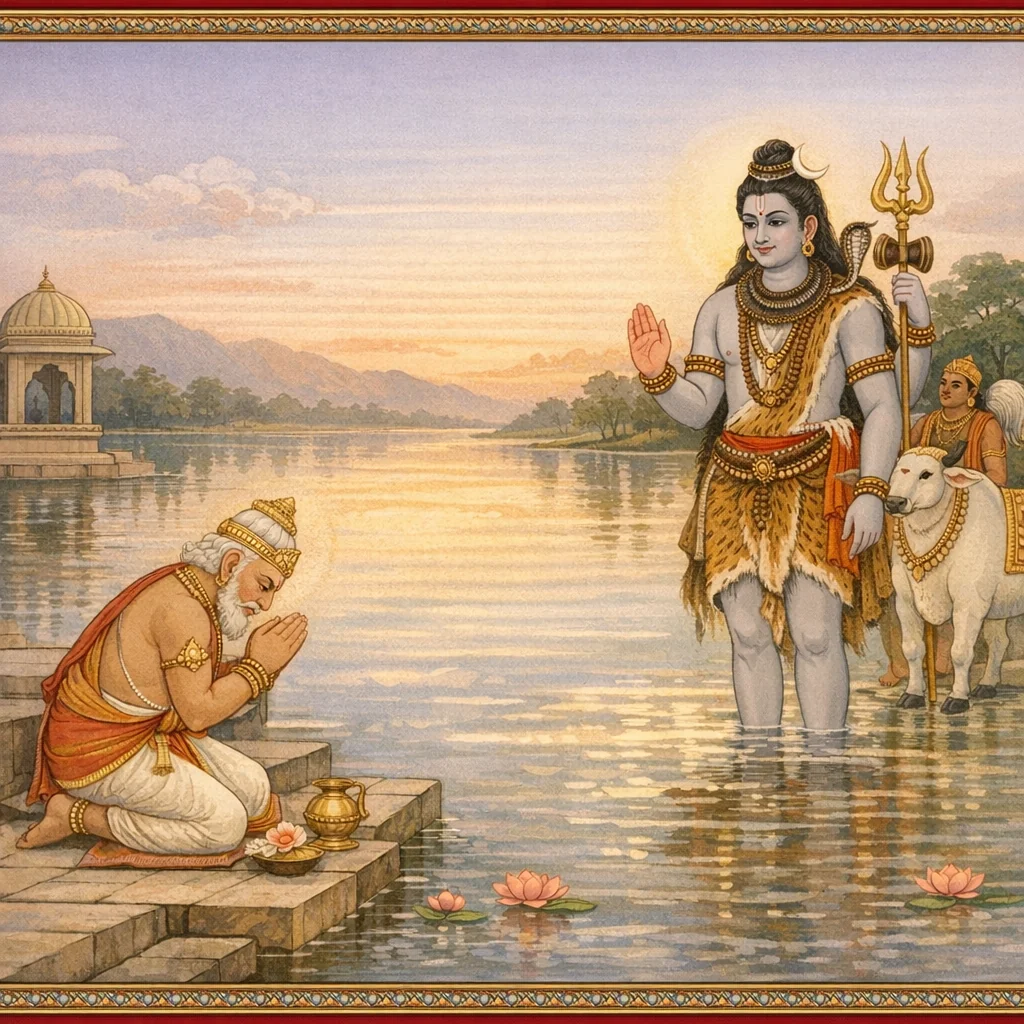
Chapter 204 is a dialogue in which Mārkaṇḍeya points to Bhṛgu Tīrtha, famed as the supremely meritorious Paitāmaha Tīrtha that destroys sin and moral demerit. Yudhiṣṭhira asks why Brahmā, the cosmic grandsire, worshipped Maheśvara (Śiva) with such intense devotion. Mārkaṇḍeya recounts an ancient itihāsa: Brahmā, desiring to approach his own daughter, was cursed by Śiva, whereby his Vedas and knowledge declined and his public status as worthy of worship was diminished. Stricken with grief, Brahmā undertook long austerities on the northern bank of the Revā, bathing and propitiating Śiva for three hundred years. Pleased, Śaṅkara restored Brahmā’s worship-worthiness at recurring festival times and proclaimed his own abiding presence there along with the gods and the pitṛs (ancestors). Thus the tīrtha became renowned as Paitāmaha, the best among sacred fords. The chapter then states ritual timings and fruits: bathing especially on amāvāsyā (new-moon day) in the dark fortnight of Bhādrapada, followed by tarpaṇa to pitṛs and deities, grants long-lasting ancestral satisfaction even with minimal offerings (a single piṇḍa or sesame-water). It also emphasizes śrāddha observance when the sun is in Kanyā (Virgo), declaring that the full fruit of śrāddha across all pitṛ-tīrthas is obtained here on amāvāsyā. Finally, it promises release from major and minor faults for one who bathes and worships Śiva, and an assured, non-returning passage to Rudra-loka for those who die at this tīrtha with a disciplined mind.
Shlokas
Verse 1
श्रीमार्कण्डेय उवाच । भृगुतीर्थं ततो गच्छेत्तीर्थराजमनुत्तमम् । पैतामहं महापुण्यं सर्वपातकनाशनम्
Śrī Mārkaṇḍeya said: Then one should go to Bhṛgu-tīrtha, the unsurpassed king of sacred fords, called “Paitāmaha,” supremely meritorious and the destroyer of all sins.
Verse 2
ब्रह्मणा तत्र तीर्थे तु पुरा वर्षशतत्रयम् । आराधनं कृतं शम्भोः कस्मिंश्चित्कारणान्तरे
There at that tīrtha, in ancient times, Brahmā worshiped Śambhu for three hundred years, due to a certain circumstance.
Verse 3
युधिष्ठिर उवाच । किमर्थं मुनिशार्दूल ब्रह्मा लोकपितामहः । आराधयद्देवदेवं महाभक्त्या महेश्वरम्
Yudhiṣṭhira said: O tiger among sages, for what reason did Brahmā, the grandsire of the worlds, worship Maheśvara—the God of gods—with great devotion?
Verse 4
आराध्यः सर्वभूतानां जगद्भर्ता जगद्गुरुः । श्रोतव्यं श्रोतुमिच्छामि महदाश्चर्यमुत्तमम्
He is worthy of worship for all beings—the sustainer of the world, the teacher of the world. I wish to hear what ought to be heard: that great and supreme wonder.
Verse 5
धर्मपुत्रवचः श्रुत्वा मार्कण्डेयो मुनीश्वरः । कथयामास तद्वृत्तमितिहासं पुरातनम्
Having heard the words of Dharmaputra (Yudhiṣṭhira), the sage-lord Mārkaṇḍeya began to relate that ancient account—an old tradition of what occurred.
Verse 6
मार्कण्डेय उवाच । स्वपुत्रिकामभिगन्तुमिच्छन्पूर्वं पितामहः । शप्तस्तु देवदेवेन कोपाविष्टेन सत्तम
Mārkaṇḍeya said: Formerly, when Pitāmaha (Brahmā) desired to approach his own daughter, the God of gods, enraged, pronounced a curse upon him, O best of men.
Verse 7
वेदास्तव विनश्यन्ति ज्ञानं च कमलासन । अपूज्यः सर्वलोकानां भविष्यसि न संशयः
“Your Vedas and your spiritual knowledge shall decline, O Lotus-seated one; you shall become one whom all worlds will not worship—of this there is no doubt.”
Verse 8
एवं दत्ते ततः शापे ब्रह्मा खेदावृतस्तदा । रेवाया उत्तरे कूले स्नात्वा वर्षशतत्रयम् । तोषयामास देवेशं तुष्टः प्रोवाच शङ्करः
When that curse had thus been given, Brahmā, overcome with sorrow, bathed on the northern bank of the Revā for three hundred years and propitiated the Lord of gods. Pleased, Śaṅkara spoke.
Verse 9
पूज्यस्त्वं भविता लोके प्राप्ते पर्वणि पर्वणि । अहमत्र च वत्स्यामि देवैश्च पितृभिः सह
You shall be worship-worthy in the world at every sacred parvan as it arrives; and I too shall dwell here, together with the gods and the Pitṛs.
Verse 10
श्रीमार्कण्डेय उवाच । तदाप्रभृति तत्तीर्थं ख्यातिं प्राप्तं पितामहात् । सर्वपापहरं पुण्यं सर्वतीर्थेष्वनुत्तमम्
Śrī Mārkaṇḍeya said: From that time onward, that tīrtha became renowned through Pitāmaha (Brahmā). It is holy, removes all sins, and is unsurpassed among all tīrthas.
Verse 11
तत्र भाद्रपदे मासि कृष्णपक्षे विशेषतः । अमावास्यां तु यः स्नात्वा तर्पयेत्पितृदेवताः
There—especially in the month of Bhādrapada, in the dark fortnight—whoever bathes on the new-moon day and offers tarpaṇa to the ancestral deities, the Pitṛs…
Verse 12
पिण्डदानेन चैकेन तिलतोयेन वा नृप । तृप्यन्ति द्वादशाब्दानि पितरो नात्र संशयः
With even a single offering of a piṇḍa, or with water mixed with sesame, O king, the Pitṛs are satisfied for twelve years—of this there is no doubt.
Verse 13
कन्यागते तु यस्तत्र नित्यं श्राद्धप्रदो भवेत् । अवाप्य तृप्तिं तत्पूर्वे वल्गन्ति च हसन्ति च
But when the Sun has entered Kanyā (Virgo), whoever there regularly offers śrāddha—having obtained satisfaction, his forefathers rejoice and laugh with delight.
Verse 14
सर्वेषु पितृतीर्थेषु श्राद्धं कृत्वास्ति यत्फलम् । तत्फलं समवाप्नोति दर्शे तत्र न संशयः
Whatever fruit is obtained by performing śrāddha at all Pitṛ-tīrthas, that very fruit one surely attains by doing it there on the new-moon (darśa)—no doubt.
Verse 15
पैतामहे नरः स्नात्वा पूजयन्पार्वतीपतिम् । मुच्यते नात्र सन्देहः पातकैश्चोपपातकैः
At the Paitāmaha-tīrtha, a man who bathes and worships the Lord of Pārvatī is freed—without doubt—from sins and even from secondary transgressions.
Verse 16
तत्र तीर्थे मृतानां तु नराणां भावितात्मनाम् । अनिवर्तिका गती राजन्रुद्रलोकादसंशयम्
O King, for those disciplined and purified in mind who die at that sacred ford, the onward course is irreversible—without doubt they attain Rudra’s world and do not return.
Verse 204
अध्यायः
Thus ends the Chapter describing the glory of the sacred ford.