Adhyaya 3
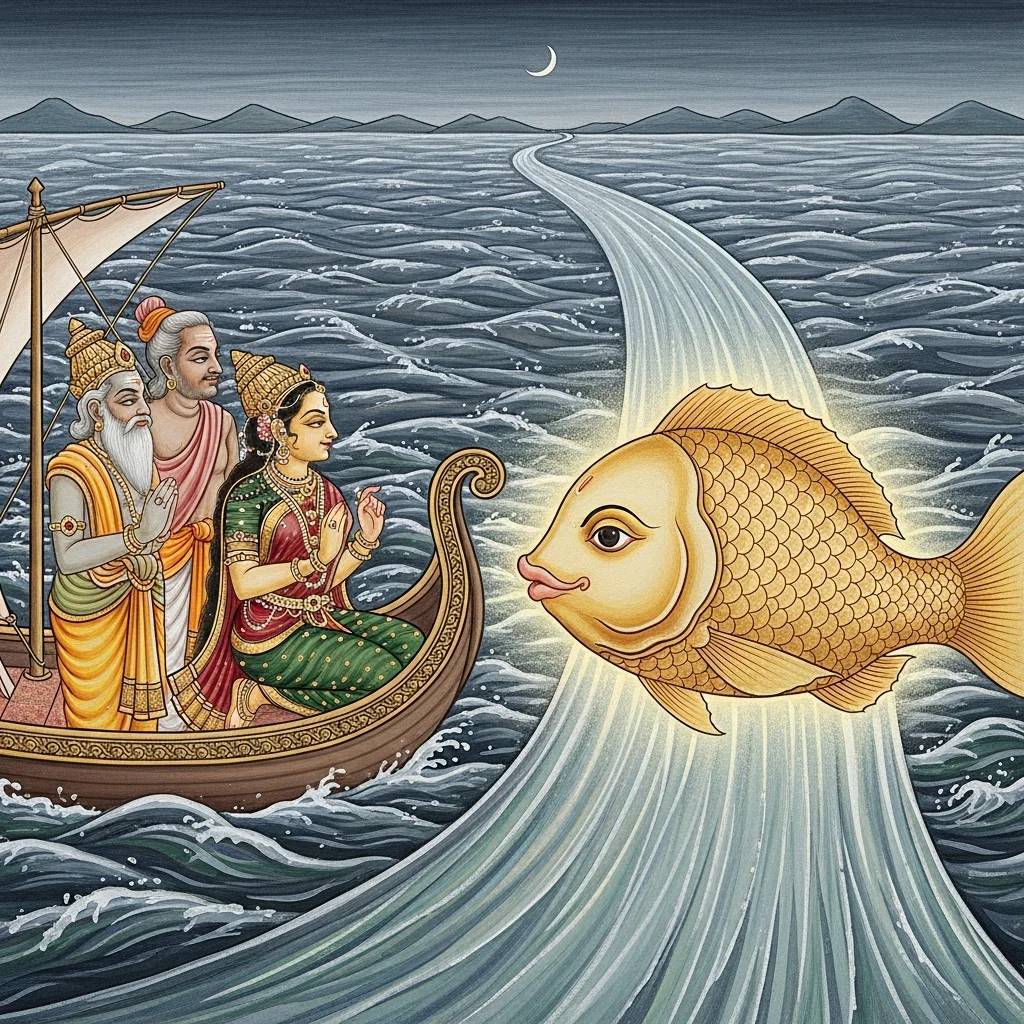
The chapter unfolds as a dialogue: Yudhiṣṭhira asks the sage Mārkaṇḍeya about the dreadful end-of-yuga conditions he has witnessed again and again—drought, the loss of herbs, rivers and reservoirs drying up, and beings departing to higher worlds. Mārkaṇḍeya replies by first affirming the authoritative lineage of purāṇic transmission (Śambhu → Vāyu → Skanda → Vasiṣṭha → Parāśara → Jātūkarṇya → other sages) and praising the Purāṇa as a liberating text to be heard, cleansing impurities gathered across many births. He then narrates a cosmic dissolution: twelve suns scorch the world until it becomes a single ocean. Wandering upon the waters, he beholds a primordial, radiant Supreme Being, and also sees another Manu with descendants moving through the dark sea. In fear and exhaustion he encounters a vast fish-form, recognized as Maheśvara, who calls him near. The narrative shifts to the wonder of a “river within the ocean” and a divine woman (Abalā) who explains her origin from Īśvara’s body and the safety of a boat bound to Śaṅkara’s presence. Mārkaṇḍeya boards with Manu and offers a Śaiva hymn invoking Sadyojāta, Vāmadeva, Bhadrakālī, and Rudra as the cosmic cause. The chapter culminates with Mahādeva pleased and inviting a boon, setting devotion and authoritative hearing as the response to the world’s impermanence.
Shlokas
Verse 1
युधिष्ठिर उवाच । सप्तकल्पक्षया घोरास्त्वया दृष्टा महामुने । न चापीहास्ति भगवन्दीर्घायुरिह कश्चन
Yudhiṣṭhira said: O great sage, you have witnessed the dreadful dissolutions of seven kalpas. Yet here, O venerable one, there is no one at all who is long-lived.
Verse 2
त्वया ह्येकार्णवे सुप्तः पद्मनाभः सुरारिहा । दृष्टः सहस्रचरणः सहस्रनयनोदरः
For you indeed beheld Padmanābha, the slayer of the gods’ foes, asleep upon the single cosmic ocean—having a thousand feet, and a body endowed with a thousand eyes.
Verse 3
। अध्याय
(Textual marker) “Chapter.”
Verse 4
किं त्वयाश्चर्यभूतं हि दृष्टं च भ्रमतानघ । एतदाचक्ष्व भगवन्परं कौतूहलं हि मे
What wondrous thing did you behold while wandering, O sinless one? Tell me this, O venerable sage, for my curiosity is exceedingly great.
Verse 5
सम्प्राप्ते च महाघोरे युगस्यान्ते महाक्षये । अनावृष्टिहते लोके पुरा वर्षशताधिके
When the exceedingly dreadful end of the age arrived—the great dissolution—long ago the world was struck by drought for more than a hundred years.
Verse 6
औषधीनां क्षये घोरे देवदानववर्जिते । निर्वीर्ये निर्वषट्कारे कलिना दूषिते भृशम्
In that terrible time, when medicinal herbs had perished, when gods and dānavas were absent, when strength was gone and the Vedic «vaṣaṭ» rites had ceased—when everything was greatly corrupted by Kali—
Verse 7
सरित्सरस्तडागेषु पल्वलोपवनेषु च । संशुष्केषु तदा ब्रह्मन्निराकारे युगक्षये
When rivers, lakes, ponds, marshes, and groves had all dried up, then—O Brahmin—at the formless end of the age,
Verse 8
जनं प्राप्ते महर्लोके ब्रह्मक्षत्रविशादयः । ऋषयश्च महात्मानो दिव्यतेजःसमन्विताः
When the people had reached Maharloka—Brahmins, Kṣatriyas, Vaiśyas, and others—there were also great-souled sages endowed with divine splendor.
Verse 9
स्थितानि कानि भूतानि गतान्येव महामुने । एतत्सर्वं महाभाग कथयस्व पृथक्पृथक्
O great sage, which beings remain, and which have departed? O noble one, tell me all of this clearly, one by one, in proper detail.
Verse 10
भूतानि कानि विप्रेन्द्र कथं सिद्धिमवाप्नुयात् । ब्रह्मविष्ण्विन्द्ररुद्राणां काले प्राप्ते सुदारुणे
O best of brahmins, which beings are they, and how may one attain perfection—especially when the exceedingly terrible time arrives even for Brahmā, Viṣṇu, Indra, and Rudra?
Verse 11
एवमुक्तस्ततः सोऽथ धर्मराजेन धीमता । मार्कण्डः प्रत्युवाचेदमृषिसंघैः समावृतः
Thus addressed by the wise Dharmarāja, Mārkaṇḍa then replied—surrounded by assemblies of sages.
Verse 12
श्रीमार्कण्डेय उवाच । शृण्वन्तु ऋषयः सर्वे त्वया सह नरेश्वर । महत्पुराणं पूर्वोक्तं शंभुना वायुदैवते
Śrī Mārkaṇḍeya said: Let all the sages listen, together with you, O king of men. This great Purāṇa was formerly proclaimed by Śambhu to Vāyu, the divine one.
Verse 13
वायोः सकाशात्स्कन्देन श्रुतमेतत्पुरातनम् । वसिष्ठः श्रुतवांस्तस्मात्पराशरस्ततः परम्
This ancient Purāṇa was heard by Skanda from Vāyu. From him Vasiṣṭha heard it, and thereafter Parāśara heard it in turn.
Verse 14
तस्माच्च जातूकर्ण्येन तस्माच्चैव महर्षिभिः । एवं परम्पराप्रोक्तं शतसंख्यैर्द्विजोत्तमैः
From him it was received by Jātūkarṇya, and from him again by great sages. Thus it has been taught in succession by hundreds of foremost twice-born sages.
Verse 15
संहिता शतसाहस्री पुरोक्ता शंभुना किल । आलोड्य सर्वशास्त्राणि वदार्थं तत्त्वतः पुरा
Indeed, a compendium of a hundred thousand verses was first proclaimed by Śambhu. Having churned all the śāstras, he formerly set forth their meaning in accordance with truth.
Verse 16
युगरूपेण सा पश्चाच्चतुर्धा विनियोजिता । मदप्रज्ञानुसारेण नराणां तु महर्षिभिः
Later, in keeping with the character of the ages, it was arranged into four parts by great sages—according to the varying capacities of human understanding.
Verse 17
आराध्य पशुभर्तारं मया पूर्वं महेश्वरम् । पुराणं श्रुतमेतद्धि तत्ते वक्ष्याम्यशेषतः
Having formerly worshipped Maheśvara, the Lord of creatures, I have indeed heard this Purāṇa; therefore I shall tell it to you in full, without omission.
Verse 18
यच्छ्रुत्वा मुच्यते जन्तुः सर्वपापैर्नरेश्वर । मानसैः कर्मजैश्चैव सप्तजन्मसु संचितैः
O king, by hearing this, a person is freed from all sins—those born of the mind and those born of deeds—accumulated through seven births.
Verse 19
सप्तकल्पक्षया घोरा मया दृष्टाः पुनःपुनः । प्रसादाद्देवदेवस्य विष्णोश्च परमेष्ठिनः
By the grace of the God of gods—Viṣṇu, the Supreme Lord—I have again and again witnessed the dreadful destructions at the end of seven kalpas.
Verse 20
द्वादशादित्यनिर्दग्धे जगत्येकार्णवीकृते । श्रान्तोऽहं विभ्रमंस्तत्र तरन्बाहुभिरर्णवम्
When the world was scorched by the twelve Ādityas and became a single ocean, I—utterly weary—wandered there, swimming through the flood with my arms.
Verse 21
अथाहं सलिले राजन्नादित्यसमरूपिणम् । पुरा पुरुषमद्राक्षमनादिनिधनं प्रभुम्
Then, O king, within those waters I beheld the Primeval Puruṣa, radiant like the Sun—the Lord without beginning or end.
Verse 22
शृङ्गं चैवाद्रिराजस्य भासयन्तं दिशो दश । द्वितीयोऽन्यो मनुर्दृष्टः पुत्रपौत्रसमन्वितः
I also beheld the peak of the king of mountains, shining forth and illumining the ten directions; and I saw yet another Manu—a second—attended by his sons and grandsons.
Verse 23
अगाधे भ्रमते सोऽपि तमोभूते महार्णवे । अविश्रमन्मुहूर्तं तु चक्रारूढ इव भ्रमन्
He too drifted through that unfathomable great ocean, filled with darkness; without resting even for a moment, he whirled about as though mounted upon a wheel.
Verse 24
अथाहं भयादुद्विग्नस्तरन्बाहुभिरर्णवम् । तत्रस्थोऽहं महामत्स्यमपश्यं मदसंयुतम्
Then, frightened and shaken, I swam through the ocean with my arms; and there I beheld a gigantic fish, possessed of overpowering might.
Verse 25
ततोऽब्रवीत्स मां दृष्ट्वा एह्येहीति च भारत । परं प्रधानः सर्वेषां मत्स्यरूपो महेश्वरः
Then, seeing me, he said, “Come, come!” O Bhārata. That Maheśvara—supreme and foremost of all—was present there in the form of a fish.
Verse 26
ततोऽहं त्वरया गत्वा तन्मुखे मनुजेश्वर । सुश्रान्तो विगतज्ञानः परं निर्वेदमागतः
Then I hastened to his mouth, O lord of men; utterly exhausted, my senses confounded, I fell into profound dispassion and despair toward the world.
Verse 27
ततोऽद्राक्षं समुद्रान्ते महदावर्तसंकुलाम् । उद्यत्तरंगसलिलां फेनपुञ्जाट्टहासिनीम्
Then I beheld, at the ocean’s edge, a mighty river-current, crowded with vast whirlpools; its waters rose in swelling waves, and its heaps of foam seemed to laugh aloud.
Verse 28
नदीं कामगमां पुण्यां झषमीनसमाकुलाम् । नद्यास्तस्यास्तु मध्यस्था प्रमदा कामरूपिणी
I beheld a holy river that moved according to desire, teeming with fish; and in the very midst of that river stood a maiden, able to assume forms at will.
Verse 29
नीलोत्पलदलश्यामा महत्प्रक्षोभवाहिनी । दिव्यहाटकचित्राङ्गी कनकोज्ज्वलशोभिता
Dark-hued like the petal of a blue lotus, she moved with mighty, surging force. Adorned with wondrous limbs decked in celestial gold, she shone with the splendor of radiant gold.
Verse 30
द्वाभ्यां संगृह्य जानुभ्यां महत्पोतं व्यवस्थिता । तां मनुः प्रत्युवाचेदं का त्वं दिव्यवराङ्गने
Holding fast the great boat with both her knees, she remained steady. Then Manu addressed her: “Who are you, O divine lady of excellent form?”
Verse 31
तिष्ठसे केन कार्येण त्वमत्र सुरसुन्दरि । सुरासुरगणे नष्टे भ्रमसे लीलयार्णवे
“For what purpose do you stand here, O heavenly beauty? When the hosts of gods and demons have perished, why do you roam playfully upon this ocean?”
Verse 32
सरितः सागराः शैलाः क्षयं प्राप्ता ह्यनेकशः । त्वमेका तु कथं साध्वि तिष्ठसे कारणं महत् । श्रोतुमिच्छाम्यहं देवि कथयस्व ह्यशेषतः
“Rivers, seas, and mountains—many indeed—have met destruction. Yet you alone remain; how is this so, O virtuous lady? I wish to hear, O goddess—tell me completely the great reason.”
Verse 33
अबलोवाच । ईश्वराङ्गसमुद्भूता ह्यमृतानाम विश्रुता । सरित्पापहरा पुण्या मामाश्रित्य भयं कुतः
The woman said: “I have arisen from the very body of the Lord, and I am renowned among the immortals. I am the holy river that removes sins; taking refuge in me, where could fear come from?”
Verse 34
साहं पोतमिमं तुभ्यं गृहीत्वा ह्यागता द्विज । न ह्यस्य पोतस्य क्षयो यत्र तिष्ठति शंकरः
“Therefore I have come, O brāhmaṇa, bringing this boat to you. This boat does not perish, for Śaṅkara abides where it stands.”
Verse 35
तस्यास्तद्वचनं श्रुत्वा विस्मयोत्फुल्ललोचनः । मनुना सह राजेन्द्र पोतारूढो ह्यहं तदा
Hearing her words, my eyes widened in astonishment. Then, O king of kings, I too boarded the boat together with Manu.
Verse 36
कृताञ्जलिपुटो भूत्वा प्रणम्य शिरसा विभुम् । व्यापिनं परमेशानमस्तौषमभयप्रदम्
With palms joined in reverence, bowing my head to the all-powerful Lord—pervading all, the Supreme Īśāna—I praised Him, the giver of fearlessness.
Verse 37
सद्योजाताय देवाय वामदेवाय वै नमः । भवे भवे नमस्तुभ्यं भक्तिगम्याय ते नमः
Salutations to the God Sadyojāta; indeed, salutations to Vāmadeva. In birth after birth I bow to You—salutations to You, who are attained through devotion.
Verse 38
भूर्भुवाय नमस्तुभ्यं रामज्येष्ठाय वै नमः । नमस्ते भद्रकालाय कलिरूपाय वै नमः
Salutations to You as Bhūrbhuva; indeed, salutations to You as Rāmajyeṣṭha. Salutations to You as Bhadrakāla; indeed, salutations to You as the very form of Kali—Time.
Verse 39
अचिन्त्याव्यक्तरूपाय महादेवाय धामने । विद्महे देवदेवाय तन्नो रुद्र नमोनमः
We contemplate Mahādeva—whose form is unthinkable and unmanifest, the supreme abode. We know the God of gods; therefore, O Rudra, to You—again and again—our reverent salutations.
Verse 40
जगत्सृष्टिविनाशानां कारणाय नमोनमः । एवं स्तुतो महादेवः पूर्वं सृष्टया मयानघ
Salutations again and again to the Cause of the world’s creation and dissolution. Thus was Mahādeva praised by me formerly, O sinless one, at the time of creation.
Verse 41
प्रसन्नो मावदत्पश्चाद्वरं वरय सुव्रत
Then, being pleased, he said to me: “Choose a boon, O you of noble vow.”