Adhyaya 120
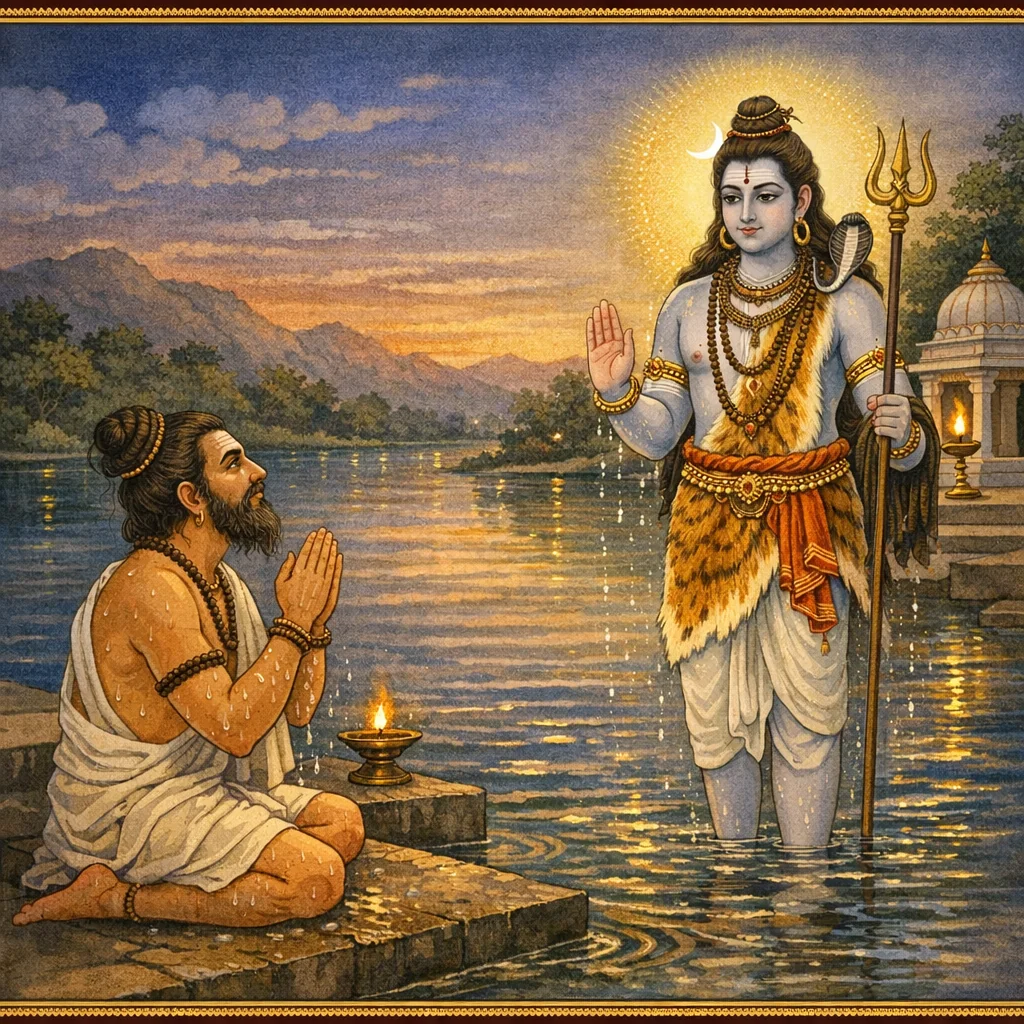
This chapter explains the origin and merit of Kambu Tīrtha, centered on Kambukeśvara/Kambu. Śrī Mārkaṇḍeya recounts the lineage from Hiraṇyakaśipu to Prahlāda, then through Virocana, Bali, Bāṇa, Śambara, and finally Kambu—an asura who awakens to an existential fear before Viṣṇu’s cosmic might and realizes that enmity toward Hari cannot yield lasting welfare. Kambu undertakes austerities on the waters of the Narmadā: mauna (sacred silence), disciplined bathing, austere dress and regimen, and prolonged worship of Mahādeva. Śiva, pleased, grants a boon yet states a theological limit: no being, even Śiva, can nullify Viṣṇu’s supremacy in cosmic conflict; hostility to Hari does not bring enduring good. After Śiva departs, Kambu establishes at that spot a pacific, disease-free form of Śiva, and the place becomes known as Kambu Tīrtha, praised as a destroyer of great faults. The phalaśruti concludes that bathing and worship—especially solar worship with Ṛg/Yajus/Sāman praises—bear fruit comparable to Vedic rites; ancestral offerings and worship of Īśāna yield Agniṣṭoma-like merit; and death there is said to lead to Rudra-loka.
Shlokas
Verse 1
श्रीमार्कण्डेय उवाच । अतः परं प्रवक्ष्यामि कम्बुकेश्वरमुत्तमम् । हिरण्यकशिपुर्दैत्यो दानवो बलदर्पितः
Śrī Mārkaṇḍeya said: “Now I shall proclaim the supreme Kambukeśvara. There was the Dānava demon Hiraṇyakaśipu, a Daitya, intoxicated with the pride of strength.”
Verse 2
अवध्यः सर्वलोकानां त्रिषु लोकेषु विश्रुतः । तस्य पुत्रो महातेजाः प्रह्लादो नाम नामतः
He was famed throughout the three worlds as invincible to all beings. His son, radiant with great spiritual splendor, was known by name as Prahlāda.
Verse 3
विष्णुप्रसादाद्भक्त्या च तस्य राज्ये प्रतिष्ठितः । विरोचनस्तस्य सुतस्तस्यापि बलिरेव च
By Viṣṇu’s grace and through devotion, he became established in his kingdom. His son was Virocana, and Virocana’s son was indeed Bali.
Verse 4
बलिपुत्रोऽभवद्बाणस्तस्मादपि च शम्बरः । शम्बरस्यान्वये जातः कम्बुर्नाम महासुरः
Bali’s son was Bāṇa; from him came Śambara. In Śambara’s lineage was born a great asura named Kambu.
Verse 5
ज्ञात्वा विष्णुमयं घोरं महद्भयमुपस्थितम् । दानवानां विनाशाय नान्यो हेतुः कदाचन
Realizing that a terrible, Viṣṇu-imbued great danger had arisen, he understood that for the destruction of the Dānavas there is never any cause other than that divine power.
Verse 6
स त्यक्त्वा पुत्रदारांश्च सुहृद्बन्धुपरिग्रहान् । चचार मौनमास्थाय तपः कम्बुर्महामतिः
Abandoning sons and wife, and every attachment to friends and kin, Kambu—great in resolve—embraced the vow of silence and practiced austerity.
Verse 7
अक्षसूत्रकरो भूत्वा दण्डी मुण्डी च मेखली । शाकयावकभक्षश्च वल्कलाजिनसंवृतः
With a rosary-string in hand—bearing a staff, shaven-headed and girded with a belt—he lived on vegetables and barley, clad in bark-cloth and antelope-skin.
Verse 8
स्नात्वा नित्यं धृतिपरो नर्मदाजलमाश्रितः । पूजयंस्तु महादेवमर्बुदं वर्षसंख्यया
Bathing each day, steadfast in resolve and sustained by the waters of the Narmadā, he continued worshipping Mahādeva for an ‘arbuda’—a vast count of years.
Verse 9
ततस्तुतोष भगवान्देवदेवो महेश्वरः । उवाच दानवं काले मेघगम्भीरया गिरा
Then the Blessed Lord—Maheśvara, God of gods—was pleased. At the proper time he spoke to the Dānava in a voice deep as thunderclouds.
Verse 10
भोभोः कम्बो महाभाग तुष्टोऽहं तव सुव्रत । इष्टं व्रतानां परमं मौनं सर्वार्थसाधनम्
“Ho, ho—Kambu, fortunate one! I am pleased with your excellent vow. Dearest among vows is supreme silence (mauna), the accomplisher of every aim.”
Verse 11
चरितं च त्वया लोके देवदानवदुश्चरम् । वरं वृणीष्व भद्रं ते यत्ते मनसि रोचते
And you have performed in this world a feat difficult even for the Devas and the Dānavas. Choose a boon—may it be auspicious for you—whatever your heart desires.
Verse 12
कम्बुरुवाच । यदि प्रसन्नो देवेश यदि देयो वरो मम । अक्षय्यश्चाव्ययश्चैव स्वेच्छया विचराम्यहम्
Kambu said: “If you are pleased, O Lord of the gods, and if a boon is to be granted to me—let me be imperishable and undecaying, and let me roam freely by my own will.”
Verse 13
दैत्यदानवसङ्घानां संयुगेष्वपलायिता । भयं चान्यन्न विद्येत मुक्त्वा देवं गदाधरम्
In battles against hosts of Daityas and Dānavas, may I never flee. And may I know no other fear—except from the god who bears the mace.
Verse 14
तस्याहं संयुगे साध्यो येनोपायेन शङ्कर । भवामि न सदा कालं तं वदस्व वरं मम
By what means, O Śaṅkara, can I be overcome by him in battle? Tell me that, so that I may not be vulnerable to him at all times—this is my boon.
Verse 15
ईश्वर उवाच । मम संनिहितो यत्र त्वं भविष्यसि दानव । तत्र विष्णुभयं नास्ति वसात्र विगतज्वरः
Īśvara said: “O Dānava, wherever you shall dwell with my presence near you, there will be no fear of Viṣṇu. Live there, free from distress.”
Verse 16
तस्य देवाधिदेवस्य वेदगर्भस्य संयुगे । शङ्खचक्रधरस्येशा नाहं सर्वे सुरासुराः
In battle with that God above gods—Viṣṇu, the very womb of the Vedas, bearer of conch and discus—even I, nor all the gods and asuras together, am his master.
Verse 17
किं पुनर्यो द्विषत्येनं लोकालोकप्रभुं हरिम् । स सुखी वर्तते कालं न निमेषं मतं मम
What then of one who hates Hari, Lord of the manifest and the unmanifest? In my view, such a one cannot remain happy even for a single moment.
Verse 18
तस्मात्त्वं परया भक्त्या सर्वभूतहिते रतः । वसिष्यसि चिरं कालमित्युक्त्वादर्शनं गतः
“Therefore, with supreme bhakti and intent on the welfare of all beings, you shall live for a long time.” Having spoken thus, the deity vanished from sight.
Verse 19
गते चादर्शनं देवे तत्र तीर्थे महामतिः । स्थापयामास देवेशं शिवं शान्तमनामयम्
When the god had vanished from sight, the great-souled one, at that sacred tīrtha, स्थापित (established) Lord Śiva—the Lord of gods—peaceful and free from affliction.
Verse 20
तस्मिंस्तीर्थे महादेवं स्थापयित्वा दिवं गतः । तदाप्रभृति तत्पार्थ कम्बुतीर्थमिति श्रुतम् । विख्यातं सर्वलोकेषु महापातकनाशनम्
Having installed Mahādeva at that sacred tīrtha, he went to heaven. From that time onward, O Pārtha, it came to be known as “Kambu-tīrtha,” famed in all worlds as a destroyer of great sins.
Verse 21
कम्बुतीर्थे नरः स्नात्वा विधिनाभ्यर्च्य भास्करम् । ऋग्यजुःसाममन्त्रैश्च स्तूयमानो नृपोत्तम
O best of kings, a man who bathes at Kambu-tīrtha and, according to proper rite, worships Bhāskara—being praised with Ṛg, Yajus, and Sāma mantras—attains great merit.
Verse 22
तस्य पुण्यं समुद्दिष्टं ब्राह्मणैर्वेदपारगैः । तत्सर्वं तु शृणुष्वाद्य ममैव गदतो नृप
Its merit has been set forth by brāhmaṇas who have mastered the Vedas. Hear all of that today, O king, as I myself relate it.
Verse 23
ऋग्यजुःसामगीतेषु साङ्गोपाङ्गेषु यत्फलम् । तत्फलं समवाप्नोति गायत्रीमात्रमन्त्रवित्
Whatever fruit is found in the recitations of Ṛg, Yajus, and Sāma—together with their auxiliaries and subsidiary limbs—that very fruit is attained by one who knows even the Gāyatrī alone as a mantra.
Verse 24
तत्र तीर्थे तु यः स्नात्वा तर्पयेत्पितृदेवताः । पूजयेद्देवमीशानं सोऽग्निष्टोमफलं लभेत्
Whoever bathes at that tīrtha, offers tarpaṇa to the Pitṛs and the deities, and worships Lord Īśāna—he obtains the fruit of the Agniṣṭoma sacrifice.
Verse 25
अकामो वा सकामो वा तत्र तीर्थे कलेवरम् । यस्त्यजेन्नात्र सन्देहो रुद्रलोकं स गच्छति
Whether desireless or desire-filled, whoever gives up the body at that tīrtha—of this there is no doubt—goes to the world of Rudra.
Verse 120
। अध्याय
“Chapter” (a colophon/section marker indicating the end or transition of the adhyāya).