Adhyaya 159
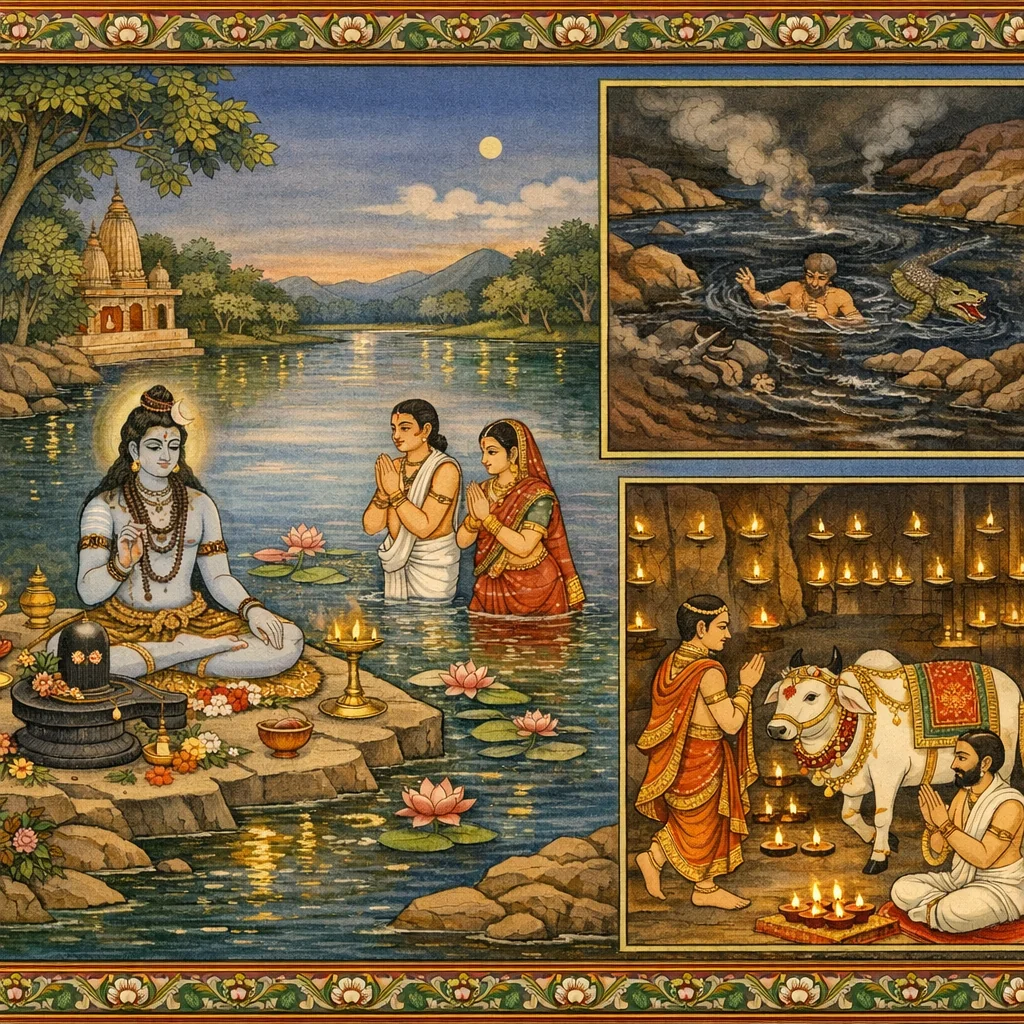
The chapter begins with Mārkaṇḍeya directing the king to a rare, supremely purifying Narmadā tīrtha called Narakeśvara, praised as a protection against the dreadful vision of the “gateway of hell.” Yudhiṣṭhira then asks how beings, after undergoing the fruits of auspicious and inauspicious deeds, return with recognizable marks. Mārkaṇḍeya answers with an ordered account of karma, linking specific sins and moral failures to bodily defects, social deprivation, or non-human births, as a didactic register of ethical causality. The teaching turns to embodiment: the fetus’ formation month by month, the blending of the five elements, and the arising of faculties and senses under divine governance. The latter half describes the fearsome Vaitaraṇī river at Yama’s gate—foul, violent, and hard to cross—where suffering increases for those who dishonor mother, teacher, and guru, harm dependents, deceive in gifts and promises, and commit sexual and social transgressions. As a remedy it prescribes the Vaitaraṇī-dhenū dāna: fashioning and donating a properly adorned cow with mantras and circumambulation, so the river becomes “sukhavāhinī,” easy to ford. The chapter closes with calendrical guidance, especially Kṛṣṇa Caturdaśī in Āśvayuja, combining Narmadā bathing, śrāddha, night vigil, tarpaṇa, lamp-gift, feeding brāhmaṇas, and Śiva worship, promising release from naraka and attainment of exalted post-mortem states and favorable human rebirth.
Shlokas
Verse 1
श्रीमार्कण्डेय उवाच । ततो गच्छेन्महाराज तीर्थं परमपावनम् । नर्मदायां सुदुष्प्रापं सिद्धं ह्यनरकेश्वरम्
Śrī Mārkaṇḍeya said: Then, O great king, one should go to the supremely purifying tīrtha on the Narmadā—hard to attain—renowned as the accomplished shrine of Anarakeśvara.
Verse 2
तस्मिंस्तीर्थे नरः स्नात्वा पापकर्मापि भारत । न पश्यति महाघोरं नरकद्वारसंज्ञिकम्
O Bhārata, even a man burdened with sinful deeds—having bathed at that sacred ford—does not behold the exceedingly dreadful place known as the “Gate of Hell.”
Verse 3
युधिष्ठिर उवाच । शुभाशुभफलैस्तात भुक्तभोगा नरास्त्विह । जायन्ते लक्षणैर्यैस्तु तानि मे वद सत्तम
Yudhiṣṭhira said: O dear one, people here—having experienced the fruits of good and evil—are born again with certain distinguishing marks. O best of the virtuous, tell me what those marks are.
Verse 4
यथा निर्गच्छते जीवस्त्यक्त्वा देहं न पश्यति । तथा गच्छन्पुनर्देहं पञ्चभूतसमन्वितः
Just as the jīva departs, abandoning the body and no longer perceiving it, so too does it proceed to another body, once again endowed with the five elements.
Verse 5
त्वगस्थिमांसमेदोऽसृक्केशस्नायुशतैः सह । विण्मूत्ररेतःसङ्घाते का संज्ञा जायते नृणाम्
Composed of skin, bone, flesh, fat, blood, hair, and hundreds of sinews—and a heap of feces, urine, and semen—what true ‘identity’ can arise for human beings from such a compound?
Verse 6
एवमुक्तः स मार्कण्डः कथयामास योगवित् । ध्यात्वा सनातनं सर्वं देवदेवं महेश्वरम्
Thus addressed, Mārkaṇḍa—the knower of Yoga—began to speak, having meditated on Maheśvara, the God of gods, the eternal Lord who is the All.
Verse 7
मार्कण्डेय उवाच । शृणु पार्थ महाप्रश्नं कथयामि यथाश्रुतम् । सकाशाद्ब्रह्मणः पूर्वमृषिदेवसमागमे
Mārkaṇḍeya said: Listen, O Pārtha, to this great question. I shall explain it as I have heard it—formerly, from Brahmā himself, at an assembly of sages and gods.
Verse 8
गुरुरात्मवतां शास्ता राजा शास्ता दुरात्मनाम् । इह प्रच्छन्नपापानां शास्ता वैवस्वतो यमः
For the self-controlled, the teacher is the disciplinarian; for the wicked, the king is the disciplinarian. But for those whose sins remain hidden in this world, Yama—the son of Vivasvān—becomes the true chastiser.
Verse 9
अचीर्णप्रायश्चित्तानां यमलोके ह्यनेकधा । यातनाभिर्वियुक्तानामनेकां जीवसन्ततिम्
In Yama’s realm, those who have not performed expiation undergo punishments in many ways; and, released from those torments, they proceed through many successive streams of embodied lives.
Verse 10
गत्वा मनुष्यभावे तु पापचिह्ना भवन्ति ते । तत्तेऽहं सम्प्रवक्ष्यामि शृणुष्वैकमना नृप
When they return to the human condition, they bear marks of sin. Those marks I shall now explain to you—listen with a single-pointed mind, O king.
Verse 11
सहित्वा यातनां सर्वां गत्वा वैवस्वतक्षयम् । विस्तीर्णयातना ये तु लोकमायान्ति चिह्निताः
Having endured every torment and reached the abode of Vaivasvata (Yama), those who have undergone extended punishments return to the world bearing visible marks.
Verse 12
गद्गदोऽनृतवादी स्यान्मूकश्चैव गवानृते । ब्रह्महा जायते कुष्ठी श्यावदन्तस्तु मद्यपः
One who speaks falsehood becomes stammering; and one who lies in matters concerning cows becomes mute. A slayer of a brāhmaṇa is born diseased with leprosy; and a drinker of intoxicants becomes one with darkened teeth.
Verse 13
कुनखी स्वर्णहरणाद्दुःश्चर्मा गुरुतल्पगः । संयोगी हीनयोनिः स्याद्दरिद्रोऽदत्तदानतः
By stealing gold one becomes diseased with deformed nails; one who violates the teacher’s bed becomes afflicted with a grievous skin disease. One who engages in forbidden unions is born into a degraded womb; and one who fails to give what should be given becomes poor.
Verse 14
ग्रामशूकरतां याति ह्ययाज्ययाजको नृप । खरो वै बहुयाजी स्याच्छ्वानिमन्त्रितभोजनात्
O king, one who performs sacrifices (yajña) for those unfit to be sacrificed for becomes a village pig. And one who conducts many sacrifices becomes a donkey by eating food offered at an impure feast known as a “dog-invitation”.
Verse 15
अपरीक्षितभोजी स्याद्वानरो विजने वने । वितर्जकोऽथ मार्जारः खद्योतः कक्षदाहतः
One who eats without due examination becomes a monkey in a lonely forest. One who reviles becomes a cat; and one who sets brushwood aflame becomes a firefly.
Verse 16
अविद्यां यः प्रयच्छेत बलीवर्दो भवेद्धि सः । अन्नं पर्युषितं विप्रे ददानः क्लीबतां व्रजेत्
He who imparts ignorance becomes, indeed, an ox. And, O brāhmaṇa, one who gives a brāhmaṇa stale food goes to the state of impotence.
Verse 17
मात्सर्यादथ जात्यन्धो जन्मान्धः पुस्तकं हरन् । फलान्याहरतोऽपत्यं म्रियते नात्र संशयः
From envy one becomes blind from birth. One who steals a book is born blind. And for one who carries off fruits, the child dies—of this there is no doubt.
Verse 18
मृतो वानरतां याति तन्मुक्तोऽथ गलाडवान् । अदत्त्वा भक्षयंस्तानि ह्यनपत्यो भवेन्नरः
After death he goes to the state of a monkey; once released from that, he becomes afflicted with a throat ailment. And a man who eats those fruits without giving a share or permission becomes without offspring.
Verse 19
हरन्वस्त्रं भवेद्गोधा गरदः पवनाशनः । प्रव्राजी गमनाद्राजन् भवेन्मरुपिशाचकः
One who steals clothing becomes an iguana. A poisoner becomes one who feeds on wind. And, O king, one who abandons the life of renunciation and wanders wrongly becomes a desert-ghoul.
Verse 20
वातको जलहर्ता च धान्यहर्ता च मूषकः । अप्राप्तयौवनां गच्छन् भवेत्सर्प इति श्रुतिः
So the sacred tradition declares: a tale-bearer is stricken with wind-disorders, and so too is a stealer of water. A stealer of grain is reborn as a mouse. And one who approaches a girl not yet come to puberty becomes a serpent.
Verse 21
गुरुदाराभिलाषी च कृकलासो भवेच्चिरम् । जलप्रस्रवणं यस्तु भिन्द्यान्मत्स्यो भवेन्नरः
One who lusts after the wife of his guru becomes a lizard for a long time. And the man who breaks a water-outlet is reborn as a fish.
Verse 22
अविक्रेयान् विक्रयन् वै विकटाक्षो भवेन्नरः । अयोनिगो वृको हि स्यादुलूकः क्रयवञ्चनात्
One who sells what ought not to be sold becomes a man with distorted, hideous eyes. One who approaches women unlawfully becomes a wolf; and one who cheats in buying and selling becomes an owl.
Verse 23
मृतस्यैकादशाहे तु भुञ्जानः श्वोपजायते । प्रतिश्रुत्य द्विजायार्थमददन्मधुको भवेत्
One who eats during the eleven-day mourning period after a death is reborn as a dog. And one who, having promised a gift to a twice-born for a sacred purpose, fails to give it becomes a bee.
Verse 24
राज्ञीगमाद्भवेद्दुष्टतस्करो विड्वराहकः । परिवादी द्विजातीनां लभते काच्छपीं तनुम्
By illicit approach to the king’s wife, one becomes a wicked thief and is reborn as a boar that feeds on filth. A slanderer of the twice-born gains the body of a tortoise.
Verse 25
व्रजेद्देवलको राजन्योनिं चाण्डालसंज्ञिताम् । दुर्भगः फलविक्रेता वृश्चिको वृषलीपतिः
A temple-servant who lives by improper service falls, O king, into a royal womb branded as Caṇḍāla. A seller of fruits becomes unfortunate; and one who takes a low-born woman as wife becomes a scorpion.
Verse 26
मार्जारोऽग्निं पदा स्पृष्ट्वा रोगवान्परमांसभुक् । सोदर्यागमनात्षण्ढो दुर्गन्धश्च सुगन्धहृत्
One who touches fire with the foot is reborn as a cat, diseased and a devourer of flesh. From approaching one’s own sister comes birth as a eunuch; and one who steals fragrance becomes foul-smelling.
Verse 27
ग्रामभट्टो दिवाकीर्तिर्दैवज्ञो गर्दभो भवेत् । कुपण्डितः स्यान्मार्जारो भषणो व्यास एव च
A village-flatterer, a man famed only by day, and an astrologer are reborn as a donkey. A pseudo-scholar becomes a cat; and a mere babbler—though calling himself a ‘Vyāsa’—also meets such a fate.
Verse 28
स एव दृश्यते राजन्प्रकाशात्परमर्मणाम् । यद्वा तद्वापि पारक्यं स्वल्पं वा यदि वा बहु
Those very marks are seen, O king, by the revealing of one’s deepest secrets—whether the matter concerns another (person or property), whether it is little or much.
Verse 29
कृत्वा वै योनिमाप्नोति तैरश्चीं नात्र संशयः । एवमादीनि चान्यानि चिह्नानि नृपसत्तम
Having acted thus, one certainly attains an animal birth—of this there is no doubt. Many other such marks too exist, O best of kings.
Verse 30
स्वकर्मविहितान्येव दृश्यन्ते यैस्तु मानवाः । ततो जन्म ततो मृत्युः सर्वजन्तुषु भारत
People are seen bearing precisely those conditions ordained by their own actions. From that comes birth, and from that comes death among all beings, O Bhārata.
Verse 31
जायते नात्र सन्देहः समीभूते शुभाशुभे । स्त्रीपुंसोः सम्प्रयोगेण विषुद्धे शुक्रशोणिते
There is no doubt that birth occurs when merit and demerit come to fruition; through the union of woman and man, when the purified seed and blood are present.
Verse 32
पञ्चभूतसमोपेतः सषष्ठः परमेश्वरः । इन्द्रियाणि मनः प्राणा ज्ञानमायुः सुखं धृतिः
Endowed with the five great elements, and as the transcendent Lord—the ‘sixth’ beyond them—He fashions within the embodied being the senses, the mind, the vital breaths, knowledge, lifespan, happiness, and steadfastness.
Verse 33
धारणं प्रेरणं दुःखमिच्छाहङ्कार एव च । प्रयत्न आकृतिर्वर्णः स्वरद्वेषौ भवाभवौ
He also brings about holding and impelling, pain, desire and ego-sense; effort, bodily form and complexion; one’s own attachment and aversion, and the conditions of becoming and non-becoming.
Verse 34
तस्येदमात्मनः सर्वमनादेरादिमिच्छतः । प्रथमे मासि स क्लेदभूतो धातुविमूर्छितः
All this belongs to that Self who, though beginningless, wills a beginning. In the first month, the embryo becomes a moist mass, with the bodily constituents still indistinct and unformed.
Verse 35
मास्यर्बुदं द्वितीये तु तृतीये चेन्द्रियैर्युतः । आकाशाल्लाघवं सौक्ष्म्यं शब्दं श्रोत्रबलादिकम् । वायोस्तु स्पर्शनं चेष्टां दहनं रौक्ष्यमेव च
In the second month it becomes a swollen mass; in the third it is endowed with the senses. From ākāśa (space) arise lightness, subtlety, sound, and the power of hearing and the like; and from vāyu (wind) arise touch, movement, and dryness as its mark.
Verse 36
पित्तात्तु दर्शनं पक्तिमौष्ण्यं रूपं प्रकाशनम् । सलिलाद्रसनां शैत्यं स्नेहं क्लेदं समार्दवम्
From pitta, the fiery principle, arise sight, digestion, heat, form, and illumination; and from salila (water) arise taste, coolness, unctuousness, moisture, and softness.
Verse 37
भूमेर्गन्धं तथा घ्राणं गौरवं मूर्तिमेव च । आत्मा गृह्णात्यजः पूर्वं तृतीये स्पन्दते च सः
From bhūmi (earth) come smell and the faculty of smelling, heaviness and solid form. The unborn Self (Ātman) first takes these on, and in the third month it also begins to pulsate and stir.
Verse 38
दौर्हृदस्याप्रदानेन गर्भो दोषमवाप्नुयात् । वैरूप्यं मरणं वापि तस्मात्कार्यं प्रियं स्त्रियाः
If a pregnant woman’s heartfelt craving (dauḥṛda) is not fulfilled, the fetus may incur harm—deformity or even death. Therefore, what is dear and beneficial to the woman should be provided.
Verse 39
स्थैर्यं चतुर्थे त्वङ्गानां पञ्चमे शोणितोद्भवः । षष्ठे बलं च वर्णश्च नखरोम्णां च सम्भवः
In the fourth month the limbs gain stability; in the fifth, blood arises. In the sixth, strength and complexion manifest, and the growth of nails and hair also occurs.
Verse 40
मनसा चेतनायुक्तो नखरोमशतावृतः । सप्तमे चाष्टमे चैव त्वचावान् स्मृतिवानपि
Endowed with mind and consciousness, covered with hundreds of nails and hairs, in the seventh and eighth months it becomes possessed of skin—and even memory as well.
Verse 41
पुनर्गर्भं पुनर्धात्रीमेनस्तस्य प्रधावति । अष्टमे मास्यतो गर्भो जातः प्राणैर्वियुज्यते
Again and again, sin rushes toward the fetus and even toward the mother who bears it. Therefore, if the child is born in the eighth month, it becomes separated from the vital breaths (and is not sustained).
Verse 42
नवमे दशमे वापि प्रबलैः सूतिमारुतैः । निर्गच्छते बाण इव यन्त्रच्छिद्रेण सज्वरः
On the ninth or even the tenth month, driven by the powerful winds of birth, the child comes forth—like an arrow shot through the opening of a device—often accompanied by feverish distress.
Verse 43
शरीरावयवैर्युक्तो ह्यङ्गप्रत्यङ्गसंयुतः । अष्टोत्तरं मर्मशतं तत्रास्था तु शतत्रयम्
Endowed with bodily parts—limbs and sub-limbs—the human frame contains one hundred and eight vital points; and within it are said to be three hundred bones.
Verse 44
सप्त शिरःकपालानि विहितानि स्वयम्भुवा । तिस्रः कोट्योऽर्धकोटी च रोम्णामङ्गेषु भारत
The Self-born (Creator) has ordained seven plates of the skull; and on the limbs, O Bhārata, there are three crores and a half-crore of hairs.
Verse 45
द्वासप्ततिसहस्राणि हृदयादभिनिसृताः । हितानाम हि ता नाड्यस्तासां मध्ये शशिप्रभा
Seventy-two thousand (channels) issue forth from the heart. They are indeed called the ‘hitā’ nāḍīs; and among them is one radiant like the moon.
Verse 46
एवं प्रवर्तते चक्रं भूतग्रामे चतुर्विधे । उत्पत्तिश्च विनाशश्च भवतः सर्वदेहिनाम्
Thus the wheel turns within the fourfold aggregate of beings: for all embodied creatures, both arising and perishing come to pass.
Verse 47
गतिरूर्ध्वा च धर्मेण ह्यधर्मेण त्वधोगतिः । जायते सर्ववर्णानां स्वधर्मचलनान्नृप
By dharma, the course is upward; but by adharma, the course is downward. For all social orders, O King, such destinies arise from deviating from one’s own duty.
Verse 48
देवत्वे मानवत्वे च दानभोगादिकाः क्रियाः । दृश्यन्ते या महाराज तत्सर्वं कर्मजं फलम्
Whether in godhood or in human life, the acts seen—charity, enjoyment, and the like—O great King, all of that is the fruit born of karma.
Verse 49
स्वकर्म विहिते घोरे कामक्सोधार्जिते शुभे । निमज्जेन्नरके घोरे यस्योत्तारो न विद्यते
When one’s own deeds become dreadful—though seemingly ‘good’ yet earned through desire and anger—one sinks into a fearful hell, from which there is no rescue.
Verse 50
उत्तारणाय जन्तूनां नर्मदातटसंस्थितम् । एवमेतन्महातीर्थं नरकेश्वरमुत्तमम्
For the deliverance of living beings, there is this sacred ford upon the bank of the Narmadā. Thus this supreme Mahātīrtha—Narakeśvara—is declared the best.
Verse 51
नरकापहं महापुण्यं महापातकनाशनम् । तत्तीर्थं सर्वतीर्थानामुत्तमं भुवि दुर्लभम्
That tīrtha removes hell, bestows great merit, and destroys grievous sins. That sacred ford is foremost among all tīrthas, rare to find upon the earth.
Verse 52
तत्र तीर्थे तु यः स्नात्वा पूजयेत महेश्वरम् । महापातकयुक्तोऽपि नरकं नैव पश्यति
Whoever bathes at that sacred ford and worships Maheśvara—even if burdened with great sins—does not behold hell.
Verse 53
तत्र तीर्थे तु यो दद्याद्धेनुं वैतरणीं शुभाम् । स मुच्यते सुखेनैव वैतरण्यां न संशयः
Whoever at that sacred ford donates an auspicious ‘Vaitaraṇī cow’ is freed with ease; regarding the Vaitaraṇī there is no doubt.
Verse 54
युधिष्ठिर उवाच । यमद्वारे महाघोरे या सा वैतरणी नदी । किंरूपा किंप्रमाणा सा कथं सा वहति द्विज
Yudhiṣṭhira said: “At the dreadful gate of Yama, that river called Vaitaraṇī—what is its form, what is its measure, and how does it flow, O brāhmaṇa?”
Verse 55
कथं तस्याः प्रमुच्यन्ते केषां वासस्तु संततम् । केषां तु सानुकूला सा ह्येतद्विस्तरतो वद
“How are beings released from it? For whom is there continual dwelling there? And to whom is it favorable? Tell this to me in detail.”
Verse 56
श्रीमार्कण्डेय उवाच । धर्मपुत्र महाबाहो शृणु सर्वं मयोदितम् । या सा वैतरणी नाम यमद्वारे महासरित्
Śrī Mārkaṇḍeya said: “O son of Dharma, mighty-armed one—listen to all that I declare. That great river at Yama’s gate is called Vaitaraṇī.”
Verse 57
अगाधा पाररहिता दृष्टमात्रा भयावहा । पूयशोणिततोया सा मांसकर्दमनिर्मिता
It is unfathomable, without a farther bank, and terrifying merely to behold; its waters are pus and blood, and it is made of mire of flesh.
Verse 58
तत्तोयं भ्रमते तूर्णं तापीमध्ये घृतं यथा । कृमिभिः सङ्कुलं पूयं वज्रतुण्डैरयोमुखैः
That liquid swirls swiftly, like ghee in the midst of intense heat; the pus there is crowded with worms—iron-mouthed, with beaks like thunderbolts.
Verse 59
शिशुमारैश्च मकरैर्वज्रकर्तरिसंयुतैः । अन्यैश्च जलजीवैः सा सुहिंस्रैर्मर्मभेदिभिः
It is filled with dolphins and makaras equipped with thunderbolt-like cutters, and with other aquatic creatures—fiercely violent, piercing the vital parts.
Verse 60
तपन्ति द्वादशादित्याः प्रलयान्त इवोल्बणाः । पतन्ति तत्र वै मर्त्याः क्रन्दन्तो भृशदारुणम्
There the twelve Ādityas blaze, fierce as at the end of pralaya; there mortals fall, wailing in exceedingly dreadful agony.
Verse 61
हा भ्रातः पुत्र हा मातः प्रलपन्ति मुहुर्मुहुः । असिपत्त्रवने घोरे पतन्तं योऽभिरक्षति
“Alas, brother! Alas, son! Alas, mother!”—they lament again and again. In the dreadful forest of sword-leaves, whoever protects one who is falling…
Verse 62
प्रतरन्ति निमज्जन्ति ग्लानिं गच्छन्ति जन्तवः । चतुर्विधैः प्राणिगणैर्द्रष्टव्या सा महानदी
Creatures cross over, plunge in, and fall into weariness; yet that great river is to be beheld by the fourfold hosts of living beings.
Verse 63
तरन्ति तस्यां सद्दानैरन्यथा तु पतन्ति ते । मातरं ये न मन्यन्ते ह्याचार्यं गुरुमेव च
In her they cross by true dāna—righteous charity; otherwise they fall. Those who do not honor their mother, and likewise their teacher, their very guru, find no safe passage.
Verse 64
अवजानन्ति मूढा ये तेषां वासस्तु संततम् । पतिव्रतां साधुशीलामूढां धर्मेषु निश्चलाम्
The deluded who despise her—such people obtain a continual abode (in suffering). (They despise) a devoted wife, faithful to her vow, of saintly conduct, steadfast and unwavering in dharma.
Verse 65
परित्यजन्ति ये पापाः संततं तु वसन्ति ते । विश्वासप्रतिपन्नानां स्वामिमित्रतपस्विनाम्
Those sinners who abandon and betray them dwell there in punishment without cease, for they have broken the trust of those who relied on them—masters, friends, and ascetics.
Verse 66
स्त्रीबालवृद्धदीनानां छिद्रमन्वेषयन्ति ये । पच्यन्ते तत्र मध्ये वै क्रन्दमानाः सुपापिनः
Those who seek out a ‘fault’ in women, children, the aged, and the helpless—such great sinners are cooked there amid torment, wailing aloud.
Verse 67
श्रान्तं बुभुक्षितं विप्रं यो विघ्नयति दुर्मतिः । कृमिभिर्भक्ष्यते तत्र यावत्कल्पशतत्रयम्
The ill-minded person who obstructs a weary and hungry brāhmaṇa is eaten there by worms for as long as three hundred kalpas.
Verse 68
ब्राह्मणाय प्रतिश्रुत्य यो दानं न प्रयच्छति । आहूय नास्ति यो ब्रूते तस्य वासस्तु संततम्
He who, having promised a gift (dāna) to a brāhmaṇa, does not give it—and he who, after calling someone, says, ‘there is nothing (for you)’—for him the dwelling in punishment is continual.
Verse 69
अग्निदो गरदश्चैव राजगामी च पैशुनी । कथाभङ्गकरश्चैव कूटसाक्षी च मद्यपः
The arsonist, the poisoner, the one who approaches the king’s house with malicious intent (or violates it), the slanderer; the breaker of sworn agreements, the false witness, and the drunkard—such offenders are condemned.
Verse 70
वज्रविध्वंसकश्चैव स्वयंदत्तापहारकः । सुक्षेत्रसेतुभेदी च परदारप्रधर्षकः
The destroyer of boundary-marks, the one who steals back what he himself has given, the breaker of embankments in good fields, and the violator of another’s wife—such offenders are condemned.
Verse 71
ब्राह्मणो रसविक्रेता वृषलीपतिरेव च । गोकुलस्य तृषार्तस्य पालीभेदं करोति यः
A brāhmaṇa who sells rasa (intoxicating drink), one who takes a śūdra woman as wife, and he who breaks the enclosure or embankment of a cowherd-set tormented by thirst—such acts are condemned.
Verse 72
कन्याभिदूषकश्चैव दानं दत्त्वा तु तापकः । शूद्रस्तु कपिलापानी ब्राह्मणो मांसभोजनी
Even one who has violated a maiden’s chastity, and one who has caused torment—after offering the prescribed dāna—finds relief. Likewise, a śūdra addicted to kapilā-liquor and a brāhmaṇa who lives by eating meat: by this very dāna they are purified.
Verse 73
एते वसन्ति सततं मा विचारं कृथा नृप । सानुकूला भवेद्येन तच्छृणुष्व नराधिप
They abide there continually—do not doubt it, O king. Now listen, O lord of men, to that by which that crossing becomes favorable and supportive to you.
Verse 74
अयने विषुवे चैव व्यतीपाते दिनक्षये । अन्येषु पुण्यकालेषु दीयते दानमुत्तमम्
At the ayana (solstices), at the viṣuva (equinoxes), at Vyatīpāta, at day’s end, and at other auspicious times—then the highest dāna, the supreme charity, should be given.
Verse 75
कृष्णां वा पाटलां वापि कुर्याद्वैतरणीं शुभाम् । स्वर्णशृङ्गीं रूप्यखुरां कांस्यपात्रस्य दोहिनीम्
One should fashion an auspicious ‘Vaitaraṇī’ cow—black or tawny—having horns of gold and hooves of silver, and set her for milking into a bronze vessel.
Verse 76
कृष्णवस्त्रयुगाच्छन्नां सप्तधान्यसमन्विताम् । कुर्यात्सद्रोणशिखर आसीनां ताम्रभाजने
Covered with a pair of black garments and accompanied by the seven grains, one should arrange her with a mound as the ‘peak,’ seated upon a copper vessel.
Verse 77
यमं हैमं प्रकुर्वीत लोहदण्डसमन्वितम् । इक्षुदण्डमयं बद्ध्वा ह्युडुपं पट्टबन्धनैः
One should prepare a golden image of Yama, furnished with an iron staff; and, using sugarcane-stalks, one should bind a little boat (raft) with cloth-straps.
Verse 78
उडुपोपरि तां धेनुं सूर्यदेहसमुद्भवाम् । कृत्वा प्रकल्पयेद्विद्वाञ्छत्त्रोपानद्युगान्विताम्
Upon that raft, the learned man should place the cow, radiant as if born from the body of the Sun, and duly equip her with a parasol and a pair of sandals.
Verse 79
अङ्गुलीयकवासांसि ब्राह्मणाय निवेदयेत् । इममुच्चारयेन्मन्त्रं संगृह्यास्याश्च पुच्छकम्
One should present a ring and garments to a Brāhmaṇa; then, holding the cow’s tail, one should recite this mantra.
Verse 80
ॐ यमद्वारे महाघोरे या सा वैतरणी नदी । तर्तुकामो ददाम्येनां तुभ्यं वैतरणि नमः । इत्यधिवासनमन्त्रः
Om. “At Yama’s dread gate lies the river Vaitaraṇī. Longing to cross it, I offer this to you. O Vaitaraṇī, salutations to you.” —Thus is the consecratory (adhivāsana) mantra.
Verse 81
गावो मे चाग्रतः सन्तु गावो मे सन्तु पृष्ठतः । गावो मे हृदये सन्तु गवां मध्ये वसाम्यहम्
May cows be before me; may cows be behind me. May cows dwell within my heart; may I dwell in the midst of cows.
Verse 82
ॐ विष्णुरूप द्विजश्रेष्ठ भूदेव पङ्क्तिपावन । सदक्षिणा मया दत्ता तुभ्यं वैतरणि नमः । इति दानमन्त्रः
Om! O best of the twice-born, god upon earth, purifier of the sacred dining-line—who are of Viṣṇu’s very form—this gift, together with its due dakṣiṇā, has been given by me. Salutations to you, O Vaitaraṇī. —Thus is the mantra of giving (dāna).
Verse 83
ब्राह्मणं धर्मराजं च धेनुं वैतरणीं शिवाम् । सर्वं प्रदक्षिणीकृत्य ब्राह्मणाय निवेदयेत्
Having reverently circumambulated the Brāhmaṇa, Dharmarāja, and the auspicious Vaitaraṇī cow, one should then formally present all of it to the Brāhmaṇa.
Verse 84
पुच्छं संगृह्य सुरभेरग्रे कृत्वा द्विजं ततः
Then, taking hold of Surabhī’s tail and placing the Brāhmaṇa in front (of the cow),
Verse 85
धेनुके त्वं प्रतीक्षस्व यमद्वारे महाभये । उत्तितीर्षुरहं धेनो वैतरण्यै नमोऽस्तु ते । इत्यनुव्रजमन्त्रः
“O cow, wait for me at Yama’s gate, in that great terror. O cow, I long to cross over—salutation to you, O Vaitaraṇī!” Thus is the ‘following’ mantra (anuvraja-mantra).
Verse 86
अनुव्रजेत गच्छन्तं सर्वं तस्य गृहं नयेत् । एवं कृते महीपाल सरित्स्यात्सुखवाहिनी
One should accompany him as he goes, and take all (the gift-articles) to his house. When this is done, O king, the river becomes a bearer of ease, granting a happy passage.
Verse 87
तारयते तया धेन्वा सा सरिज्जलवाहिनी । सर्वान्कामानवाप्नोति ये दिव्या ये च मानुषाः
By that cow, she (the river) becomes a flowing stream of water that carries one across. One obtains all desires—both heavenly and human.
Verse 88
रोगी रोगाद्विमुक्तः स्याच्छाम्यन्ति परमापदः । स्वस्थे सहस्रगुणितमातुरे शतसंमितम्
The sick person becomes freed from disease, and extreme calamities subside. If done while healthy, the merit is multiplied a thousandfold; if done while ill, it is reckoned a hundredfold.
Verse 89
मृतस्यैव तु यद्दानं परोक्षे तत्समं स्मृतम् । स्वहस्तेन ततो देयं मृते कः कस्य दास्यति । इति मत्वा महाराज स्वदत्तं स्यान्महाफलम्
But a gift made for one who is already dead, and done in their absence, is considered only equivalent (of limited value). Therefore one should give with one’s own hand—for when death comes, who will give to whom? Knowing this, O great king, what is given by oneself bears great fruit.
Verse 90
इत्येवमुक्तं तव धर्मसूनो दानं मया वैतरणीसमुत्थम् । शृणोति भक्त्या पठतीह सम्यक्स याति विष्णोः पदमप्रमेयम्
Thus have I declared to you, O son of Dharma, this gift connected with the Vaitaraṇī. Whoever here listens with devotion or recites it properly attains the immeasurable abode of Viṣṇu.
Verse 91
श्रीमार्कण्डेय उवाच । प्राप्ते चाश्वयुजे मासि तस्मिन्कृष्णा चतुर्दशी । स्नात्वा कृत्वा ततः श्राद्धं सम्पूज्य च महेश्वरम्
Śrī Mārkaṇḍeya said: When the month of Āśvayuja arrives, on the fourteenth day of the dark fortnight, having bathed, one should perform śrāddha and duly worship Maheśvara (Śiva).
Verse 92
पितृभ्यो दीयते दानं भक्तिश्रद्धासमन्वितैः । पश्चाज्जागरणं कुर्यात्सत्कथाश्रवणादिभिः
With devotion and faith one should offer gifts in honor of the Pitṛs (ancestors). Thereafter one should keep vigil, listening to sacred narratives and engaging in related pious observances.
Verse 93
ततः प्रभातसमये स्नात्वा वै नर्मदाजले । तर्पणं विधिवत्कृत्वा पित्ःणां देवपूर्वकम्
Then, at daybreak, having bathed in the waters of the Narmadā, one should duly perform tarpaṇa according to rite—first to the gods and then to the ancestors.
Verse 94
सौवर्णे घृतसंयुक्तं दीपं दद्याद्द्विजातये । पश्चात्संभोजयेद्विप्रान् स्वयं चैव विमत्सरः
One should donate to a worthy twice-born (dvijāti) a lamp of ghee set in a golden vessel. Afterwards, free from envy, one should feed the brāhmaṇas and partake oneself in humility.
Verse 95
एवं कृते नरश्रेष्ठ न जन्तुर्नरकं व्रजेत् । अवश्यमेव मनुजैर्द्रष्टव्या नारकी स्थितिः
O best of men, when this is done in such a manner, no being goes to hell. Yet the state of hell is surely to be “seen” by mortals—as a warning and moral instruction in dharma.
Verse 96
अनेन विधिना कृत्वा न पश्येन्नरकान्नरः । तत्र तीर्थे मृतानां तु नराणां विधिना नृप
Having performed the rites by this method, a man does not behold the hells. And, O king, for those who die at that tīrtha, the results arise according to the ordained rule.
Verse 97
मन्वन्तरं शिवे लोके वासो भवति दुर्लभे । विमानेनार्कवर्णेन किंकिणीशतशोभिना
For a full manvantara, one gains residence in Śiva’s world—rare to attain—traveling in a sun-hued celestial vimāna adorned with hundreds of tinkling bells.
Verse 98
स गच्छति महाभाग सेव्यमानोऽप्सरोगणैः । भुनक्ति विविधान्भोगानुक्तकालं न संशयः
O greatly fortunate one, he proceeds to that realm, attended by hosts of apsarases, and enjoys diverse delights for the stated span of time—of this there is no doubt.
Verse 99
पूर्णे चैव ततः काल इह मानुष्यतां गतः । सर्वव्याधिविनिर्मुक्तो जीवेच्च शरदां शतम्
When that allotted time is completed, he returns here to human birth, freed from all diseases, and lives a hundred autumns—that is, a hundred years.
Verse 100
प्राप्य चाश्वयुजे मासि कृष्णपक्षे चतुर्दशीम् । अहोरात्रोषितो भूत्वा पूजयित्वा महेश्वरम् । महापातकयुक्तोऽपि मुच्यते नात्र संशयः
Upon reaching, in the month of Āśvayuja, the fourteenth lunar day (caturdaśī) of the dark fortnight, and having stayed there for a full day and night, if one worships Maheśvara, even one burdened with great sins is released—of this there is no doubt.
Verse 101
अष्टाविंशतिकोट्यो वै नरकाणां युधिष्ठिर । विमुक्ता नरकैर्दुःखैः शिवलोकं व्रजन्ति ते
O Yudhiṣṭhira, there are indeed twenty-eight crores of hells. Freed from the sufferings of those hells, they go to Śiva’s world.
Verse 102
तत्र भुक्त्वा महाभोगान्दिव्यैश्वर्यसमन्वितान् । लभन्ते मानुषं जन्म दुर्लभं भुवि मानवाः
Having enjoyed there great celestial pleasures endowed with divine sovereignty, people thereafter obtain a human birth on earth—rare indeed to attain.