Adhyaya 186
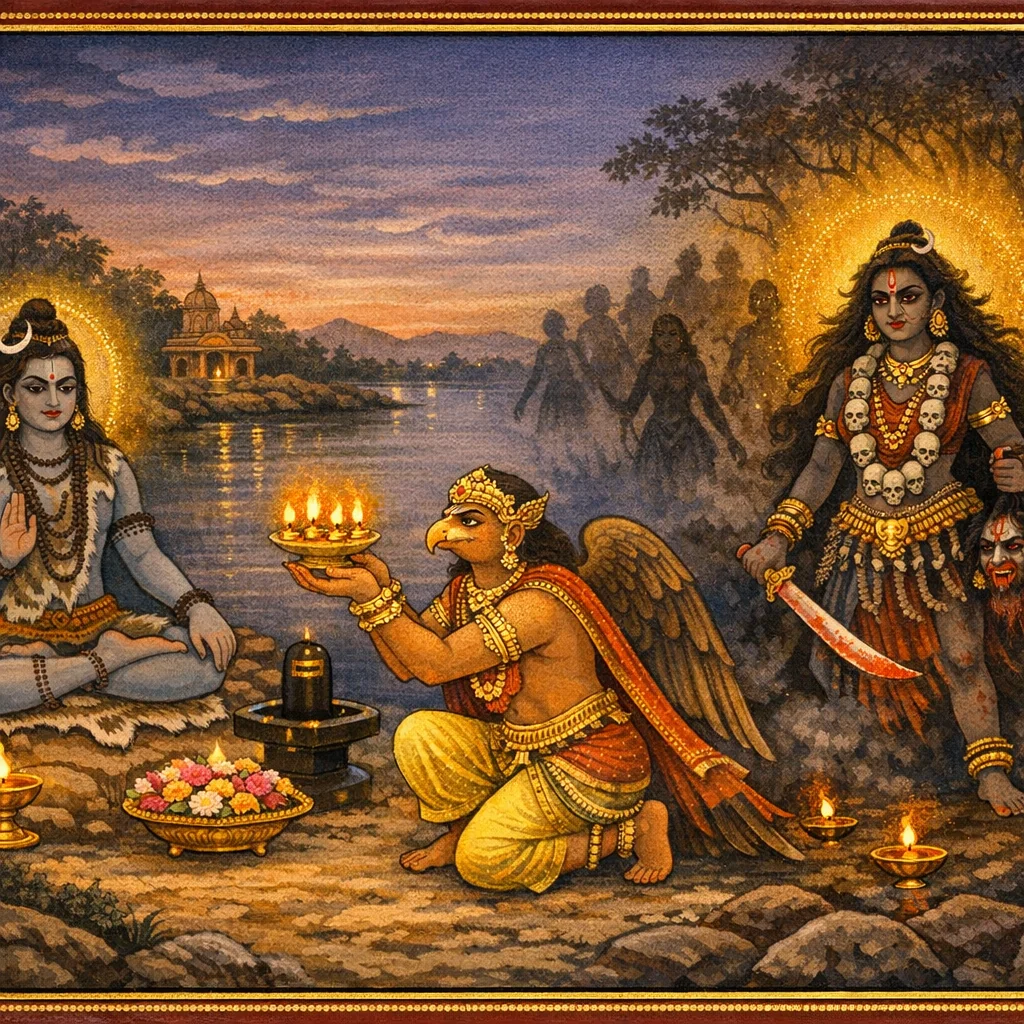
Mārkaṇḍeya recounts a tīrtha-centered episode: Garuḍa performs austerities and worship of Maheśvara (Śiva) at an eminent sacred site, whereupon Śiva appears and grants a boon dialogue. Garuḍa asks for two rare attainments—to become Viṣṇu’s vehicle and to gain lordship among birds. Śiva notes the doctrinal difficulty by invoking cosmic hierarchy (Nārāyaṇa as all-containing, Indra’s station as unique), yet grants a qualified fulfillment: Garuḍa will bear the Lord who holds conch, discus, and mace, and will be chief among birds. After Śiva departs, Garuḍa propitiates the fierce Devī Cāmuṇḍā, portrayed with cremation-ground imagery and yoginī associations, and offers an extended stuti. The praise also reveals her luminous protective identity as Kanakeśvarī, lauding her as Para-Śakti active in creation, preservation, and dissolution. Cāmuṇḍā grants Garuḍa invulnerability and victory over suras and asuras, and agrees to remain near the tīrtha. The chapter ends with tīrtha-phala: bathing and worship there yield sacrificial merit, yogic success, and an auspicious post-mortem destination accompanied by yoginī hosts.
Shlokas
Verse 1
श्रीमार्कण्डेय उवाच । ततो गच्छेन्महीपाल तीर्थं कनखलोत्तमम् । गरुडेन तपस्तप्तं पूजयित्वा महेश्वरम्
Śrī Mārkaṇḍeya said: Then, O king, one should go to the excellent Kanakhala Tīrtha, sanctified by the austerities performed by Garuḍa; there, having worshipped Maheśvara...
Verse 2
दिव्यं वर्षशतं यावज्जातमात्रेण भारत । तपोजपैः कृशीभूतो दृष्टो देवेन शम्भुना
O Bhārata, for a hundred divine years, from the very moment of his birth, he grew emaciated through austerity and japa, and was beheld by the god Śambhu (Śiva).
Verse 3
ततस्तुष्टो महादेवो वैनतेयं मनोजवम् । उवाच परमं वाक्यं विनतानन्दवर्धनम्
Then Mahādeva, pleased, spoke supreme words to Vainateya, swift as thought—words that increased the joy of Vinatā.
Verse 4
प्रसन्नस्ते महाभाग वरं वरय सुव्रत । दुर्लभं त्रिषु लोकेषु ददामि तव खेचर
Pleased with you, O fortunate one—choose a boon, O steadfast in vow. O sky-roamer, I shall grant you even that which is rare in all the three worlds.
Verse 5
गरुड उवाच । इच्छामि वाहनं विष्णोर्द्विजेन्द्रत्वं सुरेश्वर । प्रसन्ने त्वयि मे सर्वं भवत्विति मतिर्मम
Garuḍa said: O Lord of the gods, I desire to become the vehicle of Viṣṇu and to attain lordship among the twice-born. When you are pleased, everything becomes possible for me—such is my conviction.
Verse 6
श्रीमहेश उवाच । दुर्लभः प्राणिनां तात यो वरः प्रार्थितोऽनघ । देवदेवस्य वाहनं द्विजेन्द्रत्वं सुदुर्लभम्
Śrī Maheśa said: Dear one, O sinless being, the boon you have asked for is rare for embodied creatures. To be the mount of the God of gods, and to gain the rank of ‘chief among the twice-born’—this is exceedingly difficult to obtain.
Verse 7
नारायणोदरे सर्वं त्रैलोक्यं सचराचरम् । त्वया स कथमूह्येत देवदेवो जगद्गुरुः
Within Nārāyaṇa’s own being abides the entire threefold world, moving and unmoving. How then could you bear that God of gods—the Guru of the universe?
Verse 8
तेनैव स्थापितश्चेन्द्रस्त्रैलोक्ये सचराचरे । कथमन्यस्य चेन्द्रत्वं भवतीति सुदुर्लभम्
By him alone was Indra established over the three worlds, with all that moves and does not move. How could Indra-hood belong to another? Such a station is exceedingly rare.
Verse 9
तथापि मम वाक्येन वाहनं त्वं भविष्यसि । शङ्खचक्रगदापाणेर्वहतोऽपि जगत्त्रयम्
Yet, by my word, you shall indeed become the mount of him whose hands bear conch, discus, and mace—and who bears even the three worlds.
Verse 10
इन्द्रस्त्वं पक्षिणां मध्ये भविष्यसि न संशयः । इति दत्त्वा वरं तस्मा अन्तर्धानं गतो हरः
You shall be the Indra among birds—of this there is no doubt. Having thus granted that boon to him, Hara (Śiva) vanished from sight.
Verse 11
ततो गते महादेवे ह्युरुणस्यानुजो नृप । आराधयामास तदा चामुण्डां मुण्डमण्डिताम्
After Mahādeva had departed, O king, Aruṇa’s younger brother then began to worship Cāmuṇḍā, she who is adorned with skulls.
Verse 12
श्मशानवासिनीं देवीं बहुभूतसमन्विताम् । योगिनीं योगसंसिद्धां वसामांसासवप्रियाम्
He worshipped the Goddess who dwells in the cremation-ground, attended by many spirits— a Yoginī perfected in yoga, who delights in fat, flesh, and intoxicating drink.
Verse 13
ध्यातमात्रा तु तेनैव प्रत्यक्षा ह्यभवत्तदा । जालंधरे च या सिद्धिः कौलीने उड्डिशे परे
Merely by his meditation, she became manifest before him at once. That very siddhi famed in Jālandhara—in the Kaula tradition, in the supreme Uḍḍiśa—was then awakened and attained.
Verse 14
समग्रा सा भृगुक्षेत्रे सिद्धक्षेत्रे तु संस्थिता । चामुण्डा तत्र सा देवी सिद्धक्षेत्रे व्यवस्थिता
There, at Bhṛgukṣetra, she is present in the fullness of her power, truly established in Siddhakṣetra. That very Goddess, Cāmuṇḍā, abides there, firmly stationed in Siddhakṣetra.
Verse 15
संस्तुता ऋषिभिर्देवैर्योगक्षेमार्थसिद्धये । विनतानन्दजननस्तत्र तां योगिनीं नृप । भक्त्या प्रसादयामास स्तोत्रैर्वैदिकलौकिकैः
Praised by seers and gods for the attainment of welfare and protection, Vinatā’s joy-giving son (Garuḍa), O King, there propitiated that Yoginī with devotion—through hymns both Vedic and traditional.
Verse 16
गरुड उवाच । ॐ या सा क्षुत्क्षामकण्ठा नवरुधिरमुखा प्रेतपद्मासनस्था भूतानां वृन्दवृन्दैः पितृवननिलया क्रीडते शूलहस्ता । शस्त्रध्वस्तप्रवीरव्रजरुधिरगलन्मुण्डमालोत्तरीया देवी श्रीवीरमाता विमलशशिनिभा पातु वश्चर्ममुण्डा
Garuḍa said: Om. May Carmamuṇḍā protect you—she whose throat is parched with hunger, whose mouth is fresh with blood; who sits upon a lotus-seat of corpses; who sports amid multitudes of spirits, dwelling in the forest of the Pitṛs, bearing a trident in her hand; whose upper garment is a garland of skulls dripping with the blood of heroes slain by weapons—she, the Goddess, the auspicious Mother of heroes, shining like the stainless moon.
Verse 17
या सा क्षुत्क्षामकण्ठा विकृतभयकरी त्रासिनी दुष्कृतानां मुञ्चज्ज्वालाकलापैर्दशनकसमसैः खादति प्रेतमांसम् । या सा दोर्दण्डचण्डैर्डमरुरणरणाटोपटंकारघण्टैः कल्पान्तोत्पातवाताहतपटुपटहैर्वल्गते भूतमाता । क्षुत्क्षामा शुष्ककुक्षिः खवरतरनरवरैः क्षोदति प्रेतमांसं मुञ्चन्ती चाट्टहासं घुरघुरितरवा पातु वश्चर्ममुण्डा
May Carmamuṇḍā protect you—she whose throat is wasted by hunger, whose distorted, dreadful form terrifies the wicked; who, with teeth like blazing clusters of flame, devours the flesh of corpses. She, the Mother of bhūtas, with fierce arms and with the clangor of ḍamaru-drums and bells, roams amid the hard-beaten kettledrums struck by the storm-winds of cosmic dissolution. Hunger-worn, with a withered belly, she crushes corpse-flesh with the most dreadful beings; releasing peals of loud laughter and a rumbling roar—may Carmamuṇḍā protect you.
Verse 18
या सा निम्नोदराभा विकृतभवभयत्रासिनी शूलहस्ता चामुण्डा मुण्डघाता रणरणितरणझल्लरीनादरम्या । त्रैलोक्यं त्रासयन्ति ककहकहकहैर्घोररावैरनेकैर्नृत्यन्ती मातृमध्ये पितृवननिलया पातु वश्चर्ममुण्डा
May Carmamuṇḍā protect you—she of sunken-bellied form, who makes the fears of worldly existence tremble, trident in hand; Cāmuṇḍā, slayer of Muṇḍa, delighting in the ringing of battle-bells. With many dreadful cries of “kaka-haka-haka” she terrifies the three worlds; dancing amid the Mothers (Mātṛs) and dwelling in the forest of the Pitṛs—may Carmamuṇḍā protect you.
Verse 19
या धत्ते विश्वमखिलं निजांशेन महोज्ज्वला । कनकप्रसवे लीना पातु मां कनकेश्वरी
May Kanakeśvarī protect me—she, greatly resplendent, who upholds the entire universe by her own portion of power, and who is manifested and merged in Kanakaprasava.
Verse 20
हिमाद्रिसम्भवा देवी दयादर्शितविग्रहा । शिवप्रिया शिवे सक्ता पातु मां कनकेश्वरी
May Kanakeśvarī protect me—the Goddess born of Himādri, whose form is revealed through compassion; beloved of Śiva, and devoted to Śiva.
Verse 21
अनादिजगदादिर्या रत्नगर्भा वसुप्रिया । रथाङ्गपाणिना पद्मा पातु मां कनकेश्वरी
May Kanakeśvarī protect me—she who is beginningless and the origin of the world; rich with jewels, beloved of prosperity; the lotus-Goddess associated with the discus-bearing Lord (Viṣṇu).
Verse 22
सावित्री या च गायत्री मृडानी वागथेन्दिरा । स्मर्त्ःणां या सुखं दत्ते पातु मां कनकेश्वरी
May Kanakeśvarī protect me—she who is Sāvitrī and also Gāyatrī; who is Mṛḍānī, the goddess of speech and meaning, and Indirā; who grants happiness to those who remember her.
Verse 23
सौम्यासौम्यैः सदा रूपैः सृजत्यवति या जगत् । परा शक्तिः परा बुद्धिः पातु मां कनकेश्वरी
May Kanakeśvarī protect me—she who, through forms both gentle and fierce, ever creates and protects the world; she who is the supreme Power and the supreme Intelligence.
Verse 24
ब्रह्मणः सर्गसमये सृज्यशक्तिः परा तु या । जगन्माया जगद्धात्री पातु मां कनकेश्वरी
May Kanakeśvarī protect me—she who, at the time of Brahmā’s creation, is the supreme power of manifestation; the cosmic Māyā of the universe and the sustaining Mother of the worlds.
Verse 25
विश्वस्य पालने विष्णोर्या शक्तिः परिपालिका । मदनोन्मादिनी मुख्या पातु मां कनकेश्वरी
May Kanakeśvarī protect me—she who is Viṣṇu’s sustaining power in the guardianship of the universe, the foremost energy that can stir even the frenzy of desire (Madana).
Verse 26
विश्वसंलयने मुख्या या रुद्रेण समाश्रिता । रौद्री शक्तिः शिवानन्ता पातु मां कनकेश्वरी
May Kanakeśvarī protect me—she who is foremost at the dissolution of the universe, abiding with Rudra; the Raudrī power, auspicious and endless as Śiva.
Verse 27
कैलाससानुसंरूढ कनकप्रसवेशया । भस्मकाभिहृता पूर्वं पातु मां कनकेश्वरी
May Kanakeśvarī protect me—she who once dwelt upon the slopes of Kailāsa, abiding in the “Golden Source” (Kanaka-prasava), and who in former times was carried off by Bhasmaka.
Verse 28
पतिप्रभावमिच्छन्ती त्रस्यन्ती या विना पतिम् । अबला त्वेकभावा च पातु मां कनकेश्वरी
May Kanakeśvarī protect me—she who yearns for the majesty of her Lord, who trembles when without her husband; outwardly “helpless,” yet single-minded in devotion.
Verse 29
विश्वसंरक्षणे सक्ता रक्षिता कनकेन या । आ ब्रह्मस्तम्बजननी पातु मां कनकेश्वरी
May Kanakeśvarī protect me—she who is devoted to safeguarding the universe, who was protected by Kanaka, and who is the Mother of all, from Brahmā down to a mere blade of grass.
Verse 30
ब्रह्मविष्ण्वीश्वराः शक्त्या शरीरग्रहणं यया । प्रापिताः प्रथमा शक्तिः पातु मां कनकेश्वरी
May Kanakeśvarī protect me—by whose power Brahmā, Viṣṇu, and Īśvara obtain embodiment; she is the primordial, the first Śakti.
Verse 31
श्रुत्वा तु गरुडेनोक्तं देवीवृत्तचतुष्टयम् । प्रसन्ना संमुखी भूत्वा वाक्यमेतदुवाच ह
Having heard from Garuḍa the fourfold account of the Goddess, she became gracious; turning to face him, she spoke these words.
Verse 32
श्रीचामुण्डोवाच । प्रसन्ना ते महासत्त्व वरं वरय वाञ्छितम् । ददामि ते द्विजश्रेष्ठ यत्ते मनसि रोचते
Śrī Cāmuṇḍā said: “I am pleased with you, O great-souled one. Choose the boon you desire. O best of the twice-born, I grant you whatever delights your mind.”
Verse 33
गरुड उवाच । अजरश्चामरश्चैव अधृष्यश्च सुरासुरैः । तव प्रसादाच्चैवान्यैरजेयश्च भवाम्यहम्
Garuḍa said: “By your grace, may I be unaging and deathless, unassailable by gods and asuras; and by your favor, may I become unconquerable by all others as well.”
Verse 34
त्वया चात्र सदा देवि स्थातव्यं तीर्थसन्निधौ मार्कण्डेय उवाच । एवं भविष्यतीत्युक्त्वा देवी देवैरभिष्टुता
“And you, O Devī, should ever remain here, in the very presence of this sacred tīrtha.” Mārkaṇḍeya said: Having replied, “So shall it be,” the Goddess—praised by the gods—(accepted the charge).
Verse 35
जगामाकाशमाविश्य भूतसङ्घसमन्विता । यदा लक्ष्म्या नृपश्रेष्ठ स्थापितं पुरमुत्तमम्
Entering the sky, she departed, accompanied by hosts of beings. Then, O best of kings, when the splendid city had been established by Lakṣmī, (the account proceeds).
Verse 36
अनुमान्य तदा देवीं कृतं तस्यां समर्पितम् लक्ष्मीरुवाच । रक्षणाय मया देवि योगक्षेमार्थसिद्धये
Having then sought the Goddess’s consent, what had been prepared was dedicated to her. Lakṣmī said: “O Devī, for protection—so that yoga and kṣema, welfare and secure prosperity, may be accomplished—I have done this.”
Verse 37
मातृवत्प्रतिपाल्यं ते सदा देवि पुरं मम । गरुडोऽपि ततः स्नात्वा सम्पूज्य कनकेश्वरीम्
“O Goddess, always protect my city as a mother protects her child.” Then Garuḍa too, having bathed there, worshipped Kanakeśvarī with full reverence.
Verse 38
तीर्थं तत्रैव संस्थाप्य जगामाकाशमुत्तमम् । तत्र तीर्थे तु यः स्नात्वा पूजयेत्पितृदेवताः
Establishing the tīrtha right there, he went to the highest heavens. And whoever bathes at that very tīrtha and worships the deities of the ancestors (pitṛs)…
Verse 39
सर्वकामसमृद्धस्य यज्ञस्य फलमश्नुते । गन्धपुष्पादिभिर्यस्तु पूजयेत्कनकेश्वरम्
He attains the fruit of a sacrifice (yajña) fulfilled with all desired aims. And whoever worships Kanakeśvara with fragrances, flowers, and the like…
Verse 40
तस्य योगैश्वर्यसिद्धिर्योगपीठेषु जायते । मृतो योगेश्वरं लोकं जयशब्दादिमङ्गलैः । स गच्छेन्नात्र सन्देहो योगिनीगणसंयुतः
For him arises the attainment of yogic lordship (yogaiśvarya-siddhi) in the yoga-seats (yoga-pīṭhas). And when he dies, amid auspicious cries such as “Victory!”, he goes to the world of the Lord of Yoga; of this there is no doubt—accompanied by hosts of Yoginīs.
Verse 186
अध्याय
“Adhyāya” — a chapter marker indicating the division/colophon point in the manuscript tradition.