Adhyaya 34
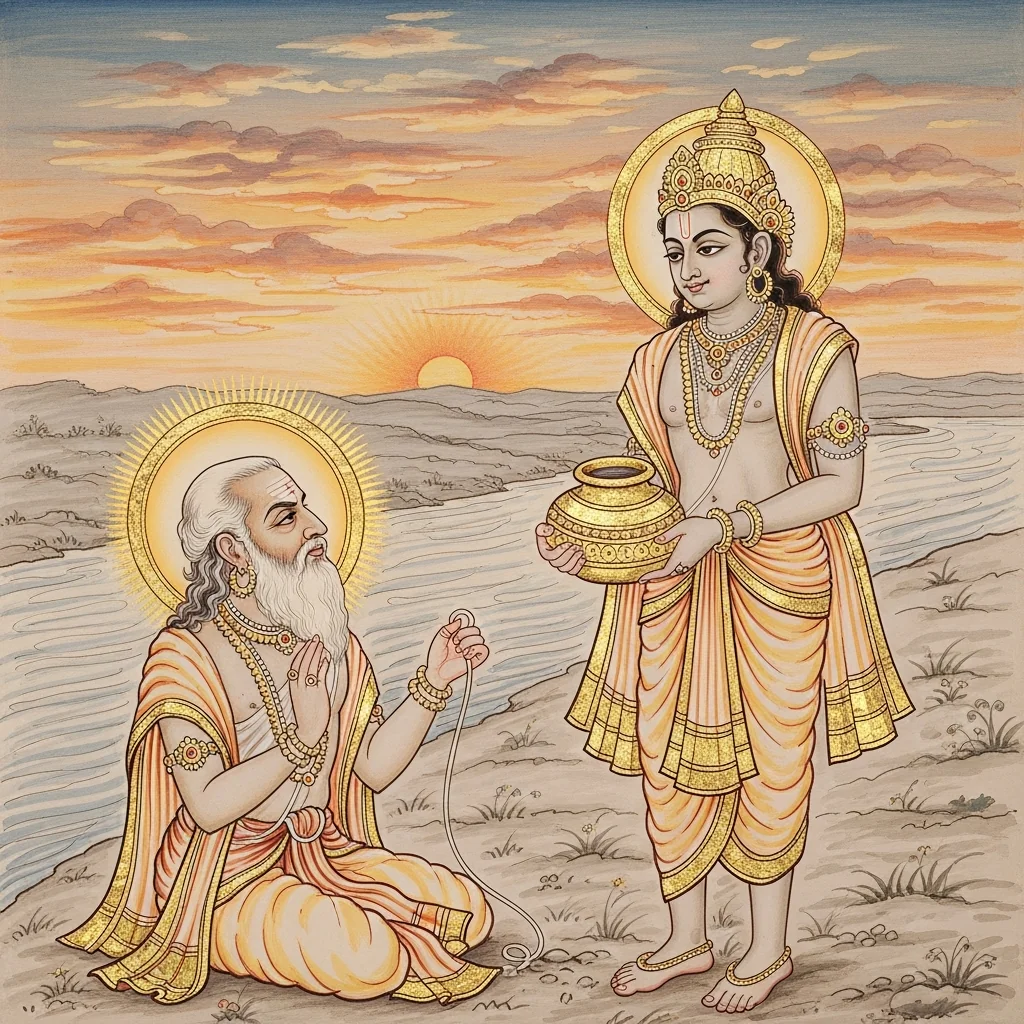
Chapter 34 unfolds as a dialogue in which Mārkaṇḍeya recounts another account of the great Āditya at a Narmadā riverbank tīrtha. Yudhiṣṭhira marvels, and Āditya is praised as all-pervading and as the savior of beings. A brāhmaṇa devotee of the Kulika lineage undertakes a severe pilgrimage-vow—traveling long without food and with only minimal water. The deity appears to him in a dream, instructs him to moderate the vow, and teaches the doctrine that the Divine pervades the moving and the unmoving world. Granted a boon, the devotee asks that Āditya abide permanently on the northern bank of the Narmadā, and that all who remember or worship him—even from afar—and those with bodily impairments receive compassion and benefit. The chapter then proclaims tīrtha-fruits: bathing and offerings yield merit like an Agniṣṭoma; certain end-of-life acts there lead to Agni-loka, Varuṇa-loka, or long honor in svarga; and daily remembrance of Bhāskara at dawn is said to remove sins accumulated through life.
Shlokas
Verse 1
श्रीमार्कण्डेय उवाच । तत्रैव तु भवेदन्यदादित्यस्य महात्मनः । कीर्तयामि नरश्रेष्ठ यदि ते श्रवणे मतिः
Śrī Mārkaṇḍeya said: “In that very region there is another sacred account concerning the great-souled Āditya, the Sun. I shall proclaim it, O best of men, if your mind is inclined to listen.”
Verse 2
युधिष्ठिर उवाच । एतदाश्चर्यमतुलं श्रुत्वा तव मुखोद्गतम् । विस्मयाद्धृष्टरोमाहं जातोऽस्मि मुनिसत्तम
Yudhiṣṭhira said: “Having heard this incomparable wonder spoken from your mouth, I am thrilled with amazement, O best of sages.”
Verse 3
सहस्रकिरणो देवो हर्ता कर्ता निरञ्जनः । अवतारेण लोकानामुद्धर्ता नर्मदातटे
The thousand-rayed God—pure, stainless, the taker and the maker—became, by an incarnation, the deliverer of the worlds upon the bank of the Narmadā.
Verse 4
पुरुषाकारो भगवानुताहो तपसः फलात् । कस्य गोत्रे समुत्पन्नः कस्य देवोऽभवद्वशी
Did the Blessed Lord assume a human form—perhaps as the fruit of austerity (tapas)? In whose lineage was he born, and by whom was that deity brought under devotion and control?
Verse 5
श्रीमार्कण्डेय उवाच । कुलिकान्वयसम्भूतो ब्राह्मणो भक्तिमाञ्छुचिः । ईक्ष्यामीति रविं तत्र तीर्थे यात्राकृतोद्यमः
Śrī Mārkaṇḍeya said: “A pure brāhmaṇa, filled with bhakti, born in the Kulikā lineage, resolved, ‘I shall behold Ravi (the Sun),’ and at that tīrtha he set himself earnestly to pilgrimage.”
Verse 6
योजनानां शतं साग्रं निराहारो गतोदकः । प्रस्थितो देवदेवेन स्वप्नान्ते वारितः किल
He set out for a hundred yojanas and more, without food and with his water exhausted; yet, it is said, at the end of a dream he was restrained and redirected by the God of gods.
Verse 7
भोभो मुने महासत्त्व अलं ते व्रतमीदृशम् । सर्वं व्याप्य स्थितं पश्य स्थावरं जङ्गमं च माम्
“O sage, great-souled one—enough of such austerity. Behold Me: I pervade all and stand within everything, in the immovable and the moving alike.”
Verse 8
तपाम्यहं ततो वर्षं निगृह्णाम्युत्सृजामि च । न मृ तं चैव मृत्युं च यः पश्यति स पश्यति
“I blaze forth as heat, and then I become the rain; I withhold it and I release it as well. He who sees Me truly sees—seeing neither death nor the dead as separate from Me.”
Verse 9
वरं वरय भद्रं त्वमात्मनो यस्तवेप्सितम्
“Choose a boon—may it be auspicious for you—whatever you desire for yourself.”
Verse 10
ब्राह्मण उवाच । यदि तुष्टोऽसि मे देव देयो यदि वरो मम । उत्तरे नर्मदाकूले सदा संनिहितो भव
The brāhmaṇa said: If you are pleased with me, O Lord, and if a boon is to be granted to me—then abide always, ever present, on the northern bank of the Narmadā.
Verse 11
ये भक्त्या परया देव योजनानां शते स्थिताः । स्मरिष्यन्ति जितात्मानस्तेषां त्वं वरदो भव
O Lord, even those who dwell a hundred yojanas away—if they remember you with supreme devotion, self-controlled—be for them a giver of boons.
Verse 12
कुब्जान्धबधिरा मूका ये केचिद्विकलेन्द्रियाः । तव पादौ नमस्यन्ति तेषां त्वं वरदो भव
Those who are hunchbacked, blind, deaf, mute—any whose senses are impaired—if they bow to your feet, be a giver of boons to them.
Verse 13
शीर्णघ्राणा गतधियो ह्यस्थिचर्मावशेषिताः । तेषां त्वं करुणां देव अचिरेण कुरुष्व ह
Even those whose senses have decayed, whose minds are failing, who are reduced to mere bone and skin—show them compassion, O Lord, and do so swiftly.
Verse 14
येऽपि त्वां नर्मदातोये स्नात्वा तत्र दिने दिने । अर्चयन्ति जगन्नाथ तेषां त्वं वरदो भव
And those who, bathing day after day in the waters of the Narmadā, worship you there—O Jagannātha, Lord of the world—be a giver of boons to them.
Verse 15
प्रभाते ये स्तविष्यन्ति स्तवैर्वैदिकलौकिकैः । अभिप्रेतं वरं देव तेषां त्वं दद भोच्युत
Those who at dawn praise You with hymns—Vedic and worldly alike—grant them, O Lord, the boon they desire, O Acyuta.
Verse 16
तवाग्रे वपनं देव कारयन्ति नरा भुवि । स्वामिंस्तेषां वरो देय एष मे परमो वरः
O Lord, those men on earth who have their tonsure performed before You—O Master—let a boon be granted to them. This is my highest boon.
Verse 17
एवमस्त्विति तं चोक्त्वा मुनिं करुणया पुनः । शतभागेन राजेन्द्र स्थित्वा चादर्शनं गतः
Saying, “So be it,” and addressing the sage again with compassion, O king, he remained there for only a hundredth part (of the time) and then vanished from sight.
Verse 18
तत्र तीर्थे नरो भक्त्या गत्वा स्नानं समाचरेत् । तर्पयेत्पितृदेवांश्च सोऽग्निष्टोमफलं लभेत्
At that sacred ford, a person should go with devotion and perform ritual bathing, and offer libations to the ancestors and the gods; thus he gains the fruit of the Agniṣṭoma sacrifice.
Verse 19
अग्निप्रवेशं यः कुर्यात्तस्मिंस्तीर्थे नराधिप । द्योतयन्वै दिशः सर्वा अग्निलोकं स गच्छति
Whoever enters fire at that sacred ford, O lord of men—illumining all the directions—he goes to the world of Agni.
Verse 20
यस्तत्तीर्थं समासाद्य त्यजतीह कलेवरम् । स गतो वारुणं लोकमित्येवं शङ्करोऽब्रवीत्
Whoever reaches that sacred ford and lays down the body there, goes to Varuṇa’s world. Thus spoke Śaṅkara.
Verse 21
तत्र तीर्थे तु यः कश्चित्संन्यासेन तनुं त्यजेत् । षष्टिवर्षसहस्राणि स्वर्गलोके महीयते
But at that sacred ford, whoever—having embraced renunciation (saṃnyāsa)—gives up the body there is honored in heaven for sixty thousand years.
Verse 22
अप्सरोगणसंकीर्णे दिव्यशब्दानुनादिते । उषित्वायाति मर्त्ये वै वेदवेदाङ्गविद्भवेत्
After dwelling there amid hosts of apsarases and the reverberation of celestial sounds, he indeed returns to the mortal world and becomes a knower of the Vedas and their Vedāṅgas.
Verse 23
व्याधिशोकविनिर्मुक्तो धनकोटिपतिर्भवेत् । पुत्रदारसमोपेतो जीवेच्च शरदः शतम्
Freed from disease and sorrow, he becomes lord of wealth in many crores; endowed with sons and wife, he lives a hundred autumns—a full century.
Verse 24
प्रातरुत्थाय यस्तत्र स्मरते भास्करं तदा । आजन्मजनितात्पापान्मुच्यते नात्र संशयः
Whoever rises there at dawn and then remembers Bhāskara, the Sun, is freed from sins accumulated from birth—of this there is no doubt.
Verse 34
। अध्याय
“Chapter.” (A closing/section marker.)