Adhyaya 209
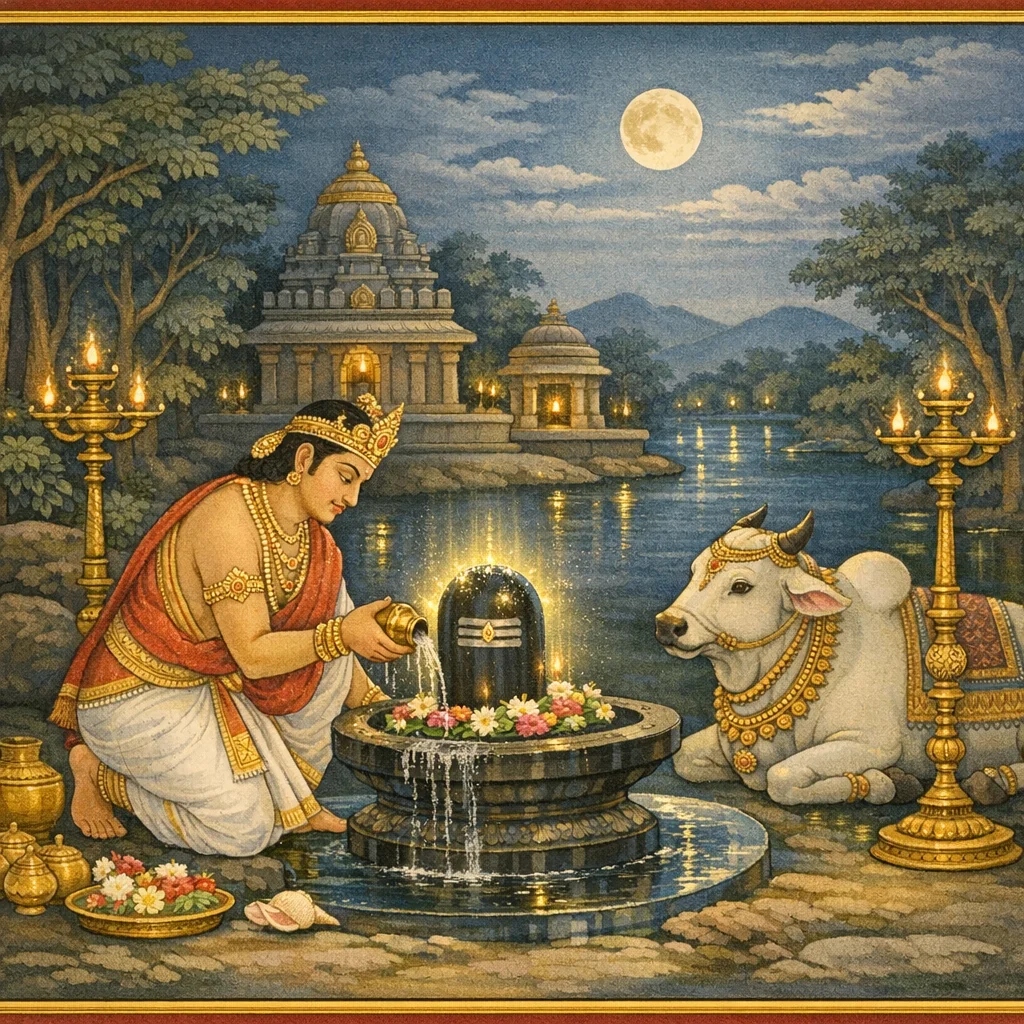
Mārkaṇḍeya points out successive tīrthas on the Revā (Narmadā), including Puṣkalī and Kṣamānātha, and then recounts the origin of the Bhārabhūti tīrtha, where Śiva abides as Rudra-Maheśvara. Yudhiṣṭhira asks why it is called “Bhārabhūti.” In the first exemplum, the virtuous brāhmaṇa Viṣṇuśarman lives by ethical discipline and austere simplicity. Mahādeva comes in the form of a student (baṭu) to study with him; a quarrel with other students over food preparation leads to a wager. Śiva manifests abundant food, and later, at the river, enacts the wager: the students are thrown into the Narmadā with a “burden” (bhāra), but Śiva rescues them, establishes a liṅga known as Bhārabhūti, and removes the brāhmaṇa’s fear of sin. The second exemplum tells of a merchant who betrays and murders a trusting friend; after death he endures harsh punishments and many transmigrations, finally becoming a burden-bearing ox in the household of a righteous king. During Kārttika/Śivarātri at Bhāreśvara, the king performs snāna, offerings, fourfold liṅga “filling” (pūraṇa) through the night-watches, dāna (gold, sesame, cloth, cow-gift), and jāgaraṇa; the ox is purified and ascends. The chapter ends with phala: bathing and observance at Bhārabhūti destroy even great sins; even a small gift yields imperishable merit; death at the tīrtha grants uninterrupted Śiva-loka, or an auspicious rebirth that leads again to liberation.
Shlokas
Verse 1
श्रीमार्कण्डेय उवाच । तस्यैवानन्तरं पार्थ पुष्कलीतीर्थमुत्तमम् । तत्र तीर्थे नरः स्नात्वा ह्यश्वमेधफलं लभेत्
Śrī Mārkaṇḍeya said: Immediately after that, O Pārtha, there is the excellent Puṣkalī Tīrtha. A man who bathes at that sacred ford indeed obtains the fruit of the Aśvamedha sacrifice.
Verse 2
क्षमानाथं ततो गच्छेत्तीर्थं त्रैलोक्यविश्रुतम् । दानवगन्धर्वैरप्सरोभिश्च सेवितम्
From there one should proceed to the sacred ford called Kṣamānātha—renowned throughout the three worlds—revered and frequented even by Dānavas, Gandharvas, and Apsarases.
Verse 3
तत्र तिष्ठति देवेशः साक्षाद्रुद्रो महेश्वरः । भारेण महता जातो भारभूतिरिति स्मृतः
There abides the Lord of gods—Maheśvara, Rudra himself in visible presence. By reason of a mighty ‘burden’ (bhāra) he became known and remembered as Bhārabhūti.
Verse 4
युधिष्ठिर उवाच । भारभूतीति विख्यातं तीर्थं सर्वगुणान्वितम् । श्रोतुमिच्छामि विप्रेन्द्र परं कौतूहलं हि मे
Yudhiṣṭhira said: ‘O best of brahmins, I wish to hear about that sacred place famed as Bhārabhūti, endowed with every excellence—for my curiosity is great.’
Verse 5
श्रीमार्कण्डेय उवाच । भारभूतिसमुत्पत्तिं शृणु पाण्डवसत्तम । विस्तरेण यथा प्रोक्ता पुरा देवेन शम्भुना
Śrī Mārkaṇḍeya said: “O best of the Pāṇḍavas, listen to the origin of Bhārabhūti, just as it was once explained in full detail by the god Śambhu himself.”
Verse 6
आसीत्कृतयुगे विप्रो वेदवेदाङ्गपारगः । विष्णुशर्मेति विख्यातः सर्वशास्त्रार्थपारगः
In the Kṛta Yuga there lived a brāhmaṇa, perfected in the Vedas and the Vedāṅgas, famed as Viṣṇuśarman, and fully versed in the meanings of all śāstras.
Verse 7
क्षमा दमो दया दानं सत्यं शौचं धृतिस्तथा । विद्या विज्ञानमास्तिक्यं सर्वं तस्मिन्प्रतिष्ठितम्
Forbearance, self-restraint, compassion, charity, truthfulness, purity, and steadfastness—along with learning, discernment, and faith—were all firmly established in him.
Verse 8
ईदृग्गुणा हि ये विप्रा भवन्ति नृपसत्तम । पतितान्नरके घोरे तारयन्ति पित्ःंस्तु ते
O best of kings, brāhmaṇas endowed with such virtues truly deliver even their forefathers who have fallen into dreadful hells.
Verse 9
इन्द्रियं लोलुपा विप्रा ये भवन्ति नृपोत्तम । पतन्ति नरके घोरे रौरवे पापमोहिताः
O best of kings, those brāhmaṇas who are greedy for sense-pleasures, deluded by sin, fall into the dreadful hell called Raurava.
Verse 10
ये क्षान्तदान्ताः श्रुतिपूर्णकर्णा जितेन्द्रियाः प्राणिवधान्निवृत्ताः । प्रतिग्रहे संकुचिताग्रहस्तास्ते ब्राह्मणास्तारयितुं समर्थाः
Those brāhmaṇas who are forbearing and self-restrained, whose ears are filled with śruti, who have conquered the senses, who refrain from harming living beings, and whose hands are held back from accepting gifts—such brāhmaṇas are able to carry others across.
Verse 11
एवं गुणगणाकीर्णो ब्राह्मणो नर्मदातटे । वसते ब्राह्मणैः सार्धं शिलोञ्छवृत्तिजीवनः
Thus, filled with a multitude of virtues, that brāhmaṇa dwelt on the bank of the Narmadā, living together with other brāhmaṇas and sustaining himself by the śiloñcha mode of livelihood.
Verse 12
तादृशं ब्राह्मणं ज्ञात्वा देवदेवो महेश्वरः । द्विजरूपधरो भूत्वा तस्याश्रममगात्स्वयम्
Knowing the brāhmaṇa to be of such a kind, Maheśvara—the God of gods—himself assumed the form of a twice-born and went to that sage’s hermitage.
Verse 13
दृष्ट्वा तं ब्राह्मणैः सार्धमुच्चरन्तं पदक्रमम् । अभिवादयते विप्रं स्वागतेन च पूजितः
Seeing him, accompanied by brāhmaṇas and reciting the padas in measured sequence, the brāhmaṇa greeted the visitor; and the guest was honored with a fitting welcome.
Verse 14
प्रोवाच तं मुहूर्तेन ब्राह्मणो विस्मयान्वितः । किमथ तद्बटो ब्रूहि किं करोमि तवेप्सितम्
After a moment, the brāhmaṇa, filled with wonder, said to him: “For what purpose have you come, young brahmacārin? Tell me—what desired service shall I do for you?”
Verse 15
बटुरुवाच । विद्यार्थिनमनुप्राप्तं विद्धि मां द्विजसत्तम । ददासि यदि मे विद्यां ततः स्थास्यामि ते गृहे
The student said: “Know me, O best of the twice-born, as one who has come seeking knowledge. If you grant me vidyā, then I shall dwell in your house.”
Verse 16
ब्राह्मण उवाच । सर्वेषामेव विप्राणां बटो त्वं गोत्र उत्तमे । दानानां परमं दानं कथं विद्या च दीयते
The Brāhmaṇa said: “O student of noble lineage, among all Brāhmaṇas, knowledge is the highest gift. How, indeed, is such vidyā to be bestowed?”
Verse 17
गुरुशुश्रूषया विद्या पुष्कलेन धनेन वा । अथवा विद्यया विद्या भवतीह फलप्रदा
Vidyā is gained by devoted service to the guru, or else by abundant wealth; or again, vidyā may be attained through vidyā itself—thus, in this world, it becomes fruitful.
Verse 18
बटुरुवाच । यथान्ये बालकाः स्नाताः शुश्रूषन्ति ह्यहर्निशम् । तथाहं बटुभिः सार्धं शुश्रूषामि न संशयः
The student said: “Just as other young pupils, having completed their daily rites, serve day and night, so too shall I, along with the other disciples, serve without doubt.”
Verse 19
तथेति चोक्त्वा विप्रेन्द्रः पाठयंस्तं दिने दिने । वर्तते सह शिष्यैः स शिलोञ्छानुपहारयन्
Saying, “So be it,” the chief of the Brāhmaṇas taught him day after day; and he lived there with the disciples, bringing gleaned grains as offerings.
Verse 20
ततः कतिपयाहोभिः प्रोक्तो बटुभिरीश्वरः । पचनाद्यं बटो कर्म कुरु क्रमत आगतम्
Then, after some days, the students addressed the Lord: “O young brahmacārin, perform the duties beginning with cooking, in the proper order as they arise.”
Verse 21
तथेति चोक्तो देवेशो भारग्राममुपागतः । ध्यात्वा वनस्पतीः सर्वा इदं वचनमब्रवीत्
Thus instructed, the Lord of the gods went to the place called Bhāragrāma. Meditating upon all the forest trees, he spoke these words.
Verse 22
यावदागच्छते विप्रो बटुभिः सह मन्दिरम् । अदर्शनाभिः कर्तव्यं तावदन्नं सुसंस्कृतम्
“Until the brāhmaṇa arrives at the shrine together with the young students, remain out of sight; meanwhile, prepare food well-cooked and properly seasoned.”
Verse 23
एवमुक्त्वा तु ताः सर्वा विश्वरूपो महेश्वरः । क्रीडनार्थं गतस्तत्र बटुवेषधरः पृथक्
Having spoken thus to all of them, Maheśvara—of universal form—went there separately, adopting the guise of a young brahmacārin for the sake of divine sport.
Verse 24
दृष्ट्वा समागतं तत्र बटुवेषधरं पृथक् । धिक्त्वां च परुषं वाक्यमूचुस्ते गिरिसन्निधौ
Seeing one who had come there separately, dressed as a young student, they spoke harshly—“Shame on you!”—in the presence of the mountain.
Verse 25
क्षुत्क्षामकंठाः सर्वे च गत्वा तु किल मन्दिरम् । त्वया सिद्धेन चान्नेन तृप्तिं यास्यामहे वयम्
All of us are famished, our throats parched with thirst. Truly we went to the shrine; we were to be satisfied by the food you had cooked and made ready.
Verse 26
तद्वृथा चिन्तितं सव त्वयागत्य कृतं द्विज । मिथ्याप्रतिज्ञेन सता दुरनुष्ठितमद्य ते
All that planning has been in vain, brāhmaṇa, because of your coming. With a false promise, you have acted badly today.
Verse 27
बटुरुवाच । सन्तापमनुतापं वा भोजनार्थं द्विजर्षभाः । मा कुरुध्वं यथान्यायं सिद्धेऽग्रे गृहमेष्यथा
The baṭu said: “O best of brāhmaṇas, do not feel distress or regret over food. When it is properly ready, you shall come to the house in due order.”
Verse 28
बटुरुवाच । दिनशेषेण चास्माकं पञ्चतां च दिने दिने । निष्पत्तिं याति वा नेति तदसिद्धमशेषतः
The baṭu said: “With the little remainder of the day, and with our very lives uncertain from day to day, whether the matter will be accomplished or not is wholly uncertain.”
Verse 29
असिद्धं सिद्धमस्माकं यत्त्वया समुदाहृतम् । दृष्ट्वानृतं गतास्तत्र त्वां बद्धाम्भसि निक्षिपे
You proclaimed to us that the unprepared was prepared. If, upon going there, we find it false, I will bind you and throw you into the water.
Verse 30
बटुरुवाच । भोभोः शृणुध्व सर्वेऽत्र सोपाध्याया द्विजोत्तमाः । प्रतिज्ञां मम दुर्धर्षां यां श्रुत्वा विस्मयो भवेत्
The baṭu said: “Listen, all of you here, together with your teachers, O best of brāhmaṇas. Hear my formidable, unassailable vow; on hearing it, one would be astonished.”
Verse 31
यदि सिद्धमिदं सर्वमन्नं स्यादाश्रमे गुरोः । यूयं बद्ध्वा मया सर्वे क्षेप्तव्या नर्मदाम्भसि
“If all this food is indeed ready in my teacher’s āśrama, then I shall bind all of you and cast you into the waters of the Narmadā.”
Verse 32
अथवान्नं न सिद्धं स्याद्भवद्भिर्दृढबन्धनैः । गुरोस्तु पश्यतो बद्ध्वा क्षेप्तव्योऽहं नर्मदाह्रदे
“Otherwise, if the food is not accomplished, then you must bind me tightly with firm bonds and—while the guru looks on—cast me into the pool of the Narmadā.”
Verse 33
तथेति कृत्वा ते सर्वे समयं गुरुसन्निधौ । स्नात्वा जाप्यविधानेन भूतग्रामं ततो ययुः
Agreeing, “So be it,” they all confirmed the pact in the guru’s presence; then, after bathing and performing japa according to rule, they proceeded to the place called Bhūtagrāma.
Verse 34
दृष्ट्वा ते विस्मयं जग्मुर्विस्तृते भक्ष्यभोजने । षड्रसेन नृपश्रेष्ठ भुक्त्वा हुत्वा पृथक्पृथक्
O best of kings, seeing the lavish spread of foods and dishes, they were filled with wonder; then, after eating the meal endowed with the six tastes, each of them separately performed oblations.
Verse 35
ततः प्रोवाच वचनं हृष्टपुष्टो द्विजोत्तमः । वरदोऽस्मि वरं वत्स वृणु यत्तव रोचते
Then the foremost of brāhmaṇas, delighted and full of vigor, spoke: “I am a giver of boons, dear child; choose a boon—whatever pleases you.”
Verse 36
साङ्गोपाङ्गास्तु ते वेदाः शास्त्राणि विविधानि च । प्रतिभास्यन्ति ते विप्र मदीयोऽस्तु वरस्त्वयम्
“The Vedas with their limbs and auxiliaries, and the many branches of śāstra, will shine forth in your understanding, O brāhmaṇa—this is the boon I grant you.”
Verse 37
प्रणम्य बटुभिः सार्धं स चिक्रीड यथासुखम् । द्वितीये तु ततः प्राप्ते दिवसे नर्मदाजले
Having bowed, and together with the young students, he sported at ease; then, when the second day arrived, in the waters of the Narmadā…
Verse 38
क्रीडनार्थं गताः सर्वे सोपाध्याया युधिष्ठिर । ततः स्मृत्वा पणं सर्वे भाषयित्वा विधानतः
O Yudhiṣṭhira, all of them went out to play together with their teacher. Then, remembering the wager, they all restated it properly, in the prescribed manner.
Verse 39
उपाध्यायमथोवाच नत्वा देवः कृताञ्जलिः । जले प्रक्षेपयाम्यद्य निष्प्रतिज्ञान् बटून् प्रभो
Then Deva, having bowed to the teacher with folded hands, said: “Lord, today I shall cast into the water those students who have become faithless to their pledge.”
Verse 40
तद्देवस्य वचः श्रुत्वा नष्टास्ते बटवो नृप । गुरोस्तु पश्यतो राजन्धावमाना दिशो दश
O king, hearing Deva’s words, those young students vanished; and while the guru looked on, O ruler, they ran off into all the ten directions.
Verse 41
वायुवेगेन देवेन लुञ्जितास्ते समन्ततः । भारं बद्ध्वा तु सर्वेषां बटूनां च नरेश्वर
O lord of men, driven by Deva with the speed of the wind, they were seized from every side; and then a burden was bound upon all those young students.
Verse 42
शापानुग्रहको देवोऽक्षिपत्तोये यथा गृहे । ततो विषादमगमद्दृष्ट्वा तान्नर्मदाजले
That God—who both chastises and bestows grace—cast them into the water as one might cast something into a house; then, seeing them in the waters of the Narmadā, he was overcome with sorrow.
Verse 43
गुरुणा बटुरुक्तोऽथ किमेतत्साहसं कृतम् । एतेषां मातृपितरो बालकानां गृहेऽङ्गनाः
Then the young student said to his teacher: “What rash deed is this that has been done? The mothers and fathers of these children are at home, with the women of the household.”
Verse 44
यदि पृच्छन्ति ते बालान् क्व गतान् कथयाम्यहम् । एवं स्थिते महाभाग यदि कश्चिन्मरिष्यति
“If they ask about the boys—‘Where have they gone?’—what shall I tell them? In such a situation, O greatly fortunate one, if someone should die…”
Verse 45
तदा स्वकीयजीवेन त्वं योजयितुमर्हसि । मृतेषु तेषु विप्रेषु न जीवे निश्चयो मृतः
Then you ought to restore them with your own life. If those brāhmaṇa boys die, I am certain I will not go on living—I will die.
Verse 46
ब्रह्महत्याश्च ते बह्व्यो भविष्यन्ति मृते मयि । द्विजबन्धनमात्रेण नरको भवति ध्रुवम्
If I die, many brahmahatyā-sins will be yours. For merely binding a twice-born (brāhmaṇa), hell surely results.
Verse 47
मरणाद्यां गतिं यासि न तां वेद्मि द्विजाधम । एवमुक्तः स्मितं कृत्वा देवदेवो महेश्वरः
What course you will meet beginning with death—I do not know, O worst of the twice-born! Thus addressed, Maheśvara, the God of gods, smiled.
Verse 48
भारभूतेश्वरे तीर्थ उज्जहार जलाद्द्विजान् । मुक्त्वा भारं तु देवेन छादयित्वा तु तान्द्विजान्
At the Bhārabhūteśvara tīrtha, he lifted the twice-born (boys) up from the water. Having removed the burden, the God then covered those brāhmaṇas (protected them).
Verse 49
लिङ्गं प्रतिष्ठितं तत्र भारभूतेति विश्रुतम् । मृतांस्तान् वै द्विजान् दृष्ट्वा ब्रह्महत्या निराकृता
A liṅga was established there, renowned as ‘Bhārabhūta’. Seeing those brāhmaṇas (as if) dead, the sin of brahmahatyā was driven away (nullified).
Verse 50
गतानि पञ्च वै दृष्ट्वा ब्रह्महत्याशतानि वै । ततः स विस्मयाविष्टो दृष्ट्वा तान्बालकान् गुरुः
Seeing that five hundred sins of brahmahatyā had departed, the teacher, beholding those boys, was seized with wonder.
Verse 51
नान्यस्य कस्यचिच्छक्तिरेवं स्यादीश्वरं विना । ज्ञात्वा तं देवदेवेशं प्रणाममकरोद्द्विजः
“No one else has such power—nothing like this is possible without Īśvara.” Knowing him to be the Lord of the gods, the brāhmaṇa bowed down in reverence.
Verse 52
अज्ञानेन मया सव यदुक्तं परमेश्वर । अप्रियं यत्कृतं सर्वं क्षन्तव्यं तन्मम प्रभो
O Parameśvara, whatever I have spoken in ignorance, and whatever displeasing act I have done—O Lord—may all that be forgiven by you.
Verse 53
देव उवाच । भगवन्गुरुर्भवान्देवो भवान्मम पितामहः । वेदगर्भ नमस्तेऽस्तु नास्ति कश्चिद्व्यतिक्रमः
The Deva said: O Blessed One, you are my guru; you are my deity; you are my grandfather. O Vedagarbha, womb of the Vedas, salutations to you—there can be no transgression of your authority.
Verse 54
जनिता चोपनेता च यस्तु विद्यां प्रयच्छति । अन्नदाता भयत्राता पञ्चैते पितरः स्मृताः
The begetter, the initiator who confers upanayana, the one who imparts knowledge, the giver of food, and the protector from fear—these five are remembered as ‘fathers’.
Verse 55
एवमुक्त्वा जगन्नाथो विष्णुशर्माणमानतः । तत्र तीर्थे जगामाशु कैलासं धरणीधरम्
Thus having spoken, Jagannātha—after bowing to Viṣṇuśarmā—swiftly departed from that sacred ford and went to Kailāsa, the mountain that upholds the earth.
Verse 56
तदाप्रभृति तत्तीर्थं भारभूतीति विश्रुतम् । विख्यातं सर्वलोकेषु महापातकनाशनम्
From that time onward, that tīrtha became renowned as “Bhārabhūti”; in all worlds it is celebrated as the destroyer of great sins.
Verse 57
तत्र तीर्थे पुनर्वृत्तमितिहासं ब्रवीमि ते । सर्वपापहरं दिव्यमेकाग्रस्त्वं शृणुष्व तत्
Concerning that tīrtha, I shall tell you an ancient account that later occurred there again. It is divine and removes all sins—listen with one-pointed attention.
Verse 58
पुरा कृतयुगस्यादौ वैश्यः कश्चिन्महामनाः । सुकेश इति विख्यातस्तस्य पुत्रोऽतिधार्मिकः
Long ago, at the beginning of the Kṛtayuga, there lived a noble-minded vaiśya named Sukeśa. His son was exceedingly righteous.
Verse 59
सोमशर्मेति विख्यातो मृतः पृथुललोचनः । स सखायं वणिक्पुत्रं कंचिच्चक्रे दरिद्रिणम्
He was known as Somaśarman, and in time, O wide-eyed one, he died. He had made a certain merchant’s son—fallen into poverty—his friend.
Verse 60
सुदेवमिति ख्यातं सर्वकर्मसु कोविदम् । एकदा तु समं तेन व्यवहारमचिन्तयत्
He was renowned as Sudeva, skilled in every kind of work. Once, he devised with him a joint venture in trade.
Verse 61
सखे समुद्रयानेन गच्छावोत्तरणैः शुभैः । भाण्डं बहु समादाय मदीये द्रव्यसाधने
“Friend, let us journey by sea to auspicious ports and crossings. Taking abundant merchandise, we shall seek wealth upon my capital.”
Verse 62
परं तीरं गमिष्याव उत्कर्षस्त्वावयोः समः । इति तौ मन्त्रयित्वा तु मन्त्रवत्समभीप्सितम्
“Let us go to the farther shore; the gain shall be equal for us both.” Thus having conferred, the two set their minds—like men acting by a settled plan—upon the desired undertaking.
Verse 63
सर्वं प्रयाणकं गृह्य ह्यारूढौ लवणोदधिम् । तौ गत्वा तु परं भाण्डं विक्रीय पुरतस्तदा
Taking all provisions for the journey, the two boarded the salt ocean. Reaching the farther land, they then sold their merchandise in the city before them.
Verse 64
प्राप्तौ बहु सुवर्णं च रत्नानि विविधानि च । नावं तां संगतां कृत्वा पश्चात्तावारुरोहतुः
They obtained much gold and jewels of many kinds. Then, having made the ship ready and fully fitted out, the two boarded it again for the return.
Verse 65
नावमन्तर्जले दृष्ट्वा निशीथे स्वर्णसंभृताम् । दृष्ट्वा तु सोमशर्माणमुत्सङ्गे कृतमस्तकम्
Seeing the boat in mid-water at midnight, laden with gold, and seeing Somaśarmā lying with his head resting in one’s lap,
Verse 66
शयानमतिविश्वस्तं सहदेवो व्यचिन्तयत् । एष निद्रावशं यातो मयि प्राणान्निधाय वै
Sahadeva, seeing him asleep and utterly trusting, thought: “He has fallen under the power of sleep, having indeed entrusted his very life to me.”
Verse 67
अस्याधीनमिदं सर्वं द्रव्यरत्नमशेषतः । उत्कर्षार्द्धं तु मे दद्यात्तत्र गत्वेति वा न वा
“All this wealth and all these jewels, without remainder, are under his control. Will he truly give me half the profit after we reach there—or will he not?”
Verse 68
इति निश्चित्य मनसा पापस्तं लवणोदधौ । चिक्षेप सोमशर्माणं पापध्यातेन चेतसा
Having decided thus in his mind, the sinner hurled Somaśarmā into the salt-ocean, with a mind darkened by wicked intent.
Verse 69
उत्तीर्य तरणात्तस्माद्गत्वा संगृह्य तद्धनम् । ततः कतिपयाहोभिः संयुक्तः कालधर्मणा
Crossing over from that boat, he went and gathered up that wealth. Then, after only a few days, he met what time ordains—the inevitable law of death.
Verse 70
गतो यमपुरं घोरं गृहीतो यमकिंकरैः । स नीतस्तेन मार्गेण यत्र संतपते रविः
He went to the dreadful city of Yama, seized by Yama’s servants. He was led along that path where the sun burns with tormenting heat.
Verse 71
कृत्वा द्वादशधात्मानं सम्प्राप्ते प्रलये यथा । सुतीक्ष्णाः कण्टका यत्र यत्र श्वानः सुदारुणाः
As though his very being were split into twelve parts, as at the coming of dissolution, he entered regions where razor-sharp thorns abound, and where fierce, terrifying dogs are found at every turn.
Verse 72
तीक्ष्णदंष्ट्रा महाव्याला व्याघ्रा यत्र महावृकाः । सुतप्ता वालुका यत्र क्षुधा तृष्णा तमो महत्
There are great serpents with razor-sharp fangs; there are tigers and huge wolves. The sand there is scorching-hot, and there prevail hunger, thirst, and deep darkness.
Verse 73
पानीयस्य कथा नास्ति न छाया नाश्रमः क्वचित् । अन्नं पानीयसहितं यावत्तद्दीयते विषम्
There is not even talk of drinking-water; nowhere is there shade or a resting-place. And whatever food and water are given there are only poison.
Verse 74
छायां संप्रार्थमानानां भृशं ज्वलति पावकः । तैर्दह्यमाना बहुशो विलपन्ति मुहुर्मुहुः
For those who beg for shade, the fire blazes all the more fiercely; burned again and again by it, they wail repeatedly, over and over.
Verse 75
हा भ्रातर्मातः पुत्रेति पतन्ति पथि मूर्छिताः । इत्थंभूतेन मार्गेण स गीतो यमकिंकरैः
Crying, “Alas, brother! Mother! Son!”, they collapse upon the road, fainting. Along such a path he is driven onward by Yama’s attendants.
Verse 76
यत्र तिष्ठति देवेशः प्रजासंयमनो यमः । ते द्वारदेशे तं मुक्त्वाचक्षुर्यमकिंकराः
Where the Lord—Yama, the restrainer and ruler of beings—abides, there at the very gate Yama’s attendants release him and report the matter.
Verse 77
बद्ध्वा तं गलपाशेन ह्यासीनं मित्रघातिनम् । अवधारय देवेश बुध्यस्व यदनन्तरम्
Having bound that slayer of a friend with a noose at the throat and making him sit, they said: “O Lord, take heed—understand what follows.”
Verse 78
यम उवाच । न तु पूर्वं मुखं दृष्टं मया विश्वासघातिनाम् । ये मित्रद्रोहिणः पापास्तेषां किं शासनं भवेत्
Yama said: “Never before have I even seen the face of those who betray trust. For those sinful people who are treacherous to friends—what punishment should there be?”
Verse 79
ऋषयोऽत्र विचारार्थं नियुक्ता निपुणाः स्थिताः । ते यत्र ब्रुवते तत्र क्षिपध्वं मा विचार्यताम्
(Yama said:) “Here, expert sages are appointed and stand for deliberation. Wherever they direct, cast him there at once—let there be no further debate.”
Verse 80
इत्युक्तास्ते तमादाय किंकराः शीघ्रगामिनः । मुनीशांस्तत्र तानूचुस्तं निवेद्य यमाज्ञया
Thus instructed, those swift-moving attendants took him and went to the chief sages there; presenting him, they spoke in accordance with Yama’s command.
Verse 81
द्विजा अनेन मित्रं स्वं प्रसुप्तं निशि घातितम् । विश्वस्तं धनलोभेन को दण्डोऽस्य भविष्यति
(They said:) “O twice-born sages, by this man his own friend—trusting and asleep at night—was killed out of greed for wealth. What punishment shall be for him?”
Verse 82
मुनय ऊचुः । अदृष्टपूर्वमस्माभिर्वदनं मित्रघातिनाम् । कृत्वा पटान्तरे ह्येनं शृण्वन्तु गतिमस्य ताम्
The sages said: “Never before have we seen the face of those who betray a friend. Having placed this man behind a screen, let the messengers hear what fate awaits him.”
Verse 83
ते शास्त्राणि विचार्याथ ऋषयश्च परस्परम् । आहूय यमदूतांस्तानूचुर्ब्राह्मणपुंगवाः
Then, after deliberating upon the scriptures among themselves, those foremost brāhmaṇa-sages summoned the messengers of Yama and addressed them.
Verse 84
आलोकितानि शास्त्राणि वेदाः साङ्गाः स्मृतीरपि । पुराणानि च मीमांसा दृष्टमस्माभिरत्र च
“We have examined the śāstras—the Vedas with their auxiliaries, the Smṛtis, the Purāṇas, and the Mīmāṃsā as well; and we have ascertained the rule to be applied in this matter.”
Verse 85
ब्रह्मघ्ने च सुरापे च स्तेये गुर्वङ्गनागमे । निष्कृतिर्विहिता शास्त्रे कृतघ्ने नास्ति निष्कृतिः
For the slayer of a brāhmaṇa, for the drinker of liquor, for the thief, and for one who violates the guru’s wife—scripture prescribes expiation; but for the ungrateful betrayer there is no expiation.
Verse 86
ये स्त्रीघ्नाश्च गुरुघ्नाश्च ये बालब्रह्मघातिनः । विहिता निष्कृतिः शास्त्रे कृतघ्ने नास्ति निष्कृतिः
Even for those who kill women, who kill their guru, and who slay young brāhmaṇas—scripture lays down expiation; but for the ungrateful betrayer there is no expiation.
Verse 87
वापीकूपतडागानां भेत्तारो ये च पापिनः । उद्यानवाटिकानां च छेत्तारो ये च दुर्जनाः
Sinful men who break and ruin wells, step-wells, and ponds, and wicked men who cut down orchards and gardens—(even for such offenders scripture recognizes consequences and classifications).
Verse 88
दावाग्निदाहका ये च सततं येऽसुहिंसकाः । न्यासापहारिणो ये च गरदाः स्वामिवञ्चकाः
Those who set forests ablaze, those who constantly injure living beings, those who steal entrusted deposits, poisoners, and those who deceive their own masters—(even these are enumerated among sinners).
Verse 89
मातापितृगुरूणां च त्यागिनो दोषदायिनः । स्वभर्तृवञ्चनपरा या स्त्री गर्भप्रघातिनी
Those who abandon mother, father, and guru and instead impute faults to them; and that woman who is intent on deceiving her husband and who destroys the womb (causes abortion)—(these too are counted among offenders).
Verse 90
विवेकरहिता या स्त्री यास्नाता भोजने रता । द्विकालभोजनरतास्तथा वैष्णववासरे
A woman bereft of discernment, unbathed yet delighting in food; and those who are fond of eating twice a day—likewise on a Vaiṣṇava sacred day—are also censured.
Verse 91
तासां स्त्रीणां गतिर्दृष्टा न तु विश्वासघातिनाम् । विश्वासघातिनां पुंसां मित्रद्रोहकृतां तथा
The fate of those women has been observed (and known), but not that of the betrayers of trust—of those men who violate trust and commit treachery against friends.
Verse 92
तेषां गतिर्न वेदेषु पुराणेषु च का कथा । इति स्थितेषु पापेषु गतिरेषां न विद्यते
For such people there is no refuge taught even in the Vedas—what then to say of the Purāṇas? Thus, while they remain fixed in sin, no saving course is found for them.
Verse 93
नान्या गतिर्मित्रहनने विश्वस्तघ्ने च नः श्रुतम् । इतो नीत्वा यमदूता एनं विश्वस्तघातिनम्
We have heard of no other destiny for one who kills a friend, or who slays one who trusted him. Therefore the messengers of Yama, taking this betrayer of trust away from here…
Verse 94
कल्पकोटिशतं साग्रं पर्यायेण पृथक्पृथक् । नरकेषु च सर्वेषु त्रिंशत्कोटिषु संख्यया
For a hundred crores of kalpas and more—passing in turn, separately and again separately—he is made to undergo all the hells, numbered as thirty crores.
Verse 95
क्षिप्यतामेष मित्रघ्नो विचारो मा विधीयताम् । इति ते वचनं श्रुत्वा किंकरास्तं निगृह्य च
“Cast this slayer of a friend in—let no deliberation be made!” Hearing those words, the attendants seized him and held him fast.
Verse 96
यत्र ते नरका घोरास्तत्र क्षेप्तुं गतास्ततः । ते तमादाय हि नरके घोरे रौरवसंज्ञिते
Then they went to the place where those dreadful hells are, in order to cast him in. Taking him along, they brought him to the terrible hell called Raurava.
Verse 97
चिक्षिपुस्तत्र पापिष्ठं क्षिप्ते रावोऽभवन्महान् । नरकस्थितभूतेषु मोक्तव्यो नैष पापकृत्
There they hurled the most sinful one; when he was thrown in, a great cry arose. Among the beings confined in hell, this evildoer is not to be released.
Verse 98
अस्य संस्पर्शनादेव पीडा शतगुणा भवेत् । यथा व्यथासिकाष्ठैश्च समिद्धैर्दहनात्मकैः
By merely touching him, the torment would become a hundredfold—like the burning produced by fiercely kindled, pain-giving firewood.
Verse 99
भवति स्पर्शनात्तस्य किमेतेन कृतामलम् । यथा दुर्जनसंसर्गात्सुजनो याति लाघवम्
From contact with him it comes to be so—what then of the defilement caused by him? Just as through association with the wicked, even a good person is brought low.
Verse 100
सन्निधानात्तथास्याशु क्षते क्षारावसेचनम् । प्रसादः क्रियतामाशु नीयतां नरकेऽन्यतः
By his very proximity, it is as though alkali were swiftly poured into a wound. Show favor at once—take him away to another hell.
Verse 101
एवमुक्तास्ततस्तैस्तु गतास्ते त्वशुचिं प्रति । तत्र ते नारकाः सन्ति पूर्ववत्तेऽपि चुक्रुशुः
Thus addressed by them, those attendants went toward the impure place. There too the hell-beings were present, and as before, they also cried out.
Verse 102
एवं ते किंकराः सर्वे पर्यटन्नरकमण्डले । नरकेऽपि स्थितिस्तस्य नास्ति पापस्य दुर्मतेः
Thus all those attendants kept roaming throughout the circuit of hell; for that sinful, evil-minded man there was not even a fixed stay—even in hell.
Verse 103
यदा तदा तु ते सर्वे तं गृह्य यमसन्निधौ । गत्वा निवेद्य तत्सर्वं यदुक्तं नारकैर्नरैः । नरके न स्थितिर्यस्य तस्य किं क्रियतां वद
Then, at a certain time, they all seized him and went into Yama’s presence, reporting everything spoken by the beings in hell: “For one who has no fixed place even in hell—what should be done? Tell us.”
Verse 104
यम उवाच । पापिष्ठ एष वै यातु योनिं तिर्यङ्निषेविताम् । कालं मुनिभिरुद्दिष्टः तिर्यग्योनिं प्रवेश्यताम्
Yama said: “This most sinful one should indeed go to a womb frequented by beasts. For the period indicated by the sages, let him enter an animal birth.”
Verse 105
एवमुक्ते तु वचने प्रजासंयमनेन च । स गतः कृमितां पापो विष्ठासु च पृथक्पृथक्
When these words were spoken by the restrainer of beings, that sinner fell into the state of worms—separately, in various heaps of filth.
Verse 106
ततोऽसौ दंशमशकान् पिपीलिकसमुद्भवान् । यूकामत्कुणकाढ्यांश्च गत्वा पक्षित्वमागतः
Then he became biting flies and mosquitoes, born among ants; and, full of lice and bedbugs, he eventually attained the state of a bird.
Verse 107
स्थावरत्वं गतः पश्चात्पाषाणत्वं ततः परम् । सरीसृपानजगरवराहमृगहस्तिनः
After that he went into the condition of immobile beings, and then further into the state of stone; thereafter he passed through births as creeping creatures, pythons, boars, deer, and elephants.
Verse 108
वृकश्वानखरोष्ट्रांश्च सूकरीं ग्रामजातिकाम् । योनिमाश्वतरीं प्राप्य तथा महिषसम्भवाम्
He also became wolves, dogs, donkeys, and camels; and entered the womb of a village-bred sow. He attained birth as a mule, and likewise one arising as a buffalo.
Verse 109
एताश्चान्याश्च बह्वीर्वै प्राप योनीः क्रमेण वै । स ता योनीरनुप्राप्य धुर्योऽभूद्भारवाहकः
He attained these and many other births in due sequence. Having passed through those wombs, he became a beast of burden, a carrier of loads.
Verse 110
स गृहे पार्थिवेशस्य धार्मिकस्य यशस्विनः । स दृष्ट्वा कार्त्तिकीं प्राप्तामेकदा नृपसत्तमः
He was born in the house of a righteous and renowned king. Once, that best of kings, seeing that the sacred Kārttikī season had arrived, took notice.
Verse 111
पुरोहितं समाहूय ब्राह्मणांश्च तथा बहून् । न गृहे कार्त्तिकीं कुर्यादेतन्मे बहुशः श्रुतम्
Summoning his priest and many brāhmaṇas, he said: “One should not undertake the Kārttikī observance within the house—this I have heard again and again.”
Verse 112
समेताः कुत्र यास्याम इति ब्रूत द्विजोत्तमाः । यो गृहे कार्त्तिकीं कुर्यात्स्नानदानादिवर्जितः
“Now that we are assembled, tell me—where shall we go, O best of the twice-born? For one who observes the Kārttika month only at home, neglecting sacred bathing, charity, and the like…”
Verse 113
संवत्सरकृतात्पुण्यात्स बहिर्भवति श्रुतिः । तस्मात्सर्वप्रयत्नेन तीर्थं सर्वगुणान्वितम्
“The sacred ordinance, as heard in tradition, declares that he falls outside the fruit of the merit accumulated over a year. Therefore, with every effort, one should seek a tīrtha endowed with all auspicious qualities.”
Verse 114
सहितास्तत्र गच्छामः स्नातुं दातुं च शक्तितः । एवमुक्ते तु वचने पार्थिवेन द्विजोत्तमाः
“Let us go there together—to bathe and to give in charity according to our capacity.” When the king had spoken these words, the excellent brāhmaṇas…
Verse 115
ऊचुः श्रेष्ठं नृपथेष्ठ रेवाया उत्तरे तटे । भारेश्वरेति विख्यातं मुक्तितीर्थं नृपोत्तम
They said: “O king, beloved of the royal path, the most excellent place is on the northern bank of the Revā—renowned as Bhāreśvara, a tīrtha that bestows liberation, O best of rulers.”
Verse 116
तत्र यामो वयं सर्वे सर्वपापक्षयावहम् । एवमुक्तः स नृपतिर्गृहीत्वा प्रचुरं वसु
“Let all of us go there; it brings about the destruction of every sin.” Thus addressed, the king, taking abundant wealth for gifts…
Verse 117
शकटं संभृतं कृत्वा तत्र युक्तः स धूर्वहः । यः कृत्वा मित्रहननं गोयोनिं समुपागतः
Having well provisioned the cart, he set out with it, the draught-animal yoked. There was a beast of burden who, having slain a friend, had attained birth from the womb of a cow.
Verse 118
इत्थं स नर्मदातीरे सम्प्राप्तस्तीर्थमुत्तमम् । गत्वा चतुर्दशीदिने ह्युपवासकृतक्षणः
Thus he reached the excellent tīrtha on the bank of the Narmadā. Arriving on the fourteenth lunar day (caturdaśī), he observed a fast for that time.
Verse 119
गत्वा स नर्मदातीरे नाम रुद्रेत्यनुस्मरन् । शुचिप्रदेशाच्च मृदं मन्त्रेणानेन गृह्यताम्
Having gone to the bank of the Narmadā, remembering the name “Rudra,” one should take earth (clay) from a clean spot, using this mantra: “Let it be taken.”
Verse 120
उद्धृतासि वराहेण रुद्रेण शतबाहुना । अहमप्युद्धरिष्यामि प्रजया बन्धनेन च
“You were lifted up by Varāha—by Rudra of a hundred arms. I too shall lift up (redeem) myself, together with my offspring and with the bonds that bind me.”
Verse 121
स एवं तां मृदं नीत्वा मुक्त्वा तीरे तथोत्तरे । ददर्श भास्करं पश्चान्मन्त्रेणानेन चालभेत्
Thus he took that sacred clay and, having set it down on the bank—on the northern shore—he then beheld the Sun; thereafter he should touch it or make an offering in worship with this mantra.
Verse 122
अश्वक्रान्ते रथक्रान्ते विष्णुक्रान्ते वसुंधरे । मृत्तिके हर मे पापं जन्मकोटिशतार्जितम्
O Earth—hallowed by the tread of horse, chariot, and Viṣṇu—O sacred clay, remove my sins amassed through hundreds of millions of births.
Verse 123
तत एवं विगाह्यापो मन्त्रमेतमुदीरयेत् । त्वं नर्मदे पुण्यजले तवाम्भः शङ्करोद्भवम्
Then, having entered the waters in this manner, one should recite this mantra: “O Narmadā, whose waters are holy—your water has arisen from Śaṅkara.”
Verse 124
स्नानं प्रकुर्वतो मेऽद्य पापं हरतु चार्जितम् । स स्नात्वानेन विधिना संतर्प्य पितृदेवताः
May the sin I have accumulated be removed today as I perform this bath. Having thus bathed according to this rite, he should satisfy the Pitṛs and the deities with offerings.
Verse 125
ययौ देवालयं पश्चादुपहारैः समन्वितः । भक्त्या संचिन्त्य सान्निध्ये शङ्करं लोकशङ्करम्
Afterwards, furnished with offerings, he went to the temple; and in devotion, in His very presence, he meditated upon Śaṅkara—the benefactor of the worlds.
Verse 126
पुराणोक्तविधानेन पूजां समुपचक्रमे । पूजाचतुष्टयं देवि शिवरात्र्यां निगद्यते
He began the worship according to the procedure taught in the Purāṇas. O Goddess, on Śivarātri a fourfold worship is prescribed.
Verse 127
संस्नाप्य प्रथमे यामे पञ्चगव्येन शङ्करम् । घृतेन पूरणं पश्चात्कृतं नृपवरेण तु
In the first watch of the night, he bathed Śaṅkara with pañcagavya; afterwards, the excellent king performed the anointing with ghee.
Verse 128
धूपदीपनैवेद्याद्यं संकल्प्य च यथाविधि । अर्घेणानेन देवेशं मन्त्रेणानेन शङ्करम्
Having duly made the saṅkalpa and arranged incense, lamps, and offerings according to rule, he worshipped the Lord of gods with this arghya, and Śaṅkara with this mantra.
Verse 129
नमस्ते देवदेवेश शम्भो परमकारण । गृहाणार्घमिमं देव संसाराघमपाकुरु
Salutations to You, O Lord of the lords of gods—O Śambhu, the supreme cause. Accept this arghya, O Deva, and drive away the sin born of worldly existence.
Verse 130
वित्तानुरूपतो दत्तं सुवर्णं मन्त्रकल्पितम् । अग्निर्हि देवाः सर्वे सुवर्णं च हुताशनात्
Let gold be given according to one’s means, consecrated by mantra. For Agni is indeed all the gods, and gold is born from Hutāśana, the Fire.
Verse 131
अतः सुवर्णदानेन प्रीताः स्युः सर्वदेवताः । तदर्घं सर्वदा दातुः प्रीतो भवतु शङ्करः
Therefore, by the gift of gold all the deities are pleased. And by that arghya offering, may Śaṅkara ever be pleased with the giver.
Verse 132
अनेन विधिना तेन पूजितः प्रथमे शिवः । यामे द्वितीये तु पुनः पूर्वोक्तविधिना चरेत्
Thus, by this prescribed method, Śiva was worshipped in the first watch of the night. Then, in the second watch, one should again proceed according to the procedure already stated.
Verse 133
स्नापयामास दुग्धेन गव्येन त्रिपुरान्तकम् । तंदुलैः पूरणं पश्चात्कृतं लिङ्गस्य शूलिनः
He bathed Tripurāntaka (Śiva) with cow’s milk; afterward, he offered rice-grains as a filling oblation to the liṅga of the Trident-bearing Lord.
Verse 134
कृत्वा विधानं पूर्वोक्तं दत्तं वस्त्रयुगं सितम् । श्वेतवस्त्रयुगं यस्माच्छङ्करस्यातिवल्लभम्
Having performed the previously stated rite, he offered a pair of white garments—because a pair of white clothes is exceedingly dear to Śaṅkara.
Verse 135
प्रीतो भवति वै शम्भुर्दत्तेन श्वेतवाससा । यामं तृतीयं सम्प्राप्तं दृष्ट्वा नृपतिसत्तमः
Indeed, Śambhu is pleased by the gift of white garments. Seeing that the third watch of the night had arrived, the best of kings proceeded onward.
Verse 136
देवं संस्नाप्य मधुना पूरणं चक्रिवांस्तिलैः । तिलद्रोणप्रदानं च कुर्यान्मन्त्रमुदीरयन्
Bathing the Deity with honey, he performed the offering with sesame. And while reciting a mantra, he should also donate a droṇa-measure of sesame.
Verse 137
तिलाः श्वेतास्तिलाः कृष्णाः सर्वपापहरास्तिलाः । तिलद्रोणप्रदानेनु संसारश्छिद्यतां मम
Sesame—white sesame, black sesame—sesame indeed removes all sins. By the donation of a droṇa-measure of sesame, may my bondage to saṃsāra be cut asunder.
Verse 138
अनेन विधिना राजा यामिनीयामपूजनम् । अतिवाह्य विनोदेन ब्रह्मघोषेण जागरम्
By this method, the king performed worship through the watches of the night, passing the vigil in devotional delight and with the chanting of sacred Vedic sounds.
Verse 139
चकार पूजनं शम्भोर्बहुपुण्यप्रसाधकम् । ये जागरे त्रिनेत्रस्य शिवरात्र्यां शिवस्थिताः
He performed the worship of Śambhu, a practice that brings abundant merit. Those who keep vigil for the Three-eyed Lord on Śivarātri, abiding in Śiva with the mind fixed on Him,
Verse 140
ते यां गतिं गताः पार्थ न तां गच्छन्ति यज्विनः । पापानि यानि कानि स्युः कोटिजन्मार्जितान्यपि
O Pārtha, the state attained by those who keep the Śivarātri vigil is not reached even by ritual sacrificers. Whatever sins there may be—even those amassed over millions of births—
Verse 141
हरकेशवयोः स्नान्ति जागरे यान्ति संक्षयम् । यावन्तो निमिषा नृणां भवन्ति निशि जाग्रताम्
In the vigil, the sins connected with Hara and Keśava are washed away and brought to destruction. For as many moments as people remain awake at night,
Verse 142
निमिषे निमिषे राजन्नश्वमेधफलं ध्रुवम् । उपवासपराणां च देवायतनवासिनाम्
O King, at every moment the assured fruit of an Aśvamedha sacrifice arises for those devoted to fasting and for those dwelling within the sacred precincts of a deity’s temple.
Verse 143
शृण्वतां धर्ममाख्यानं ध्यायतां हरकेशवौ । न तां बहुसुवर्णेन क्रतुना गतिमाप्नुयुः
For those who listen to this narration of dharma and meditate upon Hara and Keśava, that very spiritual attainment cannot be reached even by rituals performed with abundant gold.
Verse 144
शिवरात्रिस्तिथिः पुण्या कार्त्तिकी च विशेषतः । रेवाया उत्तरं कूलं तीरं भारेश्वरेति च
The Śivarātri lunar day (tithi) is holy, especially in the month of Kārttika. The northern bank of the Revā is also famed as the Bhāreśvara ford (tīrtha).
Verse 145
जागृतश्चातिदुःखेन कथं पापं न हास्यति । इत्थंस जागरं कृत्वा शिवरात्र्यां नरेश्वरः
If one keeps vigil even amid great hardship, how could sin fail to diminish? Thus, O lord of men, by keeping such a night‑vigil on Śivarātri…
Verse 146
प्रभाते विमले गत्वा नर्मदातीरमुत्तमम् । स्नापितास्तेन ते सर्वे वाहनानि गजादयः
At the pure dawn he went to the excellent bank of the Narmadā; and by him all those mounts—elephants and the rest—were bathed.
Verse 147
यैस्तु वाहैर्गतस्तीर्थं स्नातोऽहं स्नापयामि तान् । तत्र मध्यस्थितः स्नातस्तिर्यक्त्वान्निर्गतो वणिक्
‘With whatever mounts I have reached the tīrtha and bathed, those very mounts I also bathe.’ Having bathed there while standing in midstream, a merchant emerged—freed from an animal birth.
Verse 148
दानं ददौ तानुद्दिश्य किंचिच्छक्त्यनुरूपतः । तेन वाहकृताद्दोषान्मुक्तो भवति मानवः
He gave dāna—charity—keeping them in mind, according to his ability. By that, a person becomes freed from the faults incurred through the use of mounts and conveyance.
Verse 149
अन्यथासौ कृतो लाभः कृतो व्रजति तान् प्रति । संस्नाप्य तं ततो राजा स्वयं स्नात्वा विधानतः
Otherwise, whatever gain is obtained becomes fruitless and turns against them. Therefore the king first bathed him as prescribed, and then the king himself bathed according to proper rite.
Verse 150
संतर्प्य पितृदेवांश्च कृत्वा श्राद्धं यथाविधि । कृत्वा पिण्डान्पितृभ्यश्च वृषमुत्सृज्य लक्षणम्
Having satisfied the Pitṛs and the Devas and performed the śrāddha according to rule, and having offered piṇḍas to the ancestors, he released a marked bull as prescribed.
Verse 151
गत्वा देवालयं पश्चाद्देवं तीर्थोदकेन च । संस्नाप्य पञ्चगव्येन ततः पञ्चामृतेन च
Then, having gone to the temple, he bathed the deity with the tīrtha’s sacred water; he further performed ablution with pañcagavya, and then with pañcāmṛta as well.
Verse 152
सर्वौषधिजलेनैव ततः शुद्धोदकेन च । चन्दनेन सुगन्धेन समालभ्य च शङ्करम्
He should first bathe the Lord with water infused with all medicinal herbs, and then with pure water; and he should anoint Śaṅkara with fragrant sandal paste.
Verse 153
कुङ्कुमैश्च सकर्पूरैर्गन्धैश्च विविधैस्तथा । पुष्पौघैश्च सुगन्धाढ्यैश्चतुर्थं लिङ्गपूरणम्
With kuṅkuma, with camphor, and with various perfumes, and with masses of richly fragrant flowers—thus is described the fourth mode of honoring and adorning the liṅga.
Verse 154
कृतं नृपवरेणात्र कुर्वता पूर्वकं विधिम् । गोदानं च कृतं पश्चाद्विधिदृष्टेन कर्मणा
Here the excellent king performed the preliminary rite as prescribed; afterward, he also carried out the gift of a cow (godāna), according to the action laid down by rule.
Verse 155
धेनुके रुद्ररूपासि रुद्रेण परिनिर्मिता । अस्मिन्नगाधे संसारे पतन्तं मां समुद्धर
O sacred cow, you are Rudra’s very form, fashioned by Rudra. In this unfathomable ocean of worldly existence, as I am falling—lift me out and save me.
Verse 156
धेनुं स्वलंकृतां दद्यादनेन विधिना ततः । क्षमाप्य देवदेवेशं ब्राह्मणान् भोजयेद्बहून्
Then, following this very procedure, he should gift a well-adorned cow; and, having sought pardon from the Lord of the gods, he should feed many brāhmaṇas.
Verse 157
षड्विधैर्भोजनैर्भक्ष्यैर्वासोभिस्तान् समर्चयेत् । दक्षिणाभिर्विचित्राभिः पूजयित्वा क्षमापयेत्
He should honor them with six kinds of foods, with delicacies, and with garments; and after worshipping them with varied gifts (dakṣiṇā), he should again seek pardon.
Verse 158
स स्वयं बुभुजे पश्चात्परिवारसमन्वितः । तामेव रजनीं तत्र न्यवसज्जगतीपतिः
Afterward he himself ate, together with his retinue; and that very night the lord of the land lodged there.
Verse 159
तस्य तत्रोषितस्यैवं निशीथेऽथ नरेश्वर । आकाशे सोऽति शुश्राव दिव्यवाणीसमीरितम्
While he stayed there in this manner, at midnight, O king, he clearly heard in the sky a divine voice being uttered.
Verse 160
वागुवाच । राजन्समं ततो लोके फलं भवति साम्प्रतम् । संसारसागरे ह्यत्र पतितानां दुरात्मनाम्
The Voice said: “O king, now in the world an equal fruit of that act arises, for those who have fallen here into the ocean of saṃsāra—troubled souls.”
Verse 161
यदि संनिधिमात्रेण फलं तत्रोच्यते कथम् । यदि शंतनुवंशस्य तत्रोन्मादकरं भवेत्
“If the fruit there is said to arise merely by proximity, how can that be? And if it were so, then for the lineage of Śaṃtanu it would become a cause of frenzy and bewilderment.”
Verse 162
य एष त्वद्गृहे वोढा ह्यतिभारधुरंधरः । अनेन मित्रहननं पापं विश्वासघातनम्
“This very beast of burden in your house, so able to carry excessive loads, once committed the sin of murdering a friend—an evil act of betraying trust.”
Verse 163
कृतं जन्मसहस्राणामतीते परिजन्मनि । गतेन पाप्मनात्मानं नरकेषु च संस्थितिः
“Because of that sin committed in a former rebirth, across thousands of births his soul came to dwell in the hell-realms.”
Verse 164
ततो योनिसहस्रेषु गतिस्तिर्यक्षु चैव हि । गोयोनिं समनुप्राप्तस्त्वद्गृहे स सुदुर्मतिः
“Then, passing through thousands of wombs and moving among animal births, that ill-minded one finally attained a cow’s birth—and came to be in your house.”
Verse 165
स्नापितश्च त्वया तीर्थे ह्यस्मिन् पर्वसमागमे । दृष्ट्वा पूजां त्वया कॢप्तां कृता जागरणक्रिया
At this sacred ford, at the festival gathering, you bathed him. Seeing the worship you had duly arranged, he too performed the observance of keeping vigil.
Verse 166
तेन निष्कल्मषो जातो मुक्त्वा देहं तवाग्रतः । स्वर्गं प्रति विमानस्थः सोऽद्य राजन्गमिष्यति
By that he became free from defilement; casting off the body before your very eyes, seated in a celestial car, he will go today, O King, toward heaven.
Verse 167
श्रीमार्कण्डेय उवाच । एवमुक्ते निपतितो धुर्यः प्राणैर्व्ययुज्यत । विमानवरमारूढस्तत्क्षणात्समदृश्यत
Śrī Mārkaṇḍeya said: When this was spoken, the beast of burden fell down and was parted from its life-breath. At that very moment, mounted upon an excellent celestial car, he became visible in a divine form.
Verse 168
स तं प्रणम्य राजेन्द्रमुवाच प्रहसन्निव
Having bowed to that lord of kings, he spoke, as though smiling.
Verse 169
वृष उवाच । भोभो नृपवरश्रेष्ठ तीर्थमाहात्म्यमुत्तमम् । यत्र चास्मद्विधस्तीर्थे मुच्यते पातकैर्नरः । मया ज्ञातमशेषेण मत्समो नास्ति पातकी
Vṛṣa said: O best of noble kings! Supreme indeed is the greatness of this sacred tīrtha, for here even one like me is released from sins. I have understood it completely: there is no sinner equal to me.
Verse 170
अतः परं किं तु कुर्यां परं तीर्थानुकीर्तनम् । भवान्माता भवन्भ्राता भवांश्चैव पितामहः
What more can I do, save to hymn the praise of this sacred tīrtha? To me you are a mother, a brother, and indeed a venerable grandfather.
Verse 171
क्षन्तव्यं प्रणतोऽस्म्यद्य यस्मिंस्तीर्थे हि मादृशाः । गतिमीदृग्विधां यान्ति न जाने तव का गतिः
Forgive me—I bow down today. In this tīrtha, people like me attain such a destiny; I cannot fathom what your destiny must be.
Verse 172
समाराध्य महेशानं सम्पूज्य च यथाविधि । का गतिस्तव संभाष्या देह्यनुज्ञां मम प्रभो
Having duly propitiated Maheśāna (Śiva) and worshipped Him according to rule, he said: “After speaking with me, what course will you take? Grant me your permission, O Lord.”
Verse 173
त्वरयन्ति च मां ह्येते दिविस्थाः प्रणयाद्गणाः । स्वस्त्यस्तु ते गमिष्यामीत्युक्त्वा सोऽन्तर्दधे क्षणात्
“These heavenly attendants, out of affection, are urging me to hasten. May auspiciousness be yours; I shall depart.” Having said this, he vanished from sight in an instant.
Verse 174
श्रीमार्कण्डेय उवाच । गते चादर्शनं तत्र स राजा विस्मयान्वितः । तीर्थमाहात्म्यमतुलं वर्णयन्स्वपुरं गतः
Śrī Mārkaṇḍeya said: “When he had departed and become invisible there, the king—filled with wonder—returned to his own city, proclaiming the incomparable greatness of that tīrtha.”
Verse 175
इत्थंभूतं हि तत्तीर्थं नर्मदायां व्यवस्थितम् । सर्वपापक्षयकरं सर्वदुःखघ्नमुत्तमम्
Such indeed is that tīrtha established upon the Narmadā—supreme, destroying all sorrow and bringing about the complete exhaustion of all sins.
Verse 176
उपपापानि नश्यन्ति स्नानमात्रेण भारत । कार्त्तिकस्य चतुर्दश्यामुपवासपरायणः
O Bhārata, even subsidiary sins are destroyed merely by bathing (there). And on the fourteenth day of Kārttika, one should be devoted to fasting.
Verse 177
चतुर्धा पूरयेल्लिङ्गं तस्य पुण्यफलं शृणु । ब्रह्महत्या सुरापानं स्तेयं गुर्वङ्गनागमः
One should make fourfold offerings to fill the liṅga; hear the meritorious fruit of that. The great sins are: slaying a brāhmaṇa, drinking intoxicants, theft, and approaching the wife of one’s guru.
Verse 178
महापापानि चत्वारि चतुर्भिर्यान्ति संक्षयम् । सोऽश्वमेधस्य यज्ञस्य लभते फलमुत्तमम्
These four great sins are brought to destruction by those four (observances). He attains the supreme fruit of the Aśvamedha sacrifice.
Verse 179
कार्त्तिके शुक्लपक्षस्य चतुर्दश्यामुपोषितः । स्वर्णदानाच्च तत्तीर्थे यज्ञस्य लभते फलम्
If, on the fourteenth day of the bright fortnight in Kārttika, one fasts and also gives gold at that tīrtha, one attains the fruit of a great sacrifice.
Verse 180
अष्टम्यां वा चतुर्दश्यां वैशाखे मासि पूर्ववत् । दीपं पिष्टमयं कृत्वा पितॄन् सर्वान् विमोक्षयेत्
Or, on the eighth or the fourteenth lunar day in the month of Vaiśākha, as before: having fashioned a lamp of dough, one would set free all one’s ancestors.
Verse 181
तत्र यद्दीयते दानमपि वालाग्रमात्रकम् । तदक्षयफलं सर्वमेवमाह महेश्वरः
Whatever charity is given there—even as little as the tip of a hair—becomes fruit that never perishes. Thus spoke Maheśvara (Śiva).
Verse 182
भारभूत्यां मृतानां तु नराणां भावितात्मनाम् । अनिवर्तिका गती राजञ्छिवलोकान्निरन्तरम्
O King, for disciplined and contemplative persons who die at Bhārabhūtyā, the passage is irreversible: unceasingly and without break they go to Śiva’s realm.
Verse 183
अथवा लोकवृत्त्यर्थं मर्त्यलोकं जिगीषति । साङ्गवेदज्ञविप्राणां जायते विमले कुले
Or, if he wishes to return to the human world for the sake of worldly duties and proper conduct, he is born into a pure family of brāhmaṇas learned in the Veda together with its auxiliaries.
Verse 184
धनधान्यसमायुक्तो वेदविद्यासमन्वितः । सर्वव्याधिविनिर्मुक्तो जीवेच्च शरदां शतम्
Endowed with wealth and abundant grain, accomplished in Vedic learning, freed from every disease, he would live a full hundred autumns (years).
Verse 185
पुनस्तत्तीर्थमासाद्य ह्यक्षयं पदमाप्नुयात्
Then, upon reaching that tīrtha again, he would indeed attain the imperishable state.
Verse 186
एतत्पुण्यं पापहरं कथितं ते नृपोत्तम । भारतेदं महाख्यानं शृणु चैव ततः परम्
O best of kings, this meritorious account—destroyer of sin—has been told to you. Now listen further to this great narrative preserved in the Bhārata tradition.