Adhyaya 35
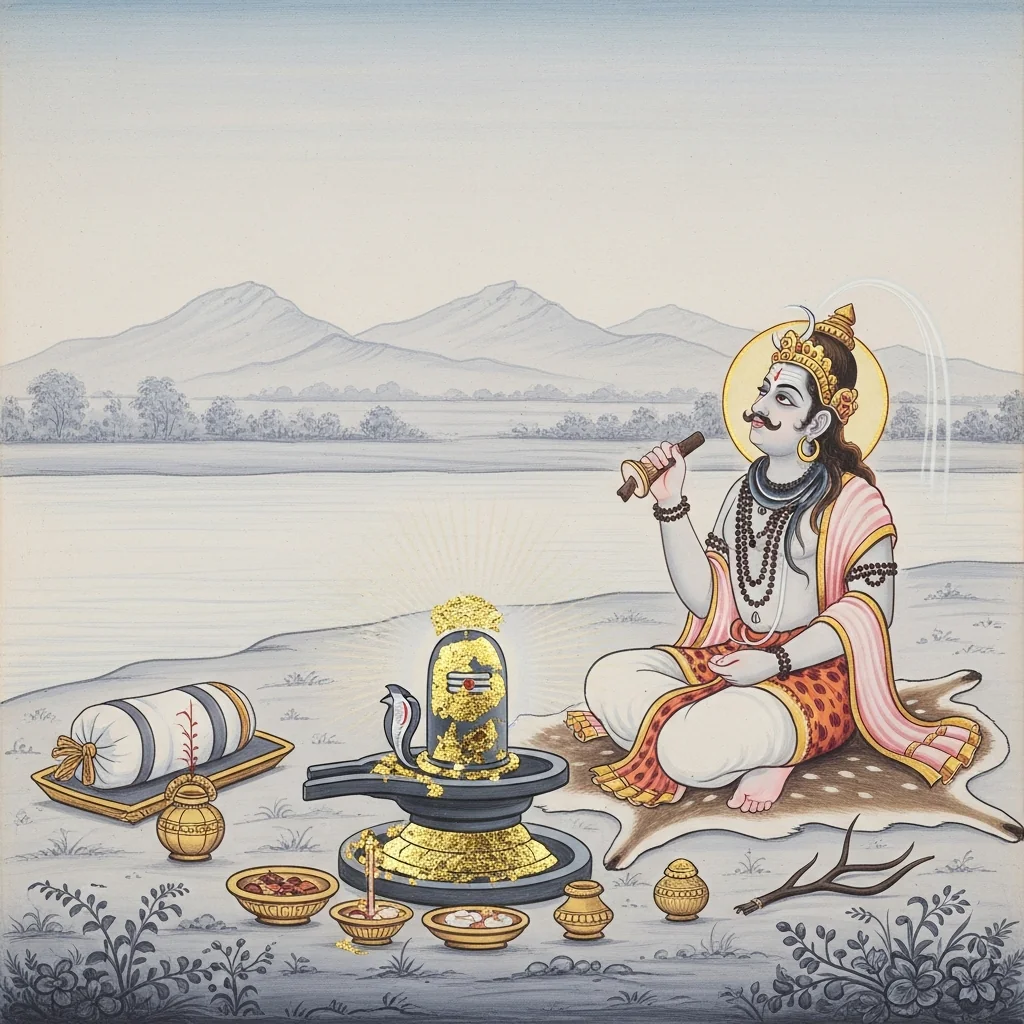
The chapter unfolds as a dialogue: Yudhiṣṭhira asks why Mahādeva (Śiva) is established in the water, not on either bank, and Mārkaṇḍeya replies with an origin-legend of the tīrtha. In Tretāyuga, Rāvaṇa meets the dānava Maya in the Vindhya region and learns that Maya’s daughter Mandodarī is performing severe tapas to obtain a husband. Rāvaṇa requests her and receives her in marriage; a son is born whose roar stuns the worlds, and Brahmā names him Meghnāda. Meghnāda undertakes strict vows and worships Śaṅkara with Umā, bringing two liṅgas from Kailāsa and travelling south. At the Narmadā he bathes and performs pūjā; when he tries to lift the liṅgas to depart for Laṅkā, a great liṅga falls into the river and becomes established midstream, while a divine utterance urges him onward. Meghnāda bows and departs. From then on the tīrtha is famed as Meghnāda (formerly Garjana). The phalaśruti declares: bathing and staying a full day and night yields Aśvamedha-like merit; piṇḍadāna equals the fruit of a sattra; feeding a Brahmin a six-flavor meal grants imperishable merit; and voluntary death there leads to residence in Śaṅkara’s world until cosmic dissolution.
Shlokas
Verse 1
युधिष्ठिर उवाच । जलमध्ये महादेवः केन तिष्ठति हेतुना । उत्तरं दक्षिणं कूलं वर्जयित्वा द्विजोत्तम
Yudhiṣṭhira said: “For what reason does Mahādeva abide in the midst of the waters, O best of the twice-born? Why does He set aside the northern and the southern bank?”
Verse 2
श्रीमार्कण्डेय उवाच । एतदाख्यानमतुलं पुण्यं श्रुतिमुखावहम् । पुराणे यच्छ्रुतं तात तत्ते वक्ष्याम्यशेषतः
Śrī Mārkaṇḍeya said: “This incomparable sacred narrative is supremely meritorious and worthy to be heard. O dear one, whatever I have heard in the Purāṇas, I shall recount to you in full, without omission.”
Verse 3
त्रेतायुगे महाभाग रावणो देवकण्टकः । त्रैलोक्यविजयी रौद्रः सुरासुरभयंकरः
“In the Tretā-yuga, O greatly fortunate one, there was Rāvaṇa—the tormentor of the gods—fierce in nature, a conqueror of the three worlds, and a source of terror to both devas and asuras.”
Verse 4
देवदानवगन्धर्वैरृषिभिश्च तपोधनैः । अवध्योऽथ विमानेन यावत्पर्यटते महीम्
“He was deemed unassailable by gods, dānavas, gandharvas, and by the ascetic sages rich in tapas; and then, in his aerial chariot (vimāna), he roamed about the earth at will.”
Verse 5
तावद्धिन्ध्यगिरेर्मध्ये दानवो बलदर्पितः । मयो नामेति विख्यातो गुहावासी तपश्चरन्
Meanwhile, within the Vindhya mountains lived a dānava, proud of his strength, renowned by the name Maya—dwelling in a cave and practicing austerities.
Verse 6
तस्य पार्श्वगतो रक्षो विनयादवनिं गतः । पूजितो दानसन्मानैरिदं वचनमब्रवीत्
Approaching him, the rākṣasa (Rāvaṇa) descended to the ground out of courtesy; and, honored with gifts and respect, he spoke these words.
Verse 7
कस्येयं पद्मपत्राक्षी पूर्णचन्द्रनिभानना । किंनामधेया तपति तप उग्रं कथं विभो
Whose is this maiden with lotus-petal eyes and a face like the full moon? What is her name, and why does she undertake such fierce austerity, O mighty one?
Verse 8
मय उवाच । दानवानां पतिः श्रेष्ठो मयोऽहं नाम नामतः । भार्या तेजोवती नाम तस्यास्तु तनया शुभा
Maya said: “I am Maya by name, a foremost lord among the dānavas. My wife is named Tejovatī, and she has a virtuous daughter.”
Verse 9
मन्दोदरीति विख्याता तपते भर्तृकारणात् । आराधयन्ती भर्तारमुमाया दयितं शुभम्
She is famed as Mandodarī. For the sake of a husband she performs austerity, worshipping as her chosen lord the auspicious beloved of Umā (Śiva).
Verse 10
तच्छ्रुत्वा वचनं तस्य रावणो मदमोहितः । प्रसृतः प्रणतो भूत्वा मयं वचनमब्रवीत्
Hearing his words, Rāvaṇa—deluded by the intoxication of pride—stepped forward; and, bowing in reverence, he addressed Maya with these words.
Verse 11
पौलस्त्यान्वयसंजातो देवदानवदर्पहा । प्रार्थयामि महाभाग सुतां त्वं दातुमर्हसि
Born in the lineage of Paulastya, a subduer of the pride of devas and dānavas, I beseech you, O noble one: be pleased to grant me your daughter.
Verse 12
ज्ञात्वा पैतामहं वृत्तं मयेनापि महात्मना । रावणाय सुता दत्ता पूजयित्वा विधानतः
Having learned the ancestral account, the great-souled Maya too, after duly honoring Rāvaṇa according to proper rite, gave his daughter to Rāvaṇa in marriage.
Verse 13
गृहीत्वा तां तदा रक्षोऽभ्यर्च्यमानो निशाचरैः । देवोद्याने विमानैश्च क्रीडते स तया सह
Then, having taken her as his wife, that Rākṣasa—worshipped by the night-roamers—sportively enjoyed with her in a divine garden, amid the vimānas.
Verse 14
केनचित्त्वथ कालेन रावणो लोकरावणः । पुत्रं पुत्रवतां श्रेष्ठो जनयामास भारत
Then, after some time, Rāvaṇa—renowned among the worlds—begot a son, O Bhārata, becoming foremost among those who have sons.
Verse 15
तेनैव जातमात्रेण रावो मुक्तो महात्मना । संवर्तकस्य मेघस्य तेन लोका जडीकृताः
By him, at the very moment of his birth, a mighty roar was loosed; by that roar the worlds were benumbed, like the dread thunder of the cloud of cosmic dissolution.
Verse 16
श्रुत्वा तन्नर्दितं घोरं ब्रह्मा लोकपितामहः । नाम चक्रे तदा तस्य मेघनादो भविष्यति
Hearing that dreadful roar, Brahmā—the grandsire of the worlds—then bestowed a name upon him: “He shall be called Meghanāda.”
Verse 17
एवंनामा कृतः सोऽपि परमं व्रतमास्थितः । तोषयामास देवेशमुमया सह शङ्करम्
Thus named, he too undertook a supreme vow, and by his observance he pleased Śaṅkara, the Lord of the gods, together with Umā.
Verse 18
व्रतैर्नियमदानैश्च होमजाप्यविधानतः । कृच्छ्रचान्द्रायणैर्नित्यं कृशं कुर्वन्कलेवरम्
By vows, disciplines and gifts, and by duly performed fire-offerings and recitations—by constant Kṛcchra and Cāndrāyaṇa austerities—he made his body emaciated through tapas.
Verse 19
एवमन्यद्दिने तात कैलासं धरणीधरम् । गत्वा लिङ्गद्वयं गृह्य प्रस्थितो दक्षिणामुखः
Thus, on another day, O dear one, he went to Kailāsa, the mountain that upholds the earth; taking up two liṅgas, he set out facing south.
Verse 20
नर्मदातटमाश्रित्य स्नातुकामो महाबलः । निक्षिप्य पूजयन् देवं कृतजाप्यो नरेश्वर
Reaching the bank of the Narmadā, the mighty one—desiring to bathe—set it down and worshipped the Lord; having completed his japa, O king.
Verse 21
तत्रायतनावासेन स्नातो हुतहुताशनः । कृतकृत्यमिवात्मानं मानयित्वा निशाचरः
There, by staying at that sacred abode, he bathed and performed offerings into the consecrated fire; and the night-roamer, esteeming himself as though his duty were accomplished, remained satisfied.
Verse 22
गन्तुकामः परं मार्गं लङ्कायां नृपसत्तम । एकमुद्धरतो लिङ्गं प्रणतः सव्यपाणिना
O best of kings, longing to proceed onward to Laṅkā, he lifted up one liṅga; bowing in reverence, he raised his left hand in salutation.
Verse 23
द्वितीयं तु द्वितीयेन भक्त्या पौलस्त्यनन्दनः । तावदेव महालिङ्गं पतितं नर्मदांभसि
Then, with the same devotion, the son of Paulastya lifted a second; at that very moment the great liṅga fell into the waters of the Narmadā.
Verse 24
याहि याहीति चेत्युक्त्वा जलमध्ये प्रतिष्ठितः । नमित्वा रावणिस्तस्य देवस्य परमेष्ठिनः
Saying, ‘Go on, go on!’ he became established in the midst of the waters; and Rāvaṇi, bowing to that supreme Lord among the gods, offered his reverence.
Verse 25
जगामाकाशमाविश्य पूज्यमानो निशाचरैः । तदा प्रभृति तत्तीर्थं मेघनादेति विश्रुतम्
He departed, entering the sky, honored by the night-roamers; from that time onward, that sacred ford became renowned as “Meghanāda Tīrtha”.
Verse 26
पूर्वं तु गर्जनं नाम सर्वपापक्षयंकरम् । तस्मिंस्तीर्थे तु राजेन्द्र यस्तु स्नानं समाचरेत्
Formerly it was called “Garjana”, the destroyer of all sins. O king of kings, whoever performs bathing at that tīrtha—
Verse 27
अहोरात्रोषितो भूत्वा अश्वमेधफलं लभेत् । पिण्डदानं तु यः कुर्यात्तस्मिंस्तीर्थे नराधिप
If one stays there for a full day and night, one gains the fruit of an Aśvamedha sacrifice. And, O king, whoever offers piṇḍa (funeral oblations) at that tīrtha—
Verse 28
यत्फलं सत्त्रयज्ञेन तद्भवेन्नात्र संशयः । तेन द्वादशवर्षाणि पितरः संप्रतर्पिताः
Whatever fruit arises from a Sattra sacrifice—this indeed is obtained here, without doubt. By that act, the forefathers are fully satisfied for twelve years.
Verse 29
यस्तु भोजयते विप्रं षड्रसात्रेन भारत । अक्षयपुण्यमाप्नोति तत्र तीर्थे नरोत्तम
But whoever feeds a vipra (brāhmaṇa) with a meal of the six tastes, O Bhārata, attains imperishable merit at that tīrtha, O best of men.
Verse 30
प्राणत्यागं तु यः कुर्याद्भावितो भावितात्मना । स वसेच्छाङ्करे लोके यावदा भूतसम्प्लवम्
And whoever, with a mind purified and steeped in contemplation, relinquishes life there—he dwells in Śaṅkara’s realm until the dissolution of all beings.
Verse 31
एषा ते नरशार्दूल गर्जनोत्पत्तिरुत्तमा । कथिता स्नेहबन्धेन सर्वपापक्षयकरी
Thus, O tiger among men, bound by affection, I have told you the excellent origin of Garjana, which destroys all sins.
Verse 35
। अध्याय
“Chapter.”