Adhyaya 85
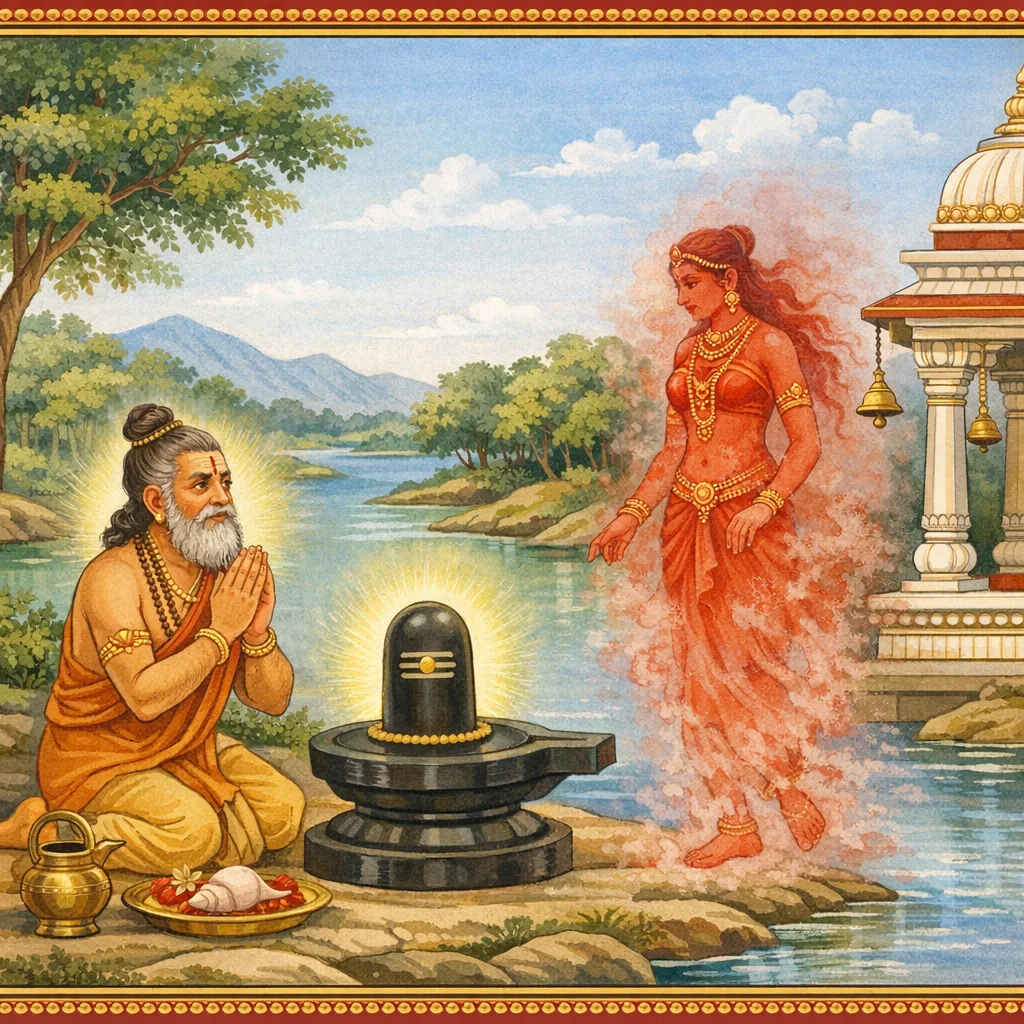
This chapter unfolds as a dialogue: Yudhiṣṭhira asks Mārkaṇḍeya about a Narmadā (Revā) tīrtha praised as equal to Vārāṇasī in merit and as a remover of brahmahatyā. Mārkaṇḍeya recounts a cosmogonic lineage culminating in Dakṣa and the lunar deity Soma, then tells how Dakṣa’s curse causes Soma’s decline. Seeking relief, Soma approaches Brahmā, who directs him to Revā’s rare sacred nodes—especially the river confluence—where austerity and worship should be performed. Soma undertakes prolonged devotion to Śiva; Śiva appears and a potent liṅga named Somanātha is established, said to dispel suffering and grave sin. An exemplar follows: King Kaṇva, afflicted by brahmahatyā for killing a brāhmaṇa in deer form, reaches the Revā confluence, bathes, worships Somanātha, and encounters Brahmahatyā personified as a red-clad maiden; by the tīrtha’s power he is released. The chapter then prescribes vrata observances—fasting on specified lunar days, night vigil, pañcāmṛta abhiṣeka, offerings, lamps, music, honoring worthy brāhmaṇas, and disciplined ethical conduct. Its phalaśruti declares that circumambulation, hearing, and regulated practice at Somanātha’s tīrtha purge major sins and grant health, prosperity, and higher worlds; it also notes Soma’s installation of multiple liṅgas at distinct sites, linking local pilgrimage to a wider Śaiva sacred geography.
Shlokas
Verse 1
श्रीमार्कण्डेय उवाच । ततो गच्छेत्तु राजेन्द्र नर्मदायाः पुरातनम् । ब्रह्महत्याहरं तीर्थं वाराणस्या समं हि तत्
Śrī Mārkaṇḍeya said: Then, O king, one should go to the ancient sacred ford of the Narmadā—a tīrtha that destroys the sin of brahmin-slaying, and is indeed equal to Vārāṇasī.
Verse 2
युधिष्ठिर उवाच । आश्चर्यं कथ्यतां ब्रह्मन्यद्वृत्तं नर्मदातटे । वाराणस्या समं कस्मादेतत्कथय मे प्रभो
Yudhiṣṭhira said: O Brahmin, let this wonder be told—what occurred on the bank of the Narmadā? Why is this equal to Vārāṇasī? Tell me, O lord.
Verse 3
निमग्नो दुःखसंसारे हृतराज्यो द्विजोत्तम । युष्मद्वाणीजलस्नातो निर्दुःखः सह बान्धवैः
O best of Brahmins, a man submerged in the sorrowful round of worldly existence, bereft of his kingdom—having bathed in the waters of your sacred speech—became free from grief, together with his kinsmen.
Verse 4
श्रीमार्कण्डेय उवाच । साधु साधु महाबाहो सोमवंशविभूषण । पृष्टोऽस्मि दुर्लभं तीर्थं गुह्याद्गुह्यतरं परम्
Śrī Mārkaṇḍeya said: “Well said, well said, O mighty-armed one, ornament of the Lunar line! You have asked me of a rare tīrtha—supreme, and more secret than what is called secret.”
Verse 5
आदौ पितामहस्तावत्समस्तजगतः प्रभुः । मनसा तस्य संजाता दशैव ऋषिपुंगवाः
In the beginning, the Pitāmaha, lord of the entire world, brought forth—by mind alone—ten foremost sages.
Verse 6
मरीचिमत्र्यङ्गिरसौ पुलस्त्यं पुलहं क्रतुम् । प्रचेतसं वसिष्ठं च भृगुं नारदमेव च
Marīci, Atri and Aṅgiras; Pulastya, Pulaha, Kratu; Pracetas (Dakṣa); Vasiṣṭha, Bhṛgu, and also Nārada—these revered progenitors and seers are enumerated.
Verse 7
जज्ञे प्राचेतसं दक्षं महातेजाः प्रजापतिः । दक्षस्यापि तथा जाताः पञ्चाशद्दुहिताः किल
From Pracetas was born Dakṣa, the Prajāpati of mighty radiance. And it is said that Dakṣa, too, had fifty daughters.
Verse 8
ददौ स दश धर्माय कश्यपाय त्रयोदश । तथैव स महाभागः सप्तविंशतिमिन्दवे
He gave ten (daughters) to Dharma and thirteen to Kaśyapa. Likewise, that greatly fortunate one gave twenty-seven to the Moon, Soma.
Verse 9
रोहिणी नाम या तासामभीष्टा साभवद्विधोः । शेषासु करुणां कृत्वा शप्तो दक्षेण चन्द्रमाः
Among them, she named Rohiṇī became the Moon’s beloved. Taking pity on the others who were neglected, Dakṣa cursed the Moon.
Verse 10
क्षयरोग्यभवच्चन्द्रो दक्षस्यायं प्रजापतेः । स च शापप्रभावेण निस्तेजाः शर्वरीपतिः
By Dakṣa’s curse, the Moon—born of that Prajāpati—was stricken with a wasting disease. By the curse’s power, the lord of the night lost his radiance.
Verse 11
गतः पितामहं सोमो वेपमानोऽमृतांशुमान् । पद्मयोने नमस्तुभ्यं वेदगर्भ नमोऽस्तु ते । शरणं त्वां प्रसन्नोऽस्मि पाहि मां कमलासन
Trembling, Soma—whose rays are like nectar—went to the Grandsire, Brahmā. “O Lotus-born, obeisance to you; O Womb of the Vedas, obeisance to you. In you I take refuge; be gracious—protect me, O Lotus-seated One.”
Verse 12
ब्रह्मोवाच । निस्तेजाः शर्वरीनाथ कलाहीनश्च दृश्यसे । उद्विग्नमानसस्तात संजातः केन हेतुना
Brahmā said: “O lord of the night, you appear bereft of radiance and lacking your phases. Dear one, your mind seems distressed—by what cause has this come about?”
Verse 13
सोम उवाच । दक्षशापेन मे ब्रह्मन्निस्तेजस्त्वं जगत्पते । निर्हारश्चास्य शापस्य कथ्यतां मे पितामह
Soma said: “O Brahman, O Lord of the world, by Dakṣa’s curse I have become without radiance. Tell me, O Grandsire, the means of release from this curse.”
Verse 14
ब्रह्मोवाच । सर्वत्र सुलभा रेवा त्रिषु स्थानेषु दुर्लभा । ओङ्कारेऽथ भृगुक्षेत्रे तथा चैवौर्वसंगमे
Brahmā said: “Revā is easily found everywhere, yet she is rare in three places: at Oṅkāra, in Bhṛgu’s sacred field, and also at the confluence with Ūrvā.”
Verse 15
तत्र गच्छ क्षपानाथ यत्र रेवान्तरं तटम् । त्वरितोऽसौ गतस्तत्र यत्र रेवौर्विसंगमः
“Go there, O lord of the night, to that bank where Revāntara—the inner stretch of Revā—lies.” Swiftly he went there, to the confluence of Revā and Ūrvā.
Verse 16
काष्ठावस्थः स्थितः सोमो दध्यौ त्रिपुरवैरिणम् । यावद्वर्षशतं पूर्णं तावत्तुष्टो महेश्वरः
Soma, motionless like a log of wood, meditated upon the Foe of Tripura (Śiva). When a full hundred years had passed, Maheśvara was pleased.
Verse 17
प्रत्यक्षः सोमराजस्य वृषासन उमापतिः । साष्टाङ्गं प्रणिपत्योच्चैर्जय शम्भो नमोऽस्तु ते
To King Soma, Umāpati—seated upon the bull—appeared directly. Soma bowed in full prostration and cried aloud: “Victory to you, O Śambhu! Reverence to you!”
Verse 18
जय शङ्कर पापहराय नमो जय ईश्वर ते जगदीश नमः । जय वासुकिभूषणधार नमो जय शूलकपालधराय नमः
Victory and homage to Śaṅkara, the remover of sins! Victory to you, O Īśvara, Lord of the world! Victory and homage to the One adorned with Vāsuki! Victory and homage to the Bearer of the trident and the skull!
Verse 19
जय अन्धकदेहविनाश नमो जय दानववृन्दवधाय नमः । जय निष्कलरूप सकलाय नमो जय काल कामदहाय नमः
Victory and homage to the Destroyer of Andhaka’s body! Victory and homage to the Slayer of the hosts of asuras! Victory and homage to the Formless who yet manifests as all! Victory and homage to Time itself, the Burner of Kāma!
Verse 20
जय मेचककण्ठधराय नमो जय सूक्ष्मनिरञ्जनशब्द नमः । जय आदिरनादिरनन्त नमो जय शङ्कर किंकरमीश भज
Victory and homage to the One who bears the dark-hued throat! Victory and homage to the subtle, stainless Lord, known through sacred sound! Victory and homage to the First—yet beginningless and endless! Victory, O Śaṅkara, O Lord—accept me as your servant; I worship you!
Verse 21
एवं स्तुतो महादेवः सोमराजेन पाण्डव । तुष्टस्तस्य नृपश्रेष्ठ शिवया शङ्करोऽब्रवीत्
Thus praised by King Soma, O Pāṇḍava, Mahādeva was pleased. Then Śaṅkara—together with Śivā (Umā)—spoke to that foremost of kings.
Verse 22
ईश्वर उवाच । वरं प्रार्थय मे भद्र यत्ते मनसि वर्तते । साधु साधु महासत्त्व तुष्टोऽहं तपसा तव
Īśvara said: “Auspicious one, ask from me the boon that abides in your heart. Well done, well done, great-souled one—your austerity has pleased me.”
Verse 23
सोम उवाच । दक्षशापेन दग्धोऽहं क्षीणसत्त्वो महेश्वर । शापस्योपशमं देव कुरु शर्म मम प्रभो
Soma said: “O Maheśvara, I am scorched by Dakṣa’s curse and my strength is diminished. O God, pacify the curse and grant me well-being, O Lord.”
Verse 24
ईश्वर उवाच । तव भक्तिगृहीतोऽहमुमया सह तोषितः । निष्पापः सोमनाथस्त्वं संजातस्तीर्थसेवनात्
Īśvara said: “I am won over by your devotion, and with Umā I am well pleased. By serving the tīrtha you have become sinless—indeed, you have become ‘Somanātha’.”
Verse 25
इत्यूचे देवदेवेशः क्षणं ध्यात्वेन्दुना ततः । स्थापितं परमं लिङ्गं कामदं प्राणिनां भुवि । सर्वदुःखहरं तत्तु ब्रह्महत्याविनाशनम्
Having spoken thus, the Lord of the gods, after meditating for a moment, caused (through Indu/Soma) the स्थापना of a supreme liṅga upon the earth—wish-fulfilling for living beings, removing all sorrow, and destroying even the sin of brahma-hatyā.
Verse 26
युधिष्ठिर उवाच । सोमनाथप्रभावं मे संक्षेपात्कथय प्रभो । दुःखार्णवनिमग्नानां त्राता प्राप्तो द्विजोत्तम
Yudhiṣṭhira said: “O Lord, tell me briefly the greatness of Somanātha. O best of the twice-born, you have come as a savior to those submerged in the ocean of sorrow.”
Verse 27
श्रीमार्कण्डेय उवाच । शृणु तीर्थप्रभावं ते संक्षेपात्कथयाम्यहम् । यद्वृत्तमुत्तरे कूले रेवाया उरिसंगमे
Śrī Mārkaṇḍeya said: “Listen. I shall tell you briefly the greatness of this tīrtha—what happened on the northern bank of the Revā (Narmadā), at the confluence called Urisaṅgama.”
Verse 28
शम्बरो नाम राजाभूत्तस्य पुत्रस्त्रिलोचनः । त्रिलोचनसुतः कण्वः स पापर्द्धिपरोऽभवत्
There was a king named Śambara. His son was Trilocana; and Trilocana’s son was Kaṇva—one who became intent on sinful gain and increase.
Verse 29
वने नित्यं भ्रमन्सोऽथ मृगयूथं ददर्श ह । मृगयूथं हतं तत्तु त्रिलोचनसुतेन च
Then, as he roamed daily through the forest, he saw a herd of deer. That herd of deer had indeed been slain by Trilocana’s son, Kaṇva.
Verse 30
मृगरूपी द्विजो मध्ये चरते निर्जने वने । स हतस्तेन सङ्गेन कण्वेन मुनिसत्तम
In that lonely forest, a twice-born man, having assumed the form of a deer, moved among them. By that association, Kaṇva killed him—O best of sages.
Verse 31
ब्रह्महत्यान्वितः कण्वो निस्तेजा व्यचरन्महीम् । व्यचरंश्चैव सम्प्राप्तो नर्मदामुरिसंगमे
Afflicted with the sin of brahmin-slaying (brahmahatyā), Kaṇva—bereft of radiance—wandered over the earth; and in the course of his wandering he reached the Narmadā, at Urisaṅgama.
Verse 32
किंशुकाशोकबहले जम्बीरपनसाकुले । कदम्बपाटलाकीर्णे बिल्वनारङ्गशोभिते
It was a forest thick with kiṃśuka and aśoka trees, crowded with citron and jackfruit; strewn with kadamba and pāṭalā, and beautified by bilva and orange trees.
Verse 33
चिञ्चिणीचम्पकोपेते ह्यगस्तितरुछादिते । प्रभूतभूतसंयुक्तं वनं सर्वत्र शोभितम्
Abounding in tamarind and campaka trees, and shaded by agasti trees, that forest—filled with many beings—was beautiful on all sides.
Verse 34
चित्रकैर्मृगमार्जारैर्हिंस्रैः शम्बरशूकरैः । शशैर्गवयसंयुक्तैः शिखण्डिखरमण्डितम्
It was peopled with spotted beasts and wildcats, with fierce śambara-deer and boars; with hares and gayals besides, and adorned with peacocks and donkeys.
Verse 35
प्रविष्टस्तु वने कण्वस्तृषार्तः श्रमपीडितः । स्नातो रेवाजले पुण्ये सङ्गमे पापनाशने
Entering that forest, Kaṇva—tormented by thirst and worn down by fatigue—bathed in the holy waters of the Revā at the confluence, the destroyer of sins.
Verse 36
अर्चितः परया भक्त्या सोमनाथो युधिष्ठिर । पपौ सुविमलं तोयं सर्वपापक्षयंकरम्
O Yudhiṣṭhira, having worshipped Somanātha with supreme devotion, he drank crystal-pure water—water that brings about the destruction of all sins.
Verse 37
फलानि च विचित्राणि चखाद सह किंकरैः । सुप्तः पादपच्छायायां श्रान्तो मृगवधेन च
He ate various kinds of fruits along with his attendants; then, weary from the hunting of deer, he fell asleep in the shade of a tree.
Verse 38
तावत्तीर्थवरं विप्रः स्नानार्थं सङ्गमं गतः । मार्गगो ब्राह्मणो हर्षोद्युक्तस्तद्गतमानसः
Just then, a brāhmaṇa went to the excellent tīrtha—the sacred confluence—for bathing. Proceeding on the path, the brāhmaṇa was filled with joy, his mind intent upon that holy place.
Verse 39
अबला तमुवाचेदं तिष्ठ तिष्ठ द्विजोत्तम । त्रस्तो निरीक्षते यावद्दिशः सर्वा नरेश्वर
The helpless woman said to him: “Stop, stop, O best of brāhmaṇas!” And, terrified, she kept looking in all directions, O king.
Verse 40
तावद्वृक्षसमारूढां स्त्रियं रक्ताम्बरावृताम् । रक्तमाल्यां तदा बालां रक्तचन्दनचर्चिताम् । रक्ताभरणशोभाढ्यां पाशहस्तां ददर्श ह
Then he saw a woman who had climbed a tree—clothed in red garments; a young maiden adorned with a red garland, anointed with red sandal; resplendent with red ornaments, and holding a noose in her hand.
Verse 41
स्त्र्युवाच । संदेशं श्रूयतां विप्र यदि गच्छसि सङ्गमे । मद्भर्ता तिष्ठते तत्र शीघ्रमेव विसर्जय
The woman said: “O brāhmaṇa, listen to my message. If you are going to the sacred confluence (saṅgama), my husband is there—deliver it to him at once.”
Verse 42
एकाकिनी च ते भार्या तिष्ठते वनमध्यगा । इत्याकर्ण्य गतो विप्रः सङ्गमं सुरदुर्लभे
“And your wife is alone, staying in the midst of the forest.” Hearing this, the brāhmaṇa went to the saṅgama—rare even for the gods to attain.
Verse 43
वृक्षच्छायान्वितः कण्वो ब्राह्मणेनावलोकितः । उवाच तं प्रति तदा वचनं ब्राह्मणोत्तमः
Kaṇva, seated in the shade of a tree, was seen by the brāhmaṇa; and then that best of brāhmaṇas spoke words to him.
Verse 44
ब्राह्मण उवाच । वनान्तरे मया दृष्टा बाला कमललोचना । रक्ताम्बरधरा तन्वी रक्तचन्दनचर्चिता
The brāhmaṇa said: “In the depths of the forest I saw a young maiden with lotus-like eyes—slender, clad in red garments, and anointed with red sandal paste.”
Verse 45
रक्तमाल्या सुशोभाढ्या पाशहस्ता मृगेक्षणा । वृक्षारूढावदद्वाक्यं मद्भर्ता प्रेष्यतामिति
Adorned with a red garland and radiant with beauty, holding a noose (pāśa) and with doe-like eyes, she sat upon a tree and spoke: “Let this message be conveyed to my husband.”
Verse 46
कण्व उवाच । कस्मिन्स्थाने तु विप्रेन्द्र विद्यते मृगलोचना । कस्य सा केन कार्येण सर्वमेतद्वदाशु मे
Kaṇva said: “O best of Brahmins, in what place is that doe-eyed maiden found? Whose is she, and for what purpose is she here? Tell me all this at once.”
Verse 47
ब्राह्मण उवाच । सङ्गमादर्धक्रोशे सा उद्यानान्ते हि विद्यते । वचनाद्ब्रह्मणस्यैषा न ज्ञाता पार्थिवेन तु
The Brāhmaṇa said: “Half a krośa from the confluence, she is found at the edge of a garden. By Brahmā’s injunction, she is not known to the king.”
Verse 48
तदा स कण्वभूपालः स्वकं दूतं समादिशत् कण्व उवाच । गच्छ त्वं पृच्छतां तां क्वागता क्वच गमिष्यसि । प्रेषितस्त्वरितो दूतो गतो नारीसमीपतः
Then King Kaṇva commanded his own messenger: “Go—question her: ‘From where have you come, and where will you go?’” Sent forth, the messenger hurried and approached the woman.
Verse 49
वृक्षस्थां ददृशो बालामुवाच नृपसत्तम । मन्नाथः पृच्छति त्वां तु कासि त्वं क्व गमिष्यसि
Seeing the young maiden seated in a tree, the messenger spoke: “O best of kings, my lord asks you: ‘Who are you, and where are you going?’”
Verse 50
कन्योवाच । गुरुरात्मवतां शास्ता राजा शास्ता दुरात्मनाम् । इह प्रच्छन्न पापानां शास्ता वैवस्वतो यमः
The maiden said: “For the self-controlled, the teacher is the disciplinarian; for the wicked, the king is the disciplinarian. But here, for sins that are concealed, the true chastiser is Yama, son of Vivasvān.”
Verse 51
ब्रह्महत्या च संजाता मृगरूपधरद्विजात् । मया युक्तोऽपि ते राजा मुक्तस्तीर्थप्रभावतः
“The sin of brahmin-slaying arose from a twice-born who had assumed the form of a deer. Yet your king—though associated with me—has been released by the power of this tīrtha.”
Verse 52
अर्धक्रोशान्तरान्मध्ये ब्रह्महत्या न संविशेत् । सोमनाथप्रभावोऽयं वाराणस्याः समः स्मृतः
“Within the space of half a krośa, brahmin-slaying cannot enter. This is the power of Somanātha, remembered as equal to that of Vārāṇasī.”
Verse 53
गच्छ त्वं प्रेष्यतां राजा शीघ्रमत्र न संशयः । गतो भृत्यस्ततः शीघ्रं वेपमानः सुविह्वलः
“Go—let the king be summoned here quickly; there is no doubt.” Then the servant went swiftly, trembling and greatly agitated.
Verse 54
समस्तं कथयामास यद्वृत्तं हि पुरातनम् । तस्य वाक्यादसौ राजा पतितो धरणीतले
He recounted in full the ancient account of what had transpired. Hearing his words, that king fell down upon the ground.
Verse 55
भृत्य उवाच । कस्मात्त्वं शोचसे नाथ पूर्वोपात्तं शुभाशुभम् । इत्याकर्ण्य वचस्तस्य राजा वचनमब्रवीत्
The servant said: “Why do you grieve, my lord, over the good and evil acquired in the past?” Hearing his words, the king replied.
Verse 56
प्राणत्यागं करिष्यामि सोमनाथसमीपतः । शीघ्रमानीयतां वह्निरिन्धनानि बहूनि च
“I shall relinquish my life near Somanātha. Quickly bring the fire, and plenty of fuel as well.”
Verse 57
आनीतं तत्क्षणात्सर्वं भृत्यैस्तद्वशवर्तिभिः । स्नानं कृत्वा शुभे तोये सङ्गमे पापनाशने
All of it was brought at once by the attendants obedient to his command. Then, having bathed in the auspicious waters at the confluence—the destroyer of sins—he proceeded further.
Verse 58
अर्चितः परया भक्त्या सोमनाथो महीभृता । त्रिःप्रदक्षिणतः कृत्वा ज्वलन्तं जातवेदसम्
The king worshiped Somanātha with supreme devotion. Then, having circumambulated the blazing fire three times in reverence, he continued with his vow.
Verse 59
प्रविष्टः कण्वराजासौ हृदि ध्यात्वा जनार्दनम् । पीताम्बरधरं देवं जटामुकुटधारिणम्
King Kaṇva entered the fire, meditating within his heart upon Janārdana—the divine Lord clad in yellow garments, bearing a crown of matted locks.
Verse 60
श्रिया युक्तं सुपर्णस्थं शङ्खचक्रगदाधरम् । सुरारिसूदनं दध्यौ सुगतिर्मे भवत्विति
He meditated on the slayer of the foes of the gods—Viṣṇu united with Śrī, seated upon Garuḍa, bearing conch, discus, and mace—thinking, “May I attain the good path.”
Verse 61
पपात पुष्पवृष्टिस्तु साधु साधु नृपात्मज । आश्चर्यमतुलं दृष्ट्वा निरीक्ष्य च परस्परम्
A rain of flowers fell, and cries of “Well done, well done!” arose, O prince. Seeing that incomparable wonder, they looked at one another in amazement.
Verse 62
मृतं तैः पावके भृत्यैर्हृदि ध्यात्वा गदाधरम् । विमानस्थास्ततः सर्वे संजाताः पाण्डुनन्दन
When he died in that fire—while the attendants too meditated in their hearts on Gadādhara—all of them thereafter found themselves seated in celestial aerial cars, O son of Pāṇḍu.
Verse 63
निष्पापास्ते दिवं याताः सोमनाथप्रभावतः । ब्राह्मणे सङ्गमे तत्र ध्यायमाने वृषध्वजम्
Freed from sin, they went to heaven by the power of Somanātha—there, at that confluence, while a brāhmaṇa was meditating on Vṛṣadhvaja (Śiva), the bearer of the bull-banner.
Verse 64
श्रीमार्कण्डेय उवाच । सोमनाथप्रभावोऽयं शृणुष्वैकमना विधिम् । अष्टम्यां वा चतुर्दश्यां सर्वकालं रवेर्दिने
Śrī Mārkaṇḍeya said: “This is the sacred power of Somanātha. Listen with a single-pointed mind to the rite: on the eighth or the fourteenth lunar day, at any time, on a Sunday…”
Verse 65
विशेषाच्छुक्लपक्षे चेत्सूर्यवारेण सप्तमी । उपोष्य यो नरो भक्त्या रात्रौ कुर्वीत जागरम्
“Especially when, in the bright fortnight, the seventh lunar day falls on a Sunday: the man who fasts in devotion and keeps night-long vigil…”
Verse 66
पञ्चामृतेन गव्येन स्नापयेत्परमेश्वरम् । श्रीखण्डेन ततो गुण्ठ्य पुष्पधूपादिकं ददेत्
One should bathe Parameśvara with the cow-born pañcāmṛta. Then anoint Him with sandal paste, and offer flowers, incense, and the other customary offerings of worship.
Verse 67
घृतेन बोधयेद्दीपं नृत्यं गीतं च कारयेत् । सोमवारे तथाष्टम्यां प्रभाते पूजयेद्द्विजान्
One should light the lamp with ghee and arrange for dance and sacred singing. On a Monday, and likewise on the eighth lunar day, one should in the morning honor the twice-born (dvija).
Verse 68
जितक्रोधानात्मवतः परनिन्दाविवर्जितान् । सर्वाङ्गरुचिराञ्छस्तान् स्वदारपरिपालकान्
They should be those who have conquered anger, are self-controlled, and refrain from slandering others—upright in conduct, pleasing in demeanor, and protectors of their own lawful wives.
Verse 69
गायत्रीपाठमात्रांश्च विकर्मविरतान् सदा । पुनर्भूवृषलीशूद्री चरेयुर्यस्य मन्दिरे
And those who do no more than recite the Gāyatrī, yet ever refrain from forbidden deeds—in the house of such a one even remarried women, outcaste women, and Śūdra women may move about without impropriety.
Verse 70
दूरतोऽसौ द्विजस्त्याज्य आत्मनः श्रेय इच्छता । हीनाङ्गानतिरिक्ताङ्गान् येषां पूर्वापरं न हि
Such a ‘twice-born’ should be shunned from afar by one who seeks his own welfare—those whose limbs are defective or abnormal and excessive, and those who have no sense of proper order or decorum.
Verse 71
व्रते श्राद्धे तथा दाने दूरतस्तान् विवर्जयेत् । आयसी तरुणी तुल्या द्विजाः स्वाध्यायवर्जिताः
In vow-observance, in śrāddha, and likewise in charity, one should keep such people far away. Twice-born men devoid of Vedic study are like a young woman made of iron—fair in form, yet barren of true function.
Verse 72
आत्मानं सह याज्येन पातयन्ति न संशयः । शाल्मलीनावतुल्याः स्युः षट्कर्मनिरता द्विजाः
They bring down both themselves and the one for whom the rite is performed—there is no doubt. Twice-born men devoted only to the ‘six acts’ are like the cotton of the śālmalī tree: outwardly abundant, yet lacking real weight.
Verse 73
दातारं च तथात्मानं तारयन्ति तरन्ति च । श्राद्धं सोमेश्वरे पार्थ यः कुर्याद्गतमत्सरः
They deliver the giver—and themselves as well—and they cross over. O Pārtha, whoever performs śrāddha at Someshvara with jealousy cast away attains this saving merit.
Verse 74
प्रेतास्तस्य हि सुप्रीता यावदाभूतसम्प्लवम् । अन्नं वस्त्रं हिरण्यं च यो दद्यादग्रजन्मने
Indeed, his departed ancestors remain greatly satisfied until the cosmic dissolution. He who gives food, clothing, and gold to a foremost-born (a Brāhmaṇa) secures for them that enduring satisfaction.
Verse 75
स याति शाङ्करे लोक इति मे सत्यभाषितम् । हयं यो यच्छते तत्र सम्पूर्णं तरुणं सितम्
He goes to Śaṅkara’s world—this is my truthful declaration. And he who donates there a complete, young, white horse also gains that exalted fruit.
Verse 76
रक्तं वा पीतवर्णं वा सर्वलक्षणसंयुतम् । कुङ्कुमेन विलिप्ताङ्गावग्रजन्महयावपि
Let the offering be either red or yellow, endowed with all auspicious marks; and let even the foremost-born (brāhmaṇa) and the horse have their limbs anointed with saffron (kuṅkuma).
Verse 77
स्रग्दामभूषितौ कार्यौ सितवस्त्रावगुण्ठितौ । अङ्घ्रिः प्रदीयतां स्कन्धे मदीये हयमारुह
Let them both be adorned with garlands and floral strings, and veiled with white cloth. Place your foot upon my shoulder and mount the horse.
Verse 78
आरूढे ब्राह्मणे ब्रूयाद्भास्करः प्रीयतामिति । स याति शांकरं लोकं सर्वपापविवर्जितः
When the brāhmaṇa has mounted, one should say, ‘May Bhāskara (the Sun) be pleased.’ Freed from all sins, he attains Śaṅkara’s world.
Verse 79
उपरागे तु सोमस्य तीर्थं गत्वा जितेन्द्रियः । सत्यलोकाच्च्युतश्चापि राजा भवति धार्मिकः
But at the time of the Moon’s eclipse, having gone to the tīrtha with the senses restrained, even one fallen from Satyaloka becomes a righteous king, established in dharma.
Verse 80
तस्य वासः सदा राजन्न नश्यति कदाचन । दीर्घायुर्जायते पुत्रो भार्या च वशवर्तिनी
O King, his dwelling never perishes at any time; a long-lived son is born to him, and his wife becomes harmonious, devoted, and obedient.
Verse 81
जीवेद्वर्षशतं साग्रं सर्वदुःखविवर्जितः । सोपवासो जितक्रोधो धेनुं दद्याद्द्विजन्मने
He lives a full hundred years, free from all suffering. Having observed fasting and conquered anger, he should give a cow in charity to a twice-born (brāhmaṇa).
Verse 82
सवत्सां क्षीरसंयुक्तां श्वेतवस्त्रावलोकिताम् । शबलां पीतवर्णां च धूम्रां वा नीलकर्बुराम्
A cow with her calf, rich in milk and presented with white cloth—whether mottled, yellow-coloured, smoky-grey, or blue-speckled—may be given.
Verse 83
कपिलां वा सवत्सां च घण्टाभरणभूषिताम् । रूप्यखुरां कांस्यदोहां स्वर्णशृङ्गीं नरेश्वर
Or, O lord of men, one may offer a tawny kapilā cow with her calf, adorned with bells and ornaments—her hooves plated with silver, her milking-vessel of bronze, and her horns capped with gold.
Verse 84
श्वेतया वर्धते वंशो रक्ता सौभाग्यवर्धिनी । शबला पीतवर्णा च दुःखघ्न्यौ संप्रकीर्तिते
By gifting a white cow, one’s lineage flourishes; a red one increases auspicious fortune. A mottled cow and a yellow-hued cow are both proclaimed destroyers of sorrow.
Verse 85
। अध्याय
End of the chapter.
Verse 86
पक्षान्तेऽथ व्यतीपाते वै धृतौ रविसंक्रमे । दिनक्षये गजच्छायां ग्रहणे भास्करस्य च
At the end of a fortnight, at the Vyatīpāta yoga, on the Dhṛti yoga, at the Sun’s transit, at day’s close, during the time called “elephant’s shadow,” and also at a solar eclipse—these are especially potent moments for sacred acts at the tīrtha.
Verse 87
ये व्रजन्ति महात्मानः सङ्गमे सुरदुर्लभे । मृदावगुण्ठयित्वा तु चात्मानं सङ्गमे विशेत्
Those great-souled ones who go to the divine, hard-to-attain confluence should cover themselves with earth, and then enter the confluence for the sacred bath.
Verse 88
हृदयान्तर्जले जाप्या प्राणायामोऽथवा नृप । गायत्री वैष्णवी चैव सौरी शैवी यदृच्छया । तेऽपि पापैः प्रमुच्यन्त इत्येवं शङ्करोऽब्रवीत्
O King, even japa performed with the “inner water” of the heart, or prāṇāyāma; and the Gāyatrī—whether Vaiṣṇavī, Saurī, or Śaivī—when undertaken spontaneously with faith: even such persons are released from sins. Thus spoke Śaṅkara.
Verse 89
जगतीं सोमनाथस्य यस्तु कुर्यात्प्रदक्षिणाम् । प्रदक्षिणीकृता तेन सप्तद्वीपा वसुंधरा
Whoever performs pradakṣiṇā of the sacred jagatī of Soma-nātha—by him, as it were, the whole earth with its seven continents is circumambulated.
Verse 90
ब्रह्महत्या सुरापानं गुरुदारनिषेवणम् । भ्रूणहा स्वर्णहर्ता च मुच्यन्ते नात्र संशयः
Even those burdened with brahmin-slaying, drinking liquor, violating the teacher’s bed, killing an embryo, and stealing gold are freed of sin here—of this there is no doubt.
Verse 91
तीर्थाख्यानमिदं पुण्यं यः शृणोति जितेन्द्रियः । व्याधितो मुच्यते रोगी चारोगी सुखमाप्नुयात्
Whoever, self-controlled, listens to this holy account of the tīrtha—if diseased, the sick person is freed from illness; and if healthy, he attains happiness.
Verse 92
यत्ते संदह्यते चेतः शृणु तन्मे युधिष्ठिर । नैकापि नृप लोकेऽस्मिन् भ्रूणहत्या सुदुस्त्यजा
That which burns your heart—listen to it from me, O Yudhiṣṭhira. O King, in this world there is no sin so hard to cast off as bhrūṇahatya, the slaying of an embryo.
Verse 93
किमु षड्विंशतिं पार्थ प्राप याः क्षणदाकरः । सोऽपि तीर्थमिदं प्राप्य तपस्तप्त्वा सुदुश्चरम्
What need to speak, O Pārtha, of the twenty-six defilements that the ‘maker of night’ incurred? Even he, having reached this tīrtha and having performed austerity (tapas) most difficult to undertake, was purified.
Verse 94
विमुक्तः सर्वपापेभ्यः शीतरश्मिरभूत्सुखी । श्रूयते नृप पौराणी गाथा गीता महर्षिभिः
Freed from all sins, the cool-rayed one—the Moon—became joyful. O King, this ancient Purāṇic song is heard, sung by the great seers.
Verse 95
लिङ्गं प्रतिष्ठितं ह्येकं दशभ्रूणहनं भवेत् । अतो लिङ्गत्रयं सोमः स्थापयामास भारत
Indeed, a single liṅga, once duly established, would serve as expiation for ten acts of embryo-slaying. Therefore Soma established three liṅgas, O Bhārata.
Verse 96
रेवौरिसंगमे ह्याद्यं द्वितीयं भृगुकच्छके । ततः सिद्धिं परां प्राप्य प्रभासे तु तृतीयकम्
The first is at the confluence of the Revā and the sea; the second is at Bhṛgukaccha. Having thus attained supreme siddhi, the third is at Prabhāsa.
Verse 97
इति ते कथितं सर्वं तीर्थमाहात्म्यमुत्तमम् । धर्म्यं यशस्यमायुष्यं स्वर्ग्यं संशुद्धिकृन्नृणाम्
Thus, all the supreme greatness of this tīrtha has been told to you—bringing dharma, fame, longevity, heaven, and inner purification for human beings.
Verse 98
पुत्रार्थी लभते पुत्रान्निष्कामः स्वर्गमाप्नुयात् । मुच्यते सर्वपापेभ्यस्तीर्थं कृत्वा परं नृप
One who longs for a son obtains sons; one who is desireless attains heaven. And having duly performed this supreme pilgrimage, O King, one is released from all sins.
Verse 99
एतत्ते सर्वमाख्यातं सोमनाथस्य यत्फलम् । श्रुत्वा पुत्रमवाप्नोति स्नात्वा चाष्टौ न संशयः
All this has been declared to you—the fruit of merit belonging to Somanātha. By merely hearing it one gains a son; and by bathing there one attains eightfold merit—of this there is no doubt.