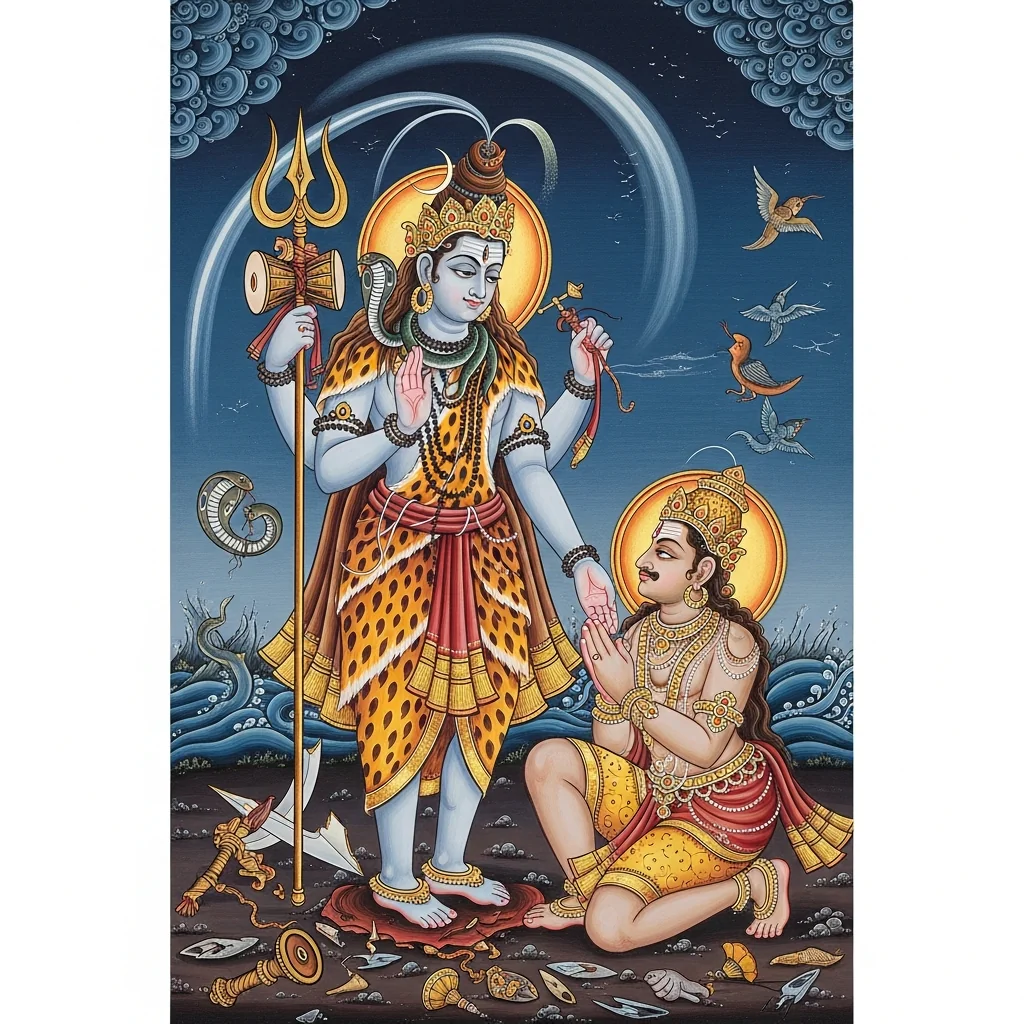
Adhyaya 48
The chapter begins with a royal query about Andhaka’s whereabouts and deeds after he has subdued the devas. Mahādeva replies that Andhaka has entered Pātāla, the subterranean realm, and is engaged in destructive acts. Keśava (Viṣṇu) arrives with bow in hand and releases the āgneya astra; Andhaka counters with the mighty vāruṇa astra, and a reciprocal exchange of divine weapons ensues. Andhaka then appears along the arrow’s course, challenges Janārdana, and escalates the quarrel with harsh speech; yet when he is physically overpowered in close combat, he shifts from confrontation to sāma (conciliation). He offers an extended stuti to Viṣṇu, invoking forms such as Narasiṃha, Vāmana, and Varāha, and praising the Lord’s compassion. Pleased, Viṣṇu grants a boon; Andhaka asks for a purifying, glorious battle by which he may ascend to higher worlds. Viṣṇu declines to fight and redirects him to Mahādeva, advising him to shake the peak of Kailāsa to provoke Śiva’s wrath. Andhaka follows this counsel; cosmic disturbances arise, Umā questions the ominous signs, and Śiva resolves to confront the offender. The devas assemble a divine chariot, and Śiva advances into a vast battle where successive astras (āgneya, vāruṇa, vāyavya, sārpa, gāruḍa, nārasiṃha) neutralize one another. The conflict intensifies into hand-to-hand struggle; Śiva is briefly immobilized, then recovers and strikes Andhaka with a major weapon, placing him upon the śūla. Blood-drops generate further dānavas, so Śiva summons Durgā/Cāmuṇḍā to drink the falling blood and prevent proliferation. With the auxiliary threat contained, Andhaka turns to praise Śiva, and Śiva grants a boon: Andhaka is absorbed into Śiva’s gaṇas as Bhṛṅgīśa, marking a movement from violent antagonism to subordinated participation in cosmic order.
Shlokas
Verse 1
उत्तानपाद उवाच । कस्मिन्स्थानेऽवसद्देव सोऽन्धको दैत्यपुंगवः । सर्वान्देवांश्च निर्जित्य कस्मिन्स्थाने समास्थितः
Uttānapāda said: “O Lord, in what place did Andhaka, foremost among the Daityas, take up his abode? Having conquered all the gods, where is he now established?”
Verse 2
श्रीमहेश उवाच । प्रविष्टो दानवो यत्र कथयामि नराधिप । पाताललोकमाश्रित्य कन्या विध्वंसते तु सः
Śrī Maheśa said: “O king, I shall tell you where that demon has entered. Taking refuge in Pātāla, the netherworld, he oppresses and destroys maidens.”
Verse 3
तत्र स्थितं तं विज्ञाय चापमादाय केशवः । व्यसृजद्बाणमाग्नेयं दह्यतामिति चिन्तयन्
Knowing him to be stationed there, Keśava took up his bow and released a fiery missile, thinking, “Let him be burned.”
Verse 4
दह्यमानोऽग्निना सोऽपि वारुणास्त्रं स संदधे । वारुणास्त्रेण महता आग्नेयं शमितं तदा
Though scorched by fire, he too deployed the Vāruṇa weapon; by that mighty Vāruṇāstra, the fiery missile was then quenched.
Verse 5
ततोऽसौ चिन्तयामास केन बाणो विसर्जितः । कस्यैषा पौरुषी शक्तिः को यास्यति यमालयम्
Then he reflected: “By whom was this arrow released? Whose is this manly power? Who will be sent to Yama’s abode?”
Verse 6
ततोऽन्धको मृधे क्रुद्धो बाणमार्गेण निर्गतः । स दृष्ट्वा बाणमार्गेण चापहस्तं जनार्दनम्
Then Andhaka, enraged in battle, advanced along the path of the arrows; following that arrow-track, he beheld Janārdana holding the bow.
Verse 7
अन्धक उवाच । न शर्म लप्स्यसे ह्यद्य मया दृष्ट्याभिवीक्षितः । न शक्नोषि तथा गन्तुं नागः शार्दूलदर्शनात्
Andhaka said: “Today you shall find no peace, for my gaze has fixed upon you. You will not be able to depart—like an elephant that cannot go on after beholding a tiger.”
Verse 8
आगच्छति यथा भक्ष्यं मार्जारस्य च मूषिकः । न शक्नोषि तथा यातुं संस्थितस्त्वं ममाग्रतः
“Just as a mouse comes forward to become a cat’s food, so you too will not be able to depart, standing here before me.”
Verse 9
अहं त्वां प्रेषयिष्यामि यममार्गे सुदारुणे । अहमन्वेषयिष्यामि किल यास्यामि ते गृहम्
“I shall send you onto the grim road of Yama, Lord of Death. Indeed, I will pursue you and come even to your very dwelling.”
Verse 10
उपनीतोऽसि कालेन सङ्ग्रामे मम केशव । ये त्वया निर्जिताः पूर्वं दानवा अप्यनेकशः
“O Keśava, Time itself has brought you into my battle—you who formerly conquered many hosts of Dānava-s.”
Verse 11
न भवन्ति पुमांसस्ते स्त्रियस्ताश्चैव केशव । परं न शस्त्रसङ्ग्रामं करिष्यामि त्वया सह
“Those whom you defeated before, O Keśava, were not truly men—they were as women. Therefore, I will not engage you in a battle of weapons.”
Verse 12
वदतो दानवेन्द्रस्य न चुकोप स केशवः । अयुध्यमानं तं दृष्ट्वा चिन्तयामास दानवः
While the lord of the Dānava-s spoke thus, Keśava did not grow angry. Seeing him not taking up combat, the Dānava pondered what to do.
Verse 13
द्वन्द्वयुद्धं करिष्यामि निश्चित्य युयुधे नृप । स कृष्णेन पदाक्षिप्तः पतितः पृथिवीतले
“I shall fight a duel,” he resolved, and he engaged in combat, O King. But struck by Kṛṣṇa’s foot, he fell upon the ground.
Verse 14
मुहूर्तात्स समाश्वस्य उत्थायेदं व्यचिन्तयत् । अशक्तो द्वन्द्वयुद्धाय ततः साम प्रयुक्तवान् । पाणिभ्यां सम्पुटं कृत्वा साष्टाङ्गं प्रणतः शुचिः
After a moment he regained his breath, rose up, and reflected thus: unable to fight a duel, he then resorted to conciliation. Folding his hands into a reverent cup, the purified one bowed in the eightfold prostration.
Verse 15
अन्धक उवाच । जय कृष्णाय हरये विष्णवे जिष्णवे नमः । हृषीकेश जगद्धात्रे अच्युताय महात्मने
Andhaka said: “Victory to Kṛṣṇa! Homage to Hari, to Viṣṇu, to the unconquered Victor. O Hṛṣīkeśa, sustainer of the worlds—salutations to Acyuta, the great-souled.”
Verse 16
नमः पङ्कजनाभाय नमः पङ्कजमालिने । जनार्दनाय श्रीशाय श्रीपते पीतवाससे
Homage to the Lotus-naveled; homage to the Lord garlanded with lotuses. Salutations to Janārdana, to the Lord of Śrī, to Śrīpati, to the One clad in yellow garments.
Verse 17
गोविन्दाय नमो नित्यं नमो जलधिशायिने । नमः करालवक्त्राय नरसिंहाय नादिने
Everlasting homage to Govinda; homage to the One who reclines upon the ocean. Salutations to the fierce-faced One—to Narasiṃha, the roaring Lord.
Verse 18
शार्ङ्गिणे सितवर्णाय शङ्खचक्रगदाभृते । नमो वामनरूपाय यज्ञरूपाय ते नमः
Salutations to the wielder of Śārṅga, to the radiant-hued One, to Him who bears conch, discus, and mace. Homage to the Lord in the form of Vāmana; homage to You whose very form is Sacrifice (Yajña).
Verse 19
नमो वराहरूपाय क्रान्तलोकत्रयाय च । व्याप्ताशेषदिगन्ताय केशवाय नमोनमः
Salutations again and again to Keśava, who has taken the form of the Boar—who has strode across the three worlds and whose presence pervades the farthest limits of every direction.
Verse 20
वासुदेव नमस्तुभ्यं नमः कैटभनाशिने । लक्ष्म्यालय सुरश्रेष्ठ नमस्ते सुरनायक
O Vāsudeva, salutations to you; salutations to the slayer of Kaiṭabha. O abode of Lakṣmī, best among the gods—salutations to you, O leader of the devas.
Verse 21
विष्णोर्देवाधिदेवस्य प्रमाणं येऽपि कुर्वते । प्रजापतेर्जगद्धातुस्तेषामपि नमाम्यहम्
I bow even to those who affirm the true greatness of Viṣṇu, the God above gods—and likewise to those who uphold Prajāpati, the sustainer of the world.
Verse 22
समस्तभूतदेवस्य वासुदेवस्य धीमतः । प्रणामं ये प्रकुर्वन्ति तेषामपि नमाम्यहम्
I bow even to those who offer prostration to wise Vāsudeva, the divine Lord who abides in all beings.
Verse 23
तस्य यज्ञवराहस्य विष्णोरमिततेजसः । प्रणामं ये प्रकुर्वन्ति तेषामपि नमाम्यहम्
I bow even to those who prostrate to that Viṣṇu of immeasurable splendor—the sacrificial Varāha.
Verse 24
गुणानां हि निधानाय नमस्तेऽस्तु पुनःपुनः । कारुण्याम्बुनिधे देव सर्वभक्तिप्रियाय च
Salutations to you again and again, O treasury of virtues. O God, ocean of compassion and beloved of every devotee—salutations to you.
Verse 25
श्रीभगवानुवाच । तुष्टस्ते दानवेन्द्राहं वरं वृणु यथेप्सितम् । ददामि ते वरं नूनमपि त्रैलोक्यदुर्लभम्
The Blessed Lord said: “O king of the Dānavas, I am pleased with you. Choose a boon as you desire; I shall surely grant you a boon—even one difficult to obtain in the three worlds.”
Verse 26
अन्धक उवाच । यदि तुष्टोऽसि मे देव वरं दास्यसि चेप्सितम् । तदा ददस्व मे देव युद्धं परमशोभनम् । अवद्धस्तपूतो येनाहं लोकान्गन्तास्मि शोभनान्
Andhaka said: “If you are pleased with me, O Lord, and will grant the boon I desire, then grant me, O God, a most splendid battle—by which, unbound and purified by austerity, I may go to radiant worlds.”
Verse 27
श्रीभगवानुवाच । कथं ददामि ते युद्धं तोषितोऽहं त्वया पुनः । न त्वां तु प्रभवेत्कोपः कथं युध्यामि तेऽन्धक
The Blessed Lord said: “How can I grant you battle, when you have pleased me again? No anger arises in me toward you—so how could I fight you, O Andhaka?”
Verse 28
यदि ते वर्तते बुद्धिर्युद्धं प्रति न संशयः । ततो गच्छस्व युद्धाय देवं प्रति महेश्वरम्
If your mind is set on battle and there is no doubt, then go forth to fight—approach the God Maheśvara.
Verse 29
अन्धक उवाच । न तत्र सिध्यते कार्यं देवं प्रति महेश्वरम्
Andhaka said: “No undertaking succeeds there, when it is directed against the Great Lord, Maheśvara.”
Verse 30
श्रीभगवानुवाच । पुत्र त्वं शिखरं गत्वा धूनयस्व बलेन च
The Blessed Lord said: “My son, go to the mountain-peak and shake it with your strength.”
Verse 31
विधूते तत्र देवेशः कोपं कर्ता सुदारुणम् । कोपितः शङ्करो रौद्रं युद्धं दास्यति दानव
When that peak is shaken, the Lord of gods will unleash a most terrible wrath. Enraged, Śaṅkara will grant you a fierce battle, O Dānava.
Verse 32
विष्णुवाक्यादसौ पापो गतो यत्र महेश्वरः । कैलासशिखरं प्राप्य धुनोति स्म मुहुर्मुहुः
At Viṣṇu’s word, that sinful one went to where Maheśvara was. Reaching the summit of Kailāsa, he shook it again and again.
Verse 33
धूनिते तत्र शिखरे कम्पितं भुवनत्रयम् । निपेतुः शिखराग्राणि कम्पमानान्यनेकशः
When that summit was shaken, the three worlds trembled. Many crag-tops, quivering violently, fell down in great numbers.
Verse 34
चत्वारः सागराः क्षिप्रमेकीभूता महीपते । निपेतुरुल्कापाताश्च पादपा अप्यनेकशः
O king, the four oceans quickly seemed to become one; meteoric falls rained down, and many trees too were uprooted and cast down.
Verse 35
उमया सहितो देवो विस्मयं परमं गतः । गाढमालिङ्ग्य गिरिजा देवं वचनमब्रवीत्
The Lord, accompanied by Umā, was seized by great astonishment. Clasping the God tightly, Girijā spoke these words.
Verse 36
किमर्थं कम्पते शैलः किमर्थं कम्पते धरा । किमर्थं कम्पते नागो मर्त्यः पातालमेव च । किं वा युगक्षयो देव तन्ममाख्यातुमर्हसि
“Why does the mountain quake? Why does the earth tremble? Why do the Nāgas, mortals, and even Pātāla shake? Or is it the end of an age, O Lord? Please tell me this.”
Verse 37
ईश्वर उवाच । कस्यैषा दुर्मतिर्जाता क्षिप्तः सर्पमुखे करः । ललाटे च कृतं वर्म स यास्यति यमालयम्
Īśvara said: “Whose wicked notion has arisen—to thrust a hand into a serpent’s mouth, and to set armor upon the forehead? He shall go to Yama’s abode.”
Verse 38
कैलासमाश्रितो येन सुप्तोऽहं येन बोधितः । तं वधिष्ये न सन्देहः सम्मुखो वा भवेद्यदि
“The one who, taking refuge on Kailāsa, disturbed my repose—by whom I was awakened—I shall slay him without doubt, if he comes before me.”
Verse 39
चिन्तयामास देवेशो ह्यन्धकोऽयं न संशयः । उपायं चिन्तयामास येनासौ वध्यते क्षणात्
The Lord of the Devas reflected: “This is Andhaka—there is no doubt.” He then pondered a means by which that foe might be slain in an instant.
Verse 40
आगताश्च सुराः सर्वे ब्रह्माद्या वसुभिः सह । रथं देवमयं कृत्वा सर्वलक्षणसंयुतम्
All the gods arrived—Brahmā and the rest, together with the Vasus—and fashioned a divine chariot, complete with every auspicious mark.
Verse 41
केचिद्देवाः स्थिताश्चक्रे केचित्तुण्डाग्रपार्श्वयोः । केचिन्नाभ्यां स्थिता देवाः केचिद्धुर्येषु संस्थिताः
Some gods took their places upon the wheel; some stood by the front and its sides; some deities stationed themselves at the hub, while others stood upon the yoke.
Verse 42
धुरीषु निश्चलाः केचित्केचिद्यूपेषु संस्थिताः । केचित्स्यन्दनसंस्तम्भाः केचित्स्यन्दनवेष्टकाः
Some remained steady upon the yokes; some were stationed at the posts; some became the chariot’s supporting pillars, and others its protective bindings.
Verse 43
आमलसारकेऽन्येऽपि अन्येऽपि कलशे स्थिताः । रिपोर्भयंकरं दिव्यं ध्वजमालादिशोभितम्
Others too were set upon the āmalasāraka (crest-ornament), and others upon the finial (kalaśa). The divine chariot was adorned with banners and garlands, terrifying to the enemy.
Verse 44
रथं देवमयं कृत्वा तमारूढो जगद्गुरुः । निर्ययौ दानवो यत्र कोपाविष्टो महेश्वरः
Having thus prepared the divine chariot, the World-Teacher mounted it. Then Mahēśvara, filled with wrath, set forth to where the Dānava was.
Verse 45
तिष्ठ तिष्ठेत्युवाचाथ क्व प्रयास्यसि दुर्मते । शरासनं करे गृह्य शरांश्चिक्षेप दानवे
“Stand! Stand!” he cried. “Where will you go, O evil-minded one?” Taking up the bow in his hand, he hurled arrows at the Dānava.
Verse 46
दानवेऽधिष्ठिते युद्धे शरैश्चिछेद सायकान् । शरासनेण तत्रैव अन्धकश्छादितस्तदा
As the Dānava pressed the battle, he cut down the missiles with his arrows. Then, right there, Andhaka was covered over—obscured by the shower of bow and arrows.
Verse 47
न तत्र दृश्यते सूर्यो नाकाशं न च चन्द्रमाः । आग्नेयमस्त्रं व्यसृजद्दानवोऽपि शिवं प्रति
There the sun was not seen—nor the sky, nor even the moon. Then the Dānava too discharged the Fiery Weapon (Āgneya-astra) against Śiva.
Verse 48
। अध्याय
“Chapter (Adhyāya)” — a colophon marker indicating the close or transition of the adhyāya in the manuscript tradition.
Verse 49
ततो देवाधिदेवोऽसौ वारुणास्त्रमयोऽजयत् । वारुणास्त्रेण निमिषादाग्नेयं नाशितं तदा
Then that Lord of gods prevailed by manifesting the Varuṇa-weapon. In a mere instant, by the Varuṇa-weapon, the fiery weapon was destroyed.
Verse 50
दानवेन तदा मुक्तं वायव्यास्त्रं रणाजिरे । वारुणं च गतं तात वायव्यास्त्रविनाशितम्
Then, on the battlefield, the Dānava released the Vāyu-weapon. And, dear one, the Varuṇa-weapon too was neutralized—destroyed by that Vāyu-weapon.
Verse 51
देवो व्यसर्जयत्सार्पं क्रोधाविष्टेन चेतसा । मारुतं नाशितं बाणैः सर्पैस्तत्र न संशयः
Enraged at heart, the Deva released the Serpent-weapon. By those serpent-like arrows, the wind-force was destroyed—of this there is no doubt.
Verse 52
दानवेन ततो मुक्तं गरुडास्त्रं च लीलया । गारुडास्त्रं च तद्दृष्ट्वा सार्पं नैव व्यदृश्यत
Then the Dānava, as though in sport, released the Garuḍa-weapon. And when that Gāruḍa-astra appeared, the Serpent-weapon was seen no more.
Verse 53
ततो देवाधिदेवेन नारसिंहं विसर्जितम् । नारसिंहास्त्रबाणेन गारुडास्त्रं प्रशामितम्
Then the Lord of gods discharged the Nārasiṃha power. By the arrow of the Nārasiṃha-weapon, the Garuḍa-weapon was pacified and brought to rest.
Verse 54
अस्त्रमस्त्रेण शम्येत न बाध्येत परस्परम् । महद्युद्धमभूत्तातसुरासुरभयंकरम्
A weapon is to be quelled by a weapon; they do not overpower one another outright. Thus there arose, dear one, a great battle—terrifying to gods and asuras alike.
Verse 55
चक्रनालीकनाराचैस्तोमरैः खड्गमुद्गरैः । वत्सदन्तैस्तथा भल्लैः कर्णिकारैश्च शोभनैः
With discus-weapons, barbed darts, iron arrows, spears, swords, and maces; with ‘calf-tooth’ missiles, with bhalla arrows, and with splendid karṇikāra shafts—
Verse 56
एवं न शक्यते हन्तुं दानवो विविधायुधैः । तदा ज्वालाकरालाश्च खड्गनाराचतोमराः
In this way the Dānava could not be slain by weapons of many kinds. Then there appeared blazing, fearsome swords, iron arrows, and spears—
Verse 57
वृषाङ्केन विमुक्तास्तु समरे दानवं प्रति । न संस्पृशन्ति शस्त्राणि गात्रं गौडवधूरिव
But the weapons loosed in battle by the Bull-bannered Lord against the Dānava did not even touch his body—like suitors’ advances that cannot reach a noble Gauḍa bride.
Verse 58
आयुधानि ततस्त्यक्त्वा बाहुयुद्धमुपस्थितौ । करं करेण संगृह्य प्रहरन्तौ स्वमुष्टिभिः । रणप्रयोगैर्युध्यन्तौ युयुधाते शिवान्धकौ
Then, casting aside their weapons, the two entered hand-to-hand combat. Grasping hand with hand and striking with their fists, employing the arts of battle, Śiva and Andhaka fought on.
Verse 59
श्रीमार्कण्डेय उवाच । अन्धकं प्रति देवेशश्चिन्तयामास निग्रहम् । हनिष्यामि न सन्देहो दुष्टात्मानं न संशयः
Śrī Mārkaṇḍeya said: The Lord of the Devas resolved to restrain Andhaka. “I shall slay that wicked-souled one—of this there is no doubt, no uncertainty.”
Verse 60
स शिवेन यदा क्षिप्तः पतितः पृथिवीतले । ऊर्ध्वबाहुरधोवक्त्रो दानवो नृपसत्तम
O best of kings, when that Dānava was hurled by Śiva, he fell upon the earth—his arms flung upward, his face turned downward.
Verse 61
क्रोधाविष्टेन देवेशः सङ्ग्रामे देवशत्रुणा । कक्षयोः कुहरे क्षिप्त्वा बन्धेनाक्रम्य पीडितः
In the battle, the Lord of the Devas, seized by wrath, was assailed by the enemy of the gods; he was cast into the hollow of the armpits and, being bound and pressed down by fetters, was pained.
Verse 62
निस्पन्दश्चाभवद्देवो मूर्च्छायुक्तो महेश्वरः । मूर्च्छापन्नं तु तं ज्ञात्वा चिन्तयामास दानवः
Maheśvara became motionless, the Lord overcome by a swoon. Knowing that he had fallen into faintness, the dānava began to ponder.
Verse 63
हाहा कष्टं कृतं मेऽद्य दुष्कृतं पापकर्मणा । किं करोमि कथं कर्म कस्मिन्स्थाने तु मोचये
“Alas, alas! Today I have done a grievous deed—an evil act born of sinful conduct. What shall I do? How shall I act? In what place may I find release from this sin?”
Verse 64
गृहीत्वा देवमुत्सङ्गे गतः कैलासपर्वतम् । शय्यायां शङ्करं न्यस्य निर्ययौ दैत्यराट्ततः
Lifting the God into his lap, he went to Mount Kailāsa. Placing Śaṅkara upon a couch, the king of the Daityas then went out.
Verse 65
शय्यायां पतितो देवः प्रपेदे वेदनां ततः । तावद्ददर्श चात्मानं स्वकीयभवनस्थितम्
The God, fallen upon the couch, then felt pain. At that moment he beheld himself as though situated in his own abode.
Verse 66
पराभवः कृतो मद्यं कथं तेन दुरात्मना । क्रोधवेगसमाविष्टो निर्ययौ दानवं प्रति
“How has that wicked one brought this disgrace upon me?” Enveloped by the surge of wrath, he went forth against the demon.
Verse 67
आयसीं लगुडीं गृह्य प्रभुर्भारसहस्रजाम् । दानवं च ततो दृष्ट्वा प्राक्षिपत्तस्य मूर्धनि
Taking up an iron club, the Lord—weighty as a thousand burdens—beheld the demon and hurled it upon his head.
Verse 68
खड्गेन ताडयामास दानवः प्रहसन्रणे । देवेनाथस्मृतं चास्त्रं कौच्छेराख्यं महाहवे
Laughing amid the fray, the demon struck with his sword; then, in that great battle, the God recalled the weapon called “Kaucchera”.
Verse 69
दीप्यमानं समुत्सृज्य हृदये ताडितः क्षणात् । ततः स ताडितस्तेन रुधिरोद्गारमुद्वमन्
Casting away what blazed like fire, he was struck in the heart in an instant; and, smitten thus, he spewed forth a gush of blood.
Verse 70
पतितोऽधोमुखो भूत्वा ततः शूलेन भेदितः । पुनश्च देवदेवेन शूलेन द्विदलीकृतः
Falling headlong, he was pierced by the trident; and again, by the Lord of gods, he was split in two with the trident.
Verse 71
शूलाग्रेऽसौ स्थितः पापो भ्रान्तवांश्चक्रवत्तदा । ये ये भूम्यां पतन्ति स्म तत्कायाद्रक्तबिन्दवः
That sinner, fixed upon the trident’s tip, then whirled like a spinning wheel; and whatever drops of blood fell to the ground from his body—
Verse 72
ते ते सर्वे समुत्तस्थुर्दानवाः शास्त्रपाणयः । व्याकुलस्तु ततो देवो दानवेन तरस्विना
From those drops they all arose—Dānavas with weapons in their hands. Then the god was troubled by that swift and forceful Dānava.
Verse 73
देवेनाथ स्मृता दुर्गा चामुण्डा भीषणानना । आयाता भीषणाकारा नानायुधविराजिता
Then the god remembered Durgā—Chamūṇḍā of dreadful visage. She came forth, terrifying in form, resplendent with many kinds of weapons.
Verse 74
महादंष्ट्रा महाकाया पिङ्गाक्षी लम्बकर्णिका । आदेशो दीयतां देव को यास्यति यमालयम्
‘Great-tusked, huge-bodied, tawny-eyed, long-eared—give the command, O Lord: who shall be sent to Yama’s abode?’
Verse 75
ईश्वर उवाच । पिबास्य रुधिरं भद्रे यथेष्टं दानवस्य च । निपतद्रुधिरं भूमौ दुर्गे गृह्णीष्व माचिरम्
Īśvara said: ‘Drink his blood, O blessed one—drink as you wish of the Dānava’s blood. And whatever blood falls upon the ground, O Durgā, take it up without delay.’
Verse 76
निहन्मि दानवं यावत्साहाय्यं कुरु सुन्दरि । एवमुक्ता तु सा दुर्गा पपौ च रुधिरं ततः
‘While I slay the Dānava, render assistance, O fair one.’ Thus addressed, Durgā then drank the blood.
Verse 77
निहता दानवाः सर्वे देवेशेन सहस्रशः । अन्धकोऽपि च तान् दृष्ट्वा दानवानवनिं गतान् । ततो वाग्भिः प्रतुष्टाव देवदेवं महेश्वरम्
By the thousands, the Lord of the gods slew all the Dānavas. And even Andhaka, seeing those Dānavas cast down upon the earth, then praised Devadeva Maheśvara with words.
Verse 78
अन्धक उवाच । जयस्व देवदेवेश उमार्धार्धाशरीरधृक् । नमस्ते देवदेवेश सर्वाय त्रिगुणात्मने
Andhaka said: “Be victorious, O Lord of the gods, who bears Umā as half of Your very body. Salutations to You, O Lord of the gods—the All, whose nature is the three guṇas.”
Verse 79
वृषभासनमारूढ शशाङ्ककृतशेखर । जय खट्वाङ्गहस्ताय गङ्गाधर नमोऽस्तु ते
O Lord seated upon the bull, whose crest is adorned with the moon—victory to You, the bearer of the khaṭvāṅga staff! O Gaṅgādhara, holder of the Gaṅgā, may salutations be to You.
Verse 80
नमो डमरुहस्ताय नमः कपालमालिने । स्मरदेहविनाशाय महेशाय नमोऽस्तु ते
Salutations to You who hold the ḍamaru; salutations to You who wear a garland of skulls. Salutations to Maheśa, the destroyer of Smara (Kāma)’s body.
Verse 81
पूष्णो दन्तनिपाताय गणनाथाय ते नमः । जय स्वरूपदेहाय अरूपबहुरूपिणे
Salutations to You, Gaṇanātha, who caused Pūṣan’s teeth to fall. Victory to You whose body is pure essential being—formless, yet assuming many forms.
Verse 82
उत्तमाङ्गविनाशाय विरिञ्चेरपि शङ्कर । श्मशानवासिने नित्यं नित्यं भैरवरूपिणे
O Śaṅkara—destroyer even of Brahmā’s head—ever dwelling in the cremation ground, ever, ever manifest as Bhairava!
Verse 83
त्वं सर्वगोऽसि त्वं कर्ता त्वं हर्ता नान्य एव च । त्वं भूमिस्त्वं दिशश्चैव त्वं गुरुर्भार्गवस्तथा
You are all-pervading; You are the doer; You are the withdrawer—there is none other. You are the earth; You are the directions; and You are also the Guru—Bhārgava as well.
Verse 84
सौरिस्त्वं देवदेवेश भूमिपुत्रस्तथैव च । ऋक्षग्रहादिकं सर्वं यद्दृश्यं तत्त्वमेव च
O God of gods, You are Śauri as well, and likewise the son of Earth. All of it—constellations, planets, and whatever is seen—indeed, that very reality is You alone.
Verse 85
एवं स्तुतिं तदा कृत्वा देवं प्रति स दानवः । संहताभ्यां तु पाणिभ्यां प्रणनाम महेश्वरम्
Having thus offered his hymn to the God, that Dānava then bowed to Maheśvara with his hands joined in reverence.
Verse 86
ईश्वर उवाच । साधु साधु महासत्त्व वरं याचस्व दानव । दाताहं याचकस्त्वं हि ददामीह यथेप्सितम्
Īśvara said: “Well done, well done, O great-souled one. Ask for a boon, O Dānava. I am the giver and you are the petitioner; here I shall grant what you desire.”
Verse 87
अन्धक उवाच । यदि तुष्टोऽसि देवेश यदि देयो वरो मम । तदात्मसदृशोऽहं ते कर्तव्यो नापरो वरः
Andhaka said: “If you are pleased, O Lord of the gods, and if a boon is to be granted to me—then make me like unto your own nature; I seek no other boon.”
Verse 88
भस्मी जटी त्रिनेत्री च त्रिशूली च चतुर्भुजः । व्याघ्रचर्मोत्तरीयश्च नागयज्ञोपवीतकः
(Let me become) ash-smeared, matted-haired, and three-eyed; bearing the trident, four-armed; wearing a tiger-skin as an upper garment, and having a serpent as the sacrificial thread.
Verse 89
एतदिच्छाम्यहं सर्वं यदि तुष्टो महेश्वर
If you are pleased, O Maheśvara, I desire all this.
Verse 90
ईश्वर उवाच । ददामि ते वरं ह्यद्य यस्त्वया याचितोऽनघ । गणेषु मे स्थितः पुत्र भृङ्गीशस्त्वं भविष्यसि
Īśvara said: “Blameless one, today I grant you the boon you have asked for. My son, established among my gaṇas, you shall become Bhṛṅgīśa.”