Adhyaya 9
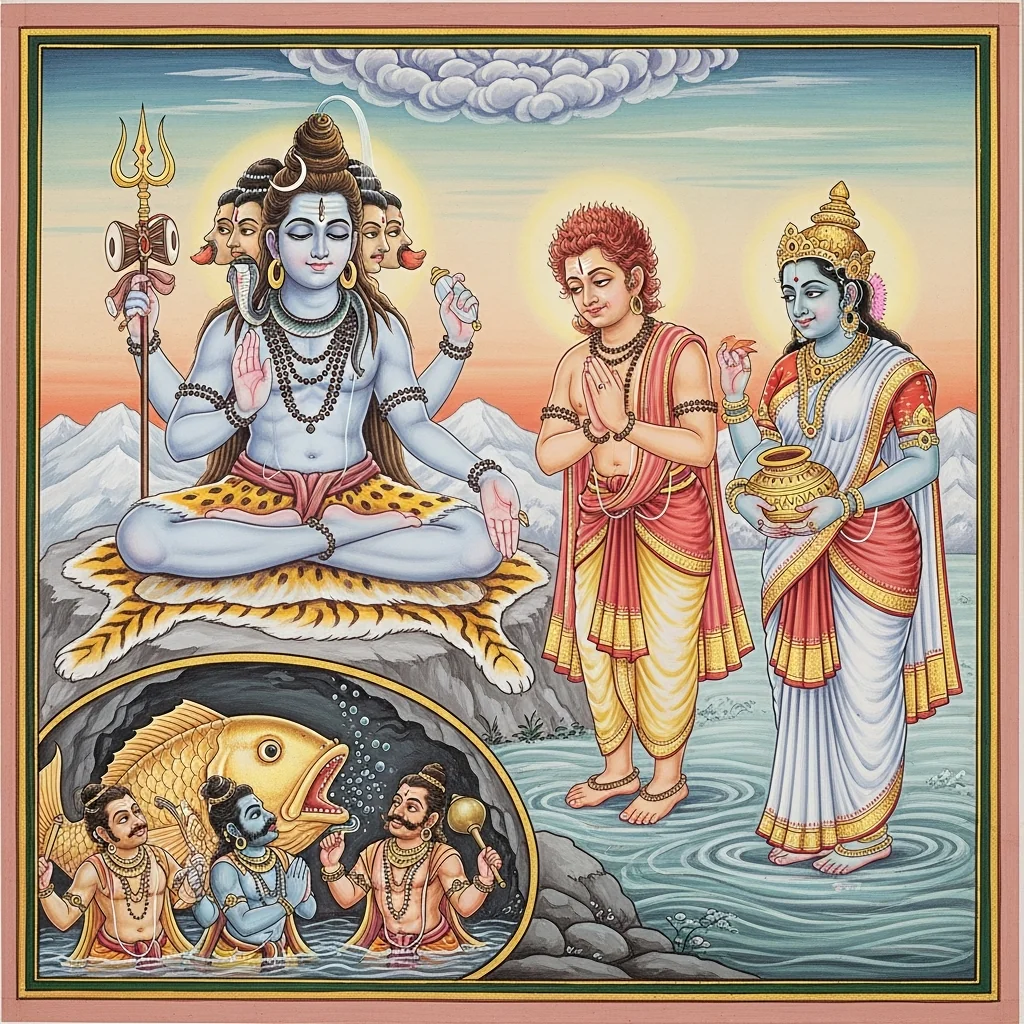
Narrated by Śrī Mārkaṇḍeya, this chapter portrays the yugānta-pralaya: the world is overwhelmed by waters. Śiva, the supreme Lord, is shown resting in yogic absorption, upheld by Prakṛti, as sages and divine beings behold him and offer praise. A theological exchange follows. Brahmā laments that the four Vedas have been lost, declaring them indispensable for creation, for the remembrance of time (past and present), and for ordered knowledge. At Śiva’s prompting, Narmadā (Revā) explains the cause: the mighty daityas Madhu and Kaiṭabha exploited a vulnerability during the divine sleep-state and hid the Vedas in the ocean’s depths. The Vaiṣṇava intervention is then recalled: the deity assumes fish-form (mīnarūpa), descends to Pātāla, finds the Vedas, defeats the daityas, and restores the Vedas to Brahmā so that creation may begin anew. The discourse culminates in river-theology: Gaṅgā, Revā (Narmadā), and Sarasvatī are presented as one sacred power in three expressions, each linked to a major deity-form. Narmadā is praised as subtle, all-pervading, purifying, and a means to cross saṃsāra; contact with her waters and reverent worship of Śiva on her banks are said to grant purification and exalted spiritual fruits.
Shlokas
Verse 1
श्रीमार्कण्डेय उवाच । पुनर्युगान्तं ते चान्यं सम्प्रवक्ष्यामि तच्छृणु । सूर्यैरादीपिते लोके जङ्गमे स्थावरे पुरा
Śrī Mārkaṇḍeya said: “I shall now tell you of yet another end of an age; listen. Formerly, when the world was scorched by suns, both the moving creatures and the immovable beings were afflicted.”
Verse 2
सरित्सरःसमुद्रेषु क्षयं यातेषु सर्वशः । निर्मानुषवषट्कारे ह्यमर्यादगतिं गते
When rivers, lakes, and oceans had altogether gone to destruction, and when the human rites of “vaṣaṭ” had ceased—indeed, when all had fallen into a state beyond proper order—…
Verse 3
नानारूपैस्ततो मेघैः शक्रायुधविराजितैः । सर्वमापूरितं व्योम वार्यौघैः पूरिते तदा
Then the sky was wholly filled with clouds of many forms, radiant with Indra’s weapon—lightning; and at that time it was flooded with torrents of water.
Verse 4
ततस्त्वेकार्णवीभूते सर्वतः सलिलावृते । जगत्कृत्वोदरे सर्वं सुष्वाप भगवान्हरः
Then, when everything had become a single ocean and was covered by water on all sides, the Blessed Hara (Śiva), having taken the entire universe into His belly, lay down to sleep.
Verse 5
प्रकृतिं स्वामवष्टभ्य योगात्मा स प्रजापतिः । शेते युगसहस्रान्तं कालमाविश्य सार्णवम्
Holding fast to His own Prakṛti (cosmic nature), that Lord—whose very essence is Yoga, the Prajāpati—lies merged in the oceanic flood, abiding in repose until the end of a thousand ages.
Verse 6
तत्र सुप्तं महात्मानं ब्रह्मलोकनिवासिनः । भृग्वादिऋषयः सर्वे ये चान्ये सनकादयः
There, the great-souled One lay asleep; and all the sages dwelling in Brahmaloka—Bhṛgu and the rest—together with others such as Sanaka and his brothers, came and beheld Him.
Verse 7
पर्यङ्के विमले शुभ्रे नानास्तरणसंस्तृते । शयानं ददृशुर्देवं सपत्नीकं वृषध्वजम्
Upon a pure and radiant couch, spread with many coverings, they saw the God lying in repose—Bull-bannered Śiva (Vṛṣadhvaja)—together with His consort.
Verse 8
विश्वरूपा तु सा नारी विश्वरूपो महेश्वरः । गाढमालिङ्ग्य सुप्तस्तां ददृशे चाहमव्ययम्
That Woman was of universal form, and Maheśvara too was of universal form. Holding Her in a close embrace, He slept; and I beheld that imperishable One.
Verse 9
। अध्याय
Chapter—heading marker.
Verse 10
विमलाम्बरसंवीतां व्यालयज्ञोपवीतिनीम् । श्यामां कमलपत्राक्षीं सर्वाभरणभूषिताम्
They beheld Her clad in spotless garments, wearing a serpent as the sacred thread—dark-hued, lotus-petaled-eyed, adorned with every ornament.
Verse 11
सकलं युगसाहस्रं नर्मदेयं विजानती । प्रसुप्तं देवदेवेशमुपास्ते वरवर्णिनी
Knowing the Narmadā region, the fair and excellent lady worshipfully attended the Lord of the lords of gods, who lay in deep repose, throughout the entire span of a thousand ages.
Verse 12
हृतैर्वेदैश्चतुर्भिश्च ब्रह्माप्येवं महेश्वरः । भृग्वाद्यैर्मानसैः पुत्रैः स्तौति शङ्करमव्ययम्
Even Brahmā—though the four Vedas had been taken away—thus, together with his mind-born sons such as Bhṛgu, praised the imperishable Śaṅkara.
Verse 13
भक्त्या परमया राजंस्तत्र शम्भुमनामयम् । स्तुवन्तस्तत्र देवेशं मन्त्रैरीश्वरसम्भवैः
O King, there with supreme devotion they praised Śambhu, the faultless One; there they extolled the Lord of gods with mantras born of Īśvara.
Verse 14
प्रसुप्तं देवमीशानं बोधयन्समुपस्थितः । उत्तिष्ठ हर पिङ्गाक्ष महादेव महेश्वर
Standing near, seeking to awaken the sleeping Lord Īśāna, he said: “Arise, O Hara, O tawny-eyed One—O Mahādeva, O Maheśvara!”
Verse 15
मम वेदा हृताः सर्वे अतोऽहं स्तोतुमुद्यतः । वेदैर्व्याप्तं जगत्सर्वं दिव्यादिव्यं चराचरम्
All my Vedas have been taken away; therefore I now rise to offer praise. For the entire universe—divine and non-divine alike, moving and unmoving—is pervaded and upheld by the Vedas.
Verse 16
अतीतं वर्तमानं च स्मरामि च सृजाम्यहम् । तैर्विना चाहमेकस्तु मूकोऽधो जडवत्सदा
I remember the past and the present, and I bring forth creation. Yet without those (Vedas), I alone become ever mute, diminished, and inert—like one senseless.
Verse 17
गतिर्वीर्यं बलोत्साहौ तैर्विना न प्रजायते । तैर्विना देवदेवेश नाहं किंचित्स्मरामि वै
Without them, movement, vigor, strength, and resolve do not arise. Without them, O Lord of the gods, I truly cannot remember anything at all.
Verse 18
तान्वेदान्देवदेवेश शीघ्रं मे दातुमर्हसि । जडान्धबधिरं सर्वं जगत्स्थावरजङ्गमम्
Therefore, O Lord of the gods, swiftly grant me those Vedas. Without them, the entire world—both the stationary and the moving—becomes as if inert, blind, and deaf.
Verse 19
स्थानादि दश चत्वारि न शोभन्ते सुरेश्वर । प्रणमाम्यल्पवीर्यत्वाद्वेदहीनः सुरेश्वर
O Lord of the gods, the fourteen stations and the rest do not shine for me. Deprived of the Vedas and weakened in power, I bow down to you, O Sureśvara.
Verse 20
वेदेभ्यः सकलं जातं यत्किंचित्सचराचरम् । तावच्छोभन्ति शास्त्राणि समस्तानि जगद्गुरो
From the Vedas has arisen everything whatsoever, moving and unmoving. Only so long do all the scriptures shine forth, O Teacher of the world.
Verse 21
यावद्वेदनिधिरयं नोपतिष्ठेत्सनातनः । यथोदितेन सूर्येण तमो याति विनाशताम्
So long as this eternal treasure of the Veda does not stand present, darkness remains—just as, when the sun rises, darkness goes to destruction.
Verse 22
एवं समस्तपापानि यान्ति वेदस्य धारणात् । वेदे रहसि यत्सूक्ष्मं यत्तद्ब्रह्म सनातनम्
Thus, all sins depart through the upholding of the Veda. And that subtle, secret essence within the Veda—know that to be the eternal Brahman.
Verse 23
हृदिस्थं देव जानामि गतं तद्वेदगर्जनात् । वेदानुच्चरतो मेऽद्य तव शङ्कर चाग्रतः
O God, I know that what dwelt within my heart has departed, borne away by the roaring of the Veda. Today, unable to recite the Vedas, I stand before you, O Śaṅkara.
Verse 24
अकस्मात्ते गता वेदा न सृजेयं विभो भुवम् । तेऽपि सर्वे महादेव प्रविष्टाः सम्मुखार्णवम्
When your Vedas suddenly departed, O Lord, I could not create the world. And those very Vedas, O Mahādeva, have all entered into the ocean that lies before you.
Verse 25
ते याच्यमाना देवेश तिष्ठन्तु स्मरणे मम । दुहितेयं विशालाक्षी सर्वः सर्वं विजानते
O Lord of the gods, when they are implored, may they remain within my remembrance. This daughter, wide-eyed, knows all; indeed, the All-knowing understands everything.
Verse 26
जायती युगसाहस्रं नान्या काचिद्भवेदृशी । ऋषिश्चायं महाभागो मार्कण्डो धीमतां वरः
She endures for a thousand yugas—none other is ever found like her. And this sage, the greatly fortunate Mārkaṇḍeya, is foremost among the wise.
Verse 27
कल्पे कल्पे महादेव त्वामयं पर्युपासते । जगत्त्रयहितार्थाय चरते व्रतमुत्तमम्
In every kalpa, O Mahādeva, he worships you with devoted attendance. For the welfare of the three worlds, he practices an excellent vow.
Verse 28
एवमुक्तस्तु देवेशो ब्रह्मणा परमेष्ठिना । उवाच श्लक्ष्णया वाचा नर्मदां सरितां वराम्
Thus addressed by Brahmā, the Supreme Lord, the Lord of gods spoke in gentle words to Narmadā—the best among rivers.
Verse 29
कथयस्व महाभागे ब्रह्मणस्त्वं तु पृच्छतः । केन वेदा हृताः सर्वे वेधसो जगतीगुरोः
O greatly blessed one, tell, for Brahmā is asking: by whom were all the Vedas stolen from the Creator, the Guru of the world?
Verse 30
एवमुक्ता तु रुद्रेण उवाच मृगलोचना । ब्रह्मणो जपतो वेदांस्त्वयि सुप्ते महेश्वर
Thus spoken to by Rudra, the doe-eyed one replied: “While Brahmā was reciting the Vedas, and while you, O Maheśvara, were asleep…”
Verse 31
भवतश्छिद्रमासाद्य घोरेऽस्मिन्सलिलावृते । पूर्वकल्पसमुद्भूतावसुरौ सुरदुर्जयौ
Finding an opening in your unguarded moment, in this dreadful expanse covered by waters, two asuras arose from a former kalpa—invincible even to the gods.
Verse 32
श्रियावृत्तौ महादेव त्वया चोत्पादितौ पुरा । सुरासुरसुदुर्जेयौ दानवौ मधुकैटभौ
O Mahādeva, in connection with Śrī’s activity and the turning of fortune, you formerly brought them forth—those dānavas Madhu and Kaiṭabha, exceedingly difficult to conquer for both gods and asuras.
Verse 33
तौ वायुभूतौ सूक्ष्मौ च पठतोऽस्मात्पितामहात् । तावाशु हृत्वा वेदांश्च प्रविष्टौ च महार्णवम्
Those two, becoming like the wind—subtle indeed—swiftly stole the Vedas from the Grandsire as he recited, and then entered the great ocean.
Verse 34
एतच्छ्रुत्वा महातेजा ह्यमृतायास्ततो वचः । सस्मार स च देवेशं शङ्खचक्रगदाधरम्
Hearing these words of Amṛtā (Narmadā), that mighty one then remembered the Lord—bearing conch, discus, and mace.
Verse 35
स विवेश महाराज भूतलं ससुरोत्तमः । दानवान्तकरो देवः सर्वदैवतपूजितः
O King, that God—praised even by the best among the gods, the destroyer of the Dānavas, and worshipped by all the deities—entered down into the nether region beneath the earth.
Verse 36
मीनरूपधरो देवो लोडयामास चार्वणम् । वेदांश्च ददृशे तत्र पाताले निहितान्प्रभुः
Assuming the form of a fish, the Lord churned and searched that watery depth; and there, in the realm of Pātāla, the sovereign beheld the Vedas that had been hidden away.
Verse 37
तौ च दैत्यौ महावीर्यौ दृष्टवान्मधुसूदनः । महावेगौ महाबाहू सूदयामास तेजसा
Seeing those two mighty, heroic Daityas—swift in their onrush—the slayer of Madhu, the great-armed Lord, struck them down by his divine power.
Verse 38
वेदांस्तत्रापि तोयस्थानानिनाय जगद्गुरुः । चतुर्वक्त्राय देवायाददाच्चक्रविभूषितः
Then the World-Teacher brought the Vedas even from those watery abodes, and—adorned with the sacred discus—handed them to the four-faced god, Brahmā.
Verse 39
ततः प्रहृष्टो भगवान् वेदांल्लब्ध्वा पितामहः । जनयामास निखिलं जगद्भूयश्चराचरम्
Thereafter the revered Pitāmaha, Brahmā, delighted upon regaining the Vedas, brought forth once again the entire universe—both the moving and the unmoving.
Verse 40
सा च देवी नदी पुण्या रुद्रस्य परिचारिका । पावनी सर्वभूतानां प्रोवाह सलिलं तदा
And that holy river-goddess—an attendant of Rudra—purifying all beings, then set her waters flowing forth.
Verse 41
तस्यास्तीरे ततो देवा ऋषयश्च तपोधनाः । यजन्ति त्र्यम्बकं देवं प्रहृष्टेनान्तरात्मना
Upon her bank, the gods and the austerity-rich sages worship Tryambaka (Śiva), their inner selves filled with gladness.
Verse 42
एका मूर्तिर्महेशस्य कारणान्तरमागता । त्रैगुण्या कुरुते कर्म ब्रह्मचक्रीशरूपतः
A single form of Maheśa, manifesting through another causal mode, performs actions through the three guṇas—appearing as Brahmā, as the Discus-bearer (Viṣṇu), and as Īśa (Śiva).
Verse 43
एतेषां तु पृथग्भावं ये कुर्वन्ति सुमोहिताः । तेषां धर्मः कुतः सिद्धिर्जायते पापकर्मिणाम्
But those who, utterly deluded, insist on separateness among these divine forms—how could dharma or spiritual attainment (siddhi) arise for such sinners?
Verse 44
एवमेता महानद्यस्तिस्रो रुद्रसमुद्भवाः । एका एव त्रिधा भूता गङ्गा रेवा सरस्वती
Thus these three great rivers are born of Rudra: though truly one, they have become threefold as Gaṅgā, Revā (Narmadā), and Sarasvatī.
Verse 45
गङ्गा तु वैष्णवी मूर्तिः सर्वपापप्रणाशिनी । रुद्रदेहसमुद्भूता नर्मदा चैवमेव तु
Gaṅgā is indeed a manifestation of Viṣṇu, the destroyer of all sins. Likewise, Narmadā too—arisen from the very body of Rudra—has the same sin-destroying power.
Verse 46
ब्राह्मी सरस्वती मूर्तिस्त्रिषु लोकेषु विश्रुता । दिव्या कामगमा देवी वाग्विभूत्यै तु संस्थिता
Sarasvatī is the Brāhmī embodiment, renowned throughout the three worlds. A divine, wish-fulfilling goddess, she is established for the splendour and mastery of speech.
Verse 47
नर्मदा परमा काचिन्मर्त्यमूर्तिकला शिवा । दिव्या कामगमा देवी सर्वत्र सुरपूजिता
Narmadā is supremely exalted—Śivā himself appearing as a portion in a form visible to mortals. Divine and wish-fulfilling, she is worshipped everywhere by the gods.
Verse 48
व्यापिनी सर्वभूतानां सूक्ष्मात्सूक्ष्मतरा स्मृता । अक्षया ह्यमृता ह्येषा स्वर्गसोपानमुत्तमा
She pervades all beings and is remembered as subtler than the subtle. Truly she is imperishable—truly she is deathless; she is the supreme stairway leading to heaven.
Verse 49
सृष्टा रुद्रेण लोकानां संसारार्णवतारिणी
Created by Rudra for the worlds, she ferries beings across the ocean of worldly existence.
Verse 50
सीरजलं येऽपि पिबन्ति लोके मुच्यन्ति ते पापविशेषसङ्घैः । व्रजन्ति संसारमनादिभावं त्यक्त्वा चिरं मोक्षपदं विशुद्धम्
Even those in this world who drink the plough-drawn water are freed from heaps of particular sins. Having long abandoned the stainless state of liberation, they again enter beginningless worldly existence.
Verse 51
यथा गङ्गा तथा रेवा तथा चैव सरस्वती । समं पुण्यफलं प्रोक्तं स्नानदर्शनचिन्तनैः
As is Gaṅgā, so is Revā, and so too Sarasvatī. The same measure of meritorious fruit is declared to arise from bathing, seeing, and remembering them.
Verse 52
वरदानान्महाभागा ह्यधिका चोच्यते बुधैः । कारुण्यान्तरभावेन न मृता समुपागता
Because she grants boons, that greatly fortunate one is said by the wise to be even superior. Through her inner disposition of compassion, she has not ‘died away’ or diminished.
Verse 53
मुच्यन्ते दर्शनात्तेन पातकैः स्नानमङ्गलैः । नर्मदायां नृपश्रेष्ठ ये नमन्ति त्रिलोचनम्
By that auspicious bathing, and even by the mere sight, they are freed from sins. O best of kings—those who, at the Narmadā, bow to Trilocana, the Three-Eyed Lord Śiva, attain such release.
Verse 54
उमारुद्राङ्गसम्भूता येन चैषा महानदी । लोकान्प्रापयते स्वर्गं तेन पुण्यत्वमागता
Because this great river was born from the body of Umā and Rudra, and because she conveys beings to heaven, she has thereby attained the status of supreme merit and holiness.
Verse 55
य एवमीशानवरस्य देहं विभज्य देवीमिह संशृणोति । स याति रुद्रं महतारवेण गन्धर्वयक्षैरिव गीयमानः
Whoever, in this manner, hears here the account of the Goddess—how the body of the excellent Lord Īśāna was apportioned—attains Rudra, proceeding amid a great resounding acclaim, as though sung by Gandharvas and Yakṣas.