Adhyaya 121
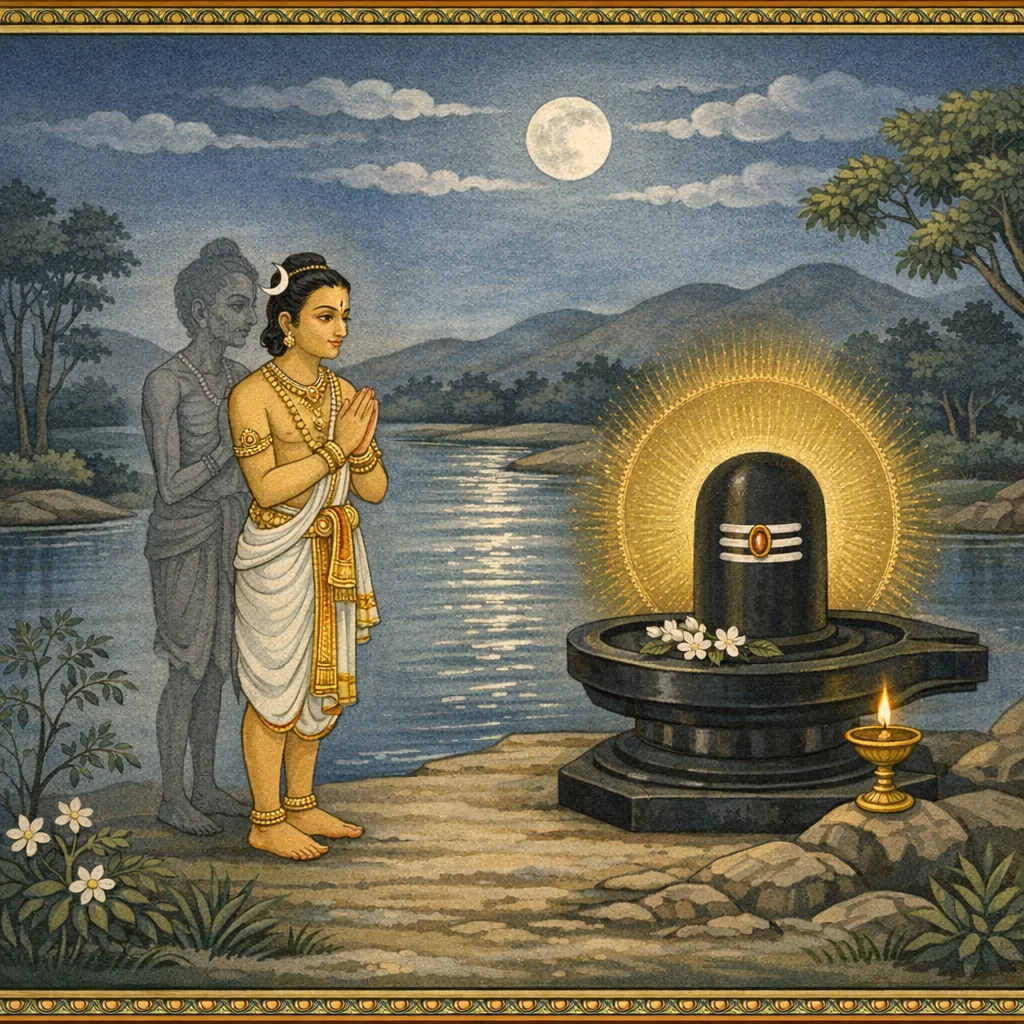
This chapter unfolds as Yudhiṣṭhira’s inquiry and Mārkaṇḍeya’s reply, offering a theological and ethical account of Soma (the Moon deity), the causes of affliction, and the means of relief. Candrahāsa is indicated as the next sacred destination, and Soma’s attainment of “supreme accomplishment” (parā-siddhi) is recalled. Mārkaṇḍeya explains Soma’s suffering as arising from Dakṣa’s curse, framed as a moral warning for householders: neglect of conjugal duty brings karmic consequence. Soma then wanders among holy tīrthas and finally reaches the Narmadā/Revā, praised as a remover of sins. Through twelve years of disciplined observances—fasting, gifts, vows, and restraints—Soma is freed from impurity. The narrative culminates in the bathing/abhiṣeka of Mahādeva and the establishment and worship of Śiva, yielding imperishable (akṣaya) religious fruit and an exalted destination. The chapter further sets out tīrtha procedures and auspicious timings: bathing at Somatīrtha and Candrahāsa, especially during lunar and solar eclipses and at calendrical junctions such as saṅkrānti, vyatīpāta, ayana, and viṣuva, grants purification, enduring merit, and a radiance likened to Soma. It closes by contrasting informed pilgrims with those unaware of Candrahāsa on the Revā, adding that renunciation undertaken there leads to an irreversible auspicious path associated with Soma’s realm.
Shlokas
Verse 1
मार्कण्डेय उवाच । ततो गच्छेन्महीपाल चन्द्रहासमतः परम् । यत्र सिद्धिं परां प्राप्तः सोमराजः सुरोत्तमः
Mārkaṇḍeya said: “Then, O king, one should go onward from Candra-hāsa-mata, to the place where Somarāja, best among the gods, attained the supreme siddhi.”
Verse 2
युधिष्ठिर उवाच । कथं सिद्धिं परां प्राप्तः सोमनाथो जगत्पतिः । तत्सर्वं श्रोतुमिच्छामि कथयस्व ममानघ
Yudhiṣṭhira said: “How did Somnātha, the Lord of the world, attain the supreme perfection? I wish to hear it all—tell me, O sinless one.”
Verse 3
श्रीमार्कण्डेय उवाच । पुरा शप्तो मुनीन्द्रेण दक्षेण किल भारत । असेवनाद्धि दाराणां क्षयरोगी भविष्यसि
Śrī Mārkaṇḍeya said: “In former times, O Bhārata, he was indeed cursed by the great sage Dakṣa: ‘Because you neglect the companionship of your lawful wives, you shall become afflicted with consumption.’”
Verse 4
उद्वाहितानां पत्नीनां ये न कुर्वन्ति सेवनम् । या निष्ठा जायते नृणां तां शृणुष्व नराधिप
“Those men who do not fulfill due conjugal conduct toward their wedded wives—hear, O king, what fixed consequence (niṣṭhā) arises for such men.”
Verse 5
ऋतावृतौ हि नारीणां सेवनाज्जायते सुतः । सुतात्स्वर्गश्च मोक्षश्च इत्येवं श्रुतिभाषितम्
For in the season of fertility, through union with a woman a son is born; and from a son arise heaven and even liberation—so indeed is it spoken in the Śruti.
Verse 6
तत्कालोचितधर्मेण वेष्टितो रौरवे पतेत् । तस्यास्तद्रुधिरं पापः पिबते कालमीप्सितम्
Bound by the wrongdoing of neglecting what is proper in its proper time, he falls into the Raurava hell; there the sinner drinks her blood for as long as destiny ordains.
Verse 7
ततोऽवतीर्णः कालेन यां यां योनिं प्रयास्यति । तस्यां तस्यां स दुष्टात्मा दुर्भगो जायते सदा
Then, brought down again by time, whatever womb he enters, in that very birth the wicked-souled one is always born unfortunate.
Verse 8
नारीणां तु सदा कामोऽभ्यधिकाः परिवर्तते । विशेषेण ऋतौ काले पीड्यते कामसायकैः
In women, indeed, desire is ever strong and recurrent; and especially in the season of fertility, they are afflicted by the arrows of passion.
Verse 9
परिभूता हिता भर्त्रा ध्यायन्तेऽन्यं पतिं स्त्रियः । ततः पुत्रः समुत्पन्नो ह्यटते कुलमुत्तमम्
When women are mistreated and disregarded by their husband, they may think of another man as husband; then a son is born who brings disgrace, roaming and ruining even a noble lineage.
Verse 10
स्वर्गस्थास्तेन पितरः पूर्वजास्ते पितामहाः । पतन्ति जातमात्रेण कुलटस्तेन चोच्यते
Because of him, the ancestors—fathers, forefathers, and grandfathers dwelling in heaven—fall down the very moment he is born; therefore he is called “kulaṭa,” a betrayer of the lineage.
Verse 11
तेन कर्मविपाकेन क्षयरोग्यभवच्छशी । त्यक्त्वा लोकं सुरेन्द्राणां मर्त्यलोकमुपागतः
By the ripening of that karma, the Moon (Śaśī) became afflicted with consumption; abandoning the world of the gods, he came down to the mortal realm.
Verse 12
ततस्तीर्थान्यनेकानि पुण्यान्यायतनानि च । भ्रमन्वै नर्मदां प्राप्तः सर्वपापप्रणाशनीम्
Thereafter, wandering through many sacred fords and holy abodes, he reached the Narmadā—she who destroys all sins.
Verse 13
उपवासं च दानानि व्रतानि नियमांस्तथा । चचार द्वादशाब्दानि ततो मुक्तः स किल्बिषैः
He practiced fasting, charitable gifts, vows, and disciplines for twelve years; thereafter he was freed from his sins.
Verse 14
स्नापयित्वा महादेवं सर्वपातकनाशनम् । जगाम प्रभया पूर्णः स च लोकमनुत्तमम्
Having bathed Mahādeva—the destroyer of all grave sins—he departed, filled with radiance, to the unsurpassed world.
Verse 15
येनैव स्थापितो देवः पूज्यते वर्षसंख्यया । तावद्वर्षसहस्राणि रुद्रलोके स पूज्यते
For as many years as a deity, once installed by someone, is worshipped, for that same number of thousands of years he is honored in Rudra’s world.
Verse 16
तेन देवान्विधानोक्तान्स्थापयन्ति नरा भुवि । अक्षयं चाव्ययं यस्मात्कालं भुञ्जन्ति मानवाः
Therefore, people on earth install deities according to the injunctions of scripture, because thereby human beings enjoy an imperishable, unfailing span of merit.
Verse 17
सोमतीर्थे नरः स्नात्वा पूजयेद्देवमीश्वरम् । स भ्राजते नरो लोके सोमवत्प्रियदर्शनः
At Somatīrtha, having bathed, a person should worship the Lord Īśvara; that person shines in the world, pleasing to behold like the Moon.
Verse 18
चन्द्रहासे तु यो गत्वा ग्रहणे चन्द्रसूर्ययोः । स्नानं समाचरेद्भक्त्या मुच्यते सर्वकिल्बिषैः
Whoever goes to Candrahāsa and, at the time of a lunar or solar eclipse, performs bathing with devotion, is released from all sins.
Verse 19
तत्र स्नानं च दानं च चन्द्रहासे शुभाशुभम् । कृतं नृपवरश्रेष्ठ सर्वं भवति चाक्षयम्
There, at Candrahāsa, both bathing and charity—whether undertaken for auspicious or inauspicious reasons—become wholly inexhaustible, O best of excellent kings.
Verse 20
ते धन्यास्ते महात्मानस्तेषां जन्म सुजीवितम् । चन्द्रहासे तु ये स्नात्वा पश्यन्ति ग्रहणं नराः
Blessed indeed are those great-souled ones; their birth is truly fulfilled—those who, having bathed at Candrahāsa, behold the eclipse.
Verse 21
वाचिकं मानसं पापं कर्मजं यत्पुराकृतम् । स्नानमात्रेण राजेन्द्र तत्र तीर्थे प्रणश्यति
Verbal sin, mental sin, and sin born of deeds committed long ago—by bathing alone, O lord of kings, all of it perishes at that tīrtha.
Verse 22
बहवस्तं न जानन्ति महामोहसमन्विताः । देहस्थमिव सर्वेषां परमानन्दरूपिणम्
Many, enveloped in great delusion, do not recognize Him—the very form of Supreme Bliss—though He abides, as it were, within the body of all beings.
Verse 23
पश्चिमे सागरे गत्वा सोमतीर्थे तु यत्फलम् । तत्समग्रमवाप्नोति चन्द्रहासे न संशयः
Whatever merit is gained by going to the western ocean and bathing at Somatīrtha—that entire fruit is obtained at Candrahāsa; of this there is no doubt.
Verse 24
संक्रान्तौ च व्यतीपाते अयने विषुवे तथा । चन्द्रहासे नरः स्नात्वा सर्वपापैः प्रमुच्यते
On Saṅkrānti, on Vyatīpāta, at the solstices and the equinoxes as well—by bathing at Candrahāsa, a person is released from all sins.
Verse 25
ते मूढास्ते दुराचारास्तेषां जन्म निरर्थकम् । चन्द्रहासं न जानन्ति ये रेवायां व्यवस्थितम्
They are deluded; they are of wicked conduct; their birth is fruitless—those who do not know Candrahāsa, established on the Revā river.
Verse 26
चन्द्रहासे तु यः कश्चित्संन्यासं कुरुते द्विजः । अनिवर्तिका गतिस्तस्य सोमलोकान्न संशयः
Any twice-born who undertakes renunciation at Candrahāsa gains an irreversible course—attaining the world of Soma; of this there is no doubt.
Verse 121
। अध्याय
Thus ends the sacred Chapter.