Adhyaya 97
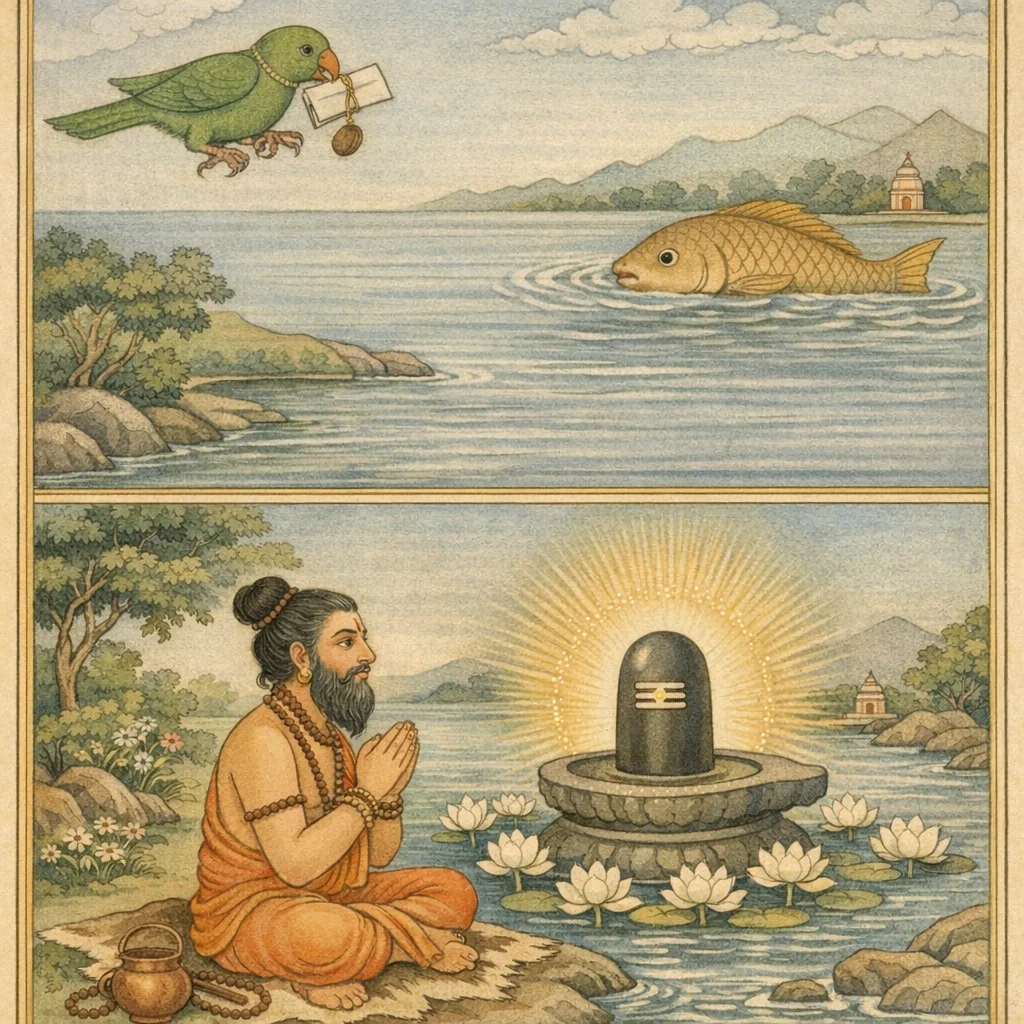
This chapter unfolds as a didactic dialogue: Mārkaṇḍeya instructs King Yudhiṣṭhira and proclaims Vyāsatīrtha as a rare, supremely meritorious sacred ford, said to be “situated in mid-air” (antarikṣe) through the wondrous agency of Revā/Narmadā. It then weaves an extended origin-tale: Parāśara’s austerities and his meeting with the ferrygirl, revealed as royal-born (Satyavatī/Yojaṇagandhā); the seed conveyed by a letter-bearing parrot, the parrot’s death and the seed’s entry into a fish, the girl’s emergence, and finally the birth of Vyāsa. Vyāsa later undertakes tīrtha-yātrā and performs tapas on the Narmadā’s bank. Śiva appears in response to worship, and Narmadā herself answers Vyāsa’s stotra. A ritual-ethical dilemma arises: sages wish to accept hospitality without breaking their vow by crossing to the southern bank; Vyāsa petitions Narmadā, meets refusal, faints, draws divine concern, and at last gains her compliance. Thereafter snāna, tarpaṇa, and homa are performed, a liṅga manifests, and the tīrtha’s name is established. The closing portion gives detailed prescriptions for high-fruit observances—especially in Kārttika on śukla caturdaśī and pūrṇimā—along with liṅga-abhiṣeka substances, flower offerings, mantra-japa options, qualifications of worthy brāhmaṇa recipients, and specific dāna items. The phalāśruti concludes with promises of protection from Yama’s realm, graded results according to offerings, and auspicious post-mortem attainments through the power of Vyāsatīrtha.
Shlokas
Verse 1
श्रीमार्कण्डेय उवाच । ततो गच्छेन्महीपाल व्यासतीर्थमनुत्तमम् । दुर्लभं मनुजैः पुण्यमन्तरिक्षे व्यवस्थितम्
Śrī Mārkaṇḍeya said: “Then, O protector of the earth, go to the unsurpassed Vyāsa-tīrtha—rare for mortals to reach—an exceedingly meritorious sacred place situated in the mid-region, as though in the sky.”
Verse 2
युधिष्ठिर उवाच । कस्माद्वै व्यासतीर्थं तदन्तरिक्षे व्यवस्थितम् । एतदाख्याहि संक्षेपात्त्यज ग्रन्थस्य विस्तरम्
Yudhiṣṭhira said: “Why indeed is that Vyāsa-tīrtha situated in the mid-region? Tell me this briefly—set aside lengthy elaboration.”
Verse 3
श्रीमार्कण्डेय उवाच । साधु साधु महाबाहो धर्मवान्साधुवत्सल । स्वकर्मनिरतः पार्थ तीर्थयात्राकृतादरः
Śrī Mārkaṇḍeya said: “Well said, well said, O mighty-armed one—righteous and loving toward the virtuous. O Pārtha, you are devoted to your own duties and show reverence for pilgrimage.”
Verse 4
दुर्लभं सर्वजन्तूनां व्यासतीर्थं नरेश्वर । पीडितो वृद्धभावेन अकल्पोऽहं नृपात्मज
O lord of men, Vyāsa’s sacred ford (Vyāsa-tīrtha) is exceedingly rare for all beings to attain. Afflicted by the weight of old age, I am not fit for strenuous effort, O prince.
Verse 5
विसंज्ञो गतवित्तस्तु संजातः स्मृतिवर्जितः । गुह्याद्गुह्यतरं तीर्थं नाख्यातं कस्यचिन्मया
I became senseless, bereft of wealth, and deprived of memory. This pilgrimage-place—more secret than secret—has not been disclosed by me to anyone.
Verse 6
कलिस्तत्रैव राजेन्द्र न विशेद्व्याससंश्रयात् । अन्तरिक्षे तु संजातं रेवायाश्चेष्टितेन तु
O king of kings, Kali does not enter there at all, because that place rests under Vyāsa’s protection. Indeed, it came to be in the mid-air through the wondrous action of the Revā (Narmadā).
Verse 7
विरिञ्चिर्नैव शक्नोति रेवाया गुणकीर्तनम् । कथं ज्ञास्याम्यहं तात रेवामाहात्म्यमुत्तमम्
Even Viriñci (Brahmā) cannot fully sing the virtues of the Revā. How then, dear child, shall I come to know the supreme greatness of the Revā?
Verse 8
व्यासतीर्थं विशेषेण लवमात्रं ब्रवीम्यतः । प्रत्यक्षः प्रत्ययो यत्र दृश्यतेऽद्य कलौ युगे
Therefore I shall speak—specifically—only a little about Vyāsatīrtha. For there, even today in the age of Kali, direct proof and palpable certainty are seen.
Verse 9
विहङ्गो गच्छते नैव भित्त्वा शूलं सुदारुणम् । तस्योत्पत्तिं समासेन कथयामि नृपात्मज
No bird can pass through, piercing that exceedingly dreadful spike. I shall tell you briefly, O prince, how it came into being.
Verse 10
आसीत्पूर्वं महीपाल मुनिर्मान्यः पराशरः । तेनात्युग्रं तपश्चीर्णं गङ्गाम्भसि महाफलम्
Formerly, O protector of the earth, there was the venerable sage Parāśara. He performed extremely fierce austerity in the waters of the Gaṅgā—an act of great fruit.
Verse 11
प्राणायामेन संतस्थौ प्रविष्टो जाह्नवीजले । पूर्णे द्वादशमे वर्षे निष्क्रान्तो जलमध्यतः
Entering the waters of Jāhnavī (the Gaṅgā), he remained steadfast in prāṇāyāma. When twelve years were completed, he emerged from the midst of the water.
Verse 12
भिक्षार्थी संचरेद्ग्रामं नावा यत्रैव तिष्ठति । तत्र तेन परा दृष्टा बाला चैव मनोहरा
Seeking alms, he wandered through a village where a boat was stationed. There he beheld a maiden—exceedingly charming and captivating.
Verse 13
तां दृष्ट्वा स च कामार्त उवाच मधुरं तदा । मां नयस्व परं पारं कासि त्वं मृगलोचने
Seeing her, he—troubled by desire—then spoke sweetly: “Take me to the far shore. Who are you, O doe-eyed one?”
Verse 14
नावारूढे नदीतीरे मम चित्तप्रमाथिनि । एवमुक्ता तु सा तेन प्रणम्य ऋषिपुंगवम्
When he spoke thus to her—she who, seated in the boat at the riverbank, was stirring his mind—she bowed down in reverence to that bull among sages.
Verse 15
कथयामास चात्मानं दृष्ट्वा तं काममोहितम् । कैवर्तानां गृहे दासी कन्याहं द्विजसत्तम
Seeing him deluded by desire, she began to tell her own story: “O best of twice-born ones, I am a maiden serving as a maid in the house of the fishermen.”
Verse 16
नावासंरक्षणार्थाय आदिष्टा स्वामिना विभो । मया विज्ञापितं वृत्तमशेषं ज्ञातुमर्हसि
“O lord, my master appointed me for the protection of the boat. I have reported the entire matter; you should know it fully.”
Verse 17
एवमुक्तस्तया सोऽथ क्षणं ध्यात्वाब्रवीदिदम्
Thus addressed by her, he reflected for a moment and then spoke these words.
Verse 18
पराशर उवाच । अहं ज्ञानबलाद्भद्रे तव जानामि सम्भवम् । कैवर्तपुत्रिका न त्वं राजकन्यासि सुन्दरि
Parāśara said: “O auspicious one, by the power of knowledge I know your birth. You are not a fisherman’s daughter; O beautiful one, you are a princess.”
Verse 19
कन्योवाच । कः पिता कथ्यतां ब्रह्मन्कस्या वा ह्युदरोद्भवा । कस्मिन्वंशे प्रसूताहं कैवर्ततनया कथम्
The maiden said: “O Brahmin, tell me—who is my father, and from whose womb was I born? In which lineage was I brought forth, and how did I become known as a fisherman’s daughter?”
Verse 20
पराशर उवाच । कथयामि समस्तं यत्त्वया पृष्टमशेषतः । वसुर्नामेति भूपालः सोमवंशविभूषणः
Parāśara said: “I shall tell you completely, without omission, all that you have asked. There was a king named Vasu, an ornament of the Lunar dynasty.”
Verse 21
जम्बूद्वीपाधिपो भद्रे शत्रूणां भयवर्धनः । शतानि सप्त भार्याणां पुत्राणां च दशैव तु
“O auspicious one, he was the sovereign of Jambūdvīpa, increasing fear in his enemies. He had seven hundred wives, and indeed ten sons.”
Verse 22
धर्मेण पालयेल्लोकानीशवत्पूज्यते सदा । म्लेच्छास्तस्याविधेयाश्च क्षीरद्वीपनिवासिनः
He safeguarded the people by dharma and was ever revered like a lord. Even the mlecchas dwelling in Kṣīradvīpa did not dare disobey him.
Verse 23
तेषामुत्सादनार्थाय ययावुल्लङ्घ्य सागरम् । संयुक्तः पुत्रभृत्यैश्च पौरुषे महति स्थितैः
To destroy them, he set forth and crossed the ocean, accompanied by his sons and servants, all established in great valor.
Verse 24
समरं तैः समारब्धं म्लेच्छैश्च वसुना सह । जिता म्लेच्छाः समस्तास्ते वसुना मृगलोचने
Then the mlecchas, together with Vasu, began the battle. Vasu defeated all those mlecchas, O doe-eyed lady.
Verse 25
करदास्ते कृतास्तेन सपुत्रबलवाहनाः । प्रधाना तस्य सा राज्ञी तव माता मृगेक्षणे
He made them tributaries, along with their sons, forces, and vehicles. And the chief queen of that king, O doe-eyed one, was your mother.
Verse 26
प्रवासस्थे महीपाले संजाता सा रजस्वला । नारीणां तु सदाकालं मन्मथो ह्यधिको भवेत्
While the king was away in exile, she entered her season. For at such times, in women, Kāma (Manmatha) is said to become especially powerful.
Verse 27
विशेषेण ऋतोः काले भिद्यन्ते कामसायकैः । मन्मथेन तु संतप्ताचिन्तयत्सा शुभेक्षणा
Especially in the season of fertility, one is pierced by the arrows of desire. Scorched by Manmatha, that fair-eyed lady began to ponder what should be done.
Verse 28
दूतं वै प्रेषयाम्यद्य वसुराज्ञः समीपतः । आहूतः सत्वरं दूत गच्छ त्वं नृपसन्निधौ
“Today I shall send a messenger to King Vasu.” Having summoned him, she said, “Quickly, messenger—go into the king’s presence.”
Verse 29
दूत उवाच । परतीरं गतो देवि वसुराजारिशासनः । तत्र गन्तुमशक्येत जलयानैर्विना शुभे
The messenger said: “O goddess-like lady, King Vasu, the chastiser of enemies, has gone to the farther shore. It is not possible to go there, O auspicious one, without watercraft.”
Verse 30
तानि यानानि सर्वाणि गृहीतानि परे तटे । दूतवाक्येन सा राज्ञी विषण्णा कामपीडिता
All those boats had been taken to the farther bank. Hearing the messenger’s words, the queen became downcast, afflicted by desire.
Verse 31
तत्सखी तामुवाचाथ कस्मात्त्वं परितप्यसे । स्वलेखः प्रेष्यतां देवि शुकहस्ते यथार्थतः
Then her friend said to her: “Why do you grieve so? O lady, let your own letter be sent—truly and clearly—by the hand of a parrot.”
Verse 32
समुद्रं लङ्घयित्वा तु शकुन्ता यान्ति सुन्दरि । सखिवाक्येन सा राज्ञी स्वस्था जाता नराधिप
“Birds can cross even the ocean, O beautiful one.” By her friend’s words, the queen became composed, O king.
Verse 33
व्याहृतो लेखकस्तत्र लिख लेखं ममाज्ञया । त्वद्धीना सत्यभामाद्य वसो राजन्न जीवति
Then the scribe there was summoned: “Write a letter by my command: ‘Without you, Satyabhāmā today, O Vasu—O king—does not live (cannot bear life).’”
Verse 34
ऋतुकालोऽद्य संजातो लिख लेखं तु लेखकं । लिखिते भूर्जपत्रे तु लेखे वै लेखकेन तु
“Today the auspicious season-time has arrived. O scribe, write the letter. Let the letter indeed be written by the writer upon birch-bark.”
Verse 35
शुकः पञ्जरमध्यस्थ आनीतोद्धैव सन्निधौ
“A parrot, staying within a cage, was then brought into their very presence.”
Verse 36
सत्यभामोवाच । नीत्वा लेखं गच्छ शीघ्रं वसुराज्ञः समीपतः । शकुनिः प्रणतो भूत्वा गृहीत्वा लेखमुत्तमम्
Satyabhāmā said: “Take this letter and go quickly to King Vasu. The bird, bowing respectfully, took up the excellent message.”
Verse 37
उत्पत्य सहसा राजञ्जगामाकाशमण्डलम् । ततः पक्षी गतः शीघ्रं वसुराजसमीपतः
Suddenly taking wing, O King, it entered the vast expanse of the sky. Then the bird swiftly went to the presence of King Vasu.
Verse 38
क्षिप्ते लेखे शुकेनैव सत्यभामाविसर्जिते । वसुराज्ञा ततो लेखो गृह्य हस्तेऽवधारितः
When the parrot, dispatched by Satyabhāmā, dropped the letter, King Vasu took it up and held it in his hand, considering it carefully.
Verse 39
लेखार्थं चिन्तयित्वा तु गृह्य वीर्यं नरेश्वरः । अमोघं पुटिकां कृत्वा प्रतिलेखेन मिश्रितम्
Having reflected on the meaning of the letter, the lord of men took his seed and made an unfailing packet, enclosing it together with a written reply.
Verse 40
शुकस्य सोऽपयामास गच्छ राज्ञीसमीपतः । प्रणम्य वसुराजानं बीजं गृह्योत्पपात ह
He handed it to the parrot, saying, “Go to the queen.” Having bowed to King Vasu, the bird took the seed and flew up.
Verse 41
समुद्रोपरि सम्प्राप्तः शुकः श्येनेन वीक्षितः । सामिषं तं शुकं ज्ञात्वा श्येनस्तमभ्यधावत
When the parrot had reached above the ocean, a hawk saw it. Knowing the parrot to be carrying flesh, the hawk swooped toward it.
Verse 42
हतश्चञ्चुप्रहारेण शुकः श्येनेन भारत । मूर्च्छया तस्य तद्बीजं पतितं सागराम्भसि
Struck by the hawk’s beak-blow, O Bhārata, the parrot fell senseless; and in that swoon the seed dropped into the waters of the sea.
Verse 43
मत्स्येन गिलितं तच्च बीजं वसुमहीपतेः । कन्या मत्स्योदरे जाता तेन बीजेन सुन्दरि
That seed of King Vasu was swallowed by a fish. From the fish’s belly a maiden was born because of that seed, O fair one.
Verse 44
प्राप्तोऽसौ लुब्धकैर्मत्स्य आनीतः स्वगृहं ततः । यावद्विदारितो मत्स्यस्तावद्दृष्टा त्वमुत्तमे
That fish was obtained by the fisher-hunters and then carried to their own home. And when the fish was cut open, at that very moment you were seen—O excellent one.
Verse 45
शशिमण्डलसङ्काशा सूर्यतेजःसमप्रभा । दृष्ट्वा त्वां हर्षिताः सर्वे कैवर्ता जाह्नवीतटे
Moon-orb-like in beauty, radiant like the sun’s splendor—on seeing you, all the fisherfolk rejoiced on the bank of the Jāhnavī (Gaṅgā).
Verse 46
हर्षितास्ते गताः सर्वे प्रधानस्य च मन्दिरम् । स्त्रीरत्नं कथयामासुर्गृहाण त्वं महाप्रभम्
Rejoicing, they all went to the house of their chief. They reported, “A jewel among women has appeared—please accept her, O great lord.”
Verse 47
गृहीता तेन तन्वङ्गी ह्यपुत्रेण मृगेक्षणा । भार्यां स्वामाह तन्वङ्गि पालयस्व मृगेक्षणे
Then he, the childless man, accepted that slender-limbed maiden with doe-like eyes. And addressing her as his wife he said: “O slender one, O doe-eyed lady, guard and govern the household.”
Verse 48
ततः सा चिन्तयामास पराशरवचस्तदा । एवमुक्त्वा तु सा तेन दत्तात्मानं नरेश्वर
Then she pondered the words of Parāśara. And having spoken thus, O king, she yielded herself to him in acceptance.
Verse 49
उवाच साधु मे ब्रह्मन्मत्स्यगन्धोऽनु वर्तते । ततस्तेन तु सा बाला दिव्यगन्धाधिवासिता
She said, “Well then, O venerable brāhmaṇa—this fish-scent still clings to me.” Thereupon, through his power, the young maiden was suffused with a divine fragrance.
Verse 50
कृता योगबलेनैव ज्वालयित्वा विभावसुम् । कृत्वा प्रदक्षिणं वह्निमूढा तेन रसात्तदा
By yogic power alone he kindled the fire; and after circumambulating the sacred flame, he then led her to a secluded place.
Verse 51
जलयानस्य मध्ये तु कामस्थानान्यसंस्पृशत् । ज्ञात्वा कामोत्सुकं विप्रं भीता सा धर्मनन्दन
But in the midst of the boat she did not allow contact with the places of passion. Knowing the brāhmaṇa to be inflamed with desire, she became afraid—O son of Dharma.
Verse 52
हसन्ती तमुवाचाथ देव त्वं लोकसन्निधौ । न लज्जसे कथं धीमन्कुर्वाणः पामरोचितम्
Smiling, she said to him: “Sir, you are in the presence of people. How do you not feel ashamed, O wise one, while doing what is fit only for the vulgar?”
Verse 53
ततस्तेन क्षणं ध्यात्वा संस्मृता हृदि तामसी । आगता तामसी माया यया व्याप्तं चराचरम्
Then, after meditating for a moment, he recalled within his heart the dark (tāmasī) power. And that tamasic māyā came forth—by which the entire moving and unmoving world is pervaded.
Verse 54
ततः सा विस्मिता तेन कर्मणैव तु रञ्जिता । ब्रह्मचर्याभितप्तेन स्त्रीसौख्यं क्रीडितं तदा
Then she, astonished and delighted by that very deed of his, experienced womanly joy—sportively—through the power of one who was purified and empowered by the heat of brahmacarya (spiritual continence).
Verse 55
ततः सा तत्क्षणादेव गर्भभारेण पीडिता । प्रसूता बालकं तत्र जटिलं दण्डधारिणम्
Then, at that very instant, burdened by the weight of pregnancy, she gave birth right there to a boy—matted-haired and bearing a staff.
Verse 56
कमण्डलुधरं शान्तं मेखलाकटिभूषितम् । उत्तरीयकृतस्कन्धं विष्णुमायाविवर्जितम्
He bore a water-pot (kamaṇḍalu), was serene, adorned with a waist-girdle (mekhalā); his upper cloth was set upon his shoulder—free from delusion, beyond even Viṣṇu’s māyā.
Verse 57
ततोऽपि शङ्किता पार्थ दृष्ट्वा तं कलबालकम् । वेपमाना ततो बाला जगाम शरणं मुनेः
Even so, O Pārtha, on seeing that extraordinary child she grew anxious; trembling, the young maiden went for refuge to the sage.
Verse 58
रक्ष रक्ष मुनिश्रेष्ठ पराशर महामते । जातं मेऽत्यद्भुतं पुत्रं कौपीनवरमेखलम् । दण्डहस्तं जटायुक्तमुत्तरीयविभूषितम्
“Protect me, protect me, O best of sages—O Parāśara of great wisdom! An utterly wondrous son has been born to me: wearing a fine loincloth and girdle, with a staff in hand, with matted locks, and adorned with an upper cloth.”
Verse 59
पराशर उवाच । मा भैषीः स्वसुते जाते कुमारी त्वं भविष्यसि । नाम्ना योजनगन्धेति द्वितीयं सत्यवत्यपि
Parāśara said: “Do not fear. Though your son has been born, you will remain a maiden. By name you shall be Yojanagandhā; and also, as a second name, Satyavatī.”
Verse 60
शंतनुर्नाम राजा यः स ते भर्ता भविष्यति । प्रथमा महिषी तस्य सोमवंशविभूषणा
“A king named Śaṃtanu—he shall be your husband. You will be his first queen, an ornament of the Lunar dynasty.”
Verse 61
गच्छ त्वं स्वाश्रयं शुभ्रे पूर्वरूपेण संस्थिता । मा विषादं कुरुष्वात्र दृष्टं ज्ञानस्य मे बलम्
“Go now to your own dwelling, O fair one, restored to your former appearance. Do not grieve here—witness the power of my spiritual knowledge.”
Verse 62
इत्युक्त्वा प्रययौ विप्रः सा बाला पुत्रमाश्रिता । नत्वोचे मातरं भक्त्या साष्टाङ्गं विनयानतः
Having spoken thus, the brāhmaṇa departed. The young woman, taking her son with her, bowed down and then addressed her mother with devotion—prostrating fully, in humble reverence.
Verse 63
क्षम्यतां मातरुक्तं मे प्रसादः क्रियतामपि । ईश्वराराधने यत्नं करिष्याम्यहमम्बिके
“Mother, forgive what I have said, and be gracious to me as well. O dear mother, I shall strive earnestly in the worship of the Lord, Īśvara.”
Verse 64
ततः सा पुत्रवाक्येन विषण्णा वाक्यमब्रवीत्
Then she, distressed by her son’s words, spoke in sorrow.
Verse 65
योजनगन्धोवाच । मा त्यक्त्वा गच्छ वत्साद्य मातरं मामनागसम् । त्वद्वियोगेन मे पुत्र पञ्चत्वं भाव्यसंशयम्
Yojanagandhā said: “Do not abandon me and go, dear child—do not leave your blameless mother now. Separated from you, my son, I shall surely meet death; of this there is no doubt.”
Verse 66
नास्ति पुत्रसमः स्नेहो नास्ति भ्रातृसमं कुलम् । नास्ति सत्यपरो धर्मो नानृतात्पातकं परम्
There is no affection equal to that for a son; there is no family like that upheld by a brother. There is no dharma higher than devotion to truth; there is no sin greater than falsehood.
Verse 67
बालभावे मया जात आधारः किल जायसे । न मे भर्ता न मे पुत्रः पश्य कर्मविडम्बनम्
Born to me in my girlhood, you were indeed to become my very support. Yet I have neither husband nor (a son who remains with me)—behold the cruel irony of karma.
Verse 68
व्यास उवाच । मा विषादं कुरुष्वान्तः सत्यमेतन्मयोरितम् । आपत्कालेऽस्मि ते देवि स्मर्तव्यः कार्यसिद्धये
Vyāsa said: “Do not grieve within your heart. What I have spoken is true. In times of distress, O Devī, remember me—for the fulfillment of your purpose.”
Verse 69
आपदस्तारयिष्यामि क्षम्यतां मे दुरुत्तरम् । इत्युक्त्वा प्रययौ व्यासः कन्या सापि गता गृहम्
“I shall deliver you from calamities; forgive my harsh words.” Having said this, Vyāsa departed, and the maiden too went home.
Verse 70
पराशरसुतस्तत्र विषष्णो वनमध्यतः । त्रेतायुगावसाने तु द्वापरादौ नरेश्वर
There, Parāśara’s son (Vyāsa), sorrowful in the midst of the forest—at the close of the Tretā Yuga and at the beginning of the Dvāpara, O king—remained absorbed in thought.
Verse 71
व्यासार्थं चिन्तयामासुर्देवाः शक्रपुरोगमाः । आख्यातो नारदेनैव पुत्रः पराशरस्य सः
The gods, led by Śakra (Indra), began to deliberate for Vyāsa’s sake. Nārada himself had informed them that he was the son of Parāśara.
Verse 72
कैवर्तपुत्रिकाजातो ज्ञानी जह्नुसुतातटे । ततो नारदवाक्येन आगताः सुरसत्तमाः
Born of the fisherman’s daughter, that knower (Vyāsa) stood on the bank of the Jahnusutā. Then, at Nārada’s word, the foremost of the gods arrived.
Verse 73
रामः पितामहः शक्रो मुनिसङ्घैः समावृताः । आस्यादिकं पृथग्दत्त्वा साधु साध्वित्युदीरयन्
Rāma, Pitāmaha (Brahmā), and Śakra (Indra), surrounded by hosts of sages, offered various honors—reverential greetings and the like—each in due manner, proclaiming, “Well done! Well done!”
Verse 74
पितामहेन वै बालो गर्भाधानादिसंस्कृतः । द्वीपायनो द्वीपजन्मा पाराशर्यः पराशरात्
That boy was duly consecrated by Pitāmaha with the sacraments (saṃskāras) beginning with garbhādhāna. Born upon an island, he became known as Dvaipāyana, and as Pārāśarya, the son of Parāśara.
Verse 75
कृष्णांशात्कृष्णनामायं व्यासो वेदान्व्यसिष्यति । विरञ्चिनाभिषिक्तोऽसौ मुनिसङ्घैः पुनःपुनः
Being a portion of Kṛṣṇa, he bore the name “Kṛṣṇa”; and as Vyāsa he would arrange and divide the Vedas. He was consecrated by Virañci (Brahmā), and again and again honored by hosts of sages.
Verse 76
व्यासस्त्वं सर्वलोकेषु इत्युक्त्वा प्रययुः सुराः । तीर्थयात्रा समारब्धा कृष्णद्वैपायनेन तु
Saying, “You are Vyāsa in all the worlds,” the gods departed. Then Kṛṣṇadvaipāyana undertook a pilgrimage to the sacred tīrthas.
Verse 77
गङ्गावगाहिता तेन केदारश्च सपुष्करः । गया च नैमिषं तीर्थं कुरुक्षेत्रं सरस्वती
He bathed in the sacred Gaṅgā and visited Kedāra and Puṣkara; he went to Gayā, to the tīrtha of Naimiṣa, to Kurukṣetra, and to the Sarasvatī.
Verse 78
उज्जयिन्यां महाकालं सोमनाथं प्रभासके । पृथिव्यां सागरान्तायां स्नात्वा यातो महामुनिः
In Ujjayinī he worshipped Mahākāla; at Prabhāsa he visited Somanātha. Having bathed across the earth up to the ocean’s edge, the great sage proceeded onward.
Verse 79
अमृतां नर्मदां प्राप्तो रुद्रदेहोद्भवां शुभाम् । साह्लादो नर्मदां दृष्ट्वा चित्तविश्रान्तिमाप च
He reached the Narmadā, ambrosial and auspicious, said to have arisen from Rudra’s very body. Seeing the Narmadā with joy, he attained deep rest and peace of mind.
Verse 80
तपश्चचार विपुलं नर्मदातटमाश्रितः । ग्रीष्मे पञ्चाग्निमध्यस्थो वर्षासु स्थण्डिलेशयः
Dwelling upon the bank of the Narmadā, he performed abundant austerities: in summer he practiced the penance of the five fires, and in the rainy season he lay upon the bare ground.
Verse 81
सार्द्रवासाश्च हेमन्ते तिष्ठन्दध्यौ महेश्वरम् । स्वान्तर्हृत्कमले स्थाप्य ध्यायते परमेश्वरम्
In winter, wearing damp garments, he remained standing and contemplated Maheśvara. Placing the Supreme Lord within the lotus of his inner heart, he meditated upon Parameśvara.
Verse 82
सृष्टिसंहारकर्तारमछेद्यं वरदं शुभम् । नित्यं सिद्धेश्वरं लिङ्गं पूजयेद्ध्यानतत्परः
Intent on meditation, he should daily worship the Siddheśvara Liṅga—auspicious, boon-giving, inviolable—the Lord who brings about creation and dissolution.
Verse 83
अर्चनात्सिद्धलिङ्गस्य ध्यानयोगप्रभावतः । प्रत्यक्षः शङ्करो जातः कृष्णद्वैपायनस्य सः
By worshipping that Siddha-Liṅga, and by the power of his meditative yoga, Śaṅkara became manifest before Kṛṣṇadvaipāyana—directly present to him.
Verse 84
ईश्वर उवाच । तोषितोऽहं त्वया वत्स वरं वरय शोभनम्
Īśvara said: “I am pleased with you, dear child. Choose a splendid boon.”
Verse 85
व्यास उवाच । यदि तुष्टोऽसि मे देव यदि देयो वरो मम । प्रत्यक्षो नर्मदातीरे स्वयमेव भविष्यसि । अतीतानागतज्ञोऽहं त्वत्प्रसादादुमापते
Vyāsa said: “If you are pleased with me, O Lord, and if a boon may be granted to me—then may you yourself become manifest on the bank of the Narmadā. By your grace, O Lord of Umā, may I be a knower of what has passed and what is yet to come.”
Verse 86
ईश्वर उवाच । एवं भवतु ते पुत्र मत्प्रसादादसंशयम् । त्वयि भक्तिगृहीतोऽहं प्रत्यक्षो नर्मदातटे
Īśvara said: “So be it, my son—by my grace, without doubt. Captivated by your devotion, I shall be directly manifest on the bank of the Narmadā.”
Verse 87
सहस्रांशार्धभावेन प्रत्यक्षोऽहं त्वदाश्रमे । इत्युक्त्वा प्रययौ देवः कैलासं नगमुत्तमम्
“In the form of half a thousand rays of radiance, I shall be directly present in your āśrama.” Having spoken thus, the God departed for Kailāsa, the supreme mountain.
Verse 88
पत्नीसंग्रहणं जातं कृष्णद्वैपायनस्य तु । शास्त्रोक्तेन विधानेन पत्नी पालयतस्तथा
Then Kṛṣṇa Dvaipāyana (Vyāsa) took a wife; and, in the manner enjoined by the śāstras, he duly maintained and cared for his consort.
Verse 89
पुत्रो जातो ह्यपुत्रस्य पराशरसुतस्य च । देवैर्वर्धापितः सर्वैरिञ्चेन्द्रपुरोगमैः
To that sage who had been without a son—Parāśara’s son (Vyāsa)—a son was born. All the devas rejoiced in the auspicious birth, with Indra and the rest at their head.
Verse 90
पुत्रजन्मन्यथाजग्मुर्वशिष्ठाद्या मुनीश्वराः । तीर्थयात्राप्रसङ्गेन पराशरपुरोगमाः
At the time of the child’s birth, the great munis—Vasiṣṭha and others—came there, led by Parāśara, on the occasion of their pilgrimage to the sacred tīrthas.
Verse 91
मन्वत्रिविष्णुहारीतयाज्ञवल्क्योशनोऽङ्गिराः । यमापस्तम्बसंवर्ताः कात्यायनबृहस्पती
Manu, Atri, Viṣṇu, Hārīta, Yājñavalkya, Uśanas, and Aṅgiras also came; likewise Yama, Āpastamba, Saṃvarta, Kātyāyana, and Bṛhaspati.
Verse 92
एवमादिसहस्राणि लक्षकोटिशतानि च । सशिष्याश्च महाभागा नर्मदातटमाश्रिताः
Thus, thousands upon thousands—hundreds of thousands and crores—of illustrious ones, together with their disciples, took refuge along the bank of the Narmadā.
Verse 93
व्यासाश्रमे शुभे रम्ये संतुष्टा आययुर्नृप । दृष्ट्वा तान्सोऽपि विप्रेन्द्रानभ्युत्थानकृतोद्यमः
O King, contented at heart they came to Vyāsa’s auspicious and delightful hermitage. Seeing those foremost of brāhmaṇa-sages, he too hastened to rise in respectful welcome.
Verse 94
पितुः पूर्वं प्रणम्यादौ सर्वेषां च यथाविधि । आसनानि ददौ भक्त्या पाद्यमर्घं न्यवेदयत्
First he bowed to his father, and then—according to proper custom—paid reverence to all. With devotion he offered them seats, and presented the water for washing the feet and the respectful offering (arghya).
Verse 95
कृताञ्जलिपुटो भूत्वा वाक्यमेतदुवाच ह । उद्धृतोऽहं न सन्देहो युष्मत्सम्भाषणार्चनात्
Joining his palms in reverence, he spoke these words: “I am surely uplifted—there is no doubt—by conversing with you and by honoring you.”
Verse 96
आरण्यानि च शाकानि फलान्यारण्यजानि च । तानि दास्यामि युष्माकं सर्वेषां प्रीतिपूर्वकम्
“I shall give to all of you, with affection, forest-gathered vegetables and fruits that grow in the wilderness.”
Verse 97
। अध्याय
End of the chapter (closing marker).
Verse 98
वर्धयित्वा जयाशीर्भिरवलोक्य परस्परम् । पराशरः समस्तैश्च वीक्षितो मुनिपुंगवैः
After exchanging blessings of victory and looking upon one another, Parāśara was regarded with reverent attention by all those sages, bull-like among the munis.
Verse 99
उत्तरं दीयतां तात कृष्णद्वैपायनस्य च । एवमुक्तस्तु तैः सर्वैर्भगवान्स पराशरः । प्रोवाच स्वात्मजं व्यासमृषीणां यच्चिकीर्षितम्
“Give an answer, dear one—also to Kṛṣṇa Dvaipāyana.” Thus addressed by them all, the venerable Parāśara told his own son Vyāsa what the sages intended to accomplish.
Verse 100
श्रीपराशर उवाच । नेच्छन्ति दक्षिणे कूले व्रतभङ्गभयादथ । भोजनं भोक्तुकामास्ते श्राद्धे चैव विशेषतः
Śrī Parāśara said: “Fearing the breaking of their vow, they do not wish to dine upon the southern bank. Yet they desire to partake of a meal—especially in connection with the śrāddha.”
Verse 101
व्यास उवाच । करोमि भवतामुक्तमत्रैव स्थीयतां क्षणम् । यावत्प्रसाद्य सरितं करोमि विधिमुत्तमम्
Vyāsa said: “I shall do as you have said. Remain here for a moment, while I propitiate the sacred river and perform the excellent rite in proper form.”
Verse 102
एवमुक्त्वा शुचिर्भूत्वा नर्मदातटमास्थितः । स्तोत्रं जगाद सहसा तन्निबोध नरेश्वर
Having spoken thus and becoming purified, he stood upon the bank of the Narmadā. Then at once he recited a hymn—listen to it, O king.
Verse 103
जय भगवति देवि नमो वरदे जय पापविनाशिनी बहुफलदे । जय शुम्भनिशुम्भकपालधरे प्रणमामि तु देवनरार्तिहरे
Victory to you, O Blessed Goddess—salutations, O Granter of boons! Victory to you, O Destroyer of sins, Bestower of abundant fruits! Victory to you who bear the skulls of Śumbha and Niśumbha; I bow to you, remover of the sufferings of gods and men.
Verse 104
जय चन्द्रदिवाकरनेत्रधरे जय पावकभूषितवक्त्रवरे । जय भैरवदेहनिलीनपरे जय अन्धकरक्तविशोषकरे
Victory to you who bear the Moon and the Sun as your eyes; victory to you whose excellent face is adorned with fire. Victory to you who abide within Bhairava’s very body; victory to you who dry up the blood of Andhaka, the demon—O Narmadā Devī, ever worthy of praise.
Verse 105
जय महिषविमर्दिनि शूलकरे जय लोकसमस्तकपापहरे । जय देवि पितामहरामनते जय भास्करशक्रशिरोऽवनते
Victory to you, slayer of the buffalo-demon, wielder of the trident; victory to you who remove the sins of all the worlds. Victory to you, O Goddess, whom Pitāmaha (Brahmā) delights to worship; victory to you before whom Bhāskara (the Sun) and Śakra (Indra) bow their heads.
Verse 106
जय षण्मुखसायुध ईशनुते जय सागरगामिनि शम्भुनुते । जय दुःखदरिद्रविनाशकरे जय पुत्रकलत्रविवृद्धिकरे
Victory to you whom the Lord (Īśa) and the six-faced Skanda with his weapons adore; victory to you, O ocean-going one, whom Śambhu (Śiva) praises. Victory to you who destroy sorrow and poverty; victory to you who bring increase of children and spouse—bestower of worldly welfare and sacred merit.
Verse 107
जय देवि समस्तशरीरधरे जय नाकविदर्शिनि दुःखहरे । जय व्याधिविनाशिनि मोक्षकरे जय वाञ्छितदायिनि सिद्धवरे
Victory to you, O Goddess, who uphold all embodied beings; victory to you who reveal heaven and remove sorrow. Victory to you who destroy disease and grant moksha; victory to you who bestow the desired boons—supreme among the siddhas and the givers of success.
Verse 108
एतद्व्यासकृतं स्तोत्रं यः पठेच्छिवसन्निधौ । गृहे वा शुद्धभावेन कामक्रोधविवर्जितः
Whoever recites this hymn composed by Vyāsa—either in Śiva’s presence or even at home—with a purified intention and free from desire and anger,
Verse 109
तस्य व्यासो भवेत्प्रीतः प्रीतश्च वृषवाहनः । प्रीता स्यान्नर्मदा देवी सर्वपापक्षयंकरी
For such a reciter, Vyāsa becomes pleased, and so does Vṛṣavāhana (Śiva, the Bull-bannered). Narmadā Devī too becomes gracious—she who brings about the destruction of all sins.
Verse 110
न ते यान्ति यमालोकं यैः स्तुता भुवि नर्मदा । पितामहोऽपि मुह्येत देवि त्वद्गुणकीर्तनात्
Those by whom Narmadā is praised here on earth do not go to Yama’s realm. Even Pitāmaha (Brahmā) would be left in wonder, O Goddess, at the singing of your qualities.
Verse 111
वाक्पतिर्नैव ते वक्तुं स्वरूपं वेद नर्मदे । कथं गुणानहं देवि त्वदीयाञ्ज्ञातुमुत्सहे
O Narmadā, even Vākpati, lord of speech, does not truly know how to describe your form. How then could I, O Goddess, dare to know and recount your qualities?
Verse 112
इति ज्ञात्वा शुचिं भावं वाङ्मनःकायकर्मभिः । प्रसन्ना नर्मदादेवी ततो वचनमब्रवीत्
Thus, knowing his pure disposition—pure in speech, mind, body, and deeds—Devī Narmadā became gracious, and then she spoke these words.
Verse 113
सत्यवादेन तुष्टाहं भोभो व्यास महामुने । यदीच्छसि वरं किंचित्तं ते सर्वं ददाम्यहम्
“O Vyāsa, great sage! I am pleased by your truthfulness. If you desire any boon at all, I shall grant it to you in full.”
Verse 114
व्यास उवाच । यदि तुष्टासि मे देवि यदि देयो वरो मम । आतिथ्यमुत्तरे कूले ऋषीणां दातुमर्हसि
Vyāsa said: “O Goddess, if you are pleased with me—if you would grant me a boon—then allow me to offer sacred hospitality to the sages upon your northern bank.”
Verse 115
नर्मदोवाच । अयुक्तं याचितं व्यास विमार्गे यत्प्रवर्तनम् । इन्द्रचन्द्रयमैः शक्यमुन्मार्गे न प्रवर्तितुम्
Narmadā said: “O Vyāsa, what you have asked is improper, for it urges a course that strays from the right path. Even Indra, the Moon, and Yama cannot make one proceed upon a wrongful way.”
Verse 116
याचस्वान्यं वरं पुत्र यत्किंचिद्भुवि दुर्लभम् । एतच्छ्रुत्वा वचो देव्या व्यासो मूर्च्छां यतस्तदा
“Ask for some other boon, my son—anything rare in this world.” Hearing these words of the Goddess, Vyāsa then fell into a swoon.
Verse 117
वृथा क्लेशोऽद्य मे जात इति मत्वा पपात ह । धरणी चलिता सर्वा सशैलवनकानना
Thinking, “My effort today has become futile,” he collapsed. And the entire earth shook—along with its mountains, forests, and groves.
Verse 118
मूर्च्छापन्नं ततो व्यासं दृष्ट्वा देवाः सवासवाः । हाहाकारमुखाः सर्वे तत्राजग्मुः सहस्रशः
Seeing Vyāsa overcome by fainting, the gods—along with Indra—raised cries of alarm, and all of them came there in their thousands.
Verse 119
व्यासमुत्थापयामासुर्वेदव्यसनतत्परम् । ब्राह्मणार्थे च संक्लिष्टो नात्महेतोः सरिद्वरे
They lifted up Vyāsa, ever intent upon the Veda. He had been distressed for the sake of the brāhmaṇas—not for his own sake—on that best of rivers.
Verse 120
गवार्थे ब्राह्मणार्थे च सद्यः प्राणान्परित्यजेत् । एवं सा नर्मदा प्रोक्ता ब्रह्माद्यैः सुरसत्तमैः
“For the sake of cows and for the sake of brāhmaṇas, one should even give up one’s life at once.” Thus was Narmadā spoken of by Brahmā and the foremost of the gods.
Verse 121
सुशीतलैस्तं बहुभिश्च वातैर्रेवाभ्यषिञ्चत्स्वजलेन भीता । सचेतनः सत्यवतीसुतोऽपि प्रणम्य देवान्सरितं जगाद
Then Revā, frightened, revived him with many cool breezes and by sprinkling him with her own water. Regaining consciousness, the son of Satyavatī bowed to the gods and spoke to the river.
Verse 122
व्यास उवाच । तीर्थैः समस्तैः किल सेवनाय फलं प्रदिष्टं मम मन्दभाग्यात् । यद्देवि पुण्या विफला ममाशा आरण्यपुष्पाणि यथा जनानाम्
Vyāsa said: “It is said that the fruit of serving all tīrthas has been allotted to me; yet, alas, by my ill fortune, O Goddess, my pious hope has become barren—like wild forest flowers for ordinary folk.”
Verse 123
नर्मदोवाच । यतो यतो मां हि महानुभाव निनीषते चित्तमिलातलेऽत्र । विन्ध्येन सार्द्धं तव मार्गमद्य यास्याम्यहं दण्डधरस्य पृष्ठे
Narmadā said: “O great-souled one, wherever your mind would lead me here upon the earth, today I shall go upon your path—together with the Vindhya—upon the back of Daṇḍadhara.”
Verse 124
एवमुक्तो महातेजा व्यासः सत्यवतीसुतः । दक्षिणे चालयामास स्वाश्रमस्य सरिद्वराम्
Thus addressed, the mighty sage Vyāsa, son of Satyavatī, caused the excellent river of his hermitage to move southward.
Verse 125
दण्डहस्तो महातेजा हुङ्कारमकरोन्मुनिः । व्यासहुङ्कारभीता सा चलिता रुद्रनन्दिनी
The radiant sage, staff in hand, uttered a commanding huṅkāra; frightened by Vyāsa’s huṅkāra, Rudra’s beloved—Revā—began to move.
Verse 126
दण्डेन दर्शयन्मार्गं देवी तत्र प्रवर्तिता । व्यासमार्गं गता देवी दृष्टा शक्रपुरोगमैः
Pointing out the route with his staff, he set the Goddess in motion there; the Goddess followed Vyāsa’s path and was seen by Śakra (Indra) and the other gods who led the host.
Verse 127
पुष्पवृष्टिं ततो देवा व्यमुञ्चन् सह किंकरैः । किं कुर्मो ब्रूहि मे पुत्र कर्मणा ते स्म रञ्जिताः
Then the gods, together with their attendants, released a shower of flowers and said: “What shall we do? Tell us, O son—for by your deed you have delighted us.”
Verse 128
व्यास उवाच । तपश्च विपुलं कृत्वा दानं दत्त्वा महाफलम् । एतदेव नरैः कार्यं साधूनां यत्सुखावहम्
Vyāsa said: “Having performed abundant austerity and having given charity that yields great fruit—this alone should be done by men: that which brings joy to the virtuous.”
Verse 129
यदि तुष्टा महाभागा अनुग्राह्यो ह्यहं यदि । तस्मान्ममाश्रमे सर्वैः स्थीयतां नात्र संशयः
“If you, most fortunate ones, are pleased—if I am indeed worthy of your favor—then let all of you stay in my hermitage; of this there is no doubt.”
Verse 130
आतिथ्यं शाकपर्णेन रेवामृतविमिश्रितम् । प्रतिपन्नं समस्तैर्वः पराशरमुखैर्मम । स्थातव्यं स्वाश्रमे सर्वैर्रेवाया उत्तरे तटे
“Hospitality—greens and leaves blended with the nectar of the Revā—has been arranged for all of you by my people headed by Parāśara. All of you should stay in my hermitage on the northern bank of the Revā.”
Verse 131
मार्कण्डेय उवाच । स्नानतर्पणनित्यानि कृतानि द्विजसत्तमैः । व्यासकुण्डे ततो गत्वा होमः सर्वैः प्रकल्पितः
Mārkaṇḍeya said: “The best of the twice-born performed their daily rites of bathing and libations. Then, having gone to Vyāsa-kuṇḍa, all of them arranged a homa, the fire-offering.”
Verse 132
श्रीफलैर्बिल्वपत्रैश्च जुहुवुर्जातवेदसम् । गौतमो भृगुर्माण्डव्यो नारदो लोमशस्तथा
With coconuts and bilva leaves they poured oblations into Jātavedas, Agni. Present were Gautama, Bhṛgu, Māṇḍavya, Nārada, and also Lomaśa.
Verse 133
पराशरस्तथा शङ्खः कौशिकश्च्यवनो मुनिः । पिप्पलादो वसिष्ठश्च नाचिकेतो महातपाः
Parāśara, Śaṅkha, Kauśika, the sage Cyavana, Pippalāda, Vasiṣṭha, and the great ascetic Nāciketa were also there.
Verse 134
विश्वामित्रोऽप्यगस्त्यश्च उद्दालकयमौ तथा । शाण्डिल्यो जैमिनिः कण्वो याज्ञवल्क्योशनोऽङ्गिराः
Viśvāmitra and Agastya were present, and also Uddālaka and Yama; Śāṇḍilya, Jaimini, Kaṇva, Yājñavalkya, Uśanā, and Aṅgiras—venerable seers who attended the rite, adorning the sacred assembly.
Verse 135
शातातपो दधीचिश्च कपिलो गालवस्तथा । जैगीषव्यस्तथा दक्षो भरतो मुद्गलस्तथा
Śātātapa, Dadhīci, Kapila, and likewise Gālava were there; also Jaigīṣavya, Dakṣa, Bharata, and Mudgala—these too were among the illustrious present.
Verse 136
वात्स्यायनो महातेजाः संवर्तः शक्तिरेव च । जातूकर्ण्यो भरद्वाजो वालखिल्यारुणिस्तथा
Vātsyāyana of great splendor was there, along with Saṃvarta and Śakti; Jātūkarṇya, Bharadvāja, and likewise Vālakhilya and Aruṇi—all these sages were present.
Verse 137
एवमादिसहस्राणि जुह्वते जातवेदसम् । अक्षमालाकरोत्कीर्णा ध्यानयोगपरायणाः
Thus, in thousands of such acts, they offered oblations into Jātavedas, the sacred Fire. With rosaries in hand, they were devoted to dhyāna and yogic contemplation.
Verse 138
एकचित्ता द्विजाः सर्वे चक्रुर्होमक्रियां तदा । ततः समुत्थितं लिङ्गं मोक्षदं व्याधिनाशनम्
Then all the twice-born, with minds made one-pointed, performed the homa rite. Thereupon a Liṅga arose, bestowing mokṣa and destroying disease.
Verse 139
अच्छेद्यं परमं देवं दृष्ट्वा व्यासस्तुतोष च । पुष्पवृष्टिं ददुर्देवा आशीर्वादान्द्विजोत्तमाः
Beholding that inviolable Supreme Deity, Vyāsa was filled with joy. The devas showered flowers, and the foremost brāhmins bestowed blessings.
Verse 140
साष्टाङ्गं प्रणतो व्यासो देवं दृष्ट्वा त्रिलोचनम् । ब्राह्मणान्पूजयामास शाकमूलफलेन च
Having seen the three-eyed Lord, Vyāsa bowed in full aṣṭāṅga prostration. Then he honored the brāhmins with vegetables, roots, and fruits.
Verse 141
पितृपूर्वं द्विजाः सर्वे भोजिताः पाण्डुनन्दन । आशीर्वादांस्ततः पुण्यान् दत्त्वा विप्रा ययुः पुनः
O son of Pāṇḍu, after the rites for the ancestors had first been duly performed, all the twice-born were fed. Then, having bestowed sacred blessings, the vipras departed again.
Verse 142
तदा प्रभृति तत्तीर्थं व्यासाख्यं प्रोच्यते बुधैः
From that time onward, the wise proclaim that sacred ford to be called “Vyāsa-tīrtha.”
Verse 143
युधिष्ठिर उवाच । व्यासतीर्थस्य यत्पुण्यं तत्सर्वं कथयस्व मे । स्नानदानविधानं च यस्मिन्काले महाफलम्
Yudhiṣṭhira said: Tell me in full the merit of Vyāsa-tīrtha, and explain the rules for bathing and charity there—at what time they yield the greatest fruit.
Verse 144
श्रीमार्कण्डेय उवाच । कथयामि समस्तं ते भ्रातृभिः सह पाण्डव । कार्त्तिकस्य सिते पक्षे चतुर्दश्यां जितेन्द्रियः
Śrī Mārkaṇḍeya said: “O Pāṇḍava, together with your brothers I shall tell you everything in full. On the fourteenth day of the bright fortnight of Kārttika, with the senses subdued…”
Verse 145
उपोष्य यो नरो भक्त्या रात्रौ कुर्वीत जागरम् । स्नापयेदीश्वरं भक्त्या क्षौद्रक्षीरेण सर्पिषा
Whoever, fasting with devotion, keeps vigil through the night—let him, with devotion, bathe the Lord with honey, milk, and ghee.
Verse 146
दध्ना च खण्डयुक्तेन कुशतोयेन वै पुनः । श्रीखण्डेन सुगन्धेन गुण्ठयेत्परमेश्वरम्
And with curd mixed with sugar, and again with water sanctified by kuśa grass, one should anoint the Supreme Lord with fragrant sandal-paste.
Verse 147
ततः सुगन्धकुसुमैर्बिल्वपत्रैश्च पूजयेत् । मुचुकुन्देन कुन्देन कुशजातीप्रसूनकैः
Then one should worship with fragrant flowers and bilva leaves—with mucukunda blossoms, kunda flowers, and the blossoms of kuśa-jātī (jasmine).
Verse 148
उन्मत्तमुनिपुष्पैश्च तथान्यैः कालसम्भवैः । अर्चयेत्परया भक्त्या द्वीपेश्वरमनुत्तमम्
With unmattamuni flowers and other blossoms that are in season, one should worship, with supreme devotion, the unsurpassed Lord Dvīpeśvara.
Verse 149
इक्षुगडुकदानेन तुष्यते परमेश्वरः । गडुकाष्टकदानेन पातकं यात्यहोर्जितम्
By the gift of sugarcane gaḍuka offerings, the Supreme Lord is pleased. By gifting eight gaḍukas, the sin accumulated in a single day is removed.
Verse 150
मासर्जितं च नश्येत गडुकाष्टशतेन च । षाण्मासिकं सहस्रेण द्विगुणैरब्दिकं तथा
Sin accumulated over a month is destroyed by eight hundred gaḍukas; that of six months by a thousand; and by double that, the sin of a year likewise.
Verse 151
आजन्मजनितं पापमयुतेन प्रणश्यति । द्विगुणैर्नश्यते व्याधिस्त्रिगुणैः स्याद्धनागमः
Sin produced from birth is destroyed by ten thousand such gifts. By double that, disease is destroyed; by triple, there arises an inflow of wealth.
Verse 152
षड्गुणैर्जायते वाग्मी सिद्धस्तद्द्विगुणैस्तथा । रुद्रत्वं दशलक्षैश्च जायते नात्र संशयः
By sixfold giving one becomes eloquent; by twice that one becomes a siddha as well. And by ten lakhs one attains Rudra-hood—of this there is no doubt.
Verse 153
पौर्णमास्यां नृपश्रेष्ठ स्नानं कुर्वीत भक्तितः । मन्त्रोक्तेन विधानेन सर्वपापक्षयंकरम्
On the full-moon day, O best of kings, one should bathe with devotion according to the rite enjoined by mantra; it brings about the destruction of all sins.
Verse 154
वारुणं च तथाग्नेयं ब्राह्मयं चैवाक्षयंकरम् । देवान्पित्ःन्मनुष्यांश्च विधिवत्तर्पयेद्बुधः
A wise person should, according to proper rite, perform the offerings of satisfaction (tarpaṇa)—Varuṇa’s, Agni’s, and Brahmā’s—those that bestow inexhaustible merit, thereby duly gratifying the gods, the ancestors, and human beings.
Verse 155
ऋचा ऋग्वेदजं पुण्यं साम्ना सामफलं लभेत् । यजुर्वेदस्य यजुषा गायत्र्या सर्वमाप्नुयात्
By a Ṛgvedic hymn one gains the merit born of the Ṛgveda; by a Sāman one attains the fruit of the Sāmaveda; by a Yajus one gains the fruit of the Yajurveda—while by the Gāyatrī one may obtain all of these.
Verse 156
अक्षरं च जपेन्मन्त्रं सौरं वा शिवदैवतम् । अथवा वैष्णवं मन्त्रं द्वादशाक्षरसंज्ञितम्
One may also perform japa of the Akṣara-mantra, or a Saura mantra, or a mantra whose deity is Śiva; alternatively, one may recite the Vaiṣṇava mantra known as the ‘twelve-syllabled’ (dvādaśākṣara).
Verse 157
पूजयेद्ब्राह्मणान्भक्त्या सर्वलक्षणलक्षितान् । स्वदारनिरतान्विप्रान्दम्भलोभविवर्जितान्
With devotion one should honor brāhmaṇas marked by good conduct—learned and of noble character—faithful to their own spouses, and free from hypocrisy and greed.
Verse 158
भिन्नवृत्तिकरान् पापान् पतिताञ्छूद्रसेवनान् । शूद्रीग्रहणसंयुक्तान्वृषली यस्य मन्दिरे
But those of corrupted livelihood and sinful conduct—fallen men who live by improper service, who keep illicit unions, and in whose house a vṛṣalī (unrighteous woman) holds sway—are not to be treated as worthy recipients.
Verse 159
परोक्षवादिनो दुष्टान्गुरुनिन्दापरायणान् । वेदद्वेषणशीलांश्च हैतुकान् बकवृत्तिकान्
Likewise, one should avoid the malicious: those who speak ill behind one’s back, who are devoted to slandering teachers, who habitually despise the Veda, who are sophistical disputants, and who live with ‘crane-like’ hypocrisy—outward piety and inner deceit.
Verse 160
ईदृशान्वर्जयेच्छ्राद्धे दाने सर्वव्रतेषु च । गायत्रीसारमात्रोऽपि वरं विप्रः सुयन्त्रितः
Such people should be excluded from śrāddha, from charity, and from all vows. Better is a well-restrained brāhmaṇa who knows only the essence of the Gāyatrī than an unworthy man of larger learning.
Verse 161
नायन्त्रितश्चतुर्वेदी सर्वाशी सर्वविक्रयी । ईदृशान्पूजयेद्विप्रानन्नदानहिरण्यतः
One should not prefer an undisciplined knower of the four Vedas—one who eats indiscriminately and sells everything. Rather, one should honor restrained brāhmaṇas with gifts of food and of gold.
Verse 162
उपानहौ च वस्त्राणि शय्यां छत्रमथासनम् । यो दद्याद्ब्राह्मणे भक्त्या सोऽपि स्वर्गे महीयते
Whoever, with devotion, gives a brāhmaṇa footwear, garments, a bed, an umbrella, and a seat—even he is honored in heaven.
Verse 163
प्रत्यक्षा सुरभी तत्र जलधेनुस्तथाघृता । तिलधेनुः प्रदातव्या महिष्यश्च तथैव च
There, the Surabhī cow is as it were present before one’s eyes; likewise the ‘water-cow’ and the ‘ghee-cow’. One should also give the ‘sesame-cow’, and likewise a buffalo-cow as well.
Verse 164
कृष्णाजिनप्रदाता यो दाता यस्तिलसर्पिषोः । कन्यापुस्तकयोर्दाता सोऽक्षयं लोकमाप्नुयात्
Whoever gives the gift of a black antelope-skin, or donates sesame and ghee, and whoever gives a maiden in marriage and offers sacred books—such a donor attains an imperishable world.
Verse 165
धूर्वाहौ खुरसंयुक्तौ धान्योपस्करसंयुतौ । दापयेत्स्वर्गकामस्तु इति मे सत्यभाषितम्
Two oxen, well-trained for the yoke and sound of hoof, furnished with grain and necessary provisions—one who desires heaven should cause such a gift to be made. This, I declare, is true.
Verse 166
सूत्रेण वेष्टयेद्द्वीपमथवा जगतीं शुभम् । मन्दिरं परया भक्त्या परमेशमथापि वा
With a sacred thread one should ceremonially encircle the island (holy precinct), or the auspicious platform (jagatī), or even the temple itself—doing so with supreme devotion to the Supreme Lord.
Verse 167
प्रदक्षिणां विधानेन यः करोत्यत्र मानवः । जम्बूप्लाक्षाह्वयौ द्वीपौ शाल्मलिश्चापरो नृप
O King, whoever performs circumambulation here according to the proper rule thereby circumambulates Jambū-dvīpa and Plākṣa-dvīpa, and also the other one, Śālmalī.
Verse 168
कुशः क्रौञ्चस्तथा काशः पुष्करश्चैव सप्तमः । सप्तसागरपर्यन्ता वेष्टिता तेन भारत
Kuśa, Krauñca, Kāśa, and Puṣkara as the seventh—up to the boundary of the seven oceans—all are encircled by him, O Bhārata.
Verse 169
द्वीपेश्वरे महाराज वृषोत्सर्गं च कारयेत् । वृषेणारुणवर्णेन माहेशं लोकमाप्नुयात्
O great King, at Dvīpeśvara one should also perform vṛṣotsarga, the rite of releasing a bull. By releasing a bull of reddish hue, one attains the realm of Maheśa (Śiva).
Verse 170
यस्तु वै पाण्डुरो वक्त्रे ललाटे पादयोस्तथा । लाङ्गूले यस्तु वै शुभ्रः स वै नाकस्य दर्शकः
But the bull that is pale on the face, on the forehead, and on the feet—and also white at the tail—such a one is truly a revealer of heaven (Svarga).
Verse 171
नीलोऽयमीदृशः प्रोक्तो यस्तु द्वीपेश्वरे त्यजेत् । स समाः रोमसंख्याता नाके वसति भारत
This kind is described as nīla, dark in hue. Whoever releases such a one at Dvīpeśvara dwells in heaven for as many years as there are hairs upon its body, O Bhārata.
Verse 172
सौरं च शांकरं लोकं वैरञ्चं वैष्णवं क्रमात् । भुनक्ति स्वेच्छया राजन्व्यासतीर्थप्रभावतः
O King, by the power of Vyāsa-tīrtha he enjoys, in due order and at will, the worlds of Sūrya, of Śaṅkara, of Virāñca (Brahmā), and of Viṣṇu.
Verse 173
सपत्नीकं ततो विप्रं पूजयेत्तत्र भक्तितः । सितरक्तानि वस्त्राणि यो दद्यादग्रजन्मने
Then, with devotion, one should worship there a brāhmaṇa together with his wife; and whoever gives white and red garments to such a venerable brāhmaṇa gains sacred merit.
Verse 174
कृत्वा प्रदक्षिणं युग्मं प्रीयतां मे जगद्गुरुः । नास्ति विप्रसमो बन्धुरिह लोके परत्र च
Having performed a pair of circumambulations, may my Lord—the Guru of the world—be pleased. For in this world and in the next, there is no kinsman equal to a Brāhmaṇa.
Verse 175
यमलोके महाघोरे पतन्तं योऽभिरक्षति । इतिहासपुराणज्ञं विष्णुभक्तं जितेन्द्रियम्
In Yama’s world, so dreadful, whoever protects one who is falling—one who knows the Itihāsas and Purāṇas, who is devoted to Viṣṇu, and who is self-controlled—
Verse 176
पूजयेत्परया भक्त्या सामगं वा विशेषतः । द्वीपेश्वरं च ये भक्त्या संस्मरन्ति गृहे स्थिताः
One should worship with supreme devotion—especially a Sāma-chanter (a Sāmavedin). And those who, while remaining at home, remember Dvīpeśvara with devotion,
Verse 177
न तेषां जायते शोको न हानिर्न च दुष्कृतम् । प्रथमं पूजयेत्तत्र लिङ्गं सिद्धेश्वरं ततः
For them no sorrow arises—nor loss, nor wrongdoing. There one should first worship the liṅga called Siddheśvara, and then proceed onward.
Verse 178
यत्र सिद्धो महाभागो व्यासः सत्यवतीसुतः । अस्यैव पूजनात्सिद्धो धारासर्पो महामतिः
There the greatly fortunate Vyāsa, son of Satyavatī, attained perfection; by worshipping this very (liṅga/tīrtha), the great-minded Dhārāsarpa too became accomplished.
Verse 179
तत्र तीर्थे तु यो राजन्प्राणत्यागं करोति च । सूर्यलोकमसौ भित्त्वा प्रयाति शिवसन्निधौ
O King, whoever gives up his life at that sacred ford—piercing through the realm of the Sun—goes to the very presence of Śiva.
Verse 180
समाः सहस्राणि च सप्त वै जले दशैकमग्नौ पतने च षोडश । महाहवे षष्टिरशीति गोग्रहे ह्यनाशके भारत चाक्षया गतिः
Seven thousand years indeed (are gained) in water; eleven in fire; and sixteen in a fall. In a great battle, sixty; in a cow-pen, eighty. But, O Bhārata, in fasting unto death there is an imperishable attainment.
Verse 181
पिता पितामहश्चैव तथैव प्रपितामहः । वायुभूतं निरीक्षन्ते ह्यागच्छन्तं स्वगोत्रजम्
Father, grandfather, and great-grandfather as well—becoming as subtle as wind—watch for their own clansman as he comes to perform the rites.
Verse 182
अस्मद्गोत्रेऽस्ति कः पुत्रो यो नो दद्यात्तिलोदकम् । कार्त्तिक्यां च विशेषेण वेशाख्यां वा तथैव च
“Is there a son in our lineage who will offer us sesame-water (tilodaka)?”—especially in Kārttika, and likewise in Vaiśākha.
Verse 183
स्वर्गतिं च प्रयास्यामस्तत्र तीर्थोपसेवनात् । एतत्ते कथितं सर्वं द्वीपेश्वरमनुत्तमम्
“By resorting to that tīrtha and serving it, we shall attain the path to heaven.” Thus all has been told to you—the unsurpassed glory of Dvīpeśvara.
Verse 184
यः पठेत्परया भक्त्या शृणुयात्तद्गतो नृप । सोऽपि पापविनिर्मुक्तो मोदते शिवमन्दिरे
O King, whoever recites this with supreme devotion, or listens with a gathered mind—even he, freed from sin, rejoices in Śiva’s divine abode.
Verse 185
ऊषरं सर्वतीर्थानां निर्मितं मुनिपुंगवैः । कामप्रदं नृपश्रेष्ठ व्यासतीर्थं न संशयः
O best of kings, the very essence of all tīrthas—established by the foremost sages—is Vyāsa-tīrtha, without doubt. It grants the desired aims.