Adhyaya 13
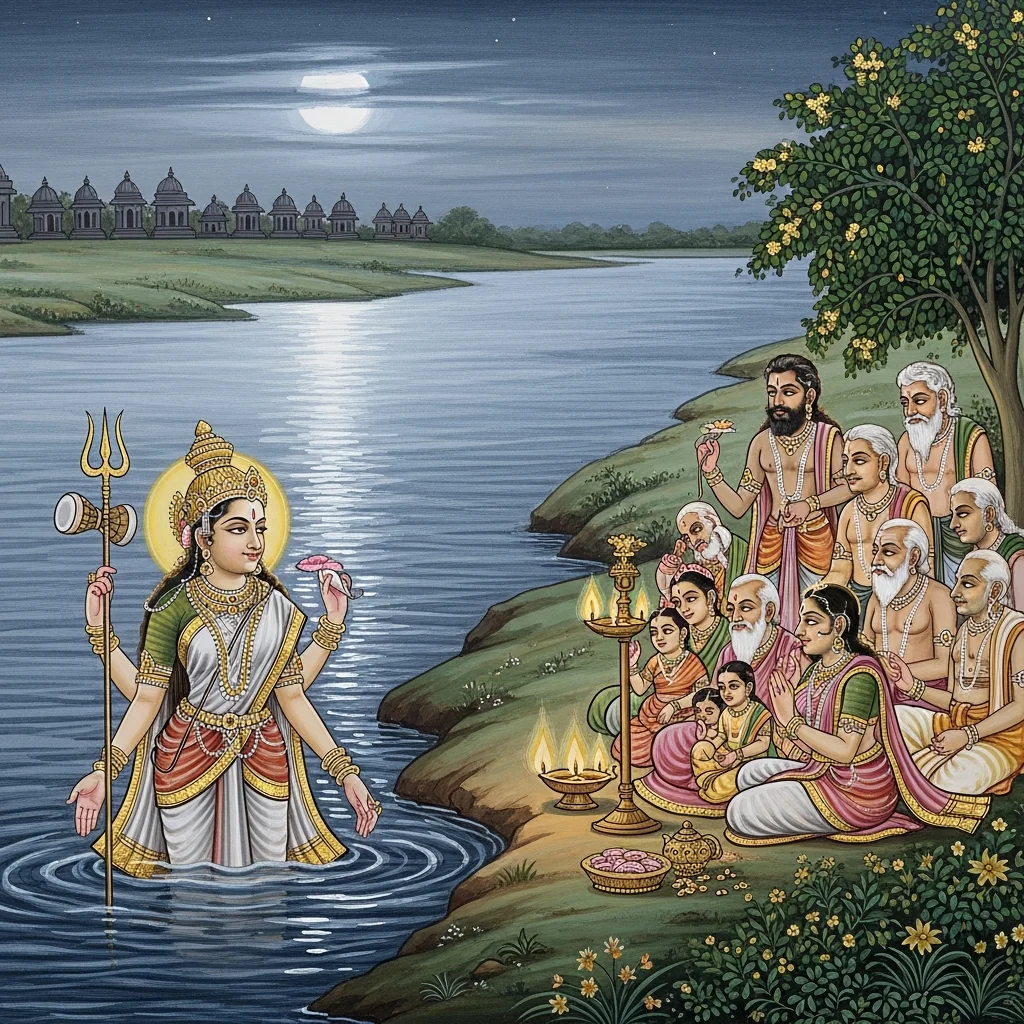
Chapter 13 unfolds a series of theological episodes centered on Narmadā/Revā as a protective, enduring sacred power. Mārkaṇḍeya relates that the Devī, praised by sages, resolves to grant boons and appears to them at night in dreams, reassuring them and inviting them to live near her without fear or want. Extraordinary signs then arise—especially an abundance of fish near the hermitages—marking divine favor and sustaining the ascetic communities. The vision widens: sages dwell along Narmadā’s banks, performing japa, tapas, and rites to ancestors and deities; the riverbanks shine with many liṅga-shrines and disciplined brāhmaṇas. In a later midnight epiphany, a radiant maiden emerges from the waters, bearing a trident and a serpent as sacred thread, urging sages with families to enter her (the river) for protection as pralaya approaches. The chapter finally proclaims Narmadā’s exceptional continuity across multiple kalpas, identifies her as Śaṅkarī-śakti, and names the kalpas in which she does not perish—revealing the river as both sacred geography and a cosmic principle.
Shlokas
Verse 1
श्रीमार्कण्डेय उवाच । एवं भगवती पुण्या स्तुता सा मुनिपुंगवैः । चिन्तयामास सर्वेषां दास्यामि वरमुत्तमम्
Śrī Mārkaṇḍeya said: Thus praised by the foremost sages, that holy, blessed Goddess reflected, “I shall grant all of them an excellent boon.”
Verse 2
ततः प्रसुप्तांस्ताञ्ज्ञात्वा रात्रौ देवी जगाम ह । एकैकस्य ऋषेः स्वप्ने दर्शनं चारुहासिनी
Then, knowing that those sages had fallen asleep, the Goddess came at night; smiling sweetly, she granted each sage her vision in a dream, one by one.
Verse 3
ततोऽर्धरात्रे सम्प्राप्त उत्थिता जलमध्यतः । विमलाम्बरसंवीता दिव्यमालाविभूषिता
Then, when midnight arrived, she rose up from the midst of the waters, clad in spotless garments and adorned with a divine garland.
Verse 4
घृतातपत्रा सुश्रोणी पद्मरागविभूषिता । जगाद मा भैरिति तानेकैकं तु पृथक्पृथक्
Holding a splendid parasol, graceful in form and adorned with rubies, she spoke to each of them separately: “Do not fear.”
Verse 5
वसध्वं मम पार्श्वे तु भयं त्यक्त्वा क्षुधादिजम्
“Dwell beside me; casting away fear—along with hunger and the like.”
Verse 6
एवमुक्त्वा तदा देवी स्वप्नान्ते तान्महामुनीन् । जगामादर्शनं पश्चात्प्रविश्य जलमात्मिकम्
Having spoken thus, the Goddess—at the end of the dream—then vanished from the sight of those great sages, entering into her own watery nature.
Verse 7
ततः प्रभाते मुनयो मिथ ऊचुर्मुदन्विताः । तथा दृष्टा मया दृष्टा स्वप्ने देवी सुदर्शना
Then, at dawn, the sages joyfully spoke to one another: “Indeed, I saw her—I saw her in a dream, the beautiful Goddess of auspicious vision.”
Verse 8
अभयं दत्तमस्माकं सिद्धिश्चाप्यचिरेण तु । प्रशस्तं दर्शनं तस्या नर्मदाया न संशयः
Fearlessness has been granted to us, and accomplishment (siddhi) will come before long. Her darśana is supremely auspicious—of Narmadā, without any doubt.
Verse 9
अथान्यदिवसे राजन्मत्स्यानां रूपमुत्तमम् । पश्यन्ति सपरीवाराः स्वकीयाश्रमसन्निधौ
Then, on another day, O King, they—together with their companions—beheld splendid fish-forms near their own āśrama.
Verse 10
तान्दृष्ट्वा विस्मयाविष्टा मत्स्यांस्तत्र महर्षयः । पूजयामासुरव्यग्रा हव्यकव्येन देवताः
Seeing those fish there, the great sages—overcome with wonder and free from agitation—worshipped the deities with offerings meant for the gods and the ancestors.
Verse 11
तान्मत्स्यसङ्घान्सम्प्राप्य महादेव्याः प्रसादतः । सपुत्रदारभृत्यास्ते वर्तयन्ति पृथक्पृथक्
Having obtained those shoals of fish by the grace of the Great Goddess, they—together with sons, wives, and dependents—maintained themselves, each household separately.
Verse 12
दिने दिने तथाप्येवमाश्रमेषु द्विजातयः । मत्स्यानां सञ्चयं दृष्ट्वा विस्मिताश्चाभवंस्तदा
Day after day, even so, the twice-born in the hermitages, seeing the accumulation of fish, became astonished.
Verse 13
अध्याय
“Chapter.”
Verse 14
हृष्टपुष्टास्तदा सर्वे नर्मदातीरवासिनः । ऋषयस्ते भयं सर्वे तत्यजुः क्षुत्तृषोद्भवम्
Then all those sages dwelling on the bank of the Narmadā became joyful and well-nourished; all of them cast off the fear born of hunger and thirst.
Verse 15
ते जपन्तस्तपन्तश्च तिष्ठन्ति भरतर्षभ । अर्चयन्ति पित्ःन्देवान्नर्मदातटमाश्रिताः
O bull among the Bhāratas, dwelling upon the bank of the Narmadā, they remain there—reciting japa and practicing tapas—while worshipping both the Pitṛs (ancestors) and the Devas.
Verse 16
तैर्जपद्भिस्तपद्भिश्च सततं द्विजसत्तमैः । भ्राजते सा सरिच्छ्रेष्ठा ताराभिर्द्यौर्ग्रहैरिव
By those excellent Brahmins, ever engaged in japa and austerity, that best of rivers shines—like the sky gleaming with stars and planets.
Verse 17
तत्र तैर्बहुलैः शुभ्रैर्ब्राह्मणैर्वेदपरागैः । नर्मदा धर्मदा पूर्वं संविभक्ता यथाक्रमम्
There, by many pure Brahmins, well-versed in the Vedas, the Narmadā—bestower of dharma—was formerly arranged and apportioned in due order.
Verse 18
ऋषिभिर्दशकोटिभिर्नर्मदातीरवासिभिः । विभक्तेयं विभक्ताङ्गी नर्मदा शर्मदा नृणाम्
By ten crores of ṛṣis dwelling on the banks of the Narmadā, this Narmadā—whose limbs were duly apportioned—was apportioned; she is the giver of well-being to men.
Verse 19
यज्ञोपवीतैश्च शुभैरक्षसूत्रैश्च भारत । कूलद्वये महापुण्या नर्मदोदधिगामिनी
O Bhārata, on both banks, with auspicious yajñopavītas and rosaries (akṣasūtras), the supremely meritorious Narmadā flows onward to the ocean.
Verse 20
पृथगायतनैः शुभ्रैर्लिङ्गैर्वालुकमृन्मयैः । भ्राजते या सरिच्छ्रेष्ठा नक्षत्रैरिव शर्वरी
That best of rivers shines with separate, pure shrines and with liṅgas made of sand and clay—like the night sparkling with constellations.
Verse 21
एवं त ऋषयः सर्वे तर्पयन्तः सुरान्पित्ःन् । न्यवसन्नर्मदातीरे यावदाभूतसम्प्लवम्
Thus all those sages, offering satisfaction to the Devas and the Pitṛs, dwelt on the bank of the Narmadā until the great dissolution of beings.
Verse 22
किंचिद्गते ततस्तस्मिन्घोरे वर्षशताधिके । अर्धरात्रे तदा कन्या जलादुत्तीर्य भारत
After some time had passed—more than a hundred formidable years—then, at midnight, O Bhārata, a maiden rose up from the waters.
Verse 23
विद्युत्पुंजसमाभासा व्यालयज्ञोपवीतिनी । त्रिशूलाग्रकरा सौम्या तानुवाच ऋषींस्तदा
Radiant like a mass of lightning, wearing a serpent as her sacred thread, gentle yet holding the tip of a trident in her hand—she then addressed those sages.
Verse 24
आगच्छध्वं मुनिगणा विशध्वं मामयोनिजाम् । समेताः पुत्रदारैश्च ततः सिद्धिमवाप्स्यथ
“Come, O hosts of sages; enter into me—the Unborn (not womb-born). Gathered together with your sons and wives, then you shall attain siddhi, spiritual accomplishment.”
Verse 25
यस्य यस्य हि या वाञ्छा तस्य तां तां ददाम्यहम् । विष्णुं ब्रह्माणमीशानमन्यं वा सुरमुत्तमम्
Whatever wish anyone may hold—each and every such desire I grant: whether it be the attainment of Viṣṇu, Brahmā, Īśāna (Śiva), or any other supreme deity among the devas.
Verse 26
तत्र सर्वान्नयिष्यामि प्रसन्ना वरदा ह्यहम् । प्राणायामपरा भूत्वा मां विशध्वं समाहिताः
There I shall lead you all, for I am gracious and truly a giver of boons. Become intent on prāṇāyāma, and with collected minds enter into me—take refuge in me.
Verse 27
सह पुत्रैश्च दारैश्च त्यक्त्वाश्रमपदानि च । कालक्षेपो न कर्तव्यः प्रलयोऽयमुपस्थितः
Together with your sons and wives, abandoning even your hermitages and stations of life—do not waste time. This dissolution (pralaya) has drawn near.
Verse 28
संहारः सर्वभूतानां कल्पदाहः सुदारुणः । एकाहमभवं पूर्वं महाघोरे जनक्षये
There is the destruction of all beings—the terribly fierce conflagration at the end of an age. Formerly, in that most dreadful annihilation of creatures, I alone remained.
Verse 29
शेषा नद्यः समुद्राश्च सर्व एव क्षयंगताः । वरदानान्महेशस्य तेनाहं न क्षयं गता
All other rivers and even the oceans went to destruction. But because of the boons bestowed by Maheśa, I did not go to ruin.
Verse 30
अमृतः शाश्वतो देवः स्थाणुरीशः सनातनः । स पूजितः प्रार्थितो वा किं न दद्याद्द्विजोत्तमाः
The deathless, everlasting God—Sthāṇu, the Lord, the Eternal—when worshipped or even entreated, what would he not grant, O best of the twice-born?
Verse 31
एवमुक्त्वा ऋषीव्रेवा प्रविवेश जलं ततः । करात्तशूला सा देवी व्यालयज्ञोपवीतिनी
Having spoken thus to the sages, Revā then entered the waters. That goddess held a trident in her hand, and wore a serpent as her sacred thread.
Verse 32
ततस्ते तद्वचः श्रुत्वा विस्मयापन्नमानसाः । अभिवन्द्य च मां सर्वे क्षामयन्तः पुनः पुनः
Then, hearing her words, their minds filled with wonder, they all bowed to me and again and again begged forgiveness.
Verse 33
क्षम्यतां नो यदुक्तं हि वसतां तव संश्रये । गृहांस्त्यक्त्वा महाभागाः सशिष्याः सहबान्धवाः
May what we have spoken be forgiven—(we) who dwell under your protection. Leaving our homes behind, O greatly fortunate one, we have come with our disciples and with our kinsmen.
Verse 34
जप्त्वा चैकाक्षरं ब्रह्म हृदि ध्यात्वा महेश्वरम् । स्नात्वा च मन्त्रपूताभिरथ चाद्भिर्जितव्रताः
Having recited the single-syllabled Brahman (the sacred seed) and meditated in the heart upon Maheśvara, and having bathed in waters purified by mantra, those steadfast in their vows thus prepared themselves.
Verse 35
विविशुर्नर्मदातोयं सपक्षा इव पर्वताः । द्योतयन्तो दिशः सर्वाः कुशहस्ताः सहाग्रयः
They entered the waters of the Narmadā like mountains furnished with wings; holding kuśa-grass in their hands with the tips raised, they seemed to illuminate all the directions.
Verse 36
गतेषु तेषु राजेन्द्र अहमेकः स्थितस्तदा । अमरेशं समासाद्य पूजयन्नर्मदां नदीम्
When they had gone, O lord of kings, I remained there alone. Approaching Amareśa, I worshipped the river Narmadā.
Verse 37
अनुभूताः सप्तकल्पा मायूराद्या मया नृप । प्रसादाद्वेधसः सर्वे रेवया सह भारत
O king—O Bhārata—by the grace of Vedhas (Brahmā), I have experienced seven kalpas, beginning with the Māyūra, together with Revā (Narmadā).
Verse 38
जन्मतोऽद्य दिनं यावन्न जानेऽस्याः पुरास्थितिम्
From my birth up to this very day, I know of no former time when she (Revā/Narmadā) was not established.
Verse 39
इयं हि शांकरी शक्तिः कला शम्भोरिलाह्वया । नर्मदा दुरितध्वंसकारिणी भवतारिणी
For she is Śāṅkarī Śakti—the very power, a portion of Śambhu—known by the name Ilā. She is Narmadā, the destroyer of sin, the one who carries beings across worldly becoming.
Verse 40
यदाहमपि नाभूवं पुराकल्पेषु पाण्डव । चतुर्दशसु कल्पेषु तेष्वियं सुखसंस्थिता
O Pāṇḍava, even in those former kalpas when I myself did not exist, in fourteen kalpas she (Narmadā) remained happily established.
Verse 41
चतुर्दश पुरा कल्पा न मृता येषु नर्मदा । तानहं सम्प्रवक्ष्यामि देवी प्राह यथा मम
There were fourteen kalpas of old in which Narmadā did not ‘die’ (did not cease). I shall now declare them, just as the Goddess told me.
Verse 42
कापिलं प्रथमं विद्धि प्राजापत्यं द्वितीयकम् । ब्राह्मं सौम्यं च सावित्रं बार्हस्पत्यं प्रभासकम्
Know the first to be the Kāpila (Kalpa), the second the Prājāpatya; then the Brāhma, the Saumya, the Sāvitra, the Bārhaspatya, and the Prabhāsaka.
Verse 43
माहेन्द्रमग्निकल्पं च जयन्तं मारुतं तथा । वैष्णवं बहुरूपं च ज्यौतिषं च चतुर्दशम्
Also know the Māhendra, the Agni-kalpa, the Jayanta, and likewise the Māruta; then the Vaiṣṇava, the Bahurūpa, and the Jyautiṣa as the fourteenth.
Verse 44
एते कल्पा मया ख्याता न मृता येषु नर्मदा । मायूरं पञ्चदशमं कौर्मं चैवात्र षोडशम्
These are the kalpas I have declared, in which Narmadā did not cease. The Māyūra is the fifteenth, and here the Kaurma is the sixteenth.
Verse 45
बकं मात्स्यं च पाद्मं च वटकल्पं च भारत । एकविंशतिमं चैतं वाराहं सांप्रतीनकम्
O Bhārata, these are the Baka, the Mātsya, the Pādma, and the Vaṭa-kalpa; and this present one is the twenty-first, called the Vārāha (Kalpa).
Verse 46
इमे सप्त मया साकं रेवया परिशीलिताः । एकविंशतिकल्पास्तु नर्मदायाः शिवाङ्गतः
These seven (kalpas) have been carefully observed by me together with Revā. And the twenty-one kalpas of Narmadā are to be known as arising from the very body, the sacred limb, of Śiva.
Verse 47
संजाताया नृपश्रेष्ठ मया दृष्टा ह्यनेकशः । कथिता नृपतिश्रेष्ठ भूयः किं कथयामि ते
O best of kings, I have indeed seen her—Revā/Narmadā—many times as she came into being. O foremost of rulers, I have already told this; what more shall I say to you again?