Adhyaya 19
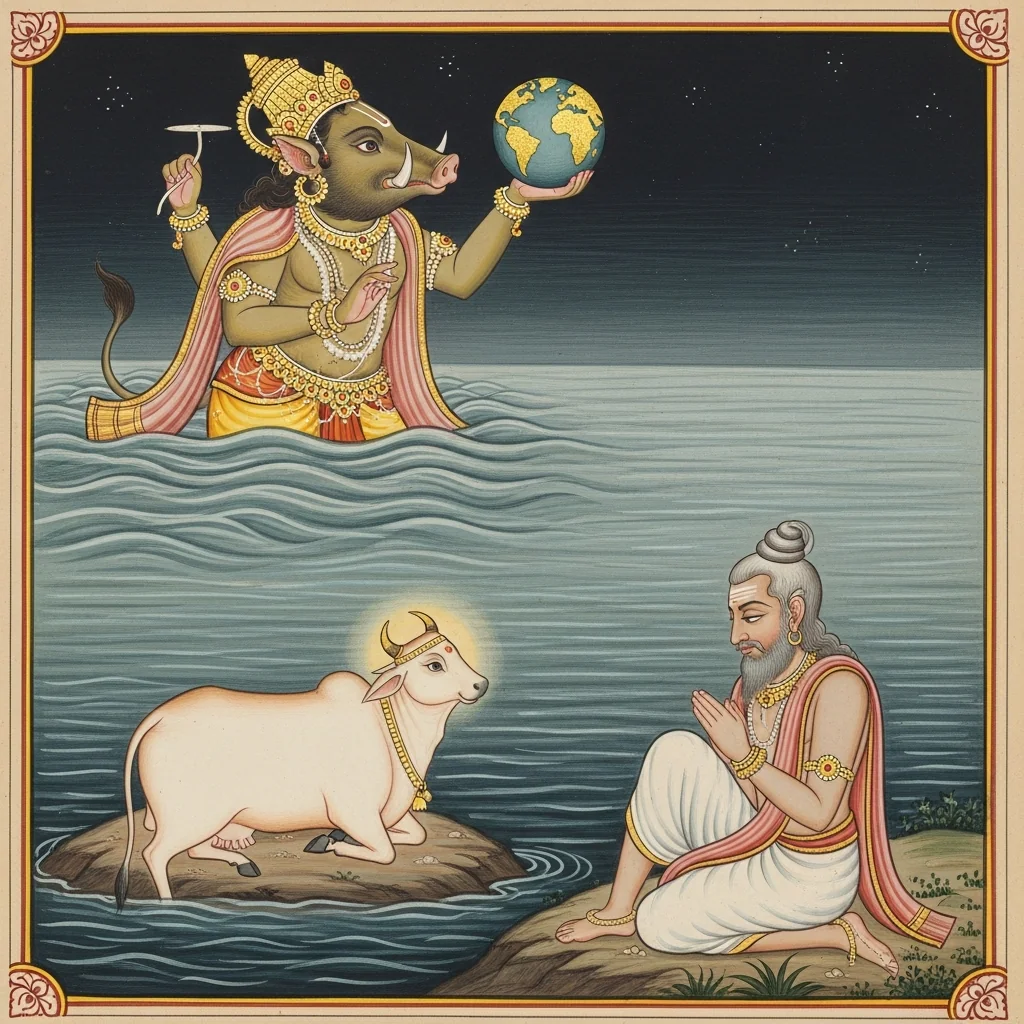
Chapter 19 unfolds a two-part theological account in Mārkaṇḍeya’s first-person voice. (1) In the ekārṇava pralaya, when all becomes a single ocean, the exhausted sage nears death and beholds a radiant cow moving upon the waters. She reassures him that by Mahādeva’s grace death will not come, tells him to hold her tail, and grants divine milk that removes hunger and thirst and restores wondrous vitality. She reveals herself as Narmadā, sent by Rudra to save the brāhmaṇa, establishing the river as a conscious savior and a bearer of Śaiva grace. (2) The narrative then turns to a cosmogonic vision: the speaker sees the Supreme Lord in the waters, associated with Umā and cosmic śakti; the deity awakens and assumes the Varāha form to raise the submerged Earth. The text affirms a non-sectarian synthesis, declaring Rudra/Hari and the creator-functions to be non-different in the highest truth, and warns against hostile, divisive readings. The closing phalaśruti proclaims that daily reading or hearing purifies and leads to auspicious heavenly attainments after death.
Shlokas
Verse 1
श्रीमार्कण्डेय उवाच । ततस्त्वेकार्णवे तस्मिन्मुमूर्षुरहमातुरः । काकूच्छ्वासस्तरंस्तोयं बाहुभ्यां नृपसत्तम
Śrī Mārkaṇḍeya said: Then, in that single ocean, distressed and near death, I floated upon the waters, gasping and pleading—swimming with my arms, O best of kings.
Verse 2
शृणोम्यर्णवमध्यस्थो निःशब्दस्तिमिते तदा । अम्भोरवमनौपम्यं दिशो दश विनादिनम्
Then, stationed in the midst of the ocean in a stillness without sound, I heard the matchless roar of the waters—resounding through all the ten directions.
Verse 3
हंसकुदेन्दुसंकाशां हारगोक्षीरपाण्डुराम् । नानारत्नविचित्राङ्गीं स्वर्णशृङ्गां मनोरमाम्
I beheld a cow—radiant like a swan, a jasmine blossom, and the moon; pale like a garland and like milk. Her limbs were adorned with many kinds of jewels, and her horns were golden—exceedingly charming to behold.
Verse 4
सुरैः प्रवालकमयैर्लाङ्गुलध्वजशोभिताम् । प्रलम्बघोणां नर्दन्तीं खुरैरर्णवगाहिनीम्
She was adorned with coral-like ornaments worthy of the gods, and made splendid with a tail and banner. With a long muzzle and a roaring cry, she strode through the ocean, wading it with her hooves.
Verse 5
गां ददर्शाहमुद्विग्नो मामेवाभिमुखीं स्थिताम् । किंकिणीजालमुक्ताभिः स्वर्णघण्टासमावृताम्
Agitated, I beheld that cow standing alone, facing me—covered with strings of tinkling bells and pearls, and adorned with golden bells.
Verse 6
तस्याश्चरणविक्षेपैः सर्वमेकार्णवं जलम् । विक्षिप्तफेनपुञ्जौघैर्नृत्यन्तीव समं ततः
With the swift movements of her feet, all that water became as though a single cosmic ocean. The surging masses of foam flung about made it seem as if the waters themselves were dancing everywhere.
Verse 7
ररास सलिलोत्क्षेपैः क्षोभयन्ती महार्णवम् । सा मामाह महाभाग श्लक्ष्णगम्भीरया गिरा
Stirring the great ocean with upsurging jets of water, she roared. Then, in a smooth and profound voice, she addressed me: “O fortunate one…”
Verse 8
मा भैषीर्वत्स वत्सेति मृत्युस्तव न विद्यते । महादेवप्रसादेन न मृत्युस्ते ममापि च
“Do not fear, my child, my child. Death does not exist for you. By the grace of Mahādeva, death is not for you—nor for me as well.”
Verse 9
ममाश्रयस्व लाङ्गूलं त्वामतस्तारयाम्यहम् । घोरादस्माद्भयाद्विप्र यावत्संप्लवते जगत्
“Hold fast to my tail; thus shall I ferry you across. O brāhmaṇa, from this dreadful fear—until the whole world is overwhelmed by the flood—I will deliver you.”
Verse 10
क्षुत्तृषाप्रतिघातार्थं स्तनौ मे त्वं पिबस्व ह । पयोऽमृताश्रयं दिव्यं तत्पीत्वा निर्वृतो भव
“To ward off hunger and thirst, drink from my breasts. This divine milk is founded on nectar; having drunk it, become peaceful and satisfied.”
Verse 11
तस्यास्तद्वचनं श्रुत्वा हर्षात्पीतो मया स्तनः । न क्षुत्तृषा पीतमात्रे स्तने मह्यं तदाभवत्
Hearing her words, I drank from her breast with joy. The moment I drank, hunger and thirst no longer afflicted me.
Verse 12
दिव्यं प्राणबलं जज्ञे समुद्रप्लवनक्षमम् । ततस्तां प्रत्युवाचेदं का त्वमेकार्णवीकृते
A divine strength of life-breath arose in me, capable of crossing the ocean. Then I replied to her: “Who are you, when everything has become this single cosmic sea?”
Verse 13
भ्रमसे ब्रूहि तत्त्वेन विस्मयो मे महान्हृदि । भ्रमतोऽत्र ममार्तस्य मुमूर्षोः प्रहतस्य
“Tell me truly who you are, moving about here—great wonder has arisen in my heart. As I wandered here, afflicted, near death, and struck down…”
Verse 14
त्वं हि मे शरणं जाता भाग्यशेषेण सुव्रते
Truly, you have become my refuge—by the last remnant of my good fortune, O woman of noble vows.
Verse 15
गौरुवाच । किमहं विस्मृता तुभ्यं विश्वरूपा महेश्वरी । नर्मदा धर्मदा न्ःणां स्वर्गशर्मबलप्रदा
Gaurī said: “Have you forgotten me? I am Maheśvarī of universal form—Narmadā, bestower of dharma upon people, granting the happiness of heaven and the power to attain it.”
Verse 16
दृष्ट्वा त्वां सीदमानं तु रुद्रेणाहं विसर्जिता । तं द्विजं तारयस्वार्ये मा प्राणांस्त्यजतां जले
Seeing you sinking, I was dispatched by Rudra. O noble lady, save that brāhmaṇa—let him not give up his life in the waters.
Verse 17
गोरूपेण विभोर्वाक्यात्त्वत्सकाशमिहागता । मा मृषावचनः शम्भुर्भवेदिति च सत्वरा
Assuming the form of a cow, and by the command of the Lord, I have come here to you—swiftly—so that Śambhu’s word may not prove false.
Verse 18
एवमुक्तस्तयाहं तु इन्द्रायुधनिभं शुभम् । लाङ्गूलमव्ययं ज्ञात्वा भुजाभ्यामवलम्बितः
Thus addressed by her, I recognized that auspicious tail—like Indra’s thunderbolt and unperishing—and I clung to it with both arms.
Verse 19
अध्याय
“Chapter” — a scribal or sectional marker, not a metrical verse.
Verse 20
ततो युगसहस्रान्तमहं कालं तया सह । व्यचरं वै तमोभूते सर्वतः सलिलावृते
Thereafter, for a span equal to a thousand yugas, I wandered with her in a world sunk in darkness and covered on every side by waters.
Verse 21
महार्णवे ततस्तस्मिन् भ्रमन्गोः पुच्छमाश्रितः । निर्वाते चान्धकारे च निरालोके निरामये
Then, in that great ocean, drifting about while clinging to the cow’s tail, I remained in windless darkness—lightless, and free from affliction.
Verse 22
अकस्मात्सलिले तस्मिन्नतसीपुष्पसन्निभम् । विभिन्नांजनसङ्काशमाकाशमिव निर्मलम्
Suddenly, within those waters, there appeared something like the blossom of flax—pure as the sky—dark-hued like powdered collyrium dispersed.
Verse 23
नीलोत्पलदलश्यामं पीतवाससमव्ययम् । किरीटेनार्कवर्णेन विद्युद्विद्योतकारिणा
Dark as the petal of a blue lotus, clad in imperishable yellow garments, and crowned with a sun-colored diadem that flashed like lightning—
Verse 24
भ्राजमानेन शिरसा खमिवात्यन्तरूपिणम् । कुण्डलोद्धष्टगल्लं तु हारोद्द्योतितवक्षसम्
With a radiant head, exquisitely formed like the very sky; his cheeks brushed by earrings, and his chest illumined by a gleaming necklace—
Verse 25
जाम्बूनदमयैर्दिव्यैर्भूषणैरुपशोभितम् । नागोपधानशयनं सहस्रादित्यवर्चसम्
Adorned with divine ornaments of jāmbūnada gold; reclining with a serpent as his pillow—radiant with the splendor of a thousand suns.
Verse 26
अनेकबाहूरुधरं नैकवक्त्रं मनोरमम् । सुप्तमेकार्णवे वीरं सहस्राक्षशिरोधरम्
I behold the heroic Lord asleep in the single cosmic ocean—delightful to behold, bearing many arms and mighty thighs, with many faces, and crowned with thousands of eyes and heads.
Verse 27
जटाजूटेन महता स्फुरद्विद्युत्समार्चिषा । एकार्णवं जगत्सर्वं व्याप्य देवं व्यवस्थितम्
With a vast matted crown of hair, blazing like flashing lightning, the Deity stands established—pervading the single ocean and the entire universe.
Verse 28
ग्रसित्वा शङ्करः सर्वं सदेवासुरमानवम् । प्रपश्याम्यहमीशानं सुप्तमेकार्णवे प्रभुम्
After Śaṅkara has swallowed all—gods, asuras, and humans—I behold that sovereign Lord, Īśāna, asleep in the single cosmic ocean.
Verse 29
सर्वव्यापिनमव्यक्तमनन्तं विश्वतोमुखम् । तस्य पादतलाभ्याशे स्वर्णकेयूरमण्डिताम्
He is all-pervading, unmanifest, endless, and facing every direction. Near the soles of His feet I beheld Her—adorned with golden armlets—
Verse 30
विश्वरूपां महाभागां विश्वमायावधारिणीम् । श्रीमयीं ह्रीमयीं देवीं धीमयीं वाङ्मयीं शिवाम्
…the Goddess of universal form, most auspicious, bearer of the world’s māyā—filled with Śrī and sacred modesty; the Devī who is wisdom itself and speech itself, the gracious Śivā.
Verse 31
सिद्धिं कीर्तिं रतिं ब्राह्मीं कालरात्रिमयोनिजाम् । तामेवाहं तदात्यन्तमीश्वरान्तिकमास्थिताम्
I recognized Her as Siddhi, Kīrti, Rati, Brāhmī, and Kālarātri—the Unborn One; and then I saw Her abiding wholly near the Lord.
Verse 32
अद्राक्षं चन्द्रवदनां धृतिं सर्वेश्वरीमुमाम्
I saw Umā, moon-faced—Dhṛti herself, the Supreme Lady of all.
Verse 33
शान्तं प्रसुप्तं नवहेमवर्णमुमासहायं भगवन्तमीशम् । तमोवृतं पुण्यतमं वरिष्ठं प्रदक्षिणीकृत्य नमस्करोमि
Having circumambulated in pradakṣiṇā, I bow to the Blessed Lord—peaceful, asleep, of fresh-gold hue, accompanied by Umā; veiled in darkness, yet most holy, the highest of all.
Verse 34
ततः प्रसुप्तः सहसा विबुद्धो रात्रिक्षये देववरः स्वभावात् । विक्षोभयन् बाहुभिरर्णवाम्भो जगत्प्रणष्टं सलिले विमृश्य
Then, at the end of the night, the best of gods awoke suddenly by His own nature. Stirring the ocean-waters with His arms, He reflected upon the world that had vanished into the flood.
Verse 35
किं कार्यमित्येव विचिन्तयित्वा वाराहरूपोऽभवदद्भुताङ्गः । महाघनाम्भोधरतुल्यवर्चाः प्रलम्बमालाम्बरनिष्कमाली
Thinking, ‘What must be done?’, He assumed the form of Varāha, wondrous-limbed—His splendor like a great, dark rain-cloud, adorned with a long garland, garments, and golden ornaments.
Verse 36
सशङ्खचक्रासिधरः किरीटी सवेदवेदाङ्गमयो महात्मा । त्रैलोक्यनिर्माणकरः पुराणो देवत्रयीरूपधरश्च कार्ये
Crowned and bearing conch, discus, and sword, that great-souled Lord is formed of the Vedas and their auxiliaries. The Primeval One, the maker of the three worlds, assumes—when there is work to be done—the forms of the divine triad: Brahmā, Viṣṇu, and Rudra.
Verse 37
स एव रुद्रः स जगज्जहार सृष्ट्यर्थमीशः प्रपितामहोऽभूत् । संरक्षणार्थं जगतः स एव हरिः सुचक्रासिगदाब्जपाणिः
He alone is Rudra—He withdraws the universe. For the purpose of creation, the Lord becomes the Prāpitāmaha (Brahmā). And for the protection of the world, He alone is Hari, whose hands bear the splendid discus, sword, mace, and lotus.
Verse 38
तेषां विभागो न हि कर्तुमर्हो महात्मनामेकशरीरभाजाम् । मीमांसाहेत्वर्थविशेषतर्कैर्यस्तेषु कुर्यात्प्रविभेदमज्ञः
No division should ever be made among those great beings who share one essential body. Ignorant is the one who, using disputations of exegesis, causality, and hairsplitting logic, tries to manufacture differences among them.
Verse 39
स याति घोरं नरकं क्रमेण विभागकृद्द्वेषमतिर्दुरात्मा । या यस्य भक्तिः स तयैव नूनं देहं त्यजन् स्वं ह्यमृतत्वमेति
That evil-souled one—who makes divisions and is bent on hatred—goes step by step to dreadful hell. But whatever deity a person truly worships with devotion, by that very devotion, surely, on leaving the body, one attains immortality.
Verse 40
संमोहयन्मूर्तिभिरत्र लोकं स्रष्टा च गोप्ता क्षयकृत्स देवः । तस्मान्न मोहात्मकमाविशेत द्वेषं न कुर्यात्प्रविभिन्नमूर्तिः
That very God, through diverse forms, bewilders this world—becoming creator, protector, and bringer of dissolution. Therefore one should not enter into delusion, and one should not cultivate hatred, thinking the forms to be truly separate.
Verse 41
वाराहमीशानवरोऽप्यतोऽसौ रूपं समास्थाय जगद्विधाता । नष्टे त्रिलोकेऽर्णवतोयमग्ने विमार्गितोयौघमयेऽन्तरात्मा
Therefore that Lord—supreme even over Īśāna—assumed the form of the Boar (Varāha) as the ordainer of the cosmos. When the three worlds had perished and were submerged in the ocean-flood, the Inner Self sought within the watery mass what had been lost.
Verse 42
भित्त्वार्णवं तोयमथान्तरस्थं विवेश पातालतलं क्षणेन । जले निमग्नां धरणीं समस्तां समस्पृशत्पङ्कजपत्रनेत्राम्
Splitting the ocean’s waters and entering what lay within, in an instant He reached the floor of Pātāla. There He touched the entire Earth, sunk beneath the waters—Earth of lotus-petal eyes, lovely and radiant.
Verse 43
विशीर्णशैलोपलशृङ्गकूटां वसुंधरां तां प्रलये प्रलीनाम् । दंष्ट्रैकया विष्णुरतुल्यसाहसः समुद्दधार स्वयमेव देवः
That Earth, whose mountains, rocks, peaks, and crags were shattered and who had dissolved in the pralaya, Viṣṇu—the God of incomparable valor—lifted her up by a single tusk, all by Himself.
Verse 44
सा तस्य दंष्ट्राग्रविलम्बिताङ्गी कैलासशृङ्गाग्रगतेव ज्योत्स्ना । विभ्राजते साप्यसमानमूर्तिः शशाङ्कशृङ्गे च तडिद्विलग्ना
Hanging from the tip of His tusk, she—the Earth—shone like moonlight resting upon the summit of Kailāsa. That peerless-formed Earth gleamed also like lightning clinging to the horn of the Moon.
Verse 45
तामुज्जहारार्णवतोयमग्नां करी निमग्नामिव हस्तिनीं हठात् । नावं विशीर्णामिव तोयमध्यादुदीर्णसत्त्वोऽनुपमप्रभावः
He forcefully lifted her up from the ocean depths—like an elephant raising a submerged she-elephant. With surging strength and incomparable power, He drew her out as one would pull up a broken boat from the midst of the waters.
Verse 46
स तां समुत्तार्य महाजलौघात्समुद्रमार्यो व्यभजत्समस्तम् । महार्णवेष्वेव महार्णवाम्भो निक्षेपयामास पुनर्नदीषु
Having lifted the earth up from the immense flood of waters, that noble Lord apportioned the ocean in its entirety. He then set the waters of the great seas back into the great oceans, and again released them into the rivers.
Verse 47
शीर्णांश्च शैलान्स चकार भूयो द्वीपान्समस्तांश्च तथार्णवांश्च । शैलोपलैर्ये विचिताः समन्ताच्छिलोच्चयांस्तान्स चकार कल्पे
He again fashioned the shattered mountains, and likewise all the continents and the oceans. Those regions that lay strewn everywhere with mountain-stones—he made them into lofty heaps of rock for the ordering of the age (kalpa).
Verse 48
अनेकरूपं प्रविभज्य देहं चकार देवेन्द्रगणान्समस्तान् । मुखाच्च वह्निर्मनसश्च चन्द्रश्चक्षोश्च सूर्यः सहसा बभूव
Dividing his body into many forms, he brought forth all the hosts of the gods. From his mouth fire arose; from his mind the moon; and from his eye the sun came into being at once.
Verse 49
जज्ञेऽथ तस्येश्वरयोगमूर्तेः प्रध्यायमानस्य सुरेन्द्रसङ्घः । वेदाश्च यज्ञाश्च तथैव वर्णास्तथा हि सर्वौषधयो रसाश्च
Then, as that Lord—whose very form is yogic sovereignty—entered profound contemplation, the assembly of the gods was born. The Vedas and the sacrifices (yajñas), the varṇas, and indeed all herbs and their vital essences also came forth.
Verse 50
जगत्समस्तं मनसा बभूव यत्स्थावरं किंचिदिहाण्डजं वा । जरायुजं स्वेदजमुद्भिज्जं वा यत्किंचिदा कीटपिपीलकाद्यम्
All this universe came to be through his mind—whatever is immobile, whatever is egg-born, womb-born, sweat-born, or sprout-born; indeed, whatever exists, down to worms, ants, and the like.
Verse 51
ततो विजज्ञे मनसा क्षणेन अनेकरूपाः सहसा महेशा । चकार यन्मूर्तिभिरव्ययात्मा अष्टाभिराविश्य पुनः स तत्र
Then, in an instant, Maheśa knew by his mind the many forms. The imperishable Self assumed eight forms, entered them, and again remained there, pervading them.
Verse 52
लीलां चकाराथ समृद्धतेजा अतोऽत्र मे पश्यत एव विप्राः । तेषां मया दर्शनमेव सर्वं यावन्मुहूर्तात्समकारि भूप
Then the radiant Lord performed his divine līlā. “Therefore, O brāhmaṇas, behold what I have seen here: within the span of a single muhūrta, all of it became visible to me, O king.”
Verse 53
कृत्वा त्वशेषं किल लीलयैव स देवदेवो जगतां विधाता । सर्वत्रदृक्सर्वग एव देवो जगाम चादर्शनमादिकर्ता
Having accomplished everything, as it were, merely by play, that Devadeva—the ordainer of worlds—who sees everywhere and moves everywhere, the primal maker then withdrew from sight.
Verse 54
यत्तन्मुहूर्तादिह नामरूपं तावत्प्रपश्यामि जगत्तथैव । द्वीपैः समुद्रैरभिसंवृतं हि नक्षत्रतारादिविमानकीर्णम्
From that very muhūrta onward, I behold here the world exactly as it is in name and form—encircled by continents and oceans, and filled with celestial chariots amid the stars and constellations.
Verse 55
वियत्पयोदग्रहचक्रचित्रं नानाविधैः प्राणिगणैर्वृतं च । तां वै न पश्यामि महानुभावां गोरूपिणीं सर्वसुरेश्वरीं च
I see the sky adorned with clouds, planets, and their circling courses, and I see it surrounded by beings of many kinds; yet I do not behold that mighty one—the supreme goddess of all the gods—who appears in the form of a cow.
Verse 56
क्व सांप्रतं सेति विचिन्त्य राजन्विभ्रान्तचित्तस्त्वभवं तदैव । दिशो विभागानवलोकयानृते पुनस्तां कथमीश्वराङ्गीम्
“Where is she now?”—thinking thus, O King, my mind at once became bewildered. Unless I looked carefully into every quarter, how could I behold her again—the River-Goddess who is the very limb of the Lord?
Verse 57
पश्यामि तामत्र पुनश्च शुभ्रां महाभ्रनीलां शुचिशुभ्रतोयाम् । वृक्षैरनेकैरुपशोभिताङ्गीं गजैस्तुरङ्गैर्विहगैर्वृतां च
Again I behold her there—radiant and bright, dark-blue like a great rain-cloud, her waters pure and shining. Her form is adorned by many trees, and she is surrounded by elephants, horses, and flocks of birds.
Verse 58
यथा पुरातीरमुपेत्य देव्याः समास्थितश्चाप्यमरकण्टके तु । तथैव पश्यामि सुखोपविष्ट आत्मानमव्यग्रमवाप्तसौख्यम्
Just as before, having approached the bank of the Goddess, I found myself settled there—indeed at Amarakāṇṭaka. In the same way I behold myself seated at ease, untroubled, having attained contentment.
Verse 59
तथैव पुण्या मलतोयवाहां दृष्ट्वा पुनः कल्पपरिक्षयेऽपि । अम्बामिवार्यामनुकम्पमानामक्षीणतोयां विरुजां विशोकः
So too, beholding again that holy river whose waters bear away impurity—even at the ending of an aeon—I am freed from sorrow and disease. Like a noble mother she shows compassion; her waters never fail, and she grants health and peace.
Verse 60
एवं महत्पुण्यतमं च कल्पं पठन्ति शृण्वन्ति च ये द्विजेन्द्राः । महावराहस्य महेश्वरस्य दिने दिने ते विमला भवन्ति
Thus, O best of the twice-born, those who recite and those who hear this most supremely meritorious account become purified day by day—this being the sacred narrative of Maheśvara, the Great Boar.
Verse 61
अशुभशतसहस्रं ते विधूय प्रपन्नास्त्रिदिवममरजुष्टं सिद्धगन्धर्वयुक्तम् । विमलशशिनिभाभिः सर्व एवाप्सरोभिः सह विविधविलासैः स्वर्गसौख्यं लभन्ते
Shaking off hundreds of thousands of inauspicious deeds, they attain the heavenly worlds beloved of the gods, filled with Siddhas and Gandharvas; and all of them, in the company of Apsarases radiant like the spotless moon, enjoy the pleasures of heaven with manifold delights.