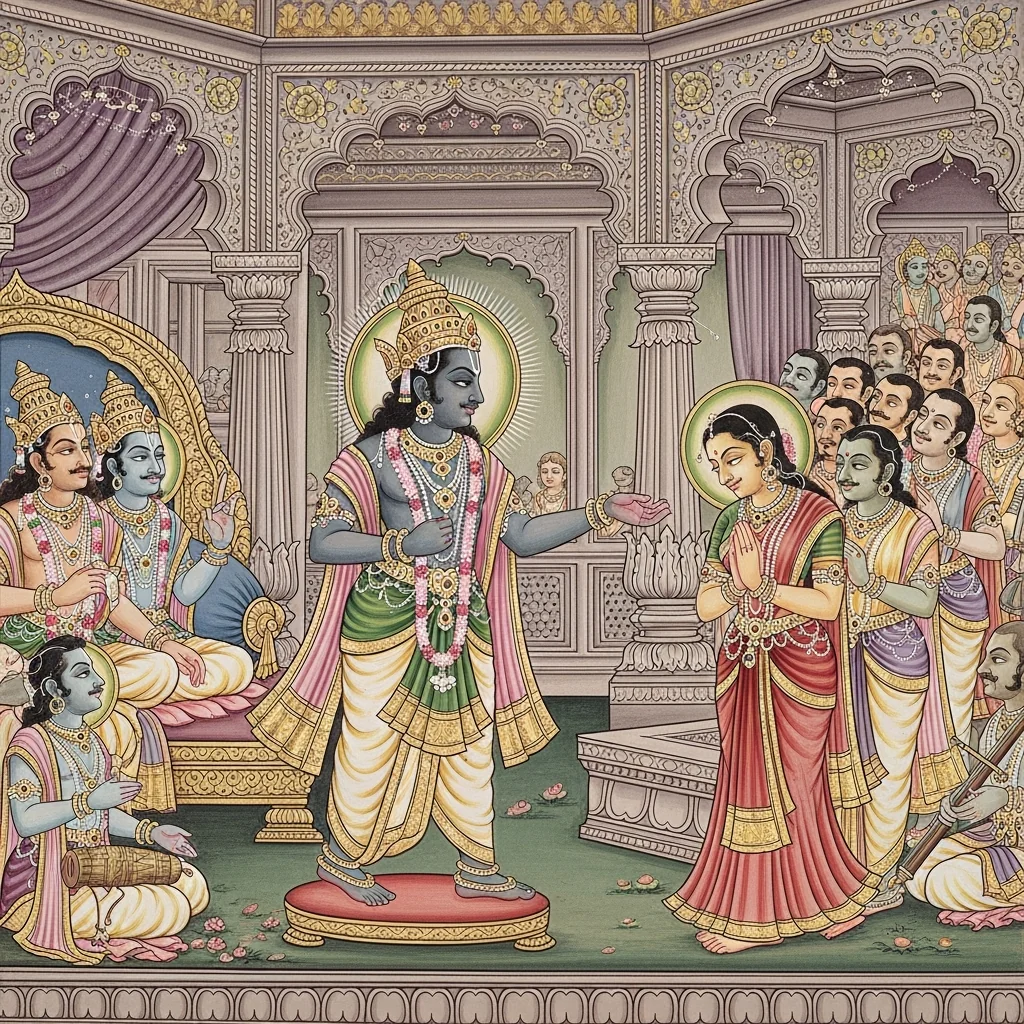
Adhyaya 46
Mārkaṇḍeya recounts that the Daitya Andhaka, empowered by a boon from Śambhu (Śiva), returns to his own city and is welcomed with a grand public celebration—squares adorned, gardens and tanks prepared, temples honored, Vedic recitations and auspicious chants resounding, gifts bestowed, and the community rejoicing. He dwells thereafter in prosperity and power. When the Devas learn that this boon has made Andhaka nearly invincible, they gather and seek refuge with Vāsava (Indra). As they deliberate, Andhaka grows audacious, climbs alone to the difficult heights of Meru, and enters Indra’s fortified realm of Svarga as though it were his own. Indra, fearful and unable to find a protector for heaven, offers hospitality and, at Andhaka’s request, displays celestial treasures—Airāvata, Uccaiḥśravas, Urvaśī and other apsarases, Pārijāta blossoms, and heavenly music. Amid the performances, Andhaka’s gaze fixes upon Śacī; he seizes Indra’s consort and departs, igniting conflict. The ensuing battle shows the Devas driven back by Andhaka’s singular might, revealing how cosmic order is shaken when boon-born power is joined to unchecked desire and coercive domination.
Shlokas
Verse 1
श्रीमार्कण्डेय उवाच । स दानवो वरं लब्ध्वा जगाम स्वपुरं प्रति । ददर्श स्वपुरं राजञ्छोभितं चित्रचत्वरैः
Śrī Mārkaṇḍeya said: Having obtained the boon, that Dānava set out toward his own city. O King, he beheld his city adorned with splendid, ornamented squares and crossroads.
Verse 2
उद्यानैश्चैव विविधैः कदलीखण्डमण्डितैः । पनसैर्बकुलैश्चैवाम्रातैराम्रैश्च चम्पकैः
It was graced with many kinds of gardens, embellished with groves of banana plants—filled with jackfruit and bakula trees, with mangoes and mango-groves, and with campaka blossoms.
Verse 3
अशोकैर्नालिकेरैश्च मातुलिङ्गैः सदाडिमैः । नानावृक्षैश्च शोभाढ्यं तडागैरुपशोभितम्
It was rich in beauty with aśoka trees and coconut palms, with citron and pomegranate; adorned with many kinds of trees, and further beautified by ponds and tanks.
Verse 4
देवतायतनैर्दिव्यैर्ध्वजमालासुशोभितैः । वेदाध्ययननिर्घोषैर्मङ्गलाद्यैर्विनादितम्
It resounded with the auspicious tones of Vedic recitation and benedictory rites, and it shone with divine temples of the gods, beautifully adorned with rows of banners and flags.
Verse 5
प्राविशद्भवने दिव्ये काञ्चने रुक्ममालिनि । अपश्यत्स सुतान् भार्याममात्यान् दासभृत्यकान्
He entered his splendid golden mansion, decked with garlands of golden ornaments, and there he saw his sons, his wife, his ministers, and his servants and attendants.
Verse 6
ततो जयप्रदान् सर्वानितश्चेतश्च धावतः । हृच्छोभां च प्रकुर्वाणान् वै जयन्तीभिरुच्चकैः
Then he saw everyone rushing here and there, bestowing cries of victory—stirring delight in the heart as they loudly proclaimed triumphal acclamations.
Verse 7
केचित्तोरणमाबध्य केचित्पुष्पाण्यवाकिरन् । मातुलिङ्गकराश्चान्ये धावन्ति ह्यन्धकं प्रति
Some fastened festive gateways (toraṇas), some scattered flowers; others, holding citrons in their hands, ran swiftly toward Andhaka.
Verse 8
पुरे जनाश्च दृश्यन्ते भाजनैरन्नपूरितैः । पूर्णहस्ताः प्रदृश्यन्ते तत्रैव बहवो जनाः
In the city, people were seen carrying vessels filled with food; many there appeared with hands full (of offerings), gathered in great numbers.
Verse 9
साक्षतैर्भाजनैस्तत्र शतसाहस्रयोषितः । मन्त्रान् पठन्ति विप्राश्च मङ्गलान्यपि योषितः
There, hundreds of thousands of women held vessels filled with akṣata, unbroken rice. Brāhmaṇas recited mantras, and the women too uttered auspicious blessings.
Verse 10
अमात्याश्चैव भृत्याश्च गजांश्चाढौकयन्ति च । वर्धापयन्ति ते सर्वे ये केचित्पुरवासिनः
Ministers and servants likewise brought the elephants forward; and all the city’s residents—whoever they were—performed vardhāpana, festive acts of auspicious increase.
Verse 11
हृष्टस्तुष्टोऽवसत्तत्र सचिवैः सह सोऽन्धकः । ददर्श स जगत्सर्वं तुरङ्गांश्च पदातिकान्
There Andhaka stayed on, delighted and satisfied, together with his ministers. He beheld the whole realm—its cavalry and its foot-soldiers as well.
Verse 12
तथैव विविधान् कोशांस्तत्र काञ्चनपूरितान् । महिषीर्गा वृषांश्चैवापश्यच्छत्राण्यनेकधा
Likewise he saw there many kinds of treasuries filled with gold; and he beheld buffalo-cows, cattle, and bulls, and also many sorts of royal umbrellas.
Verse 13
स एवमन्धकस्तत्र कियन्तं कालमावसत् । हृष्टस्तुष्टो वसन्मर्त्ये स सुरैर्नाभ्यभूयत
Thus Andhaka lived there for a long time, dwelling in the world of mortals in delight and contentment; and the gods were not able to overpower him.
Verse 14
वरं लब्धं तु तं ज्ञात्वा शङ्किताः स्वर्गवासिनः । एकीभूताश्च ते सर्वे वासवं शरणं गताः
Knowing that he had obtained a boon, the dwellers of heaven grew anxious. United as one, they all sought refuge in Vāsava (Indra).
Verse 15
शक्र उवाच । कथमागमनं वोऽत्र सर्वेषामपि नाकिनाम् । कस्माद्वो भयमुत्पन्नमागताः शरणं कथम्
Śakra (Indra) said: “How is it that you all, the denizens of heaven, have come here together? From what has fear arisen in you, and why have you come seeking refuge?”
Verse 16
ततस्ते ह्यमराः सर्वे शक्रमेतद्वचोऽब्रुवन्
Then all those immortals spoke these words to Śakra (Indra).
Verse 17
देवा ऊचुः । सुरनाथान्धको नाम दैत्यः शम्भुवरोर्जितः । अजेयः सर्वदेवानां किं नु कार्यमतः परम्
The gods said: “O lord of the gods, there is a demon named Andhaka, empowered by a boon from Śambhu (Śiva). He is unconquerable by all the gods—what, then, should be done next?”
Verse 18
तत्त्वं चिन्तय देवेश क उपायो विधीयताम् । इत्थं वदन्ति ते देवाः शक्राग्रे मन्त्रणोद्यताः
“Consider the truth of the matter, O Lord of the gods, and let some means be devised.” Thus spoke the gods before Śakra, intent on counsel.
Verse 19
मन्त्रयन्ति च यावद्वै तावच्चारमुखेरितम् । ज्ञात्वा तत्र स देवौघं दानवो निर्गतो गृहात्
While they were still deliberating, a report issued from the mouth of a spy. Learning that a host of devas had gathered there, the dānava went out from his house.
Verse 20
एकाकी स्यन्दनारूढ आयुर्धैबहुभिर्वृतः । दुर्गमं मेरुपृष्ठं स लीलयैव गतो नृप
Alone, mounted upon his chariot and surrounded by many weapons, he went—O king—playfully, as it were, to the hard-to-reach slopes of Mount Meru.
Verse 21
स्वर्णप्राकारसंयुक्तं शोभितं विविधाश्रमैः । दुर्गमं शत्रुवर्गस्य तदा पार्थिवसत्तम
O best of kings, that celestial stronghold was girded with golden ramparts and beautified by many sacred āśramas; to the host of enemies it was then utterly unapproachable.
Verse 22
प्रविवेशासुरस्तत्र लीलया स्वगृहे यथा । वृत्रहा भयमापन्नः स्वकीयं चासनं ददौ
There the Asura entered as if playfully—like one entering his own home. Vṛtrahā (Indra), seized by fear, even offered him his own seat.
Verse 23
उपविष्टोऽन्धकस्तत्र शक्रस्यैवासने शुभे । आस्थानं कलयामास सर्वतस्त्रिदशावृतम्
Andhaka sat there upon Śakra’s own auspicious seat, and began to survey the royal court, surrounded on every side by the Thirty gods.
Verse 24
शक्र उवाच । किं तवागमनं चात्र किं कार्यं कथयस्व मे । यदस्मदीयं वित्तं हि तत्ते दास्यामि दानव
Śakra said: “Why have you come here, and what is your purpose? Tell me. Whatever wealth is ours, that I will give you, O Dānava.”
Verse 25
अन्धक उवाच । नाहं वै कामये कोशं न गजांश्च सुरेश्वर । स्वकीयं दर्शयस्वाद्य स्वर्गशृङ्गारभूषितम्
Andhaka said: “O lord of the gods, I do not desire your treasury, nor your elephants. Show me today your own splendour—Svarga adorned with all its heavenly ornaments.”
Verse 26
ऐरावतं महानागं तं चैवोच्चैःश्रवोहयम् । उर्वश्यादीनि रत्नानि मम दर्शय गोपते
“Show me Airāvata, the great elephant, and also that horse Uccaiḥśravas; and the precious treasures beginning with Urvaśī—show them to me, O lord and guardian.”
Verse 27
पारिजातकपुष्पाणि वृक्षजातीननेकशः । वादित्राणि च सर्वाणि दर्शयस्व शचीपते
“Show me the blossoms of the Pārijāta, the many kinds of heavenly trees, and all the musical instruments as well, O lord of Śacī.”
Verse 28
तस्य तद्वचनं श्रुत्वा शक्रश्चिन्तितवानिदम् । योऽमुं निहन्ति पाप्मानं न तं पश्यामि कर्हिचित्
Hearing his words, Śakra reflected: “I do not see anyone at any time who could slay this sinful one.”
Verse 29
नास्ति रक्षाप्रदः कश्चित्स्वर्गलोकस्य दुःखिनः । भयत्रस्तो ददावन्यद्वादित्राद्यप्सरोगणैः
“For suffering Svarga there is none who can grant protection.” Thus, shaken by fear, he bestowed other gifts as well—musical instruments and the like—together with companies of Apsarases.
Verse 30
रङ्गभूमावुपाविश्य कारयामास ताण्डवम् । उपविष्टाः सुराः सर्वे यममारुतकिन्नराः
Seating himself upon the performance-ground, he caused a tāṇḍava to be enacted. All the gods sat watching—along with Yama, the Maruts, and the Kinnaras.
Verse 31
उर्वश्याद्या अप्सरसो गीतवादित्रयोगतः । ननृतुः पुरतस्तस्य सर्वा एकैकशो नृप
O king, Urvaśī and the other Apsarases—accompanied by song and instrumental music—danced before him, each one stepping forth in turn.
Verse 32
न व्यश्राम्यत तच्चित्तं दृष्ट्वा चाप्सरसस्तदा । शचीं प्रति मनस्तस्य सकाममभवन्नृप
O king, on seeing the Apsarases then, his mind found no rest; and his heart turned with desire toward Śacī.
Verse 33
गृहीत्वा शक्रभार्यां स प्रस्थितः स्वपुरं प्रति । ततः प्रववृते युद्धमन्धकस्य सुरैः सह
Having seized Śakra’s wife, he set out toward his own city. Thereupon the battle of Andhaka with the gods broke out.
Verse 34
तेन देवगणाः सर्वे ध्वस्ताः पार्थिवसत्तम । संग्रामे विविधैः शस्त्रैश्चक्रवज्रादिभिर्घनैः
O best of kings, by him all the hosts of the Devas were crushed in battle, struck by many kinds of heavy weapons—discus, thunderbolt, and the like.
Verse 35
संतापिताः सुराः सर्वे क्षयं नीता ह्यनेकशः । सर्वेऽपि मरुतस्तेन भग्नाः संग्राममूर्धनि
All the gods were tormented and, many times over, brought to ruin; even all the Maruts were broken by him at the very height of the battle.
Verse 36
यथा सिंहोगजान् सर्वान् विचित्य विचरेद्वनम् । तद्वदेकेन ते देवा जिताः सर्वे पराङ्मुखाः
Just as a lion, having scattered all the elephants, roams the forest at will—so too were those gods conquered by a single one, and all turned away in flight.
Verse 37
बालोऽधिपो यथा ग्रामे स्वेच्छया पीडयेज्जनान् । स्वैरमाक्रम्य गृह्णाति कोशवासांसि चासकृत्
As a childish ruler in a village oppresses people at his whim—swaggering about and repeatedly seizing their treasury and garments—so did he act.
Verse 38
गतं न पश्यत्यात्मानं प्रजासंतापनेन च । गृहीत्वा शक्रभार्यां स गतो वै दानवोत्तमः
Blinded by the torment he inflicted on the people, he did not see his own downfall. Having seized Śakra’s wife, that foremost of the Dānavas indeed departed.
Verse 46
। अध्याय
The Sacred Chapter