Adhyaya 30
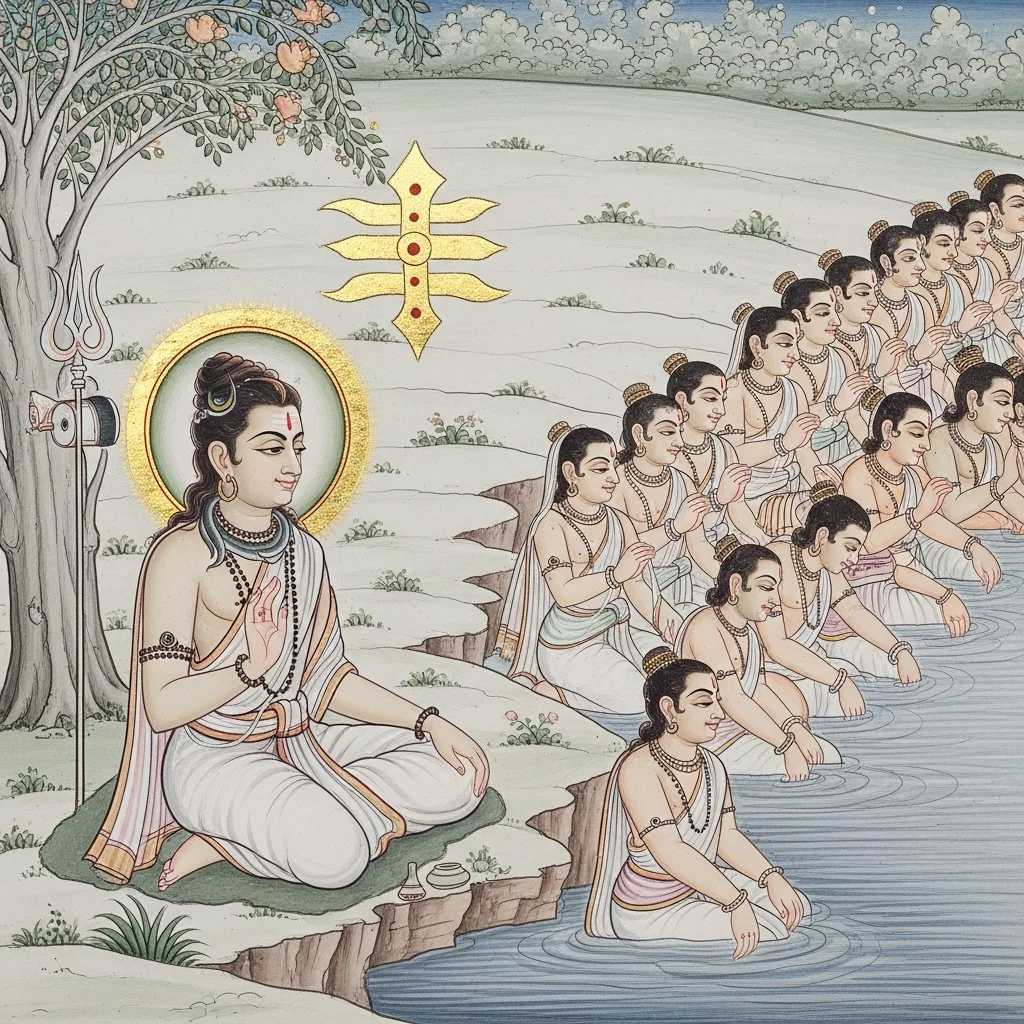
Adhyāya 30 unfolds as a dialogue in which Mārkaṇḍeya answers Yudhiṣṭhira’s question about a famed tīrtha on the northern bank of the Narmadā—Dārutīrtha. The chapter identifies its namesake, Dāru of the Bhārgava lineage, a learned brāhmaṇa skilled in Veda and Vedāṅga. His life is narrated through the āśrama sequence—brahmacarya, gṛhastha, vānaprastha—culminating in ascetic discipline in accord with yati-dharma. The narrative emphasizes his sustained meditation on Mahādeva and lifelong austerity, by which the tīrtha becomes renowned “in the three worlds.” It then gives observances: bathe there according to rule and worship pitṛs and the deities. Ethical marks—truthfulness, restraint of anger, and the welfare of beings—are paired with promised attainments, while fasting is linked with satya and śauca, and Vedic recitation (Ṛg, Sāma, Yajus) is said to yield “excellent fruit.” In a concluding, phalaśruti-like claim attributed to Śaṅkara, one who relinquishes life there with proper observance attains anivartikā gati, a non-returning course.
Shlokas
Verse 1
श्रीमार्कण्डेय उवाच । नर्मदोत्तरकूले तु दारुतीर्थमनुत्तमम् । यत्र सिद्धो महाभाग तपस्तप्त्वा द्विजोत्तमः
Śrī Mārkaṇḍeya said: “On the northern bank of the Narmadā there is an unsurpassed sacred ford called Dāru-tīrtha, where a most excellent Brāhmaṇa—fortunate and spiritually accomplished—became a Siddha after performing austerities.”
Verse 2
युधिष्ठिर उवाच । कोऽसौ द्विजवरश्रेष्ठः सिद्धस्तत्र महामुने । दारुकेति सुतः कस्य एतन्मे वक्तुमर्हसि
Yudhiṣṭhira said: “O great sage, who is that foremost among excellent Brāhmaṇas who attained perfection there? ‘Dāruka’—whose son is he? Please tell me this.”
Verse 3
श्रीमार्कण्डेय उवाच । भार्गवे विपुले वंशे धीमतो देवशार्मणः । दारुर्नाम महाभागो वेदवेदाङ्गपारगः
Śrī Mārkaṇḍeya said: “In the vast Bhārgava lineage there was a wise man named Devaśarman; his noble son was Dāru, well-versed in the Vedas and their auxiliary disciplines (Vedāṅgas).”
Verse 4
ब्रह्मचारी गृहस्थश्च वानप्रस्थो विधिक्रमात् । यतिधर्मविधानेन चचार विपुलतपः
He lived, in the proper order, as a brahmacārin, then as a householder, and then as a forest-dweller; and, following the ordinances of the yati’s dharma, he performed abundant austerities.
Verse 5
ध्यायन्वै स महादेवं निराहारो युधिष्ठिर । उवास तीर्थे तस्मिन् वै यावत्प्राणपरिक्षयम्
Meditating on Mahādeva, fasting without food, O Yudhiṣṭhira, he dwelt at that tīrtha until his life-breath was spent.
Verse 6
तस्य नाम्ना तु तत्तीर्थं त्रिषु लोकेषु विश्रुतम् । तत्र स्नात्वा विधानेन अर्चयेत्पितृदेवताः
By his very name that tīrtha became renowned in the three worlds. Having bathed there according to rule, one should worship the Pitṛs and the deities.
Verse 7
सत्यवादी जितक्रोधः सर्वभूतहिते रतः । सर्वान्कामानवाप्नोति राजन्नत्रैव सवर्था
One who speaks truth, has conquered anger, and is devoted to the welfare of all beings obtains all desired aims—O King—right here, in every way, through this tīrtha.
Verse 8
यः कुर्यादुपवासं च सत्यशौचपरायणः । सौत्रामणिफलं चास्य सम्भवत्यविचारितम्
Whoever performs fasting, devoted to truth and purity, for him the fruit of the Sautrāmaṇi rite arises unfailingly, without doubt.
Verse 9
ऋग्वेदजापी ऋग्वेदी साम वा सामपारगः । यजुर्वेदी यजुर्जप्त्वा लभते फलमुत्तमम्
Whether one is a reciter of the Ṛgveda, a knower of the Ṛgveda, a Sāmavedin or one perfected in Sāman chants, or a Yajurvedin—by reciting his own Veda, he attains here the highest fruit.
Verse 10
प्राणांस्त्यजति यो मर्त्यस्तस्मिंस्तीर्थे विधानतः । अनिवर्तिका गतिस्तस्य इत्येवं शङ्करोऽब्रवीत्
Any mortal who, in the prescribed manner, relinquishes his life-breath at that tīrtha attains a path from which there is no return; thus did Śaṅkara (Śiva) declare.
Verse 30
। अध्याय
Chapter (Adhyāya).