Adhyaya 31
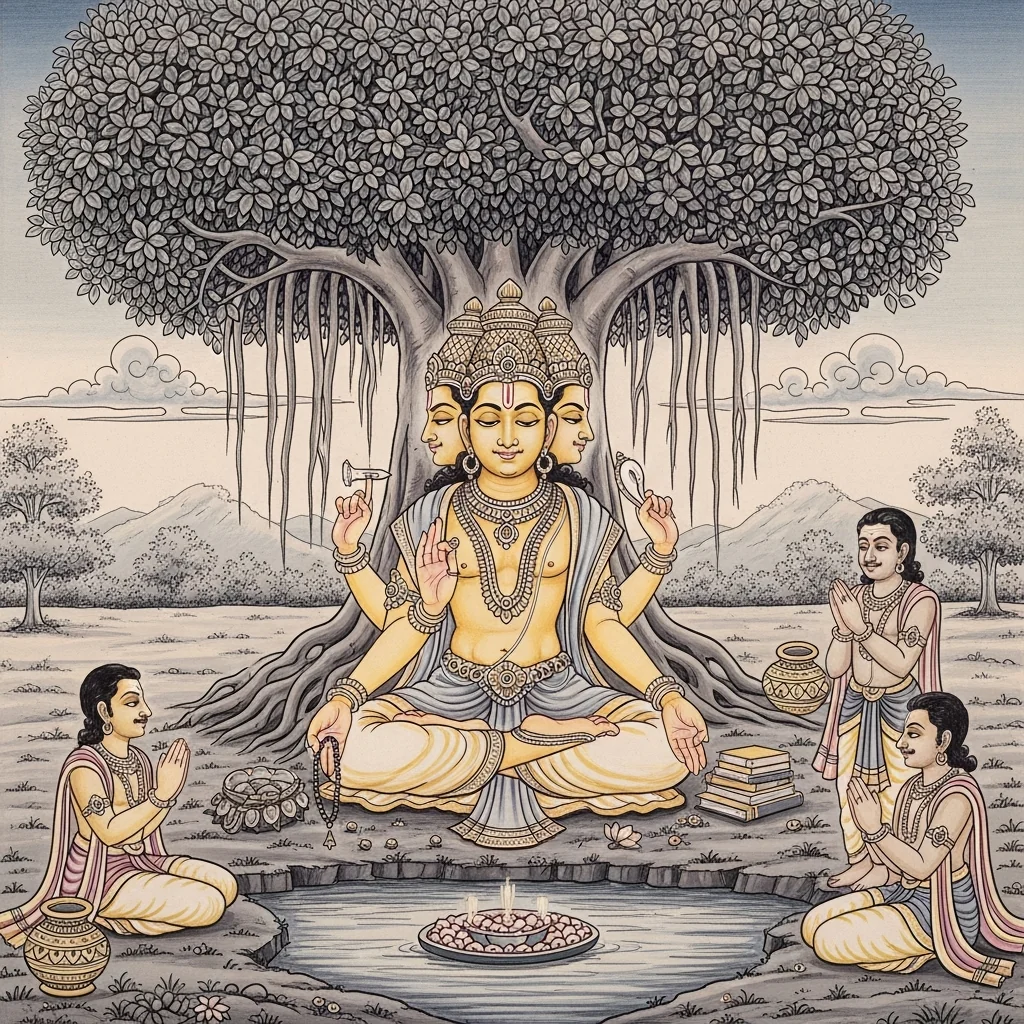
Mārkaṇḍeya tells the listening king of a famed tīrtha called Brahmāvarta, praised as a purifier of all defilement. Brahmā is portrayed as ever-present there, engaged in severe tapas—disciplined living, sustained austerity, and steady contemplation of Maheśvara (Śiva). The chapter then gives practical injunctions: one should bathe according to rule, offer tarpaṇa to ancestors and deities, and worship Īśāna (Śiva) or Viṣṇu as the Supreme Lord. The tīrtha’s fruit is declared to bestow merit equal to sacrifices properly performed with the requisite gifts. It also teaches that places do not become holy for humans without purposeful effort; resolve, capacity, and steadfastness lead to success, while negligence and greed lead to ruin. The closing maxim universalizes disciplined renunciation: wherever a self-restrained muni dwells, that place becomes equal to great sacred fields such as Kurukṣetra, Naimiṣa, and Puṣkara.
Shlokas
Verse 1
श्रीमार्कण्डेय उवाच । ततो गच्छेच्च राजेन्द्र तीर्थं त्रैलोक्यविश्रुतम् । ब्रह्मावर्तमिति ख्यातं सर्वपापप्रणाशनम्
Śrī Mārkaṇḍeya said: “Then, O king of kings, one should proceed to the tīrtha renowned in the three worlds, famed as Brahmāvarta—an annihilator of all sins.”
Verse 2
तत्र संनिहितो ब्रह्मा नित्यसेवी युधिष्ठिर । ऊर्ध्वबाहुर्निरालम्बचकार भ्रमणं सदा
There Brahmā is ever-present, O Yudhiṣṭhira, constantly devoted in service; with arms uplifted and without support, he continually performed the wandering austerity.
Verse 3
एकाहारवशेऽतिष्ठद्द्वादशाब्दं महाव्रती । अत्र तीर्थे विधानेन चिन्तयन् वै महेश्वरम्
The great observer of vows remained here for twelve years, sustaining himself on a single daily meal; at this tīrtha, in accordance with proper rite, he meditated upon Maheśvara.
Verse 4
तेन तत्पुण्यमाख्यातं ब्रह्मावर्तमिति प्रभो । तत्र स्नात्वा विधानेन तर्पयेत्पितृदेवताः
Because of that, O lord, its merit became renowned as ‘Brahmāvarta’. Bathing there according to proper rite, one should offer tarpaṇa to satisfy the Pitṛs and the deities.
Verse 5
अर्चयेद्देवमीशानं विष्णुं वा परमेश्वरम् । यत्फलं सर्वयज्ञानां विधिवद्दक्षिणावताम्
One should worship Lord Īśāna—or Viṣṇu, the Supreme Lord. Whatever fruit arises from all yajñas performed according to rule with due dakṣiṇā—
Verse 6
तत्फलं समवाप्नोति तत्तीर्थस्य प्रभावतः । यस्मिंस्तीर्थे तु यो देवो दानवो वा द्विजोऽथ वा
—that very fruit one attains by the power of that tīrtha. And in whatever tīrtha, whether it be a god, a Dānava, or even a twice-born (dvija) who—
Verse 7
सिद्धस्तेनैव तन्नाम्ना ख्यातं लोके महच्च तत् । न जलं न स्थलं नाम क्षेत्रं वा ह्यूषराणि च
Having attained siddhi there, that place became renowned in the world by that very name—and great indeed it is. It is not merely ‘water’, nor merely ‘land’, nor only a ‘field’, nor even barren wastes—
Verse 8
पवित्रत्वं लभन्त्येते पौरुषेण विना नृणाम् । सामर्थ्यान्निश्चयाद्धैर्यात्सिध्यन्ति पुरुषा नृप
These attain purity not without human striving. By capability, by firm resolve, and by steadfast courage, people succeed, O king.
Verse 9
प्रमादात्तस्य लोभेन पतन्ति नरके ध्रुवम्
But through heedlessness—and through greed—one surely falls into hell.
Verse 10
संनिरुध्येन्द्रियग्रामं यत्र यत्र वसेन्मुनिः । तत्र तत्र कुरुक्षेत्रं नैमिषं पुष्कराणि च
Wherever a sage dwells after firmly restraining the host of senses, that very place becomes (as holy as) Kurukṣetra, Naimiṣa, and Puṣkara; by disciplined living, every spot is transformed into a tīrtha.
Verse 31
। अध्याय
“Chapter” (a manuscript/recension marker indicating an adhyāya break).