Adhyaya 174
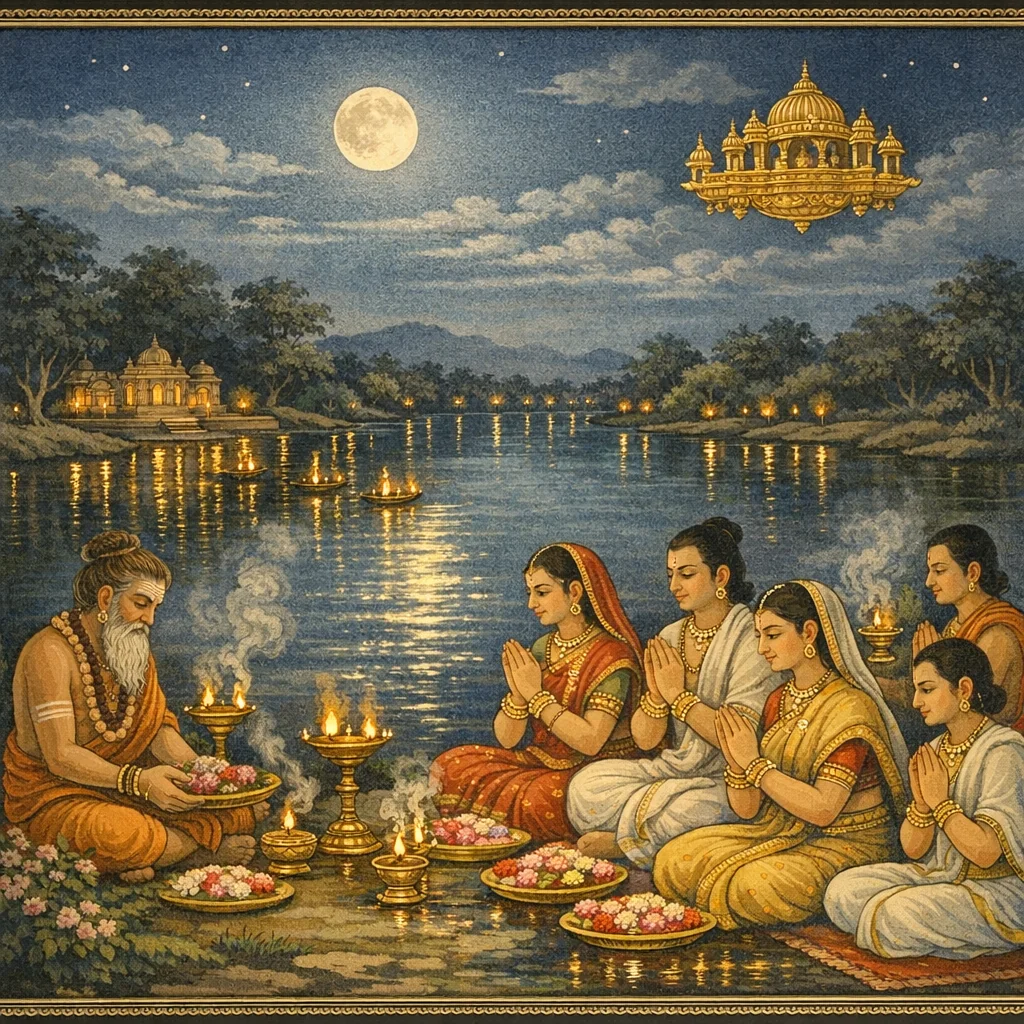
This chapter is a prescriptive mahātmya spoken by Mārkaṇḍeya to a king. It sends the pilgrim to Gopeśvara Tīrtha on the northern bank of the Narmadā, declaring that a single bath there frees one from moral taints and faults. It then sets out a sequence of merit: first, snāna at the tīrtha; second, optionally, prāṇasaṃkṣaya (voluntary death) at the spot, said to carry one by a celestial conveyance to Śiva’s abode; third, enjoyment in Śiva-loka followed by an auspicious rebirth as a powerful, prosperous, long-lived king; and fourth, a Kārttika vrata on the bright ninth (śukla navamī) involving fasting, purity, lamp-giving, worship with fragrance and flowers, and an all-night vigil. The phala is stated quantitatively: the number of lamps offered corresponds to thousands of yugas of honor in Śiva-loka. Other offerings are also listed—liṅga-pūraṇa rite, lotus offerings, and dadhy-anna (curd-rice)—with merit measured by the count of sesame seeds and lotuses. The chapter concludes that any gift at this tīrtha is multiplied “a koṭi-fold,” beyond calculation, affirming Gopeśvara’s unsurpassed status among sacred fords.
Shlokas
Verse 1
श्रीमार्कण्डेय उवाच । गोपेश्वरं ततो गच्छेदुत्तरे नर्मदातटे । यत्र स्नानेन चैकेन मुच्यन्ते पातकैर्नराः
Śrī Mārkaṇḍeya said: Then one should go to Gopeśvara on the northern bank of the Narmadā, where by a single bath people are released from their sins.
Verse 2
तत्र तीर्थे तु यः स्नात्वा कुरुते प्राणसंक्षयम् । बर्हियुक्तेन यानेन स गच्छेच्छिवमन्दिरे
Indeed, whoever bathes at that tīrtha and then gives up his life there, goes to Śiva’s abode, conveyed in a vehicle adorned with sacred barhis-grass.
Verse 3
क्रीडित्वा सुचिरं कालं शिवलोके नराधिप । इह मानुष्यतां प्राप्य राजा भवति वीर्यवान्
O lord of men, having enjoyed for a very long time in Śiva’s world, he returns here, attains human birth again, and becomes a mighty king.
Verse 4
हस्त्यश्वरथसम्पन्नो दासीदाससमन्वितः । पूज्यमानो नरेन्द्रैश्च जीवेद्वर्षशतं नरः
Endowed with elephants, horses, and chariots, attended by maidservants and servants, and honored even by other kings, that man lives for a hundred years.
Verse 5
सम्प्राप्ते कार्त्तिके मासि नवम्यां शुक्लपक्षतः । सोपवासः शुचिर्भूत्वा दीपकांस्तत्र दापयेत्
When the month of Kārttika arrives, on the ninth lunar day of the bright fortnight, one should fast, remain pure, and have lamps lit there as an offering.
Verse 6
गन्धपुष्पैः समभ्यर्च्य रात्रौ कुर्वीत जागरम् । तस्य यत्फलमुद्दिष्टं तच्छृणुष्व नराधिप
Having duly worshipped with fragrances and flowers, one should keep a night vigil. O king, now hear the fruit that is declared for this observance.
Verse 7
यावत्पुण्यं फलं संख्या दीपकानां तथैव च । तावद्युगसहस्राणि शिवलोके महीयते
In proportion to the meritorious fruit and the number of lamps offered, for that many thousands of yugas the devotee is honored and celebrated in Śiva’s world.
Verse 8
तस्मिंस्तीर्थे तु राजेन्द्र लिङ्गपूरणकं विधिम् । तथैव पद्मकैश्चैव दधिभक्तैस्तथैव च
O best of kings, at that holy ford one should perform the rite of ‘filling/adorning the liṅga’, and likewise offer lotuses, and likewise offer curd and cooked rice as devotional food.
Verse 9
यस्तु कुर्यान्नरश्रेष्ठ तस्य पुण्यफलं शृणु । यावन्ति तिलसंख्यानि दधिभक्तं तथैव च
But whoever performs it, O best among men—hear the fruit of his merit: it corresponds to the count, as numerous as sesame seeds, and likewise to the offering of curd and rice.
Verse 10
पद्मसंख्या शिवे लोके मोदते कालमीप्सितम् । तस्मिंस्तीर्थे तु राजेन्द्र यत्किंचिद्दीयते नृप
He rejoices in Śiva’s world for the desired span of time, measured as though counted in lotuses. And, O king of kings, whatever—anything at all—is given at that tīrtha, O ruler,
Verse 11
सर्वं कोटिगुणं तस्य संख्यातुं वा न शक्यते । एवं ते कथितं सर्वं सर्वतीर्थमनुत्तमम्
There, all becomes multiplied ten millionfold, and it cannot even be fully counted. Thus I have told you everything about this unsurpassed tīrtha, the foremost among all sacred fords.
Verse 174
अध्याय
“Chapter” (a chapter-marker/colophon fragment in the manuscript tradition).