Adhyaya 218
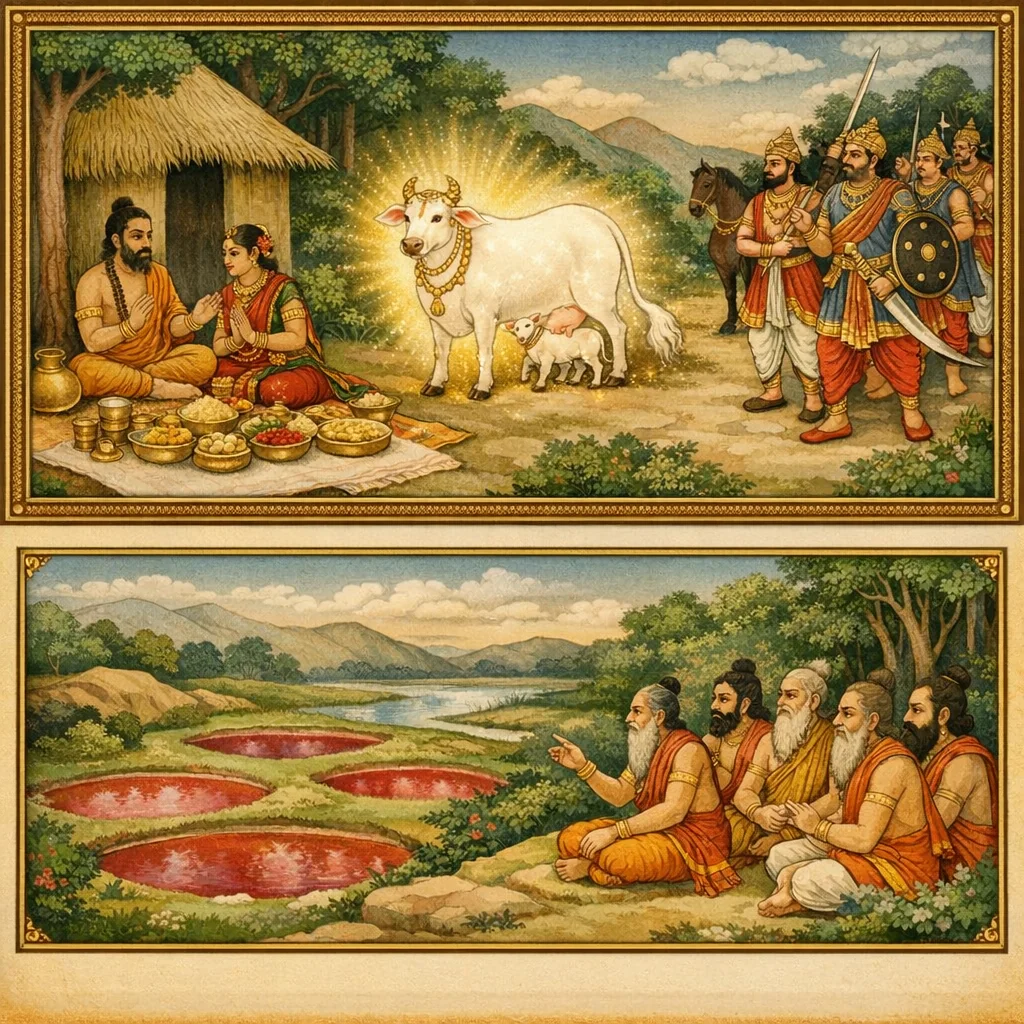
Mārkaṇḍeya directs Yudhiṣṭhira to the highly lauded pilgrimage site called Jamadagni-tīrtha, presenting it as a seat of siddhi (spiritual accomplishment) arising from the gracious activity of Janārdana/Vāsudeva manifested in human form. The sanctity of the tīrtha and the merit of devoted visitation are thus set forth. The discourse then recounts how the Haihaya ruler Kārtavīrya Arjuna—mighty and renowned—arrives at Jamadagni’s hermitage while hunting. The sage offers lavish hospitality through the miracle-working cow Kāmadhenu/Surabhī; learning the source of such abundance, the king demands the cow, offering countless ordinary cows in exchange, but Jamadagni refuses. A fierce conflict ensues: Jamadagni wields the ascetic power of the brahma-daṇḍa, and from the cow’s own body armed hosts manifest, driving the struggle into violent escalation. Jamadagni is slain by Kārtavīrya and allied kṣatriyas, and Paraśurāma vows retribution—repeatedly destroying kṣatriya lineages and creating five blood-filled lakes at Samantapañcaka to fulfill ancestral rites. Later, the pitṛs and sages counsel restraint, and the region around these lakes is consecrated as a highly meritorious sacred tract. The chapter closes with procedural guidance for rites at the Narmadā–ocean confluence: cautions against direct touch, mantras for ritual contact (sparśana), immersion, arghya offering, and dismissal (visarjana), promising purification, uplift of ancestors, and auspicious residence in a divine realm for devotees who behold Jamadagni and Reṇukā and perform the rites with devotion.
Shlokas
Verse 1
श्रीमार्कण्डेय उवाच । ततो गच्छेद्धराधीश तीर्थं परमशोभनम् । जमदग्निरिति ख्यातं यत्र सिद्धो जनार्दनः
Śrī Mārkaṇḍeya said: Then, O lord of the earth, one should go to a supremely beautiful tīrtha known as “Jamadagni,” where Janārdana abides as a perfected Siddha.
Verse 2
युधिष्ठिर उवाच । कथं सिद्धो द्विजश्रेष्ठ वासुदेवो जगद्गुरुः । मानुषं रूपमास्थाय लोकानां हितकाम्यया
Yudhiṣṭhira said: “O best of the twice-born, how did Vāsudeva—the world-teacher—fulfil his divine purpose by assuming a human form, out of compassion and for the welfare of all?”
Verse 3
एतत्सर्वं यथान्यायं देवदेवस्य चक्रिणः । चरितं श्रोतुमिच्छामि कथ्यमानं त्वयानघ
“I wish to hear, in proper sequence and according to sacred tradition, the entire holy account of the Wheel-bearing Lord—the God of gods—as you narrate it, O sinless one.”
Verse 4
श्रीमार्कण्डेय उवाच । आसीत्पूर्वं महाराज हैहयाधिपतिर्महान् । कार्तवीर्य इति ख्यातो राजा बाहुसहस्रवान्
Śrī Mārkaṇḍeya said: “In former times, O great king, there was a mighty sovereign of the Haihayas, renowned as Kārtavīrya—a king famed for possessing a thousand arms.”
Verse 5
हस्त्यश्वरथसम्पन्नः सर्वशस्त्रभृतां वरः । वेदविद्याव्रतस्नातः सर्वभूताभयप्रदः
He was endowed with elephants, horses, and chariots; the finest among bearers of weapons; purified by Vedic learning and disciplined vows; and a giver of fearlessness to all beings.
Verse 6
माहिष्मत्याः पतिः श्रीमान्राजा ह्यक्षौहिणीपतिः । स कदाचिन्मृगान्हन्तुं निर्जगाम महाबलः
That illustrious king, lord of Māhiṣmatī and commander of a full army, once set out—mighty in strength—to hunt deer.
Verse 7
बहुभिर्दिवसैः प्राप्तो भृगुकच्छमनुत्तमम् । जमदग्निर्महातेजा यत्र तिष्ठति तापसः
After many days, he reached the unsurpassed Bhṛgukaccha, where the great-splendoured ascetic Jamadagni resided.
Verse 8
रेणुकासहितः श्रीमान्सर्वभूताभयप्रदः । तस्य पुत्रोऽभवद्रामः साक्षान्नारायणः प्रभुः
There, with Reṇukā at his side, that illustrious sage—protector who grants fearlessness to all beings—had a son: Rāma, the Lord himself, none other than Nārāyaṇa in person.
Verse 9
सर्वक्षत्रगुणैर्युक्तो ब्रह्मविद्ब्राह्मणोत्तमः । तोषयन्परया भक्त्या पितरौ परमार्थवत्
Endowed with every virtue of a kṣatriya, yet a knower of Brahman and foremost among brāhmaṇas, he delighted his parents with supreme devotion, as one devoted to the highest truth.
Verse 10
तं तदा चार्जुनं दृष्ट्वा जमदग्निः प्रतापवान् । चरन्तं मृगयां गत्वा ह्यातिथ्येन न्यमन्त्रयत्
Then Jamadagni, radiant with the power of tapas, seeing Arjuna roaming on a hunt, invited him and received him with the sacred rites of hospitality.
Verse 11
तथेति चोक्त्वा स नृपः सभृत्यबलवाहनः । जगाम चाश्रमं पुण्यमृषेस्तस्य महात्मनः
Saying, “So be it,” the king—together with his servants, troops, and mounts—went to the sacred hermitage of that great-souled seer.
Verse 12
तत्क्षणादेव सम्पन्नं श्रिया परमया वृतम् । विस्मयं परमं तत्र दृष्ट्वा राजा जगाम ह
At that very instant, everything was perfectly accomplished, enveloped in supreme splendor; seeing that extraordinary marvel there, the king stood amazed.
Verse 13
गतमात्रस्तु सिद्धेन परमान्नेन भोजितः । सभृत्यबलवान्राजा ब्राह्मणेन यदृच्छया । किमेतदिति पप्रच्छ कारणं शक्तिमेव च
No sooner had he arrived than, by a fortunate turn through the brāhmaṇa, the king—together with his attendants and forces—was fed with perfectly prepared, exquisite food. He asked, “What is this? What is its cause, and what power brings it about?”
Verse 14
कामधेनोः प्रभावं तं ज्ञात्वा प्राह ततो द्विजम् । दक्षिणां देहि मे विप्र कल्मषां धेनुमुत्तमाम्
Having understood that wondrous power of the Kāmadhenū, he then said to the dvija: “O venerable vipra, give her to me as dakṣiṇā—the excellent cow named Kalmaṣā.”
Verse 15
शतं शतसहस्राणामयुतं नियुतं परम् । भूषितानां च धेनूनां ददामि तव चार्बुदम्
“I will give you hundreds, hundreds of thousands, tens of thousands, and even millions—indeed, a vast multitude—of ornamented cows in return.”
Verse 16
जमदग्निरुवाच । अयुतैः प्रयुतैर्नाहं शतकोटिभिरुत्तमाम् । कामधेनुमिमां तात न दद्मि प्रतिगम्यताम्
Jamadagni said: “Not for tens of thousands, nor for hundreds of thousands, nor even for hundreds of crores will I give up this supreme Kāmadhenū, my son. Let her be returned.”
Verse 17
एवमुक्तः स राजेन्द्रस्तेन विप्रेण भारत । क्रोधसंरक्तनयन इदं वचनमब्रवीत्
Thus addressed by that brāhmaṇa, O Bhārata, the lord of kings—his eyes reddened with anger—spoke these words.
Verse 18
यस्येदृशः कामचारो मय्यपि द्विजपांसन । अहं ते पश्यतस्तस्मान्नयामि सुरभिं गृहात्
“If such self-willed conduct is shown even toward me, you wretched brāhmaṇa, then while you look on, I will take Surabhī away from your house.”
Verse 19
द्विज उवाच । कः क्रीडति सरोषेण निर्भयो हि महाहिना । मृत्युदृष्टोतरेणापि मम धेनुं नयेत यः
The brāhmaṇa said: “Who would sport in wrath, fearless before a great serpent? Who would dare to take my cow—even after being marked out by Death’s gaze?”
Verse 20
एवमुक्त्वा महादण्डं ब्रह्मदण्डमिवापरम् । गृहीत्वा परमक्रुद्धो जमदग्निरुवाच ह
Having spoken thus, Jamadagni—burning with wrath—seized a great staff, like a second Brahma-daṇḍa, and spoke again.
Verse 21
यस्यास्ति शक्तिस्तेजो वा क्षत्रियस्य कुलाधमः । धेनुं नयतु मे सद्यः क्षीणायुः सपरिच्छदः
“Let any kṣatriya—lowest of his line—who thinks he has strength or splendor, take my cow at once; but his life shall be cut short, along with all his retinue and possessions.”
Verse 22
एतच्छ्रुत्वा वचः क्रूरं हैहयः शतशो वृतः । धावमानः क्षितितले ब्रह्मदण्डहतोऽपतत्
Hearing those cruel words, the Haihaya—surrounded by hundreds—ran across the earth, but, struck by the Brahmin’s Brahma-daṇḍa, he fell down.
Verse 23
हुंकृतेन ततो धेन्वाः खड्गपाशासिपाणयः । निर्गच्छन्तः प्रदृश्यन्ते कल्मषायाः सहस्रशः
Then, at her thunderous cry, thousands of forces of Kalmaṣā became visible—emerging with swords, nooses, and blades in their hands.
Verse 24
नासापुटाग्राद्रोमाग्रात्किराता मागधा गुदात् । रन्ध्रान्तरेषु चोत्पन्नाः शतशोऽथ सहस्रशः
From the tips of the nostrils, from the ends of the hairs, and from the anus, Kirātas and Māgadhas were born; indeed, from the spaces of the pores they arose, by hundreds and by thousands.
Verse 25
एवमन्योऽन्यमाहत्य हैहयष्टङ्कणान्दहन् । विनाशं सह विप्रेण गता ह्यर्जुनतेजसा
Thus, striking one another down and burning the Haihaya battalions, they went to destruction—together with the Brahmin—through Arjuna’s blazing might.
Verse 26
कार्तवीर्यो जयं लब्ध्वा संख्ये हत्वा द्विजोत्तमम् । जगाम स्वां पुरीं हृष्टः कृतान्तवशमोहितः
Kārtavīrya, having won victory and slain the best of Brahmins in battle, returned to his own city delighted—yet deluded by the compulsion of Kṛtānta, Death (fate).
Verse 27
ततस्त्वरान्वितः प्राप्तः पश्चाद्रामो गते रिपौ । आक्रन्दमानां जननीं ददर्श पितुरन्तिके
Then Rāma arrived in haste, after the enemy had departed, and he saw his mother wailing beside his father.
Verse 28
राम उवाच । केनेदमात्मनाशाय ह्यज्ञानात्साहसं कृतम् । मम तातं जिघांसुर्यो द्रष्टुं मृत्युमिहेच्छति
Rāma said: “Who, out of ignorance, has committed this reckless deed that leads to self-destruction? Whoever seeks to kill my father desires here to behold Death itself.”
Verse 29
ततः सा रामवाक्येन गतसत्त्वेव विह्वला । उदरं करयुग्मेन ताडयन्ती ह्युवाच तम्
Then she—stunned by Rāma’s words, as if bereft of life—tremblingly spoke to him, striking her belly with both hands.
Verse 30
अर्जुनेन नृशंसेन क्षत्रियैरपरैः सह । इहागत्य पिता तेन निहतो बाहुशालिना
By the cruel Arjuna, together with other Kṣatriyas, your father was killed—after he came here—by that mighty-armed one.
Verse 31
तं पश्य निहतं तातं गतासुं गतचेतसम् । संस्कृत्य विधिवत्पुत्र तर्पयस्व यथातथम्
Look at your father, slain—his life departed, his awareness gone. Perform the proper rites for him according to rule, my son, and offer the due libations as is enjoined.
Verse 32
एतच्छ्रुत्वा स वचनं जननीमभिवाद्य ताम् । प्रतिज्ञामकरोद्यां तां शृणुष्व च नराधिप
Having heard those words, he bowed to his mother; and then he made a solemn vow. O king, hear now the vow that he declared.
Verse 33
त्रिःसप्तकृत्वः पृथिवीं निःक्षत्रियकुलान्वयाम् । स्नात्वा च तेषामसृजा तर्पयिष्यामि ते पतिम्
‘Seven and twenty times will I make the earth bereft of the lineages of kṣatriyas; and bathing in their blood, I shall satisfy your husband with libations for the ancestors.’
Verse 34
तस्यापि परशुना बाहून् कार्तवीर्यस्य दुर्मतेः । छित्त्वा पास्यामि रुधिरमिति सत्यं शृणुष्व मे
‘And even the arms of that evil-minded Kārtavīrya will I cut off with my axe; and I shall drink his blood—hear this truth from me.’
Verse 35
एवं प्रतिज्ञां कृत्वासौ जामदग्न्यः प्रतापवान् । क्रोधेन महताविष्टः संस्कृत्य पितरं ततः
Thus, having made that vow, the mighty Jāmadagnya, seized by tremendous anger, then performed the funeral rites for his father.
Verse 36
माहिष्मतीं पुरीं रामो जगाम क्रोधमूर्छितः । छित्त्वा बाहुवनं तस्य हत्वा तं क्षत्रियाधमम्
Rāma (Paraśurāma), faint with rage, went to the city of Māhiṣmatī; cutting down his host of arms, he slew that vilest of kṣatriyas.
Verse 37
जगाम क्षत्रियान्ताय पृथिवीमवलोकयन् । सप्तद्वीपार्णवयुतां सशैलवनकाननाम्
He set forth for the destruction of the kṣatriyas, surveying the earth—together with its seven continents and oceans, with its mountains, forests, and groves.
Verse 38
पूर्वतः पश्चिमामाशां दक्षिणोत्तरतः कुरून् । समन्तपञ्चके पञ्च चकार रुधिरह्रदान्
From the eastern to the western quarter, and from the southern to the northern—within the land of the Kurus—at Samantapañcaka he made five lakes of blood.
Verse 39
स तेषु रुधिराम्भस्तु ह्रदेषु क्रोधमूर्छितः । पितॄन् संतर्पयामास रुधिरेणेति नः श्रुतम्
And there, in those lakes whose waters were blood, he—still overcome by rage—satiated the Fathers (Pitṛs) with blood; thus have we heard.
Verse 40
अथर्चीकादय उपेत्य पितरो ब्राह्मणर्षभम् । तं क्षमस्वेति जगदुस्ततः स विरराम ह
Then the Pitṛs—Arcīkā and the rest—approached that bull among brāhmaṇas and said, “Forgive; desist!” Thereupon he indeed ceased.
Verse 41
तेषां समीपे यो देशो ह्रदानां रुधिराम्भसाम् । समं तपं चक्रमिति पुण्यं तत्परिकीर्तितम्
The region near those lakes whose waters were blood is proclaimed holy; for there he performed an equalized austerity—hence it is celebrated as ‘Samaṃ Tapaḥ Cakram.’
Verse 42
निवर्त्य कर्मणस्तस्मात्पित्ःन् प्रोवाच पाण्डव । रामः परमधर्मात्मा यदिदं रुधिरं मया
Having desisted from that act, O Pāṇḍava, he addressed the Pitṛs: “Rāma is supremely righteous. As for this blood shed by me…”
Verse 43
क्षिप्तं पञ्चसु तीर्थेषु तद्भूयात्तीर्थमुत्तमम् । तथेत्युक्त्वा तु ते सर्वे पितरोऽदृश्यतां गताः
“If it is cast into five tīrthas, it shall become an excellent tīrtha.” Having said, “So be it,” all those Pitṛs then vanished from sight.
Verse 44
एवं रामस्य संसर्गो देवमार्गे युधिष्ठिर । सर्वपापक्षयकरो दर्शनात्स्पर्शनान्नृणाम्
Thus, O Yudhiṣṭhira, association with Rāma at Devamārga brings the destruction of all sins for people—through mere sight and through touch.
Verse 45
रेणुकाप्रत्ययार्थाय अद्यापि पितृदेवताः । दृश्यन्ते देवमार्गस्थाः सर्वपापक्षयंकराः
Even today, to confirm faith in Reṇukā, the Pitṛ-deities are seen standing upon Devamārga, granting the destruction of all sins.
Verse 46
तत्र तीर्थे तु राजेन्द्र नर्मदोदधिसङ्गमे । स्थानं कृत्वा विधानेन मुच्यन्ते पातकैर्नराः
At that tīrtha, O best of kings, at the confluence of the Narmadā and the ocean, people who duly establish their stay and perform the prescribed observances are freed from sins.
Verse 47
कुशाग्रेणापि कौन्तेय न स्पृष्टव्यो महोदधिः । अनेन तत्र मन्त्रेण स्नातव्यं नृपसत्तम
O son of Kuntī, the great ocean should not be touched even with the tip of kuśa-grass. There, O best of kings, one should bathe using this mantra.
Verse 48
नमस्ते विष्णुरूपाय नमस्तुभ्यमपां पते । सान्निध्यं कुरु देवेश सागरे लवणाम्भसि । इति स्पर्शनमन्त्रः
“Salutations to You whose form is Viṣṇu; salutations to You, Lord of the waters. O Lord of gods, grant Your presence in the ocean of salty waters.” This is the ‘touching’ (sparśana) mantra.
Verse 49
अग्निश्च तेजो मृडया च देहे रेतोऽथ विष्णुरमृतस्य नाभिः । एतद्ब्रुवन् पाण्डव सत्यवाक्यं ततोऽवगाहेत पतिं नदीनाम्
“Fire and radiance are in the body; and the generative essence—indeed, Viṣṇu is the navel of immortality.” Uttering this truthful saying, O Pāṇḍava, one should then immerse in the Lord of rivers.
Verse 50
पञ्चरत्नसमायुक्तं फलपुष्पाक्षतैर्युतम् । मन्त्रेणानेन राजेन्द्र दद्यादर्घं महोदधेः
O lord of kings, with this mantra one should offer arghya to the Great Ocean—together with five gems, and accompanied by fruits, flowers, and unbroken rice-grains.
Verse 51
सर्वरत्ननिधानस्त्वं सर्वरत्नाकराकरः । सर्वामरप्रधानेश गृहाणार्घं नमोऽस्तु ते । इत्यर्घमन्त्रः
“You are the treasury of all jewels; you are the mine and source of all gems. O Lord, chief among all the immortals, accept this arghya—salutations to you.” This is the arghya-mantra.
Verse 52
आ जन्मजनितात्पापान्मामुद्धर महोदधे । याह्यर्चितो रत्ननिधे पर्वतान् पार्वणोत्तम । इति विसर्जनमन्त्रः
“From the sins accrued since birth, O Great Ocean, lift me up and deliver me. Depart now, O treasure-house of gems, having been duly worshipped—O most excellent among mountains.” This is the mantra for dismissal (visarjana).
Verse 53
कोऽपरः सागराद्देवात्स्वर्गद्वारविपाटन । तत्र सागरपर्यन्तं महातीर्थमनुत्तमम्
Who indeed is another deity like the Ocean, the opener of the gate to heaven? There lies the unsurpassed great tīrtha extending up to the ocean’s limit.
Verse 54
जामदग्न्येन रामेण तत्र देवः प्रतिष्ठितः । यत्र देवाः सगन्धर्वा मुनयः सिद्धचारणाः
There the deity was installed by Rāma Jāmadagnya (Paraśurāma), in that place where gods along with Gandharvas, sages (munis), and Siddhas and Cāraṇas—celestial beings—are present.
Verse 55
उपासते विरूपाक्षं जमदग्निमनुत्तमम् । रेणुकां चैव ये देवीं पश्यन्ति भुवि मानवाः
They worship Virūpākṣa and the peerless Jamadagni; and those human beings on earth who also behold the goddess Reṇukā are blessed.
Verse 56
प्रियवासे शिवे लोके वसन्ति कालमीप्सितम् । तत्र स्नात्वा नरो राजंस्तर्पयन्पितृदेवताः
They dwell for their desired span of time in Priyavāsa, the auspicious world of Śiva. O King, having bathed there, a man should offer tarpana to satisfy the Pitṛs and the deities.
Verse 57
तारयेन्नरकाद्घोरात्कुलानां शतमुत्तरम् । स्नात्वा दत्त्वात्र सहिताः श्रुत्वा वै भक्तिपूर्वकम्
He would deliver his line from dreadful hell—more than a hundred generations of his family. Having bathed and given gifts there, and having listened with devotion to the sacred account, they attain this benefit together.