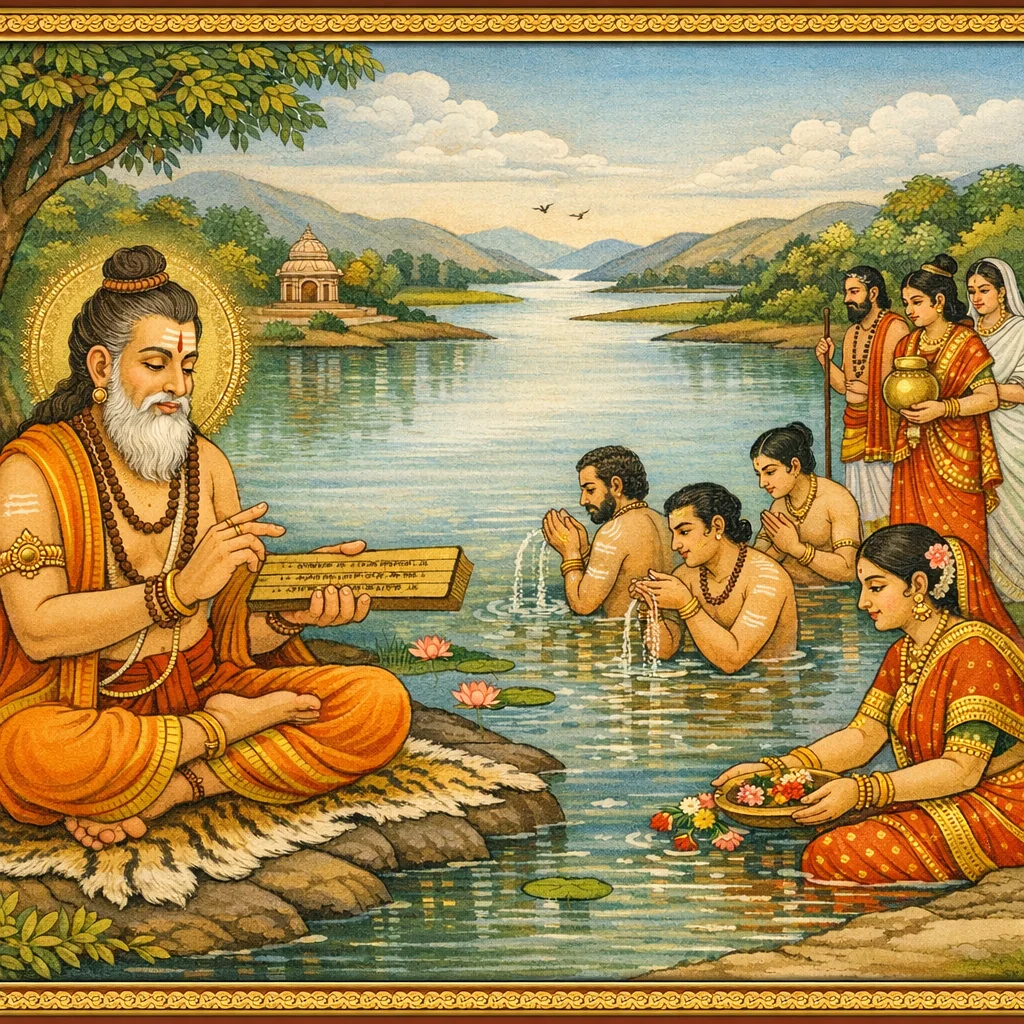
Adhyaya 227
This chapter unfolds as a dialogue in which Mārkaṇḍeya teaches Yudhiṣṭhira the extraordinary sanctity of the Narmadā (Revā). Revā is praised as “Mahādeva’s beloved” and as the “Māheśvarī Gaṅgā” (the “Southern Gaṅgā”), with a warning that disbelief and irreverence diminish spiritual fruit. It then states that ritual efficacy rests on śraddhā (intentional faith) and śāstra-guided discipline, not on arbitrary, desire-driven practice. A yātrā code of conduct is given—brahmacarya, moderation in food, truthfulness, avoidance of deceit, humility, and shunning harmful company—along with standard tīrtha duties: bathing, worship of deities, śrāddha/piṇḍa offerings where appropriate, and feeding brāhmaṇas according to one’s means. A graded expiatory scheme follows, linking pilgrimage distances (notably 24 yojanas) to kṛcchra-type results, with increased multipliers at confluences and named sacred sites. The chapter concludes by defining traditional measures (aṅgula, vitasti, hasta, dhanu, krośa, yojana) and ranking rivers by breadth, reinforcing a calibrated, procedural path of purification through Revā pilgrimage.
Shlokas
Verse 1
मार्कण्डेय उवाच । एतानि तव संक्षेपात्प्राधान्यात्कथितानि च । न शक्तो विस्तराद्वक्तुं संख्यां तीर्थेषु पाण्डव
Mārkaṇḍeya said: These I have told you in brief, only according to their foremost importance. I am not able, O Pāṇḍava, to describe in full detail the number of the sacred fords (tīrthas).
Verse 2
एषा पवित्रा विमला नदी त्रैलोक्यविश्रुता । नर्मदा सरितां श्रेष्ठा महादेवस्य वल्लभा
This river is holy and stainless, renowned throughout the three worlds—Narmadā, the best among rivers, beloved of Mahādeva.
Verse 3
मनसा संस्मरेद्यस्तु नर्मदां सततं नृप । चान्द्रायणशतस्याशु लभते फलमुत्तमम्
O king, whoever continually remembers the Narmadā in the mind swiftly attains the supreme fruit, equal to that of performing a hundred Cāndrāyaṇa vows.
Verse 4
अश्रद्दधानाः पुरुषा नास्तिकाश्चात्र ये स्थिताः । पतन्ति नरके घोरे प्राहैवं परमेश्वरः
Those men who dwell here without faith, and those who are atheistic, fall into a dreadful hell—so declared Parameśvara, the Supreme Lord.
Verse 5
नर्मदां सेवते नित्यं स्वयं देवो महेश्वरः । तेन पुण्या नदी ज्ञेया ब्रह्महत्यापहारिणी
Mahēśvara himself continually serves the Narmadā; therefore she is to be known as a supremely meritorious river—one that removes even the sin of brahmin-slaying.
Verse 6
इयं माहेश्वरी गङ्गा महेश्वरतनूद्भवा । प्रोक्ता दक्षिणगङ्गेति भारतस्य युधिष्ठिर
This is the Māheśvarī Gaṅgā, born from the very body of Maheśvara; she is proclaimed the “Southern Gaṅgā,” O Yudhiṣṭhira of Bhārata.
Verse 7
जाह्नवी वैष्णवी गङ्गा ब्राह्मी गङ्गा सरस्वती । इयं माहेश्वरी गङ्गा रेवा नास्त्यत्र संशयः
Jāhnavī is the Vaiṣṇavī Gaṅgā; Sarasvatī is the Brāhmī Gaṅgā. And this Revā is the Māheśvarī Gaṅgā—of this there is no doubt.
Verse 8
यथा हि पुरुषे देवस्त्रैमूर्तत्वमुपाश्रितः । ब्रह्मविष्णुमहेशाख्यं न भेदस्तत्र वै यथा । तथा सरित्त्रये पार्थ भेदं मनसि मा कृथाः
Just as the one God, abiding in a person, assumes the threefold form known as Brahmā, Viṣṇu, and Maheśa—without true division—so too, O Pārtha, do not create distinctions in your mind among the three sacred rivers.
Verse 9
कोटिशो ह्यत्र तीर्थानि लक्षशश्चापि भारत । तथा सहस्रशो रेवातीरद्वयगतानि तु
O Bhārata, here there are tīrthas by the crores and also by the lakhs; and likewise, by the thousands, they are found upon both banks of the Revā.
Verse 10
वृक्षान्तरिक्षसंस्थानि जलस्थलगतानि च । कः शक्तस्तानि निर्णेतुं वागीशो वा महेश्वरः
Some are established among trees and in mid-air, and others are found in water and on land—who could possibly enumerate them all, whether Vāgīśa, the lord of speech, or even Maheśvara?
Verse 11
स्मरणाज्जन्मजनितं दर्शनाच्च त्रिजन्मजम् । सप्तजन्मकृतं नश्येत्पापं रेवावगाहनात्
By remembering Revā, sin born in this present life is destroyed; by beholding her, the sin of three lifetimes is destroyed; and by bathing in Revā, the sin amassed over seven lifetimes perishes.
Verse 12
देवकार्यं कृतं तेन अग्नयो विधिवद्धुताः । वेदा अधीताश्चत्वारो येन रेवावगाहिता
For one who has bathed in Revā, the duties owed to the devas are deemed accomplished; the sacred fires are as though duly tended, and the four Vedas as though studied.
Verse 13
प्राधान्याच्चापि संक्षेपात्तीर्थान्युक्तानि ते मया । न शक्यो विस्तरः पार्थ श्रोतुं वक्तुं च वै मया
O Pārtha, I have spoken to you of the sacred tīrthas only in brief and according to their foremost importance; for their full expanse cannot truly be spoken by me, nor can it be fully heard.
Verse 14
युधिष्ठिर उवाच । विधानं च यमांश्चैव नियमांश्च वदस्व मे । प्रायश्चित्तार्थगमने को विधिस्तं वदस्व मे
Yudhiṣṭhira said: Tell me the proper procedure—also the yamas and the niyamas. For setting forth with the aim of expiation (prāyaścitta), what is the rule? Please explain it to me.
Verse 15
श्रीमार्कण्डेय उवाच । साधु पृष्टं महाराज यच्छ्रेयः पारलौकिकम् । शृणुष्वावहितो भूत्वा यथाज्ञानं वदामि ते
Śrī Mārkaṇḍeya said: Well asked, O great king—this concerns the highest good beyond this world. Listen with full attention; I shall tell you according to my understanding.
Verse 16
अध्रुवेण शरीरेण ध्रुवं कर्म समाचरेत् । अवश्यमेव यास्यन्ति प्राणाः प्राघूर्णिका इव
With this impermanent body, one should perform enduring deeds of dharma; for the vital breaths will surely depart—like a spinning top that cannot stay still.
Verse 17
दानं वित्तादृतं वाचः कीर्तिधर्मौ तथा ख्युषः । परोपकरणं कायादसारात्सारमुद्धरेत्
From wealth, draw forth charity; from speech, draw forth truth. From one’s life, draw forth fame and dharma; and from this perishable body, extract the essence—service and benefit to others.
Verse 18
अस्मिन्महामोहमये कटाहे सूर्याग्निना रात्रिदिवेन्धनेन । मासर्तुदर्वीपरिघट्टनेन भूतानि कालः पचतीति वार्ता
In this great cauldron of delusion, with the sun as fire and nights and days as fuel, stirred by the ladle of months and seasons—Time ‘cooks’ all beings: such is the truth proclaimed.
Verse 19
ज्ञात्वा शास्त्रविधानोक्तं कर्म कर्तुमिहार्हसि । नायं लोकोऽस्ति न परो न सुखं संशयात्मनः
Having understood the action taught according to scriptural ordinance, you should perform it here. For the doubting-minded gain neither this world nor the next—nor happiness.
Verse 20
मन्त्रे तीर्थे द्विजे देवे दैवज्ञे भेषजे गुरौ । यादृशी भावना यस्य सिद्धिर्भवति तादृशी
In mantra, in tīrtha, in a brāhmaṇa, in the deity, in an astrologer, in medicine, and in the guru—whatever one’s inner disposition is, the result (siddhi) becomes accordingly.
Verse 21
अश्रद्धया हुतं दत्तं तपस्तप्तं कृतं च यत् । असदित्युच्यते पार्थ न च तत्प्रेत्य नो इह
Whatever is offered in sacrifice, given in charity, or practiced as austerity without faith—O Pārtha—is called “asat,” non-being; it bears fruit neither here nor after death.
Verse 22
यः शास्त्रविधिमुत्सृज्य वर्तते कामकारतः । न स सिद्धिमवाप्नोति न सुखं न परां गतिम्
Whoever casts aside the rule of the śāstras and acts from mere whim and desire attains neither success, nor happiness, nor the highest destination.
Verse 23
सन्तीह विविधोपाया नृणां देहविशोधनाः । तीर्थसेवासमं नास्ति स्वशरीरस्य शोधनम्
There are indeed many ways for people to purify the body; yet no purification of one’s own embodied being equals the holy service of a tīrtha, a sacred ford.
Verse 24
कृच्छ्रचान्द्रायणाद्यैर्वा द्वितीयं तीर्थसेवया । यदा तीर्थं समुद्दिश्य प्रयाति पुरुषो नृप । तदा देवाश्च पितरस्तं व्रजन्त्यनु खेचराः
By arduous penances such as the Kṛcchra and the Cāndrāyaṇa one gains purification; yet the second—and superior—path is service to a tīrtha. O King, when a man sets out with his intention fixed upon a sacred place, then the gods and the ancestors follow after him, along with the celestial beings who move through the sky.
Verse 25
परमा मोदपूर्णास्ते प्रयान्त्यस्यानुयायिनः । कृत्वाभ्युदयिकं श्राद्धं समापृच्छय तु देवताम्
Those companions who follow him proceed, filled with the highest joy—after performing the auspicious abhyudayika śrāddha and duly taking leave of the deity.
Verse 26
इष्टबन्धूंश्च विष्णुं च शङ्करं सगणेश्वरम् । व्रजेद्द्विजाभ्यनुज्ञातो गृहीत्वा नियमानपि
Having paid reverence to beloved kinsmen, to Viṣṇu, and to Śaṅkara together with Gaṇeśa, and having obtained the permission of the twice-born (brāhmaṇas), one should set out, adopting the prescribed restraints as well.
Verse 27
एकाशनं ब्रह्मचर्यं भूशय्यां सत्यवादिताम् । वर्जनं च परान्नस्य प्रतिग्रहविवर्जनम्
Let him observe the discipline of a single meal, celibacy (brahmacarya), sleeping upon the ground, and truthfulness; and let him avoid food given by others and refrain from accepting gifts.
Verse 28
वर्जयित्वा तथा द्रोहवञ्चनादि नृपोत्तम । साधुवेषं समास्थाय विनयेन विभूषितः
O best of kings, having abandoned malice, deceit, and the like, let him adopt the conduct of a holy person (sādhu), adorned with humility.
Verse 29
दम्भाहङ्कारमुक्तो यः स तीर्थफलमश्नुते । यस्य हस्तौ च पादौ च मनश्चैव सुसंयतम्
He who is free from hypocrisy and ego truly partakes of the fruit of the tīrtha—he whose hands, feet, and mind are well restrained.
Verse 30
विद्या तपश्च कीर्तिश्च स तीर्थफलमश्नुते । अक्रोधनश्च राजेन्द्र सत्यशीलो दृढव्रतः
Learning, austerity (tapas), and noble repute—such a person partakes of the fruit of the tīrtha. O lord of kings, he is free from anger, devoted to truth, and firm in his vows.
Verse 31
आत्मोपमश्च भूतेषु स तीर्थफलमश्नुते । मुण्डनं चोपवासश्च सर्वतीर्थेष्वयं विधिः
He who deems all beings equal to himself truly attains the fruit of the tīrtha. Shaving the head and fasting—this is the prescribed rule at all sacred places.
Verse 32
वर्जयित्वा कुरुक्षेत्रं विशालां विरजां गयाम् । स्नानं सुरार्चनं चैव श्राद्धे वै पिण्डपातनम्
With the exception of Kurukṣetra, Viśālā, Virajā, and Gayā: one should perform bathing and worship of the gods; and in śrāddha, the offering of piṇḍas (rice-balls) is indeed prescribed.
Verse 33
विप्राणां भोजनं शक्त्या सर्वतीर्थेष्वयं विधिः । प्रायश्चित्तनिमित्तं च यो व्रजेद्यतमानसः
In every tīrtha, this is the proper rule: according to one’s means, one should feed brāhmaṇas. And whoever sets out on pilgrimage as prāyaścitta, with a disciplined and restrained mind, follows this ordinance.
Verse 34
तस्यापि च विधिं वक्ष्ये शृणु पार्थ समाहितः । एकाशनं ब्रह्मचर्यमक्षारलवणाशनम्
I shall also declare its procedure—listen attentively, O son of Pṛthā. One should eat only once a day, maintain brahmacarya, and take food without alkaline additives and without salt.
Verse 35
स्नात्वा तीर्थाभिगमनं हविष्यैकान्नभोजनम् । वर्जयेत्पतितालापं बहुभाषणमेव च
Having bathed, one should proceed to the sacred place and eat a simple havis-type meal, pure and sanctified. One should avoid conversation with the fallen and also avoid excessive speech.
Verse 36
परीवादं परान्नं च नीचसङ्गं विवर्जयेत् । व्रजेच्च निरुपानत्को वसानो वाससी शुचिः
One should avoid slander, food given by others, and the company of the base. One should proceed without footwear, wearing clean garments, remaining pure.
Verse 37
संकल्पं मनसा कृत्वा ब्राह्मणानुज्ञया व्रजेत् । तीर्थे गत्वा तथा स्नात्वा कृत्वा चैव सुरार्चनम्
Having formed the sacred resolve (saṅkalpa) in the mind, and with the permission of brāhmaṇas, one should set out. Reaching the tīrtha, one should bathe there and perform worship of the deity.
Verse 38
दुष्कर्मतो विमुक्तः स्यादनुतापी भवेद्यदि । वेदे तीर्थे च देवे च दैवज्ञे चौषधे गुरौ
If one becomes truly remorseful, one is freed from evil actions—by maintaining reverence toward the Veda, the tīrtha, the deity, the astrologer/diviner, medicine, and the guru.
Verse 39
यादृशी भावना यस्य सिद्धिर्भवति तादृशी । उक्ततीर्थफलानां च पुराणेषु स्मृतिष्वपि
As is one’s inner disposition, so does one’s attainment become. And the fruits proclaimed for the tīrthas are indeed spoken of in the Purāṇas and in the Smṛtis as well.
Verse 40
अर्थवादभवां शङ्कां विहाय भरतर्षभ । कृत्वा विचारं शास्त्रोक्तं परिकल्प्य यथोचितम्
Abandon the doubt that arises from thinking it mere eulogy, O bull among the Bharatas. Having reflected in accordance with the śāstras, one should adopt what is proper in the right manner.
Verse 41
कायेन कृच्छ्रचरणे ह्यशक्तानां विशुद्धये । ज्ञात्वा तीर्थाविशेषं हि प्रायश्चित्तं समाचरेत्
For those who are bodily unable to perform severe austerities, purification is attained by discerning the distinctive sanctity of a tīrtha and duly undertaking the fitting prāyaścitta (rite of expiation).
Verse 42
तच्छृणुष्व महाराज नर्मदायां यथोचितम् । चतुर्विंशतिसंख्येभ्यो योजनेभ्यो व्रजेन्नरः
Hear then, O great king, what is proper concerning the Narmadā: a man should set forth on the prescribed journey, measured as twenty-four yojanas.
Verse 43
चतुर्विंशतिकृच्छ्राणां फलमाप्नोति शोभनम् । अत ऊर्ध्वं योजनेषु पादकृच्छ्रमुदाहृतः
He attains the auspicious fruit equal to twenty-four Kṛcchra penances. Beyond that, for each yojana traversed, a “quarter-Kṛcchra” is declared as the measure of expiatory merit.
Verse 44
तन्मध्ये च महाराज यो व्रजेच्छुद्धिकाङ्क्षया । योजने योजने तस्य प्रायश्चित्तं विदुर्बुधाः
And within that pilgrimage, O great king, whoever proceeds with the longing for purification—the wise know that for him, at each yojana, an expiatory prāyaścitta and cleansing is gained.
Verse 45
प्रणवाख्ये महाराज तथा रेवोरिसंगमे । भृगुक्षेत्रे तथा गत्वा फलं तद्द्विगुणं स्मृतम्
At the place called Praṇava, O great king, and at the confluence of Revā and Ori, and likewise upon reaching Bhṛgukṣetra, the fruit of the observance is remembered to become doubled.
Verse 46
सङ्गमे देवनद्याश्च शूलभेदे नृपोत्तम । द्विगुणं पादहीनं स्यात्करजासंगमे तथा
At the confluence with the divine river Devā-nadī, and at Śūlabheda, O best of kings, the fruit of merit becomes “double, minus a quarter”; and the same is so at the Karajā confluence.
Verse 47
एरण्डीसङ्गमे तद्वत्कपिलायाश्च संगमे । केचित्त्रिगुणितं प्राहुः कुब्जारेवोत्थसङ्गमे
Likewise at the Eraṇḍī confluence, and at the confluence of the Kapilā; some declare that the fruit is tripled at the meeting-place where Kubjā joins the stream born of the Revā.
Verse 48
ओंकारे च महाराज तदपि स्यात्समञ्जसम् । सङ्गमेषु तथान्यासां नदीनां रेवया सह
And at Oṃkāra too, O great king, that assessment is indeed fitting. So it is as well at the confluences of other rivers together with the Revā.
Verse 49
प्राहुस्ते सार्धकृच्छ्रं वै फलं पूर्वं युधिष्ठिर । त्रिगुणं कृच्छ्रमाप्नोति रेवासागरसङ्गमे
They earlier declared to you, O Yudhiṣṭhira, that the fruit is “one-and-a-half Kṛcchra.” But at the confluence of the Revā with the ocean, one obtains the fruit of a Kṛcchra, tripled.
Verse 50
कृच्छ्रं चतुर्गुणं प्रोक्तं शुक्लतीर्थे युधिष्ठिर । योजने योजने गत्वा चतुर्विंशतियोजनम् । तत्र तत्र वसेद्यस्तु सुचिरं नृवरोत्तम
At Śukla-tīrtha, O Yudhiṣṭhira, the fruit of the Kṛcchra is declared to be fourfold. Journeying yojana by yojana for twenty-four yojanas, whoever dwells long at each place, O best among men, has his observance firmly established in merit.
Verse 51
रेवासेवासमाचारः संयुक्तः शुद्धबुद्धिमान् । दम्भाहङ्काररहितः शुद्ध्यर्थं स विमुच्यते
One who keeps the proper discipline of serving Revā, endowed with a purified understanding and free from hypocrisy and ego, is released for the sake of purification.
Verse 52
इति ते कथितं पार्थ प्रायश्चित्तार्थलक्षणम् । रेवायात्राविधानं च गुह्यमेतद्युधिष्ठिर
Thus, O Pārtha, the marks and purpose of expiation have been told to you, and also the ordinance of the Revā pilgrimage; this is a secret and sacred teaching, O Yudhiṣṭhira.
Verse 53
युधिष्ठिर उवाच । योजनस्य प्रमाणं मे वद त्वं मुनिसत्तम । यज्ज्ञात्वा निश्चितं मे स्यान्मनःशुद्धेस्तु कारणम्
Yudhiṣṭhira said: “O best of sages, tell me the true measure of a yojana. Knowing it, my understanding will become certain, becoming a cause for the purification of my mind.”
Verse 54
मार्कण्डेय उवाच । शृणु पाण्डव वक्ष्यामि प्रमाणं योजनस्य यत् । तथा यात्राविशेषेण विशेषं कृच्छ्रसम्भवम्
Mārkaṇḍeya said: “Listen, O Pāṇḍava. I shall explain the measure of a yojana, and also the distinctions that arise—through the particularities of a journey—in the merits connected with the kṛcchra observance.”
Verse 55
तिर्यग्यवोदराण्यष्टावूर्ध्वा वा व्रीहयस्त्रयः । प्रमाणमङ्गुलस्याहुर्वितस्तिर्द्वादशांगुला
Eight barley-grains laid crosswise—or three grains of rice set upright—are said to be the standard of one aṅgula (finger-breadth). A vitasti (span) is twelve aṅgulas.
Verse 56
वितस्तिद्वितयं हस्तश्चतुर्हस्तं धनुः स्मृतम् । स एव दण्डो गदितो विशेषज्ञैर्युधिष्ठिर
Two vitastis make one hasta (cubit); four hastas are remembered as a dhanu (bow-length). That very measure is also called a daṇḍa by those who know the precise standards, O Yudhiṣṭhira.
Verse 57
धनुःसहस्रे द्वे क्रोशश्चतुःक्रोशं च योजनम् । एतद्योजनमानं ते कथितं भरतर्षभ
Two thousand dhanus make one krośa, and four krośas make one yojana. Thus the measure of a yojana has been explained to you, O bull among the Bharatas.
Verse 58
येन यात्रां व्रजन् वेत्ति फलमानं निजार्जितम् । उक्तं कृच्छ्रफलं तीर्थे जलरूपे नृपोत्तम
By this, one who travels on yātrā (pilgrimage) can know the measure of the spiritual fruit he has earned. And now, O best of kings, the fruits of the kṛcchra observance are described with reference to the water-formed tīrtha, the holy waters.
Verse 59
यथाविशेषं ते वच्मि पूर्वोक्ते तत्र तत्र च । तन्मे शृणु महीपाल श्रद्दधानाय कथ्यते
I shall tell you the details according to their distinctions, in each place as previously indicated. Therefore listen to me, O protector of the earth; this is spoken for one who is full of faith.
Verse 60
यस्मिंस्तीर्थे हि यत्प्रोक्तं फलं कृच्छ्रादिकं नृप । तत्राप्युपोषणात्कृच्छ्रफलं प्राप्नोत्यथाधिकम्
In whatever tīrtha a fruit is declared—whether of kṛcchra or similar observances, O king—there too, by fasting (upoṣaṇa) one attains the fruit of kṛcchra, and even something greater.
Verse 61
दिनजाप्याच्च लभते फलं कृच्छ्रस्य शक्तितः । तत्र विख्यातदेवेशं स्नात्वा दृष्ट्वाभिपूज्य च
And by japa performed in the daytime as well, one gains the fruit of kṛcchra according to one’s capacity. There, having bathed, having beheld the renowned Lord of the gods, and having duly worshipped Him…
Verse 62
प्रणम्य लभते पार्थ फलं कृच्छ्रभवं सुधीः । तीर्थे मुख्यफलं स्नानाद्द्वितीयं चाप्युपोषणात्
Having bowed down, O Pārtha, the wise person obtains the fruit born of kṛcchra. At a tīrtha, the principal fruit comes from bathing; the second also comes from fasting.
Verse 63
तृतीयं ख्यातदेवस्य दर्शनाभ्यर्चनादिभिः । चतुर्थं जाप्ययोगेन देहशक्त्या त्वहर्निशम्
The third is attained through seeing and worshipping the renowned deity and related acts of devotion. The fourth is attained through disciplined japa, performed day and night according to one’s bodily capacity.
Verse 64
पञ्चमं सर्वतीर्थेषु कल्पनीयं हि दूरतः । तीरस्थो योजनादर्वाग्दशांशं लभते फलम्
The fifth grade of merit may be conceived at all tīrthas even from afar; one who remains on the bank, within a yojana’s distance, obtains a tenth part of the fruit.
Verse 65
उक्ततीर्थफलात्पार्थ नात्र कार्या विचारणा
O Pārtha, regarding the tīrtha-fruit that has been stated, no further deliberation is needed here.
Verse 66
उपवासेन सहितं महानद्यां हि मज्जनम् । अप्यर्वाग्योजनात्पार्थ दद्यात्कृच्छ्रफलं नृणाम्
O Pārtha, immersion in a great river, accompanied by fasting, even when performed within less than a yojana’s distance, bestows upon people merit equal to the fruit of the Kṛcchra penance.
Verse 67
षड्योजनवहा कुल्य नद्योऽल्पा द्वादशैव च । चतुर्विंशतिगा नद्यो महानद्यस्ततोऽधिकाः
A ‘kulyā’ is a watercourse extending for six yojanas; ‘small rivers’ extend to twelve. Rivers reaching twenty-four yojanas are called ‘great rivers’; those beyond that are greater still.