Adhyaya 188
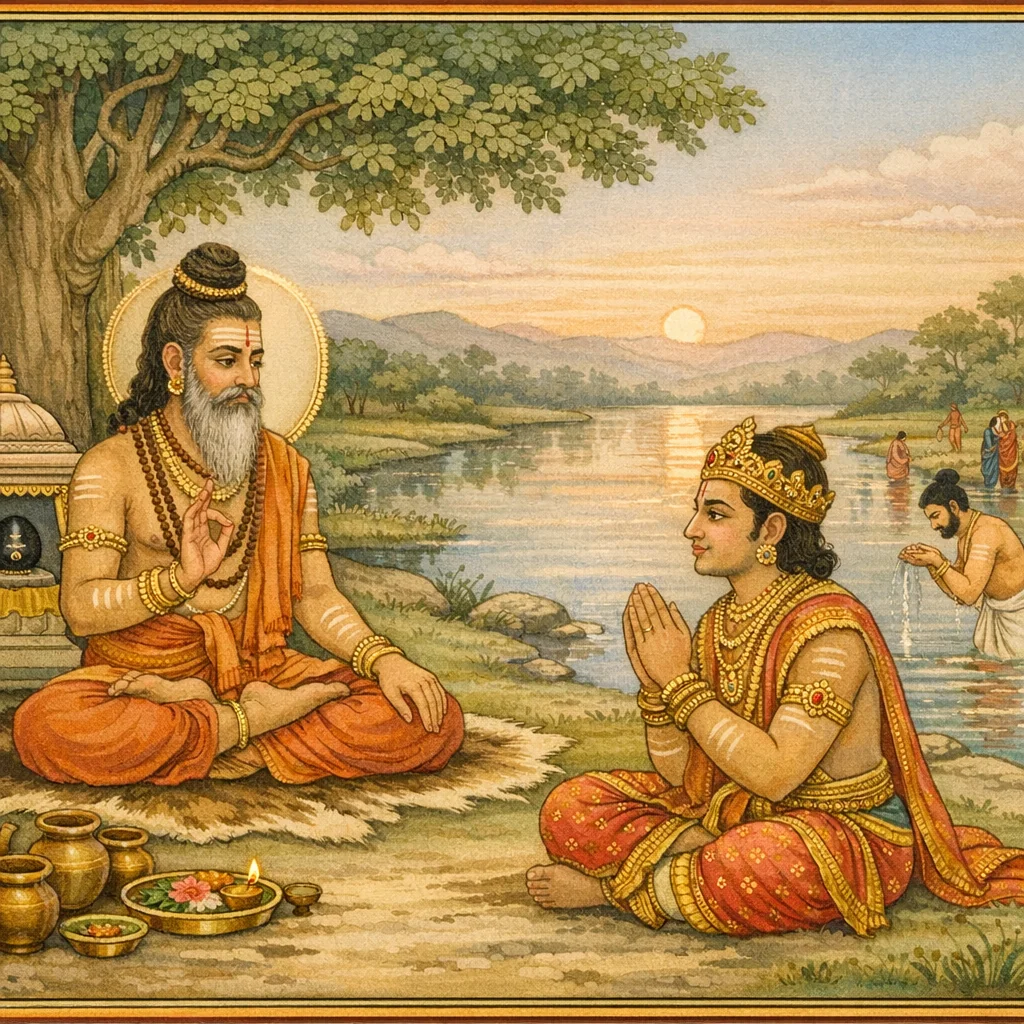
Mārkaṇḍeya instructs the king to proceed to the sacred site called Śālagrāma on the bank of the Revā/Narmadā. It is praised as worshipped by all deities and as the place where Bhagavān Vāsudeva—known also as Trivikrama and Janārdana—abides for the welfare of all beings. Its sanctity is linked to ascetic precedent and to the establishment of a proper ritual sphere for dvijas and spiritual seekers. A calendrical observance is then prescribed: when the bright-half Ekādaśī of Mārgaśīrṣa arrives, one should bathe in the Revā, fast, and keep a night vigil worshipping Janārdana. On the following morning, Dvādaśī, one bathes again, offers tarpaṇa to devas and ancestors, and completes a duly performed śrāddha. Brāhmaṇas are to be honored according to one’s means with gifts such as gold, cloth, and food, forgiveness is sought, and devotion is offered to the Lord, including under the epithet khaga-dhvaja. The phalaśruti declares freedom from sorrow, release from grievous sins (even brahmahatyā), and a liberation-oriented state through repeated darśana of Śālagrāma and remembrance of Nārāyaṇa; renunciants devoted to contemplative discipline are also said to attain Murāri’s supreme station there.
Shlokas
Verse 1
श्रीमार्कण्डेय उवाच । ततः परं महाराज चत्वारिंशत्क्रमान्तरे । शालग्रामं ततो गच्छेत्सर्वदैवतपूजितम्
Śrī Mārkaṇḍeya said: Thereafter, O great king, at a distance of forty steps, one should go to Śālagrāma, a holy place revered and worshiped by all the gods.
Verse 2
यत्रादिदेवो भगवान्वासुदेवस्त्रिविक्रमः । स्वयं तिष्ठति लोकात्मा सर्वेषां हितकाम्यया
There the Primordial God—Bhagavān Vāsudeva, Trivikrama—abides in person as the Soul of the worlds, out of a desire for the welfare of all beings.
Verse 3
नारदेन तपस्तप्त्वा कृता शाला द्विजन्मनाम् । सिद्धिक्षेत्रं भृगुक्षेत्रं ज्ञात्वा रेवातटे स्वयम्
Having performed austerities, Nārada established a hermitage-hall for the twice-born. Knowing this place on the bank of the Revā to be a ‘Field of Attainment’ and ‘Bhṛgu’s sacred field’, he himself made it renowned.
Verse 4
शालग्रामाभिधो देवो विप्राणां त्वधिवासितः । साधूनां चोपकाराय वासुदेवः प्रतिष्ठितः
The Lord known as Śālagrāma was made to dwell there for the Brāhmaṇas; and for the benefit of the sādhus, Vāsudeva was duly installed in that sacred place.
Verse 5
योगिनामुपकाराय योगिध्येयो जनार्दनः । शालग्रामेति तेनैव नर्मदातटमाश्रितः
For the welfare of yogins, Janārdana—worthy of yogic meditation—took refuge on the bank of the Narmadā; therefore he is known there as ‘Śālagrāma’.
Verse 6
मासि मार्गशिरे शुक्ला भवत्येकादशी यदा । स्नात्वा रेवाजले पुण्ये तद्दिनं समुपोषयेत्
When, in the month of Mārgaśīrṣa, the Ekādaśī of the bright fortnight arrives, having bathed in the sacred waters of the Revā, one should observe a fast on that day.
Verse 7
रात्रौ जागरणं कुर्यात्सम्पूज्य च जनार्दनम् । पुनः प्रभातसमये द्वादश्यां नर्मदाजले
At night one should keep vigil, duly worshipping Janārdana; then again, at daybreak on Dvādaśī, one should proceed in the waters of the Narmadā for the next rite.
Verse 8
स्नात्वा संतर्प्य देवांश्च पितॄन्मातॄंस्तथैव च । श्राद्धं कृत्वा ततः पश्चात्पितृभ्यो विधिपूर्वकम्
Having bathed, and having offered satisfying tarpaṇa to the gods, to the fathers, and likewise to the mothers, one should perform Śrāddha; thereafter, one should make offerings to the Pitṛs according to proper rule.
Verse 9
शक्तितो ब्राह्मणान्पूज्य स्वर्णवस्त्रान्नदानतः । क्षमापयित्वा तान्विप्रांस्तथा देवं खगध्वजम्
According to one’s capacity, having honored the brāhmaṇas with gifts of gold, garments, and food, and having sought forgiveness from those vipras, one should likewise seek the grace of the Lord Khagadhvaja, Viṣṇu of the Garuḍa-banner.
Verse 10
एवं कृते महाराज यत्पुण्यं च भवेन्नॄणाम् । शृणुष्वावहितो भूत्वा तत्पुण्यं नृपसत्तम
O great king, when this is done in this manner, the merit that arises for people—listen to that merit with an attentive mind, O best of rulers.
Verse 11
न शोकदुःखे प्रतिपत्स्यतीह जीवन्मृतो याति मुरारिसाम्यम् । महान्ति पापानि विसृज्य दुग्धं पुनर्न मातुः पिबते स्तनोद्यत्
Here he does not fall into grief and suffering; as one “dead while living,” he attains equality with Murāri (Viṣṇu). Casting off great sins, he will not again drink his mother’s milk from the upraised breast—thus he is freed from rebirth.
Verse 12
शालग्रामं पश्यते यो हि नित्यं स्नात्वा जले नार्मदेऽघौघहारे । स मुच्यते ब्रह्महत्यादिपापैर्नारायणानुस्मरणेन तेन
Whoever, after bathing in the waters of the Narmadā—the remover of floods of sin—beholds Śālagrāma each day is released from sins beginning with brahmahatyā, by that very remembrance of Nārāyaṇa.
Verse 13
वसन्ति ये संन्यसित्वा च तत्र निगृह्य दुःखानि विमुक्तसङ्घाः । ध्यायन्तो वै सांख्यवृत्त्या तुरीयं पदं मुरारेस्तेऽपि तत्रैव यान्ति
Those who dwell there after renouncing the world—having restrained and overcome sufferings and becoming free from attachment—meditate, in the manner of Sāṅkhya, upon the “fourth” (turīya) state, the supreme abode of Murāri (Viṣṇu). They too attain that very goal from that very place.
Verse 188
अध्याय
Chapter (heading).