Adhyaya 202
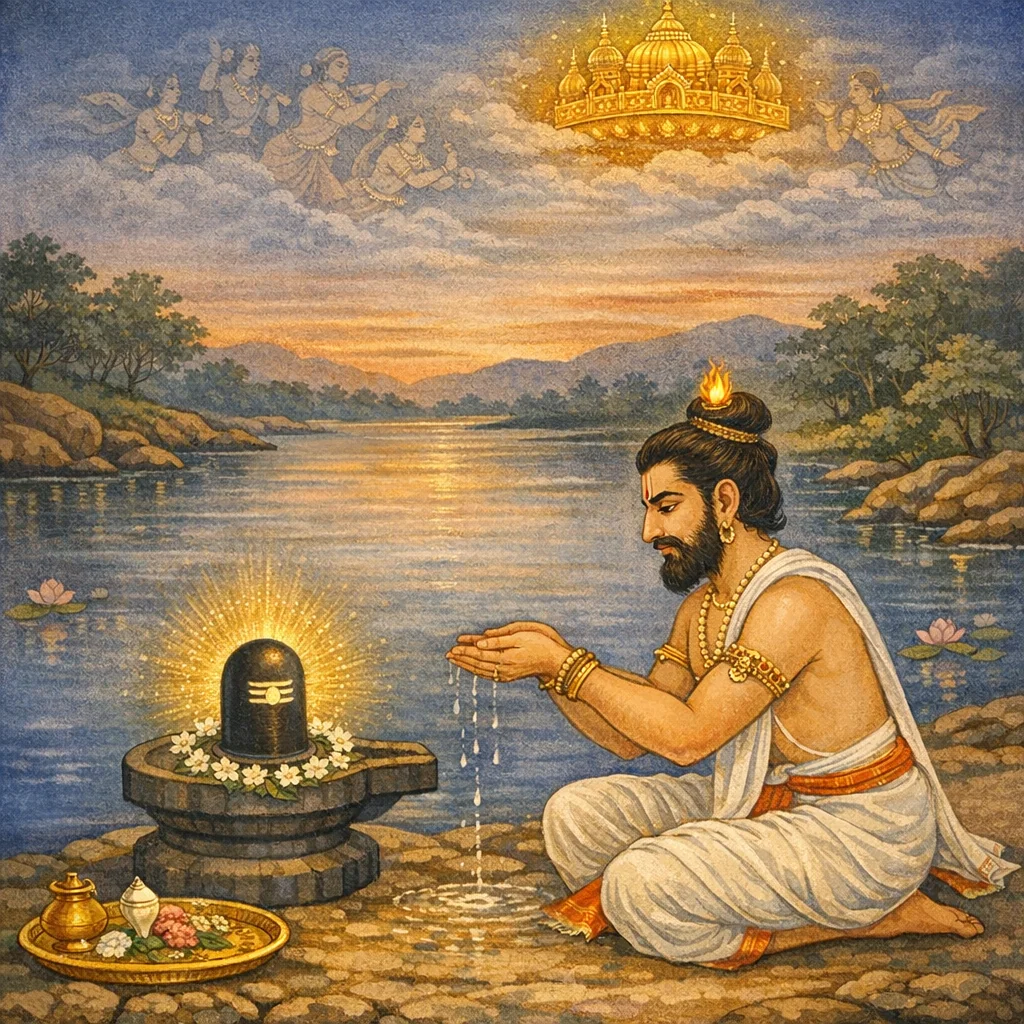
Mārkaṇḍeya extols an eminent pilgrimage place called Śikhitīrtha, praised as a principal tīrtha and as an excellent pañcāyatana worship-setting centered on a main deity with associated devotions. He relates its origin: Havyavāhana (Agni) performs austerities there to obtain a śikhā (crest/flame/tuft), becomes known as Śikhī, and establishes Śiva’s presence at the spot under the epithet Śikha-ākhyā. A calendrical rite is then prescribed: at a specified lunar time in Āśvayuja, the pilgrim should go to the tīrtha, bathe in the waters of the Narmadā, and offer tarpaṇa to the gods, sages, and ancestors with sesame-water; give gold to a brāhmaṇa, and honor and satisfy the sacred fire. The observance culminates in Śiva-pūjā with fragrance, garlands, and incense. The phalaśruti declares that proper worship leads to ascent to Rudra’s realm in a sun-colored aerial vehicle, accompanied by apsaras and praised by gandharvas, and also grants worldly fruit—destruction of enemies and the attainment of one’s own tejas, radiant spiritual vigor.
Shlokas
Verse 1
मार्कण्डेय उवाच । तस्यैवानन्तरं चान्यच्छिखितीर्थमनुत्तमम् । प्रधानं सर्वतीर्थानां पञ्चायतनमुत्तमम्
Mārkaṇḍeya said: “Immediately after that is another unsurpassed sacred ford called Śikhitīrtha—foremost among all holy places, and an excellent pañcāyatana shrine (a sacred complex of five deities).”
Verse 2
तत्र तीर्थे तपस्तप्त्वा शिखार्थं हव्यवाहनः । शिखां प्राप्य शिखी भूत्वा शिखाख्यं स्थापयञ्छिवम्
At that tīrtha, Havyavāhana (Agni) performed austerities in order to obtain a crest (śikhā). Having gained that crest and becoming ‘Śikhī’, he established Śiva there, giving Him the name ‘Śikhākhya’ (Śiva known as Śikhākhya).
Verse 3
प्रतिपच्छुक्लपक्षे या भवेदाश्वयुजे नृप । तदा तीर्थवरे गत्वा स्नात्वा वै नर्मदाजले
O king, when the first lunar day (pratipat) of the bright fortnight occurs in the month of Āśvayuja, then one should go to that excellent tīrtha and bathe indeed in the waters of the Narmadā.
Verse 4
देवानृषीन् पित्ःंश्चान्यांस्तर्पयेत्तिलवारिणा । हिरण्यं ब्राह्मणे दद्यात्संतर्प्य च हुताशनम्
With water mixed with sesame, one should offer tarpaṇa to the devas, the ṛṣis, the ancestors, and others. Having also satisfied Hutāśana, the sacred fire, one should give gold as dāna to a brāhmaṇa.
Verse 5
गन्धमाल्यैस्तथा धूपैस्ततः सम्पूजयेच्छिवम् । अनेन विधिनाभ्यर्च्य शिखितीर्थे महेश्वरम्
Then one should worship Śiva fully with fragrances, garlands, and incense. Having thus adored Maheśvara at Śikhitīrtha according to this rite, the devotee attains the promised fruit.
Verse 6
विमानेनार्कवर्णेन ह्यप्सरोगणसंवृतः । गीयमानस्तु गन्धर्वैर्रुद्रलोकं स गच्छति
Surrounded by hosts of apsarases and praised in song by gandharvas, he goes to Rudra’s world in a sun-hued celestial chariot.
Verse 7
शत्रुक्षयमवाप्नोति तेजस्वी जायते भुवि
He obtains the destruction of enemies and becomes radiant and powerful upon the earth.
Verse 202
अध्यायः
Chapter (marker).