Adhyaya 155
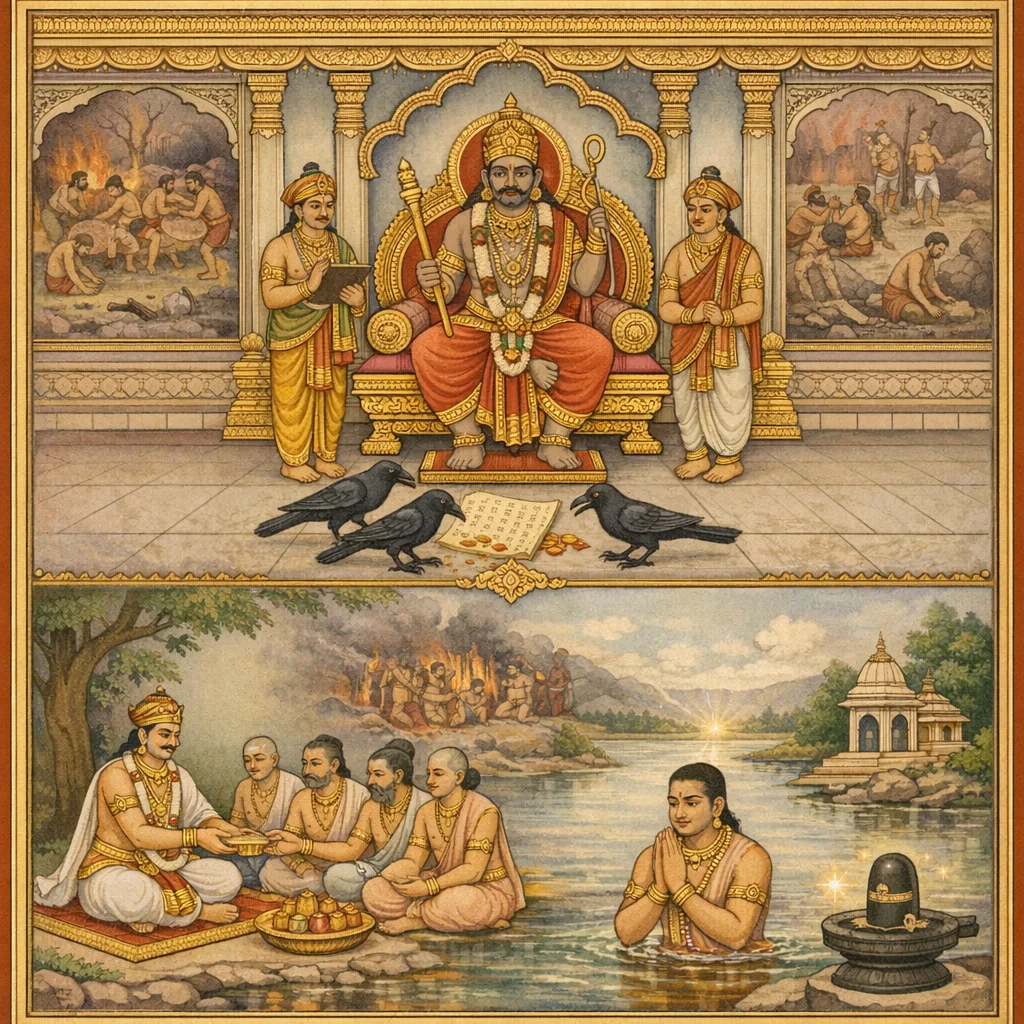
Chapter 155 is cast as a dialogue in which Mārkaṇḍeya points out Śukla Tīrtha on the northern bank of the Narmadā as an unsurpassed place of pilgrimage. A hierarchy of tīrthas is asserted, declaring that other holy places do not equal even a fraction of Śukla Tīrtha’s efficacy. This claim is grounded through three strands: doctrinal praise of the Narmadā as universally purificatory; an origin account in which Viṣṇu performs prolonged tapas at Śukla Tīrtha and Śiva manifests, consecrating a sacred zone that grants both worldly welfare and liberation; and an exemplum centered on King Cāṇakya. In that narrative, two cursed beings in crow-form are sent to Yama’s realm, where Yama proclaims that those who die at Śukla Tīrtha lie beyond his jurisdiction and attain a higher state without adjudication. The crows recount visions of Yama’s city, lists of hell-realms with their moral causality, and the enjoyment of dāna-fruits by donors. The chapter concludes with Cāṇakya renouncing passions, giving away his wealth, and attaining a Vaiṣṇava end after immersion at the tīrtha, reaffirming the chapter’s ethical and soteriological teaching.
Shlokas
Verse 1
। श्रीमार्कण्डेय उवाच । अतः परं प्रवक्ष्यामि सर्वतीर्थादनुत्तमम् । उत्तरे नर्मदाकूले शुक्लतीर्थं युधिष्ठिर
Śrī Mārkaṇḍeya said: Next I shall declare the unsurpassed one among all tīrthas—Śukla-tīrtha, on the northern bank of the Narmadā, O Yudhiṣṭhira.
Verse 2
तस्य तीर्थस्य चान्यानि पुण्यत्वाच्छुभदर्शनात् । पृथिव्यां सर्वतीर्थानि कलां नार्हन्ति षोडशीम्
Because of that tīrtha’s holiness and its auspicious vision, all other tīrthas on earth do not attain even a sixteenth part of its glory.
Verse 3
युधिष्ठिर उवाच । तस्य तीर्थस्य माहात्म्यं श्रोतुमिच्छामि तत्त्वतः । भ्रातृभिः सहितः सर्वैस्तथान्यैर्द्विजसत्तमैः
Yudhiṣṭhira said: I wish to hear, in truth and in full, the greatness of that tīrtha—together with all my brothers, and with other foremost brāhmaṇas as well.
Verse 4
श्रीमार्कण्डेय उवाच । शुक्लतीर्थस्य चोत्पत्तिमाकर्णय नरेश्वर । यस्य संदर्शनादेव ब्रह्महत्या प्रलीयते
Śrī Mārkaṇḍeya said: O king, listen to the origin of Śukla-tīrtha—by the mere sight of which even the sin of brahmin-slaying is dissolved.
Verse 5
नर्मदा सरितां श्रेष्ठा सर्वपापप्रणाशिनी । यच्च बाल्यं कृतं पापं दर्शनादेव नश्यति
The Narmadā is the foremost among rivers, the destroyer of all sins; and even the wrongdoing committed in childhood perishes by her mere sight.
Verse 6
मोक्षदानि न सर्वत्र शुक्लतीर्थमृते नृप । शुक्लतीर्थस्य माहात्म्यं पुराणे यच्छ्रुतं मया
O king, liberating holy places are not found everywhere—except at Śukla-tīrtha. The greatness of Śukla-tīrtha is what I have heard in the Purāṇas.
Verse 7
समागमे मुनीनां तु देवानां हि तथैव च । कथितं देवदेवेन शितिकण्ठेन भारत । कैलासे पर्वतश्रेष्ठे तत्ते संकथयाम्यहम्
In an assembly of sages—and likewise of the gods—this was spoken by the God of gods, Śitikaṇṭha (Śiva), O Bhārata, upon Kailāsa, the greatest of mountains. That account I shall now narrate to you.
Verse 8
पुरा कृतयुगस्यादौ तोषितुं गिरिजापतिम् । तपश्चचार विपुलं विष्णुर्वर्षसहस्रकम् । वायुभक्षो निराहारः शुक्लतीर्थे व्यवस्थितः
Long ago, at the beginning of the Kṛta Yuga, Viṣṇu performed immense austerities for a thousand years to please the Lord of Girijā (Śiva). Living on air alone, fasting without food, he remained established at Śukla-tīrtha.
Verse 9
ततः प्रत्यक्षतामागाद्देवदेवो महेश्वरः । प्रादुर्भूतस्तु सहसा तत्र तीर्थे नराधिप
Then the God of gods, Maheśvara, became directly manifest; suddenly he appeared there at that tīrtha, O ruler of men.
Verse 10
क्रोशद्वयमिदं चक्रे भुक्तिमुक्तिप्रदायकम् । तस्मिंस्तीर्थे नरः स्नात्वा मुच्यते सर्वकिल्बिषैः
He made this area extending two krośas a bestower of both worldly enjoyment and liberation. Bathing at that tīrtha, a person is freed from all sins.
Verse 11
गङ्गा कनखले पुण्या कुरुक्षेत्रे सरस्वती । ग्रामे वा यदि वारण्ये पुण्या सर्वत्र नर्मदा
The Gaṅgā is holy at Kanakhala; Sarasvatī is holy at Kurukṣetra. But the Narmadā is holy everywhere—whether in village or in forest.
Verse 12
सर्वौषधीनामशनं प्रधानं सर्वेषु पेयेषु जलं प्रधानम् । निद्रा सुखानां प्रमदा रतीनां सर्वेषु गात्रेषु शिरः प्रधानम्
Among all medicines, food is foremost; among all drinks, water is foremost. Among pleasures, sleep is foremost; among the delights of love, a beloved woman is foremost. Among all limbs, the head is foremost.
Verse 13
स्नातस्यापि यथा पुण्यं ललाटं नृपसत्तम । शुक्लतीर्थं तथा पुण्यं नर्मदायां युधिष्ठिर
O best of kings, just as the forehead is deemed especially auspicious even for one who has bathed, so too is Śukla-tīrtha especially holy upon the Narmadā, O Yudhiṣṭhira.
Verse 14
सरितां च यथा गङ्गा देवतानां जनार्दनः । शुक्लतीर्थं तथा पुण्यं नर्मदायां व्यवस्थितम्
Just as the Gaṅgā is foremost among rivers, and Janārdana is foremost among the gods, so too is Śuklatīrtha—abiding on the Narmadā—supremely holy.
Verse 15
चतुष्पदानां सुरभिर्वर्णानां ब्राह्मणो यथा । प्रधानं सर्वतीर्थानां शुक्लतीर्थं तथा नृप
O King, just as Surabhī is foremost among four-footed beings, and the Brāhmaṇa is foremost among the social orders, so Śukla-tīrtha is foremost among all sacred fords.
Verse 16
ग्रहाणां तु यथादित्यो नक्षत्राणां यथा शशी । शिरो वा सर्वगात्राणां धर्माणां सत्यमिष्यते
As the Sun is chief among the grahas, and the Moon among the constellations, and as the head is foremost among all limbs—so truth is held to be the foremost among all dharmas.
Verse 17
तथैव पार्थ तीर्थानां शुक्लतीर्थमनुत्तमम् । दुर्विज्ञेयो यथा लोके परमात्मा सनातनः
So too, O son of Pṛthā, among the tīrthas Śuklatīrtha is unsurpassed—yet it is difficult to recognize, just as the eternal Supreme Self (Paramātman) is hard to comprehend in this world.
Verse 18
सुसूक्ष्मत्वादनिर्देश्यः शुक्लतीर्थं तथा नृप । मन्दप्रज्ञत्वमापन्ने महामोहसमन्वितः
So too, O King, Śuklatīrtha is hard to point out because of its extreme subtlety; one who has fallen into dull understanding—overwhelmed by great delusion—fails to grasp it.
Verse 19
शुक्लतीर्थं ना जानाति नर्मदातटसंस्थितम् । बहुनात्र किमुक्तेन धर्मपुत्र पुनः पुनः
He does not know Śuklatīrtha, situated on the bank of the Narmadā. What is the use of saying much more here, O Dharmaputra, again and again?
Verse 20
शुक्लतीर्थं महापुण्यं सम्प्राप्तं कल्मषक्षयात् । योऽत्र दत्ते शुचिर्भूत्वा एकं रेवाजलाञ्जलिम्
Śuklatīrtha is exceedingly meritorious, bringing about the destruction of sin. Whoever, becoming pure, offers here even a single añjali—one handful of Revā (Narmadā) water—
Verse 21
कल्पकोटिसहस्राणि पितरस्तेन तर्पिताः
By that act, the ancestors are satisfied for thousands of crores of kalpas.
Verse 22
एकः पुत्रो धरापृष्ठे पित्ःणामार्तिनाशनः । चाणक्यो नाम राजाभूच्छुक्लतीर्थं च वेद सः
On the face of the earth there was a single son who dispelled the distress of the ancestors. A king named Cāṇakya arose—he indeed knew Śuklatīrtha.
Verse 23
युधिष्ठिर उवाच । कोऽसौ द्विजवरश्रेष्ठ चाणक्यो नाम नामतः । शुक्लतीर्थस्य यो वेत्ता नान्यो वेत्ता हि कश्चन
Yudhiṣṭhira said: “O best among the excellent Brāhmaṇas, who is that man known by the name Cāṇakya—he who knows Śuklatīrtha, and of whom it is said that none other knows it?”
Verse 24
केनोपायेन तत्तीर्थं तेन ज्ञातं धरातले । तदहं श्रोतुमिच्छामि परं कौतूहलं हि मे
“By what means was that sacred ford (tīrtha) discovered upon the earth, and by whom? I wish to hear it, for my curiosity is exceedingly great.”
Verse 25
श्रीमार्कण्डेय उवाच । इक्ष्वाकुप्रभवो राजा नप्ता शुद्धोदनस्य च । चाणक्यो नाम राजर्षिर्बुभुजे पृथिवीमिमाम्
Śrī Mārkaṇḍeya said: “There was a king born in the Ikṣvāku line, a grandson of Śuddhodana. That royal seer, named Cāṇakya, ruled this earth.”
Verse 26
विक्रान्तो मतिमाञ्छूरः सर्वलोकैरवञ्चितः । वञ्चितः सहसा धूर्तवायसाभ्यां नृपोत्तमः
Valiant, intelligent, and heroic—never deceived by anyone—yet that best of kings was suddenly tricked by two crafty crows.
Verse 27
युधिष्ठिर उवाच । कथं स वञ्चितो राजा वायसाभ्यां कुतोऽथवा । पुरा येन प्रतिज्ञातं धीगर्भेण महात्मना
Yudhiṣṭhira said: “How was that king deceived by the two crows—and from where did they come? And how was it that, long ago, a promise was made by that great-souled Dhīgarbha?”
Verse 28
न जीवे वञ्चितोऽन्येन प्राणांस्त्यक्ष्ये न संशयः । एतन्मे वद विप्रेन्द्र परं कौतूहलं मम
“I would not live on if I were deceived by another; I would give up my life—of that there is no doubt. Tell me this, O best of brāhmaṇas; my curiosity is intense.”
Verse 29
श्रीमार्कण्डेय उवाच । आत्मानं वञ्चितं ज्ञात्वा तदा संगृह्य वायसौ । प्रेषयामास तीव्रेण दण्डेन यमसादनम्
Śrī Mārkaṇḍeya said: “Realizing that he had been deceived, he then seized the two crows and, with a harsh punishment, sent them to Yama’s abode (death).”
Verse 30
वायसावूचतुः । सुन्दोपसुन्दयोः पुत्रावावां काकत्वमागतौ । मा वधीस्त्वं महाभाग कस्मिंश्चित्कारणान्तरे
The two crows said: “We are the sons of Sunda and Upasunda, and have come into the state of crow-hood. Do not kill us, O fortunate king—there is a certain reason behind this.”
Verse 31
तावावां कृतसंकल्पौ त्वया कोपेन मानद । निरस्तावनिरस्तौ वा यास्यावः परमां गतिम्
“We two are bound by a destined resolve. By your anger, O giver of honor, whether cast off or not cast off, we shall attain the highest end.”
Verse 32
तदादेशय राजेन्द्र कृत्वा तव महत्प्रियम् । मुक्तशापौ भविष्यावो ब्रह्मणो वचनं तथा
Therefore, O lord of kings, command us—after we have done what is greatly pleasing to you. Then we shall be freed from the curse; such indeed is Brahmā’s word.
Verse 33
तच्छ्रुत्वा काकवचनं चाणक्यो नृपसत्तमः । नाहं जीवे विदित्वैवं वञ्चितः केन कर्हिचित्
Hearing the crows’ words, Cāṇakya—the best of kings—thought: “Knowing this, I will not live on, for I have been deceived by someone at some time.”
Verse 34
तस्मात्तीर्थं विजानीतं यमस्य सदने द्विजौ । प्रेषयामि यथान्यायं श्रुत्वा तत्कथयिष्यथः
“Therefore, O two Brāhmaṇas, know this as a sacred ford even in Yama’s abode. I shall send you there in due and proper order; after witnessing it, you shall relate it.”
Verse 35
तेनैव मुक्तौ तौ काकौ स्रक्चन्दनविभूषितौ । शीघ्रगौ प्रेषयामास यमस्य सदनं प्रति
By that very act, the two crows were set free, adorned with garlands and sandal-paste; swift of flight, he sent them toward the abode of Yama.
Verse 36
राजोवाच । तत्र धर्मपुरं गत्वा विचरन्तावितस्ततः । यदि पृच्छति धर्मात्मा यमः संयमनो महान्
The King said: “Having gone there to the City of Dharma, roam about here and there. If the righteous-souled Yama—the great Restrainer—should question you…”
Verse 37
कुतो वामागतं ब्रूतं केन वा भूषितावुभौ । मदीया भारती तस्य कथनीया ह्यशङ्कितम्
“Tell him from what place you have come, and by whom you both have been adorned. And my very words are to be conveyed to him—without hesitation.”
Verse 38
इक्ष्वाकुसंभवो राजा चाणक्यो नाम धार्मिकः । द्वादशाहे मृतस्यास्य तर्पितावशनादिना
“A righteous king named Cāṇakya, born in the line of Ikṣvāku—during the twelve-day rite for the departed—has satisfied us with food and the like.”
Verse 39
तच्छ्रुत्वा वचनं राज्ञो गतौ तौ यमसादनम् । क्रीडितौ प्राङ्गणे तस्य स्रक्चन्दनविभूषितौ । धर्मराजेन तौ दृष्टौ पृष्टौ धृष्टौ च वायसौ
Hearing the king’s words, the two went to Yama’s abode. Adorned with garlands and sandal, they sported in his courtyard. Dharmarāja saw the bold crows and questioned them.
Verse 40
यम उवाच । कुतः स्थानात्समायातौ केन वा भूषितावुभौ । वृत्तं वै कथ्यतामेतद्वायसावविशङ्कया
Yama said: “From what place have you come, and by whom have you both been adorned? Tell this whole account, O crows, without any fear or doubt.”
Verse 41
काकावूचतुः । इक्ष्वाकुसम्भवो राजा चाणक्यो नाम धार्मिकः । द्वादशाहे मृतस्यास्य तर्पितावशनादिभिः
The two crows said: “A righteous king named Cāṇakya, born in Ikṣvāku’s line—during the twelve-day observance for the departed—has satisfied us with food and other offerings.”
Verse 42
तयोस्तद्वचनं श्रुत्वा सदा वैवस्वतो यमः । चित्रगुप्तं कलिं कालं वीक्ष्यतामिदमब्रवीत्
Having heard their statement, Vaivasvata Yama looked toward Citragupta, Kali, and Kāla, and spoke these words.
Verse 43
अण्डजस्वेदजातीनां भूतानां सचराचरे । विहितं लोककर्त्ःणां सान्निध्यं ब्रह्मणा मम
“For beings born from eggs and from sweat—indeed for all moving and unmoving creation—Brahmā, the Creator of worlds, has ordained my presence as the regulator.”
Verse 44
गतः कुत्र दुराचारश्चाणक्यो नामतस्त्विह । अन्विष्यतां पुराणेषु त्वितिहासेषु या गतिः
“Where has that wicked man—known here by the name Cāṇakya—gone? Search in the Purāṇas and the Itihāsas to determine what destiny has befallen him.”
Verse 45
ततस्तैर्धर्मपालैस्तु धर्मराजप्रचोदितैः । निरीक्षिता पुराणोक्ता कर्मजा गतिरागतिः
Then those guardians of dharma, urged on by Dharmarāja (Yama), examined the Purāṇa-declared course of going and returning—destiny born of one’s deeds.
Verse 46
ततः प्रोवाच वचनं धर्मो धर्मभृतां वरः । शृण्वतां धर्मपालानां मेघगम्भीरया गिरा
Then Dharma—the foremost among the upholders of righteousness—spoke to the listening dharmapālas, in a voice deep as thunderclouds.
Verse 47
शुक्लतीर्थे मृतानां तु नर्मदाविमले जले । अण्डजस्वेदजातीनां न गतिर्मम सन्निधौ
But those who die at Śukla Tīrtha—in the pure waters of the Narmadā—find no passage into my domain, even beings born from eggs or from sweat.
Verse 48
तत्तीर्थं धार्मिकं लोके ब्रह्मविष्णुमहेश्वरैः । निर्मितं परया भक्त्या लोकानां हितकाम्यया
That tīrtha is renowned in the world as a seat of dharma—fashioned by Brahmā, Viṣṇu, and Maheśvara with supreme devotion, desiring the welfare of all beings.
Verse 49
पापोपपातकैर्युक्ता ये नरा नर्मदाजले । शुक्लतीर्थे मृताः शुद्धा न ते मद्विषयाः क्वचित्
Even those burdened with sins and minor transgressions—if they die at Śukla Tīrtha in the waters of the Narmadā—are purified; they never fall under my jurisdiction at any time.
Verse 50
एतच्छ्रुत्वा तु वचनं तौ काकौ यमभाषितम् । आगतौ शीघ्रगौ पार्थ दृष्ट्वा यमपुरं महत्
Having heard these words spoken by Yama, the two crows—swift of flight—returned, O Pārtha, after beholding the great city of Yama.
Verse 51
पृष्टौ तौ प्रणतौ राज्ञा यथावृत्तं यथाश्रुतम् । कथयामासतुः पार्थ दानवौ काकतां गतौ
Questioned by the king, the two—bowing—reported exactly what had happened and what they had heard, O Pārtha: the two dānavas who had assumed the form of crows.
Verse 52
अस्मात्स्थानाद्गतावावां यमस्य पुरमुत्तमम् । पृथिव्या दक्षिणे भागे ह्यतीत्य बहुयोनिजम्
From this place we set forth for Yama’s most excellent city, passing beyond many realms of diverse births, toward the southern quarter of the earth.
Verse 53
तत्पुरं कामगं दिव्यं स्वर्णप्राकारतोरणम् । अनेकगृहसम्बाधं मणिकाञ्चनभूषितम्
That city was divine and wondrous, appearing at will—its walls and gateways of gold, crowded with countless mansions, adorned with gems and gleaming gold.
Verse 54
चतुष्पथैश्चत्वरैश्च घण्टामार्गोपशोभितम् । उद्यानवनसंछन्नं पद्मिनीखण्डमन्दितम्
Adorned with four-way crossroads and spacious squares, beautified by avenues marked with bells; covered with gardens and groves, and embellished with clusters of lotus-ponds.
Verse 55
हंससारससंघुष्टं कोकिलाकुलसंकुलम् । सिंहव्याघ्रगजाकीर्णमृक्षवानरसेवितम्
Resounding with the calls of swans and cranes, crowded with flocks of cuckoos; filled with lions, tigers, and elephants, and frequented by bears and monkeys.
Verse 56
नरनारीसमाकीर्णं नित्योत्सवविभूषितम् । शंखदुन्दुभिर्निर्घोषैर्वीणावेणुनिनादितम्
Crowded with men and women, adorned with festivals that seemed unceasing; echoing with the blare of conches and kettledrums, and ringing with the music of vīṇā and flute.
Verse 57
यममार्गेऽपि विहितं स्वर्गलोकमिवापरम् । गतौ तत्र पुनश्चान्यैर्यमदूतैर्यमाज्ञया
Even upon Yama’s road it was established, as though another heaven. Reaching that place again, by Yama’s command, they proceeded onward with other messengers of Yama.
Verse 58
विदितौ प्रेषितौ तत्र यत्र देवो जगत्प्रभुः । प्राणस्य भीत्या दृष्टोऽसौ सिंहासनगतः प्रभुः
Recognized, they were dispatched to the place where the god, the Lord of the world, was present. There he was seen—so awe-inspiring that one’s very life-breath trembled—seated upon his throne, the Sovereign.
Verse 59
महाकायो महाजङ्घो महास्कन्धो महोदरः । महावक्षा महाबाहुर्महावक्त्रेक्षणो महान्
Vast-bodied, with mighty legs, broad shoulders, and a great belly; with a massive chest and powerful arms—great indeed, with an immense face and commanding eyes.
Verse 60
महामहिषमारूढो महामुकुटभूषितः । तत्रान्यश्च कलिः कालश्चित्रगुप्तो महामतिः
Mounted upon a great buffalo and adorned with a towering crown. There too were others—Kali and Kāla—and Citragupta, the greatly wise.
Verse 61
समागतौ तदा दृष्टौ मध्ये ज्वलितपावकौ । पुण्यपापानि जन्तूनां श्रुतिस्मृत्यर्थपारगौ
Then two were seen, arrived there, standing amid blazing fire—those who discern the merits and sins of beings, fully versed in the meanings of Śruti and Smṛti.
Verse 62
विचारयन्तौ सततं तिष्ठाते तौ दिवानिशम् । ततो ह्यावां प्रणामान्ते यमेन यममूर्तिना
Ever deliberating, those two remained there day and night. Then, when our prostration was completed, Yama—embodiment of his sacred office—addressed us.
Verse 63
पृष्टावागमने हेतुं तमब्रूव शृणुष्व तत् । उज्जयिन्यां महीपालश्चाणक्योऽभूत्प्रतापवान्
When asked the reason for our coming, he said, “Hear this.” In Ujjayinī there was a mighty and illustrious ruler named Cāṇakya.
Verse 64
द्वादशाहे मृतस्यास्य भुक्त्वा प्राप्तौ यमालयम् । ततोऽस्माकं वचः श्रुत्वा कम्पयित्वा शिरो यमः
After the twelve-day rite for this departed one, we ate and then arrived at Yama’s abode. Hearing our words, Yama shook his head in astonishment.
Verse 65
उवाच वचनं सत्यं सभामध्ये हसन्निव । अस्ति तत्कारणं येन चाणक्यः पापपूरुषः
In the midst of the assembly, Yama spoke truthful words, as though smiling: “There is a reason why that sinful man, Cāṇakya, did not come here.”
Verse 66
नायातो मम लोके तु सर्वपापभयंकरे । शुक्लतीर्थे मृतानां तु नर्मदायां परं पदम्
“He did not enter my realm, the dread destination feared on account of all sins. For those who die at Śukla-tīrtha on the Narmadā, there is the supreme state.”
Verse 67
जायते सर्वजन्तूनां नात्र काचिद्विचारणा । अवशः स्ववशो वापि जन्तुस्तत्क्षेत्रमण्डले
For all beings, the ordained fruit arises there without any further deliberation: whether helpless or self-controlled, a creature within that sacred precinct (kṣetra-maṇḍala) attains the appointed result.
Verse 68
मृतः स वै न सन्देहो रुद्रस्यानुचरो भवेत् । तद्धर्मवचनं श्रुत्वा निर्गत्य नगराद्बहिः
Whoever dies there—of this there is no doubt—becomes an attendant of Rudra. Hearing that teaching of dharma, they went out beyond the city.
Verse 69
पश्यन्तौ विविधां घोरां नरके लोकयातनाम् । त्रिंशत्कोट्यो हि घोराणां नरकाणां नृपोत्तम
As the two of them looked upon the many dreadful torments of beings in hell, (the narrator said): “O best of kings, there are thirty crores of terrible hells.”
Verse 70
दृष्टा भीतौ परामार्तिगतौ तत्र महापथि । नरको रौरवस्तत्र महारौरव एव च
On that great roadway (of the afterlife), they were seen—terrified and overwhelmed with anguish. There appeared the hell named Raurava, and also Mahāraurava.
Verse 71
पेषणः शोषणश्चैव कालसूत्रोऽस्थिभञ्जनः । तामिस्रश्चान्धतामिस्रः कृमिपूतिवहस्तथा
There were (hells named) Peṣaṇa and Śoṣaṇa; Kālasūtra and Asthibhañjana; Tāmisra and Andhatāmisra; and likewise Kṛmipūtivaha.
Verse 72
दृष्टश्चान्यो महाज्वालस्तत्रैव विषभोजनः । नरकौ दंशमशकौ तथा यमलपर्वतौ
And there were seen other (hells) as well: Mahājvāla, and there itself Viṣabhojana; the hells named Daṃśa and Maśaka; and also the twin Yamalaparvatas.
Verse 73
नदी वैतरणी दृष्टा सर्वपापप्रणाशिनी । शीतलं सलिलं यत्र पिबन्ति ह्यमृतोपमम्
They saw the river Vaitaraṇī, the destroyer of all sins—where the water is cool, and people drink it as though it were nectar.
Verse 74
तदेव नीरं पापानां शोणितं परिवर्तते । असिपत्रवनं चान्यद्दृष्टान्या महती शिला
That very water turns into blood for sinners. Another terror is seen there too—the forest of sword-like leaves (Asipatravana), and likewise a vast rock-slab (a crushing stone) is beheld.
Verse 75
अग्निपुंजनिभाकारा विशाला शाल्मली परा । इत्यादयस्तथैवान्ये शतसाहस्रसंज्ञिताः
There is the supreme Śālmalī (hell), vast in extent, whose form appears like a heap of fire. In this way, many other hells too are spoken of—known by names numbering in the hundreds of thousands.
Verse 76
घोरघोरतरा दृष्टाः क्लिश्यन्ते यत्र मानवाः । वाचिकैर्मानसैः पापैः कर्मजैश्च पृथग्विधैः
More and more dreadful realms are seen—where human beings are afflicted—on account of sins of speech, sins of mind, and various other misdeeds born of action.
Verse 77
अहंकारकृतैर्दोषैर्मायावचनपूर्वकैः । पिता माता गुरुर्भ्राता अनाथा विकलेन्द्रियाः
Through faults born of ego, ushered in by deceitful speech, one may become father, mother, teacher, or brother—yet remains helpless, unprotected, and with senses impaired.
Verse 78
भ्रमन्ति नोद्धृता येषां गतिस्तेषां हि रौरवे । तत्र ते द्वादशाब्दानि क्षपित्वा रौरवेऽधमाः
Those who wander without being rescued—whose destined course is truly Raurava—remain there; and after spending twelve years in Raurava, those wretches continue on their downward fate.
Verse 79
इह मानुष्यके लोके दीनान्धाश्च भवन्ति ते । देवब्रह्मस्वहर्त्ःणां नराणां पापकर्मणाम्
Here, in the human world, they become wretched and blind—those sinful people who steal the property belonging to the gods and to Brahmins.
Verse 80
महारौरवमाश्रित्य ध्रुवं वासो यमालये । ततः कालेन महता पापाः पापेन वेष्टिताः
Consigned to Mahāraurava, they surely dwell in Yama’s abode. Then, after a long time, the sinners—wrapped round by their own sin—move onward in their fated course.
Verse 81
जायन्ते कण्टकैर्भिन्नाः कोशे वा कोशकारकाः । मृगपक्षिविहङ्गानां घातका मांसभक्षकाः
They are born pierced by thorns, or else as cocoon-makers within a cocoon—those who kill beasts and birds and live as eaters of flesh.
Verse 82
पेषणं नरकं यान्ति शोषणं जीवबन्धनात् । तत्रत्यां यातनां घोरां सहित्वा शास्त्रचोदिताम्
They go to the hell called Peṣaṇa, and to Śoṣaṇa, for binding living beings. There, having endured the dreadful torment ordained according to the śāstras, (they proceed further in accord with karma).
Verse 83
इह मानुष्यतां प्राप्य पङ्ग्वन्धबधिरा नराः । गवार्थे ब्राह्मणार्थे च ह्यनृतं वदतामिह
Here, even after attaining human birth, people become lame, blind, and deaf—those who in this world speak falsehood for the sake of cattle, or for the sake of Brāhmaṇas.
Verse 84
पतनं जायते पुंसां नरके कालसूत्रके । तत्रत्या यातना घोरा विहिता शास्त्रकर्तृभिः
Men fall into the hell called Kālasūtra; and the dreadful torments there have been laid down by the authors of the sacred ordinances.
Verse 85
भुक्त्वा समागता ह्यत्र ते यास्यन्त्यन्त्यजां गतिम् । बन्धयन्ति च ये जीवांस्त्यक्त्वात्मकुलसन्ततिम्
After experiencing those results and returning here, they go to the state of the ant’yaja, the outcaste. And those who bind living beings—abandoning the continuity of their own family line—(meet such outcomes).
Verse 86
पतन्ति नात्र सन्देहो नरके तेऽस्थिभञ्जने । तत्र वर्षशतस्यान्त इह मानुष्यतां गताः
They fall—without doubt—into the hell called Asthibhañjana. After the end of a hundred years there, they attain human birth again here.
Verse 87
कुब्जा वामनकाः पापा जायन्ते दुःखभागिनः । ये त्यजन्ति स्वकां भार्यां मूढाः पण्डितमानिनः
Those sinners who abandon their own wife—deluded, imagining themselves learned—are born as hunchbacks and dwarfs, inheritors of suffering.
Verse 88
ते यान्ति नरकं घोरं तामिस्रं नात्र संशयः । तत्र वर्षशतस्यान्ते इह मानुष्यतां गताः
They go to the dreadful hell called Tāmisra—there is no doubt. After a hundred years there, they return here to human birth.
Verse 89
दुश्चर्माणो दुर्भगाश्च जायन्ते मानवा हि ते । मानकूटं तुलाकूटं कूटकं तु वदन्ति ये
Indeed, those people are born with diseased skin and ill fortune—those who speak of false measures, false weights, and deceitful counterfeits.
Verse 90
नरके तेऽन्धतामिस्रे प्रपच्यन्ते नराधमाः । शतसाहस्रिकं कालमुषित्वा तत्र ते नराः
Those vile men are cooked in the hell called Andhatāmisra; having dwelt there for a period of a hundred thousand years, they then proceed onward according to karma.
Verse 91
इह शत्रुगृहे त्वन्धा भ्रमन्ते दीनमूर्तयः । पितृदेवद्विजेभ्योऽन्नमदत्त्वा येऽत्र भुञ्जते
Here in the world, they wander blind in an enemy’s house, wearing a wretched form—those who eat without giving food to the ancestors, the gods, and the twice-born.
Verse 92
नरके कृमिभक्ष्ये ते पतन्ति स्वात्मपोषकाः । ततः प्रसूतिकाले हि कृमिभुक्तश्च सव्रणः
Those who nourish only themselves fall into the hell called Kṛmibhakṣya. Then, at the time of birth, they are eaten by worms and covered with wounds.
Verse 93
जायतेऽशुचिगन्धोऽत्र परभाग्योपजीवकः । स्वकर्मविच्युताः पापा वर्णाश्रमविवर्जिताः
Here one is born foul-smelling, living by another’s fortune—sinful people who have fallen away from their rightful duties, forsaking the disciplines of varṇa and āśrama.
Verse 94
नरके पूयसम्पूर्णे क्लिश्यन्ते ह्ययुतं समाः । पूर्णे तत्र ततः काले प्राप्य मानुष्यकं भवम्
In a hell filled with putrid filth, they suffer indeed for ten thousand years. When that allotted time there is completed, they then attain a human birth once again.
Verse 95
उद्वेजनीया भूतानां जायन्ते व्याधिभिर्वृताः । अग्निदो गरदश्चैव लोभमोहान्वितो नरः
Afflicted by diseases, they become a source of fear to living beings. Such a man—given to arson and to administering poison—acts under the sway of greed and delusion.
Verse 96
नरके विषसम्पूर्णे निमज्जति दुरात्मवान् । तत्र वर्षशतात्कालादुन्मज्जनमवस्थितः
The evil-minded man sinks into a hell filled completely with poison; and there he remains, without rising again, for the duration of a hundred years.
Verse 97
भुवि मानुषतां प्राप्य कृपणो जायते पुनः । पादुकोपानहौ छत्रं शय्यां प्रावरणानि च
Having attained human birth upon the earth, he is again born as a miser—clinging to sandals and shoes, an umbrella, a bed, and coverings as his possessions.
Verse 98
अदत्त्वा दंशमशकैर्भक्ष्यन्ते जन्यसप्ततिम् । पितुर्द्रव्यापहर्तारस्ताडनक्रोशने रताः
Those who give nothing are tormented by biting insects and mosquitoes for seventy births. And those who steal their father’s wealth delight in beating and in wailing cries in the realms of punishment.
Verse 99
पीडनं क्रियते तेषां यत्र तौ युग्मपर्वतौ । या सा वैतरणी घोरा नदी रक्तप्रवाहिनी
There, at the place where those two Twin Mountains stand, torment is inflicted upon them. That is the dreadful Vaitaraṇī—a river whose current flows like blood.
Verse 100
पिबन्ति रुधिरं तत्र येऽभियान्ति रजस्वलाम् । असिपत्रवने घोरे पीड्यन्ते पापकारिणः
There, those sinners who approach a woman during her menstruation are made to drink blood; such evil-doers are tormented in the dreadful forest of sword-like leaves, Asipatravana.
Verse 101
परपीडाकरा नित्यं ये नरोऽन्त्यजगामिनः । गुरुदाररतानां तु महापातकिनामपि
Those men who constantly inflict suffering upon others, who sink into the conduct of the most fallen, and who delight in the wives of their teachers—such persons too are counted among the great sinners, the mahāpātakins.
Verse 102
शिलावगूहनं तेषां जायते जन्मसप्ततिम् । ज्वलन्तीमायसीं घोरां बहुकण्टकसंवृताम्
For them there arises, for seventy births, the torment called “stone-embrace”—a dreadful, blazing prison of iron, enclosed on all sides by many thorns.
Verse 103
शाल्मलीं तेऽवगूहन्ति परदाररता हि ये । परस्य योषितं हृत्वा ब्रह्मस्वमपहृत्य च
Those who are addicted to another man’s wife are made to embrace the Śālmalī (thorny silk-cotton) tree; likewise those who abduct another’s woman and those who steal what belongs to Brahmins (brahma-sva) are driven to that torment.
Verse 104
अरण्ये निर्जले देशे स भवेत्क्रूरराक्षसः । देवस्वं ब्राह्मणस्वं च लोभेनैवाहरेच्च यः
He who, driven by greed, steals the property dedicated to the gods or belonging to brāhmaṇas becomes a cruel rākṣasa, dwelling in a desolate wilderness without water.
Verse 105
स पापात्मा परे लोके गृध्रोच्छिष्टेन जीवति । एवमादीनि पापानि भुञ्जन्ते यमशासनात्
That sinful soul, in the next world, lives on what is left over by vultures; thus, by Yama’s ordinance, they experience the fruits of such sins and others like them.
Verse 106
येषां तु दर्शनादेव श्रवणाज्जायते भयम् । तथा दानफलं चान्ये भुञ्जाना यममन्दिरे
Some are such that fear arises merely by seeing (those scenes) or hearing (of them); while others, in Yama’s abode, enjoy the fruits of their charity.
Verse 107
दृष्टाः श्रुतं कथयतां दूतानां च यमाज्ञया । रथैरन्ये गजैरन्ये केचिद्वाजिभिरावृताः
The messengers were seen—by Yama’s command, recounting what had been witnessed and heard—some surrounded by chariots, some by elephants, and some by horses.
Verse 108
दृष्टास्तत्र महाभाग तपःसंचयसंस्थिताः । गोदाता स्वर्णदाता च भूमिरत्नप्रदा नराः
There, O greatly fortunate one, were seen men established in amassed austerity—givers of cows, givers of gold, and those who bestowed land and jewels.
Verse 109
शय्याशनगृहादीनां स लोकः कामदो नृणाम् । अन्नं पानीयसहितं ददते येऽत्र मानवाः
That realm becomes wish-fulfilling for people, granting beds, seats, houses, and the like—especially for those here who give food together with drinking water.
Verse 110
तत्र तृप्ताः सुसंतुष्टाः क्रीडन्ते यमसादने । अत्र यद्दीयते दानमपि वालाग्रमात्रकम्
There, satisfied and deeply content, they sport in Yama’s abode. Even a charity given here—though only as small as the tip of a hair—does not go to waste.
Verse 111
तदक्षयफलं सर्वं शुक्लतीर्थे नृपोत्तम । एतत्ते कथितं सर्वं यद्दृष्टं यच्च वै श्रुतम्
All of that yields imperishable fruit at Śuklatīrtha, O best of kings. Thus I have told you everything—what was seen and what indeed was heard.
Verse 112
कुरुष्व यदभिप्रेतं यदि शक्नोषि मुच्यताम् । तयोस्तद्वचनं श्रुत्वा चाणक्यो हृष्टमानसः
Do what your heart intends; if you are able, let your bondage be loosed. Hearing the words of those two, Cāṇakya rejoiced within.
Verse 113
विसर्जयामास खगावभिनन्द्य पुनःपुनः । ताभ्यां गताभ्यां सर्वस्वं दत्त्वा विप्रेषु भारत
He honored the two birds again and again and then dismissed them. After they had gone, O Bhārata, he gave away all his possessions among the brāhmaṇas.
Verse 114
कामक्रोधौ परित्यज्य जगामामरपर्वतम् । तत्र बद्ध्वोडुपं गाढं कृष्णरज्ज्वावलम्बितम्
Casting away lust and anger, he went to Amaraparvata. There he firmly secured a small boat, hanging it by a dark, black rope.
Verse 115
प्लवमानो जगामाऽशु ध्यायन्देवं जनार्दनम् । आरोग्यं भास्करादिच्छेद्धनं वै जातवेदसः
Floating along, he quickly went on, meditating on the Lord Janārdana. From Sūrya comes health, and from Agni indeed comes the granting of desired wealth.
Verse 116
प्राप्नोति ज्ञानमीशानान्मोक्षं प्राप्नोति केशवात् । नीलं रक्तं तदभवन्मेचकं यद्धि सूत्रकम्
From Īśāna one attains true knowledge; from Keśava one attains mokṣa, liberation. And the thread—dark-blue and red—became of a deep, cloud-dark hue.
Verse 117
शुद्धस्फटिकसङ्काशं दृष्ट्वा रज्जुं महामतिः । आप्लुत्य विमले तोये गतोऽसौ वैष्णवं पदम्
Seeing the rope shining like pure crystal, that great-souled one bathed in the spotless water and attained the supreme Vaiṣṇava state.
Verse 118
गायन्ति यद्वेदविदः पुराणं नारायणं शाश्वतमच्युताह्वयम् । प्राप्तः स तं राजसुतो महात्मा निक्षिप्य देहं शुभशुक्लतीर्थे
That eternal Purāṇa of Nārāyaṇa—celebrated by the knowers of the Vedas and named ‘Acyuta’—was attained by that great prince; and at the auspicious Śuklatīrtha he cast off his body.
Verse 119
एषा ते कथिता राजन्सिद्धिश्चाणक्यभूभृतः । तथान्यत्तव वक्ष्यामि शृणुष्वैकाग्रमानसः
O King, this attainment of the ruler Cāṇakya has been told to you. Now I shall declare something further—listen with a focused mind.