Adhyaya 59
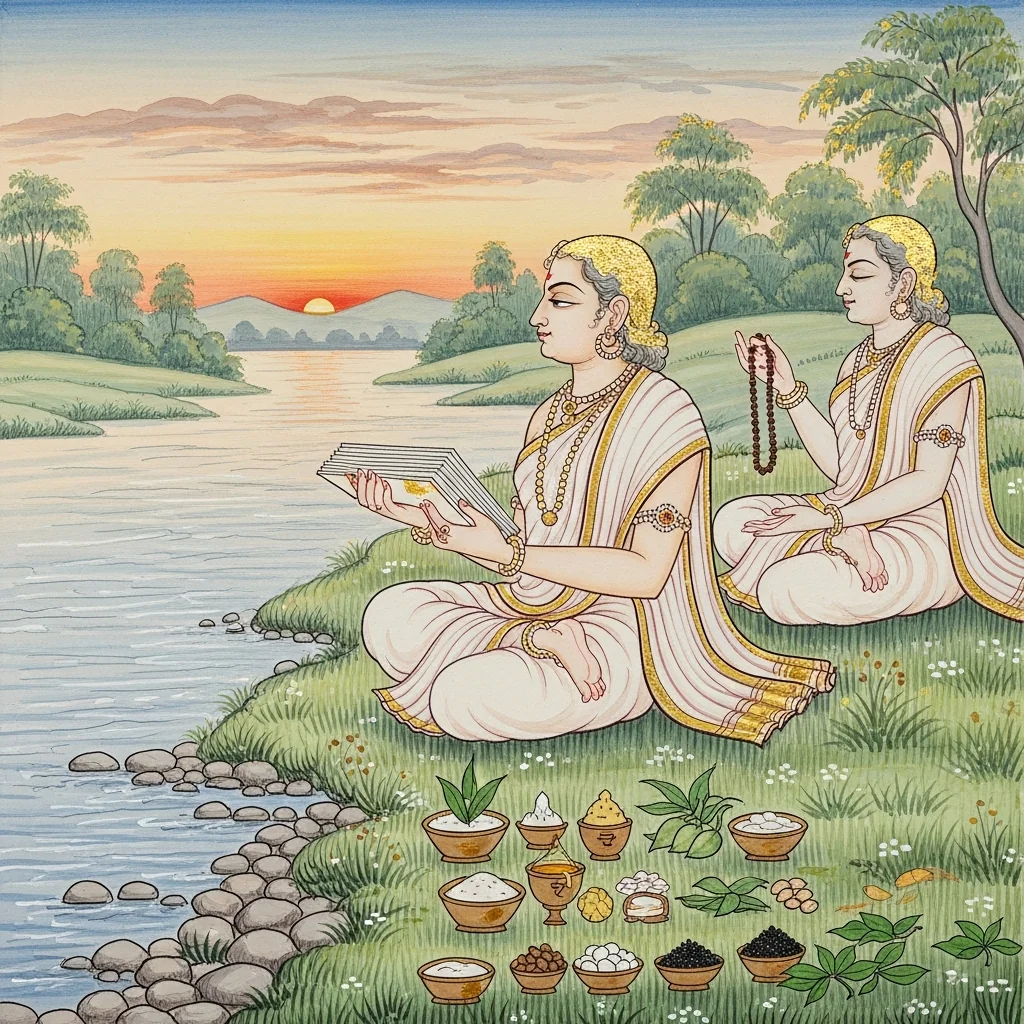
Mārkaṇḍeya describes a sin-destroying puṣkariṇī (sacred tank) to be visited for purification. It lies on the northern bank of the Revā and is declared supremely auspicious, for Divākara—the Sun, revered as vedamūrti, the embodied Veda—abides there continually. The tīrtha’s merit is likened to Kurukṣetra, especially in granting all desired aims (sarvakāma-phala) and in increasing the fruit of gifts (dāna-vṛddhi). The chapter then sets forth the merits of donations and observances: bathing during a solar eclipse and giving dāna properly (including valuables and livestock); gifting gold and silver to brāhmaṇas with merit multiplied over thirteen days; and performing tarpaṇa with sesame-mixed water to satisfy pitṛs and deities. Śrāddha with payasa, honey, and ghee is said to bestow heaven and imperishable benefit upon ancestors, while offerings of grains and fruits (akṣata, badara, bilva, iṅguda, tila) yield inexhaustible results. Its devotional climax is solar worship—bathing, pūjā to Divākara, reciting the Ādityahṛdaya, and Vedic japa (even a single ṛc/yajus/sāman)—which grants comprehensive Vedic fruit, freedom from sins, and access to an exalted realm. Finally, it declares that one who relinquishes life there according to rite attains the supreme station associated with the Sun.
Shlokas
Verse 1
श्रीमार्कण्डेय उवाच । ततः पुष्करिणीं गच्छेत्सर्वपापप्रणाशिनीम् । श्रुते यस्याः प्रभावे तु सर्वपापैः प्रमुच्यते
Śrī Mārkaṇḍeya said: Then one should go to Puṣkariṇī, the destroyer of all sins. Truly, by merely hearing of its power, one is released from every sin.
Verse 2
रेवाया उत्तरे कूले तीर्थं परमशोभनम् । यत्रास्ते सर्वदा देवो वेदमूर्तिर्दिवाकरः
On the northern bank of the Revā is a supremely beautiful tīrtha, where the god Divākara—the Sun, embodied as the Vedas—ever abides.
Verse 3
कुरुक्षेत्रं यथा पुण्यं सार्वकामिकमुत्तमम् । इदं तीर्थं तथा पुण्यं सर्वकामफलप्रदम्
Just as Kurukṣetra is supremely meritorious and fulfills all aims, so too is this tīrtha meritorious, bestowing the fruits of every wish.
Verse 4
कुरुक्षेत्रे यथा वृद्धिर्दानस्य जगतीपते । पुष्करिण्यां तथा दानं वर्धते नात्र संशयः
O lord of the earth, just as gifts given at Kurukṣetra multiply in merit, so too charity offered at Puṣkariṇī increases—of this there is no doubt.
Verse 5
यवमेकं तु यो दद्यात्सौवर्णं मस्तके नृप । पुष्करिण्यां तथा स्थानं यथा स्थानं नरे स्मृतम्
O king, whoever at Puṣkariṇī gives even a single barley-grain, topped with gold, attains that very lofty state remembered as the true ‘station’ of a person.
Verse 6
सूर्यग्रहे तु यः स्नात्वा दद्याद्दानं यथाविधि । हस्त्यश्वरथरत्नादि गृहं गाश्च युगंधरान्
But whoever, at the time of a solar eclipse, bathes there and then gives charity according to rule—elephants, horses, chariots, jewels and the like, houses, and cows fit for the yoke—wins immense merit.
Verse 7
सुवर्णं रजतं वापि ब्राह्मणेभ्यो ददाति यः । त्रयोदश दिनं यावत्त्रयोदशगुणं भवेत्
Whoever gives gold or silver to brāhmaṇas—up to thirteen days of such giving—the merit becomes thirteenfold.
Verse 8
तिलमिश्रेण तोयेन तर्पयेत्पितृदेवताः । द्वादशाब्दे भवेत्प्रीतिस्तत्र तीर्थे महीपते
O king, at that sacred ford one should satisfy the ancestral deities with water mixed with sesame; by that act, the Fathers are pleased for twelve years at that tīrtha.
Verse 9
यस्तत्र कुरुते श्राद्धं पायसैर्मधुसर्पिषा । श्राद्धदो लभते स्वर्गं पित्ःणां दत्तमक्षयम्
Whoever performs śrāddha there, offering pāyasa together with honey and ghee—such a giver of śrāddha attains heaven, and what is given to the Pitṛs becomes imperishable.
Verse 10
अक्षतैर्बदरैर्बिल्वैरिङ्गुदैर्वा तिलैः सह । अक्षयं फलमाप्नोति तस्मिंस्तीर्थे न संशयः
With akṣata (unbroken grains), badara (jujubes), bilva fruits, iṅguda fruits, or with sesame—one attains imperishable fruit at that tīrtha; of this there is no doubt.
Verse 11
तत्र स्नात्वा तु यो देवं पूजयेच्च दिवाकरम् । आदित्यहृदयं जप्त्वा पुनरादित्यमर्चयेत् । स गच्छेत्परमं लोकं त्रिदशैरपि वन्दितम्
Having bathed there, whoever worships the Lord Sun, and after reciting the Āditya-hṛdaya again venerates Āditya, goes to the supreme world, revered even by the gods.
Verse 12
ऋचमेकां जपेद्यस्तु यजुर्वा साम एव च । स समग्रस्य वेदस्य फलमाप्नोति वै नृप
But whoever recites even a single Ṛk, or a Yajus, or indeed a Sāman, truly obtains the fruit of the entire Veda, O king.
Verse 13
यस्त्र्यक्षरं जपेन्मन्त्रं ध्यायमानो दिवाकरम् । आदित्यहृदयं जप्त्वा मुच्यते सर्वपातकैः
Whoever, meditating on the Sun, recites a three-syllabled mantra and also recites the Āditya-hṛdaya, is freed from all sins.
Verse 14
यस्तत्र विधिवत्प्राणांस्त्यजते नृपसत्तम । स गच्छेत्परमं स्थानं यत्र देवो दिवाकरः
O best of kings, whoever there relinquishes life in the prescribed manner attains the supreme abode, where the divine Sun dwells.
Verse 59
। अध्याय
End of the chapter (adhyāya).