Adhyaya 82
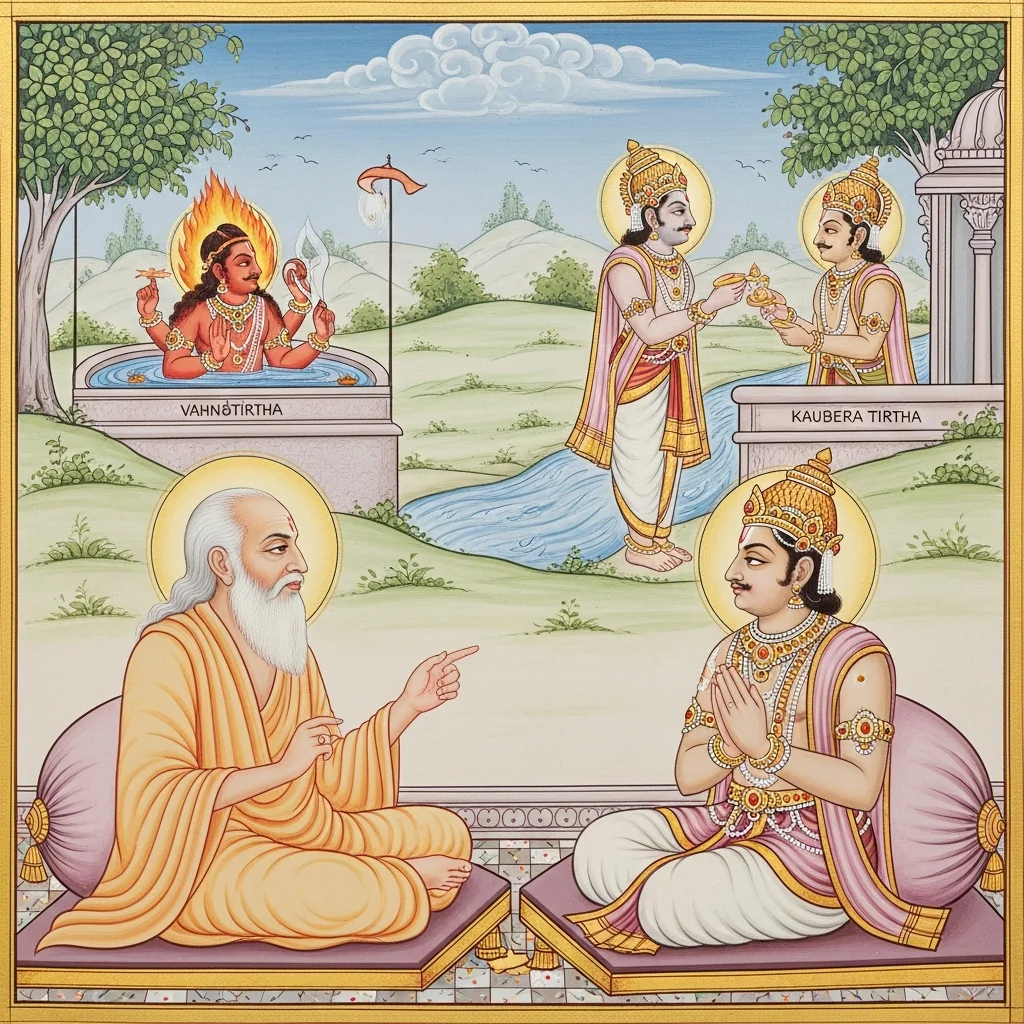
Chapter 82 is a prescriptive tīrtha teaching spoken by Śrī Mārkaṇḍeya to a royal listener. It first directs him to Vahnītīrtha on the bank of the Narmadā, an exceptional place where Hutāśana (Agni) is said to have attained purification after an earlier episode connected with the Daṇḍaka setting. The chapter then sets out rites and their fruits: bathing and worship of Maheśvara, devotional observances, and offerings to pitṛs and deities. A clear phala-logic governs the account, assigning specific rewards to specific acts, including merits held equal to major Vedic sacrifices. It next turns to Kaubera Tīrtha, linked to Kubera’s attainment as lord of the Yakṣas, prescribing bathing, worship of Jagadguru with Umā, and charitable gifts—especially gold to a brāhmaṇa—with stated, measurable merit. The chapter concludes by praising the “Narmadā tīrtha pañcaka,” affirming lofty post-mortem destinations and the enduring sanctity of the Revā even when other waters wane at cosmic dissolution.
Shlokas
Verse 1
श्रीमार्कण्डेय उवाच । ततो गच्छेन्महीपाल वह्नितीर्थमनुत्तमम् । यत्र सिद्धो महातेजास्तपः कृत्वा हुताशनः
Śrī Mārkaṇḍeya said: “Then, O king, one should go to the unsurpassed sacred ford called Vahni-tīrtha, where the blazing Fire (Hutāśana) attained accomplishment after performing austerities.”
Verse 2
सर्वभक्ष्यः कृतो योऽसौ दण्डके मुनिना पुरा । नर्मदातटमाश्रित्य पूतो जातो हुताशनः
“Formerly, in the Daṇḍaka forest, a sage made him ‘one who devours everything’; but by taking refuge on the bank of the Narmadā, Hutāśana became purified.”
Verse 3
तत्र तीर्थे तु यः स्नात्वा पूजयित्वा महेश्वरम् । अग्निप्रवेशं कुरुते स गच्छेदग्निसाम्यताम्
“At that tīrtha, whoever bathes and worships Maheśvara, and then enters fire, attains likeness to Agni.”
Verse 4
भक्त्या स्नात्वा तु यस्तत्र तर्पयेत्पितृदेवताः । अग्निष्टोमस्य यज्ञस्य फलमाप्नोत्यसंशयम्
Whoever bathes there with devotion and offers tarpaṇa to the Pitṛs and the deities attains, without doubt, the fruit of the Agniṣṭoma sacrifice.
Verse 5
तस्यैवानन्तरं राजन्कौबेरं तीर्थमुत्तमम् । कुबेरो यत्र संसिद्धो यक्षाणामधिपः पुरा
Immediately after that, O king, is the excellent Kaubera-tīrtha, where Kubera, lord of the Yakṣas, formerly attained perfection.
Verse 6
तत्र तीर्थे नरः स्नात्वा समभ्यर्च्य जगद्गुरुम् । उमया सहितं भक्त्या सर्वपापैः प्रमुच्यते
At that tīrtha, a person who bathes and devoutly worships the World-Teacher (Śiva) together with Umā is freed from all sins.
Verse 7
तत्र तीर्थे तु यः स्नात्वा दद्याद्विप्राय कांचनम् । नाभिमात्रे जले तिष्ठन्स लभेतार्बुदं फलम्
At that tīrtha, whoever bathes and gives gold to a brāhmaṇa—standing in water up to the navel—obtains the fruit of an arbuda, a vast and innumerable merit.
Verse 8
दधिस्कन्दे मधुस्कन्दे नन्दीशे वरुणालये । आग्नेये यत्फलं तात स्नात्वा तत्फलमाप्नुयात्
At Dadhiskanda, at Madhuskanda, at Nandīśa, and at Varuṇālaya—whatever fruit is declared for the Āgneya rite, dear one, that same fruit is obtained by bathing there.
Verse 9
ते वन्द्या मानुषे लोके धन्याः पूर्णमनोरथाः । यैस्तु दृष्टं महापुण्यं नर्मदातीर्थपञ्चकम्
Worthy of reverence in the human world are they—blessed, their wishes fulfilled—who have beheld the greatly meritorious set of the five Narmadā tīrthas.
Verse 10
ते यान्ति भास्करे लोके परमे दुःखनाशने । भास्करादैश्वरे लोके चैश्वरादनिवर्तके
They go to the realm of Bhāskara (the Sun), the supreme destroyer of sorrow; and from the Sun’s realm to the lordly realm—indeed, to that from which there is no return.
Verse 11
नीयते स परे लोके यावदिन्द्राश्चतुर्दश । ततः स्वर्गाच्च्युतो मर्त्यो राजा भवति धार्मिकः
He is led to the higher worlds for as long as fourteen Indras reign. Then, falling from heaven, he is born among mortals as a righteous king.
Verse 12
सर्वरोगविनिर्मुक्तो भुनक्ति सचराचरम् । विष्णुश्च देवता येषां नर्मदातीर्थसेविनाम्
Freed from every disease, he enjoys prosperity in all that moves and does not move. For those who serve the Narmadā tīrtha, Viṣṇu Himself is the presiding deity.
Verse 13
अखण्डितप्रतापास्ते जायन्ते नात्र संशयः । गङ्गा कनखले पुण्या कुरुक्षेत्रे सरस्वती
They are born with unbroken splendor—of this there is no doubt. The Gaṅgā is holy at Kanakhala, and Sarasvatī is holy at Kurukṣetra.
Verse 14
ग्रामे वा यदि वारण्ये पुण्या सर्वत्र नर्मदा । रेवातीरे वसेन्नित्यं रेवातोयं सदा पिबेत्
Whether in a village or in the forest, the Narmadā is holy everywhere. One should dwell always on the bank of the Revā and continually drink the waters of the Revā.
Verse 15
स स्नातः सर्वतीर्थेषु सोमपानं दिने दिने । गङ्गाद्याः सरितः सर्वाः समुद्राश्च सरांसि च । कल्पान्ते संक्षयं यान्ति न मृता तेन नर्मदा
He is as though he had bathed in all tīrthas, and as though he drank Soma day after day. All rivers beginning with the Gaṅgā, and even oceans and lakes, come to dissolution at the end of an aeon; therefore the Narmadā is not ‘dead’—she does not perish.
Verse 82
। अध्याय
Chapter end (colophon marker/fragment).