Adhyaya 139
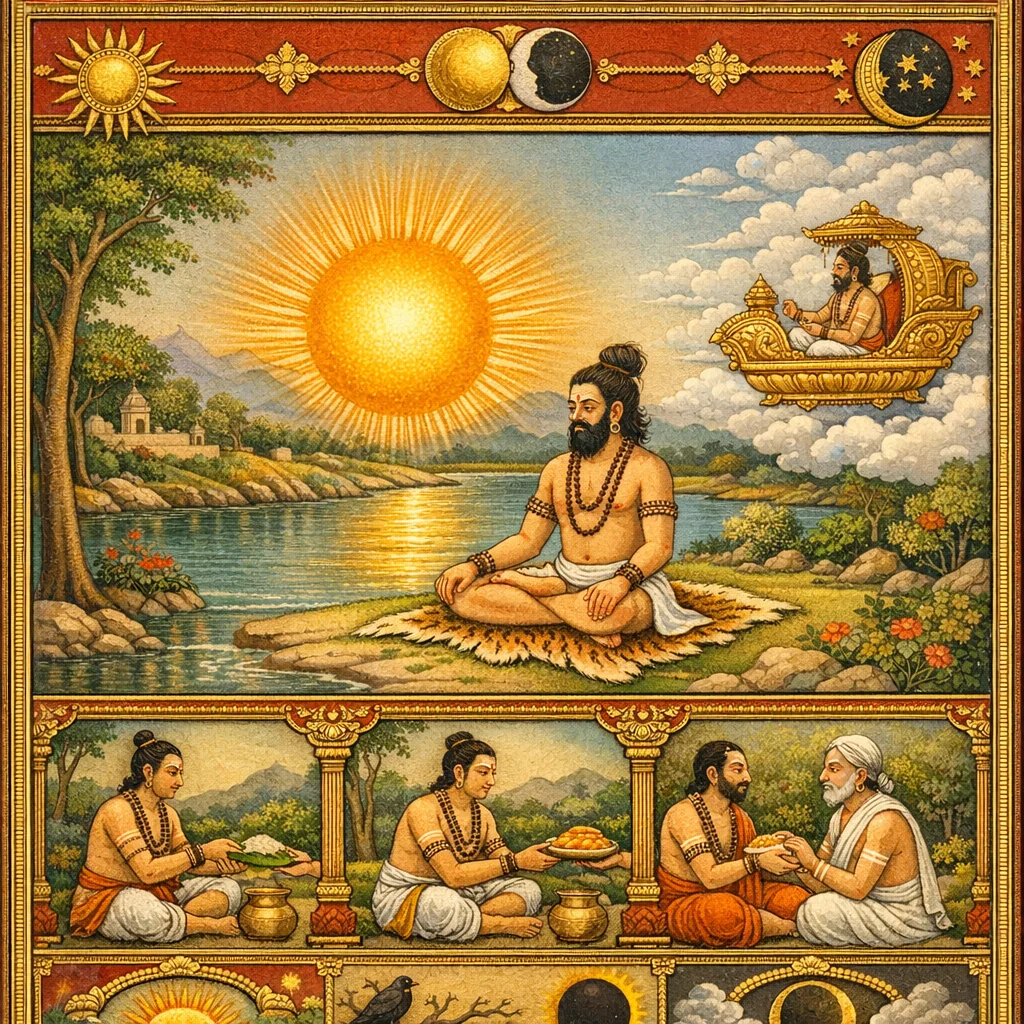
In this chapter, Mārkaṇḍeya gives itinerary-like guidance to Somatīrtha, praised as an unsurpassed sacred ford where Soma performed tapas and attained the heavenly path of the nakṣatras. He lays down a ritual sequence: bathe at the tīrtha, then perform proper ācamana and japa, and conclude with meditation upon Ravi, the Sun. The discourse then states comparative merits, declaring that practice at Somatīrtha yields fruit equal to that ascribed to recitation of the Vedic triad (Ṛg, Yajur, Sāma) and the Gāyatrī. It dwells on dharmic hospitality: feeding Brahmins of defined learning lineages (Bahvṛca, Adhvaryu, Chāndoga; those who have completed study) and giving gifts—footwear, sandals, umbrella, garments, blankets, horses—to leading Brahmins, each act extolled in “koti”-scale merit. It culminates in ascetic ethics: wherever a muni restrains the senses, that place is tantamount to Kurukṣetra, Naimiṣa, and Puṣkara; hence yogins are to be specially honored during eclipses, saṅkrānti, and vyatīpāta. One who undertakes renunciation at this tīrtha is said to ascend to heaven by vimāna, become an attendant of Soma, and share Soma’s celestial felicity.
Shlokas
Verse 1
श्रीमार्कण्डेय उवाच । ततो गच्छेन्महाराज सोमतीर्थमनुत्तमम् । यत्र सोमस्तपस्तप्त्वा नक्षत्रपथमास्थितः
Śrī Mārkaṇḍeya said: “Thereafter, O great king, one should go to the unsurpassed Somatīrtha—where Soma (the Moon), having performed austerities, attained his course among the constellations.”
Verse 2
तत्र तीर्थे तु यः स्नायादाचम्य विधिपूर्वकम् । कृतजाप्यो रविं ध्यायेत्तस्य पुण्यफलं शृणु
At that tīrtha, whoever bathes and then performs ācamana according to rule, having completed japa, should meditate upon Ravi (the Sun). Hear the meritorious fruit that comes from this.
Verse 3
ऋग्वेदयजुर्वेदाभ्यां सामवेदेन भारत । जपतो यत्फलं प्रोक्तं गायत्र्या चात्र तत्फलम्
O Bhārata, whatever fruit is declared for one who recites the Ṛgveda, Yajurveda, and Sāmaveda—here that very fruit is obtained through the recitation of the Gāyatrī as well.
Verse 4
तत्र तीर्थे तु यो भक्त्या ब्राह्मणान् भोजयेच्छुचिः । तेन सम्यग्विधानेन कोटिर्भवति भोजिता
At that tīrtha, whoever—being pure—feeds brāhmaṇas with devotion, by that rite duly performed gains merit as though a koṭi (ten million) had been fed.
Verse 5
पादुकोपानहौ छत्रं वस्त्रकम्बलवाजिनः । यो दत्ते विप्रमुख्याय तस्य तत्कोटिसंमितम्
Whoever gives to an eminent brāhmaṇa sandals and shoes, an umbrella, garments, blankets, or a horse—his merit is reckoned in koṭis, in crores.
Verse 6
सहस्रं तु सहस्राणामनृचां यस्तु भोजयेत् । एकस्य मन्त्रयुक्तस्य कलां नार्हति षोडशीम्
Even if one were to feed thousands upon thousands of brāhmaṇas without Ṛgvedic recitation, it would not equal even one-sixteenth of the merit of feeding a single person endowed with mantra and Vedic mastery.
Verse 7
एवं तु भोजयेत्तत्र बह्वृचं वेदपारगम् । शाखान्तर्गमथाध्वर्युं छन्दोगं वा समाप्तिगम्
Thus, there one should feed a Bahvṛca—an Ṛgvedic specialist who has crossed to the far shore of the Veda; likewise an Adhvaryu of a recognized branch, or a Chāndoga who has completed his study.
Verse 8
अग्निहोत्रसहस्रस्य यत्फलं प्राप्यते बुधैः । समं तद्वेदविदुषा तीर्थे सोमस्य तत्फलम्
The fruit that the wise obtain from performing a thousand Agnihotras—an equal fruit is gained by a knower of the Veda at Soma’s tīrtha; such is the merit of that place.
Verse 9
भोजयेद्यः शतं तेषां सहस्रं लभते नरः । एकस्य योगयुक्तस्य तत्फलं कवयो विदुः
He who feeds a hundred of them gains the fruit of feeding a thousand; yet the sages know that the fruit of feeding a single person endowed with yoga surpasses that measure.
Verse 10
संनिरुध्येन्द्रियग्रामं यत्रयत्र वसेन्मुनिः । तत्रतत्र कुरुक्षेत्रं नैमिषं पुष्कराणि च
Wherever a sage dwells, having restrained the host of senses—there and there are Kurukṣetra, Naimiṣa, and Puṣkara as well.
Verse 11
तस्मात्सर्वप्रयत्नेन ग्रहणे चन्द्रसूर्ययोः । संक्रान्तौ च व्यतीपाते योगी भोज्यो विशेषतः
Therefore, with every effort—especially at lunar and solar eclipses, at the Sun’s saṅkrānti (zodiacal transit), and on the vyatīpāta yoga—a yogin should be fed as a special act of merit.
Verse 12
संन्यासं कुरुते यस्तु तत्र तीर्थे युधिष्ठिर । विमानेन महाभागाः स याति त्रिदिवं नरः
But the man who takes up renunciation (saṃnyāsa) at that sacred ford, O Yudhiṣṭhira—he, greatly fortunate, goes to heaven borne in a celestial chariot (vimāna).
Verse 13
सोमस्यानुचरो भूत्वा तेनैव सह मोदते
Having become an attendant of Soma (the Moon), he rejoices together with him.
Verse 139
। अध्याय
“Chapter” — a manuscript colophon/marker indicating the end or heading of an adhyāya.