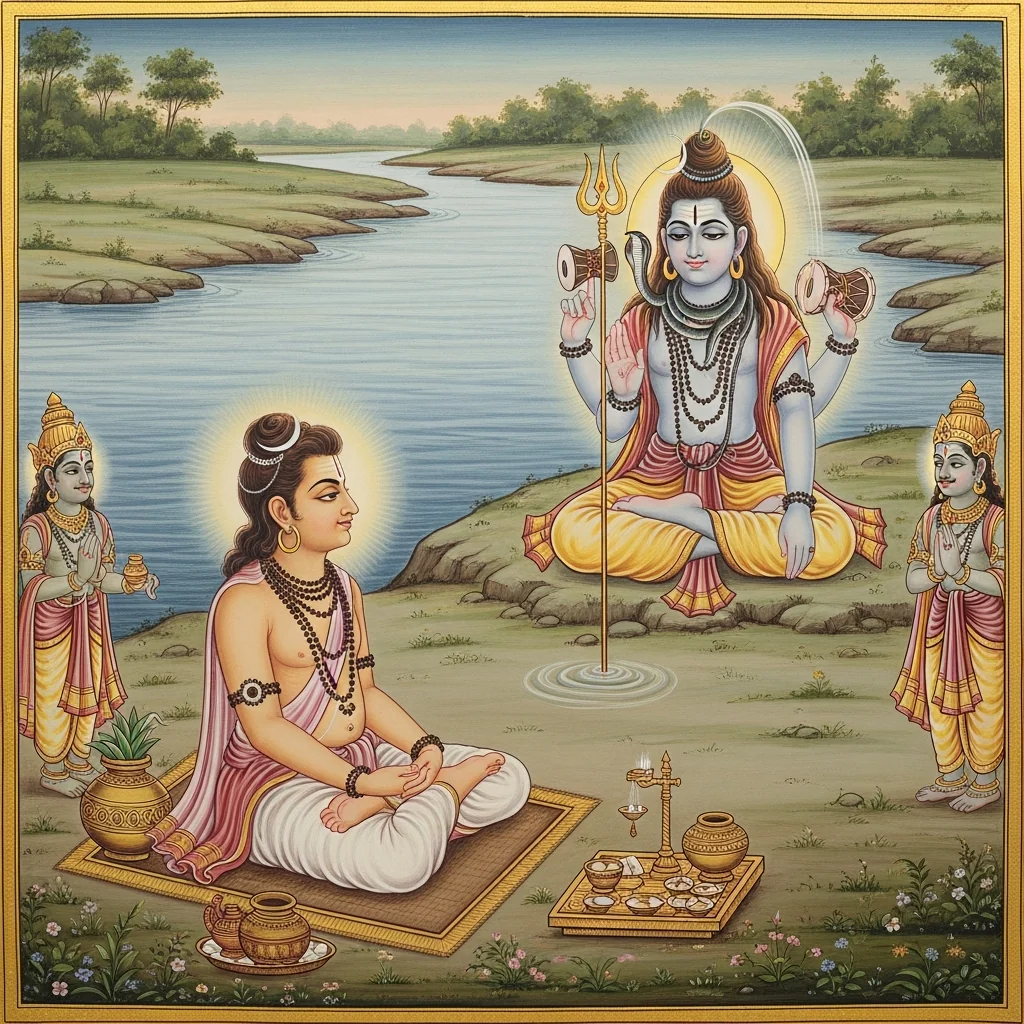
Adhyaya 29
The chapter unfolds as a theological question-and-response. Yudhiṣṭhira asks for a precise account of the Kāverī’s renown and the definite fruits gained by beholding her, touching her, bathing, reciting sacred words, giving gifts, and fasting within her holy sphere. Mārkaṇḍeya replies by extolling the Kāverī–Narmadā confluence as a widely famed tīrtha and confirms its power through an exemplary narrative. Kubera, a mighty yakṣa, performs long, rule-governed austerities at the confluence: he maintains ritual purity, worships Mahādeva (Śiva) with disciplined devotion, and undertakes graded restraints of food and vow—regulated intake, periodic fasting, and severe observances—over an extended time. Śiva appears and grants boons; Kubera asks for lordship over the yakṣas, together with enduring bhakti and a steady orientation toward dharma, and Śiva affirms these requests. The discourse then expands into a phalaśruti-like catalogue: the confluence is praised as sin-destroying and as a gateway to heavenly realms; offerings that benefit the ancestors are emphasized; and merits are compared, even equated, with major sacrifices. A protected sacred ecology is also introduced—kṣetrapālas, guarded yogas of the rivers, and named liṅgas in the Amareśvara region—along with a warning that wrongdoing within the sacred field bears especially weighty consequences. The closing verses reaffirm Kāverī’s exceptional status and her sanctity linked to Rudra’s origin.
Shlokas
Verse 1
युधिष्ठिर उवाच । कावेरीति च विख्याता त्रिषु लोकेषु सत्तम । माहात्म्यं श्रोतुमिच्छामि तस्या मार्कण्ड तत्त्वतः
Yudhiṣṭhira said: O best of the virtuous, the river famed as Kāverī is renowned in the three worlds. O Mārkaṇḍa, I wish to hear her greatness in its true essence.
Verse 2
कीदृशं दर्शनं तस्याः फलं स्पर्शेऽथवा विभो । स्नाने जाप्येऽथवा दान उपवासे तथा मुने
What is the nature of the merit gained by merely beholding her, O Mighty One? And what फल arises from touching her, from bathing, from japa, from charity, and likewise from fasting, O sage?
Verse 3
कथयस्व महाभाग कावेरीसङ्गमे फलम् । धर्मः श्रुतोऽथ दृष्टो वा कथितो वा कृतोऽपि वा
Tell me, O greatly fortunate one, the fruit obtained at the confluence (saṅgama) of the Kāverī. For dharma—whether merely heard of, or seen, or spoken of, or even practiced—
Verse 4
अनुमोदितो वा विप्रेन्द्र पुनातीति श्रुतं मया । यथा धर्मप्रसङ्गे तु मुने धर्मोऽपि जायते
—or even merely approved of: I have heard, O best of brahmins, that it purifies. For, O sage, where dharma is spoken of and engaged in, dharma itself is born within the heart.
Verse 5
स्वर्गश्च नरकश्चैव इत्येवं वैदिकी श्रुतिः
“Heaven and hell”—so indeed declares the Vedic Śruti (revelation).
Verse 6
श्रीमार्कण्डेय उवाच । साधु साधु महाभाग यत्पृष्टोऽहं त्वयाधुना । शृणुष्वैकमना भूत्वा कावेरीफलमुत्तमम्
Śrī Mārkaṇḍeya said: Well said, well said, O noble one, that you have asked me this now. Listen with a single-pointed mind to the supreme fruits bestowed by the Kāverī.
Verse 7
अस्ति यक्षो महासत्त्वः कुबेरोनाम विश्रुतः । सोऽपि तीर्थप्रभावेन राजन्यक्षाधिपोऽभवत्
There is a mighty Yakṣa renowned as Kubera. Even he, O king, by the power of a tīrtha became the lord of the Yakṣas.
Verse 8
तच्छृणुष्व विधानेन भक्त्या परमया नृप । सिद्धिं प्राप्तो महाभाग कावेरीसङ्गमेन तु
Therefore listen, O king, to the proper procedure with supreme devotion. O noble one, (Kubera) attained success and fulfillment indeed through the confluence of the Kāverī.
Verse 9
कावेर्या नर्मदायास्तु सङ्गमे लोकविश्रुते । तत्र स्नात्वा शुचिर्भूत्वा कुबेरः सत्यविक्रमः
At the world-renowned confluence of the Kāverī and the Narmadā, Kubera—whose valor was true—bathed there, and, becoming purified, prepared himself for sacred observance.
Verse 10
विधिवन्नियमं कृत्वा शास्त्रयुक्त्या नरोत्तम । आराधयन्महादेवमेकचित्तः सनातनम्
O best of men, having undertaken disciplined observances in the proper manner and according to scripture, he worshipped Mahādeva—the Eternal—with a single-pointed mind.
Verse 11
एकाहारो वसन्मासं तथा षष्ठाह्नकालिकः । पक्षोपवासी न्यवसत्कंचित्कालं नृपोत्तम
O best of kings, for a month he lived taking only one meal a day; then he ate only at the sixth-day interval; and for some time he remained observing a fortnight-long fast.
Verse 12
मूलशाकफलैश्चान्यं कालं नयति बुद्धिमान् । किंचित्कालं वसंस्तत्र तीर्थे शैवालभोजनः
The wise one passed further time living on roots, greens, and fruits; and for some time, dwelling at that sacred tīrtha, he even subsisted on aquatic moss.
Verse 13
पराकेणानयत्कालं कृच्छ्रेणापि च मानद । चान्द्रायणेन चाप्यन्यमन्यं वाय्वम्बुभोजनः
O giver of honor, he passed time by the Parāka vow and also by the Kṛcchra austerity; and at other times he observed the Cāndrāyaṇa, living on air and water as his sustenance.
Verse 14
एवं तत्र नरश्रेष्ठ कामरागविवर्जितः । स्थितो वर्षशतं साग्रं कर्षयन्स्वं तथा वपुः
Thus, O best of men, free from lust and passion, he remained there for a full hundred years and more, emaciating his body through austerity.
Verse 15
ततो वर्षशतस्यान्ते देवदेवो महेश्वरः । तुष्टस्तु परया भक्त्या तमुवाच हसन्निव
Then, at the end of that hundred years, Maheśvara—the God of gods—being pleased by his supreme devotion, spoke to him as though smiling.
Verse 16
भोभो यक्ष महासत्त्व वरं वरय सुव्रत । परितुष्टोऽस्मि ते भक्त्या तव दास्ये यथेप्सितम्
“O Yakṣa, great-souled one—O you of excellent vows—choose a boon. I am fully pleased with your devotion; I shall grant you whatever you desire.”
Verse 17
यक्ष उवाच । यदि तुष्टोऽसि देवेश उमया सह शङ्कर । अद्यप्रभृति सर्वेषां यक्षाणामधिपो भवे
The Yakṣa said: “If you are pleased, O Lord of the gods, O Śaṅkara together with Umā—then from this day onward let me become the overlord of all Yakṣas.”
Verse 18
अक्षयश्चाव्ययश्चैव तव भक्तिपुरःसरः । धर्मे मतिं च मे नित्यं ददस्व परमेश्वर
“And may I be inexhaustible and undecaying, with devotion to you set foremost; and grant me, O Parameśvara, a constant inclination of mind toward dharma.”
Verse 19
ईश्वर उवाच । यत्त्वया प्रार्थितं सर्वं फलं धर्मस्य तत्तथा । इत्येवमुक्त्वा तं तत्र जगामादर्शनं हरः
Īśvara said: “All that you have prayed for—the full fruit of dharma—shall indeed come to pass.” Having spoken thus to him there, Hara (Śiva) vanished from sight.
Verse 20
सोऽपि स्नात्वा विधानेन संतर्प्य पितृदेवताः । आमन्त्रयित्वा तत्तीर्थं कृतार्थश्च गृहं ययौ
He too, having bathed according to the prescribed rule and having satisfied the Pitṛ-deities with offerings, took leave of that sacred tīrtha and, fulfilled in purpose, went home.
Verse 21
पूजितस्तत्र यक्षैस्तु सोऽभिषिक्तो विधानतः । चकार विपुलं तत्र राज्यमीप्सितमुत्तमम्
There he was honored by the Yakṣas, and duly consecrated according to proper rite; and there he established a vast and excellent kingdom, long desired.
Verse 22
तत्र चान्ये सुराः सिद्धा यक्षगन्धर्वकिंनराः । गणाश्चाप्सरसां तत्र ऋषयश्च तथानघ
There were also other Devas and Siddhas there—Yakṣas, Gandharvas, and Kiṃnaras; hosts of Apsarases too were present, and sages as well, O sinless one.
Verse 23
कावेरीसङ्गमं तेन सर्वपापहरं विदुः । स्वर्गाणामपि सर्वेषां द्वारमेतद्युधिष्ठिर
Therefore the confluence of the Kāverī is known as the remover of all sins; indeed, O Yudhiṣṭhira, it is a gateway even to every heaven.
Verse 24
ते धन्यास्ते महात्मानस्तेषां जन्म सुजीवितम् । कावेरीसङ्गमे स्नात्वा यैर्दत्तं हि तिलोदकम्
Blessed are they—great-souled indeed—and their birth is truly well-lived: those who, having bathed at the Kāverī confluence, offer tilodaka, sesame-water, as a sacred gift and oblation.
Verse 25
दश पूर्वे परे तात मातृतः पितृतस्तथा । पितरः पितामहास्तेन उद्धृता नरकार्णवात्
Ten generations before and ten after, dear one—on the mother’s side and likewise on the father’s—ancestors and forefathers are lifted by that act from the ocean of hell.
Verse 26
तस्मात्सर्वप्रयत्नेन तत्र स्नायीत मानवः । अर्चयेदीश्वरं देवं यदीच्छेच्छाश्वतीं गतिम्
Therefore, with every effort, a person should bathe there; and should worship Lord Īśvara, the Divine—if one desires the eternal path.
Verse 27
कावेरीसङ्गमे राजन्स्नानदानार्चनं नरैः । कृतं भक्त्या नरश्रेष्ठ अश्वमेधाधिकं फलम्
O King, at the confluence of the Kāverī, bathing, giving gifts, and worship performed by people with devotion yield a fruit surpassing even that of the Aśvamedha sacrifice, O best of men.
Verse 28
होमेन चाक्षयः स्वर्गो जपादायुर्विवर्धते । ध्यानतो नित्यमायाति पदं शिवकलात्मकम्
By homa one gains an imperishable heaven; by japa one’s lifespan increases; and by meditation one continually attains the state constituted of Śiva’s divine power (Śiva-kalā).
Verse 29
। अध्याय
Chapter — a heading marker (adhyāya).
Verse 30
अनाशकं तु यः कुर्यात्तस्मिंस्तीर्थे नराधिप । तस्य पुण्यफलं यद्वै तच्छृणुष्व नरोत्तम
O king, whoever undertakes a fast at that sacred ford—listen, O best of men, to the meritorious fruit that truly arises from it.
Verse 31
गन्धर्वाप्सरःसंकीर्णे विमाने सूर्यसन्निभे । वीज्यमानो वरस्त्रीभिर्दैवतैः सह मोदते
In a radiant celestial chariot (vimāna), bright as the sun and filled with Gandharvas and Apsarases, fanned by noble women, he rejoices in the company of the gods.
Verse 32
षष्टिवर्षसहस्राणि षष्टिवर्षशतानि च । क्रीडते रुद्रलोकस्थस्तदन्ते भुवि चागतः
For sixty thousand years, and a further six thousand besides, he sports in Rudra’s world; and when that span is complete, he returns again to the earth.
Verse 33
भोगवान्दानशीलश्च जायते पृथिवीपतिः । आधिशोकविनिर्मुक्तो जीवेच्च शरदां शतम्
He is born as a sovereign of the earth—prosperous and devoted to giving—free from anxiety and grief, and he lives for a hundred autumns.
Verse 34
एवं गुणगणाकीर्णा कावेरी सा सरिन्नृप । त्रिषु लोकेषु विख्याता नर्मदासङ्गमे सदा
Thus, O king, that river Kāverī is filled with hosts of virtues—ever renowned in the three worlds at her confluence with the Narmadā.
Verse 35
जितवाक्कायचित्ताश्च ध्येयध्यानरतास्तथा । कावेरीसङ्गमे तात तेऽपि मोक्षमवाप्नुयुः
Those too—who have conquered speech, body, and mind, and who delight in contemplation and meditation—at the Kāverī confluence, dear one, attain liberation (mokṣa).
Verse 36
शृणु तेऽन्यत्प्रवक्ष्यामि आश्चर्यं नृपसत्तम । त्रिषु लोकेषु का त्वन्या दृश्यते सरिता समा
Listen—now I shall tell you another marvel, O best of kings: in the three worlds, what other river is seen to be her equal?
Verse 37
लब्धं यैर्नर्मदातोयं ये च कुर्युः प्रदक्षिणम् । ये पिबन्ति जलं तत्र ते पुण्या नात्र संशयः
Those who obtain the waters of the Narmadā, those who perform pradakṣiṇā (reverent circumambulation) there, and those who drink the water at that place—such people are filled with merit (puṇya); of this there is no doubt.
Verse 38
न तेषां सन्ततिच्छेदो दश जन्मानि पञ्च च । तेषां पापं विलीयेत हिमं सूर्योदये यथा
For them there is no break in lineage for fifteen births; and their sin melts away, just as frost dissolves at sunrise.
Verse 39
गङ्गायमुनसङ्गे वै यत्फलं लभते नरः । तत्फलं लभते मर्त्यः कावेरीस्नानमाचरन्
Whatever spiritual fruit a person gains at the sacred confluence (saṅgama) of the Gaṅgā and Yamunā, that very same fruit a mortal attains by performing the holy bath in the Kāverī.
Verse 40
भौमे तु भूतजायोगे व्यतीपाते च संक्रमे । राहुसोमसमायोगे तदेवाष्टगुणं स्मृतम्
But when it is Tuesday, and when there is the conjunction called Bhūtajā-yoga, or Vyatīpāta, or a Saṅkrānti (solar transit), or the conjunction of Rāhu and the Moon—then that same merit is remembered to become eightfold.
Verse 41
अशीतिश्च यवाः प्रोक्ता गङ्गायामुनसङ्गमे । कावेरीनर्मदायोगे तदेवाष्टगुणं स्मृतम्
Eighty measures of barley are prescribed as an offering at the confluence (saṅgama) of the Gaṅgā and Yamunā; at the confluence of the Kāverī and Narmadā, that very same (merit) is remembered to be eightfold.
Verse 42
गङ्गा षष्टिसहस्रैस्तु क्षेत्रपालैः प्रपूज्यते । तदर्धैरन्यतीर्थानि रक्षन्ते नात्र संशयः
The Gaṅgā is solemnly revered by sixty thousand kṣetrapālas, guardians of the sacred field. With half that number, other tīrthas are protected—of this there is no doubt.
Verse 43
अमरेश्वरे तु सरितां ये योगाः परिकीर्तिताः । ते त्वशीतिसहस्रैस्तु क्षेत्रपालैस्तु रक्षिताः
But at Amareśvara, the proclaimed confluences of rivers are protected by eighty thousand kṣetrapāla guardians.
Verse 44
तथामरेश्वरे याम्ये लिङ्गं वै चपलेश्वरम् । द्वितीयं चण्डहस्ताख्यं द्वे लिङ्गे तीर्थरक्षके
Likewise, to the south of Amareśvara there is indeed a liṅga called Capaleśvara; and a second named Caṇḍahasta—two liṅgas that protect the holy tīrtha.
Verse 45
शिवेन स्थापिते पूर्वं कावेर्याद्यभिरक्षके । लक्षेण रक्षिता देवी नर्मदा बहुकल्पगा
Formerly, Śiva established these as guardians, beginning with the Kāverī. The goddess Narmadā—flowing on through many ages—has been protected by a hundred thousand (guardians).
Verse 46
धनुषां षष्ट्यभियुतैः पुरुषैरीशयोजितैः । ॐ कारशतसाहस्रैः पर्वतश्चाभिरक्षितः
The mountain too is well guarded by men equipped with sixty bows, appointed by the Lord; and by hundreds of thousands of Oṃkāras, holy presences of the Praṇava.
Verse 47
अन्यदेशकृतं पापमस्मिन् क्षेत्रे विनश्यति । अस्मिंस्तीर्थे कृतं पापं वज्रलेपो भविष्यति
Sin committed in other lands perishes in this sacred kṣetra; but sin committed at this very tīrtha becomes like a coating of diamond—hard to remove and enduring in its consequence.
Verse 48
एषा ते कथिता तात कावेरी सरितां वरा । रुद्रदेहसमुत्पन्ना तेन पुण्या सरिद्वरा
Thus, dear one, I have told you of the Kāverī, the best among rivers. Born from Rudra’s own body, therefore she is supremely holy—the finest of sacred streams.