Adhyaya 1
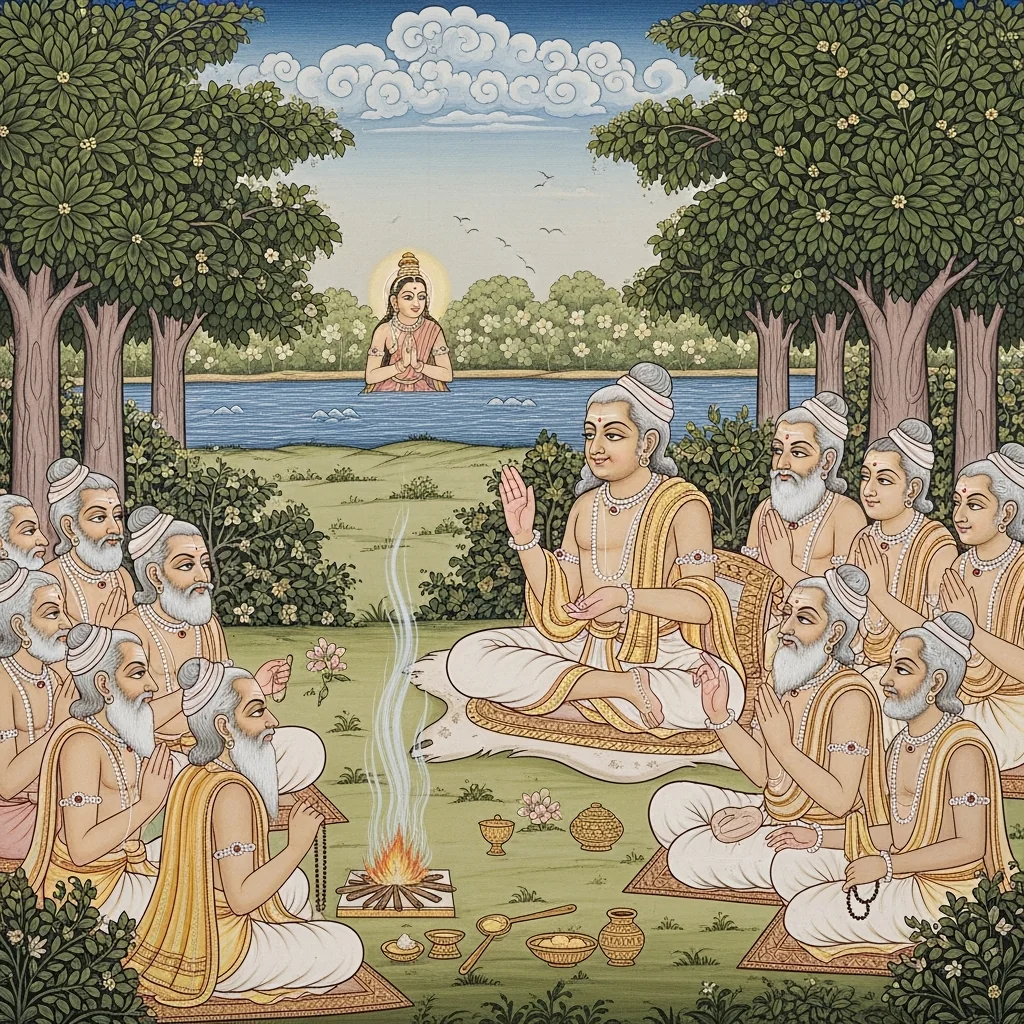
The chapter begins with an invocatory cue and an extended hymn (stuti) praising Revā/Narmadā as the purifier of dūrīta (sin and defilement), revered by gods, sages, and humans, and as a sanctified river whose banks are longed for even by ascetics. The narration then shifts to the Purāṇic frame at Naimiṣa: Śaunaka, seated in the sacrificial assembly, asks Sūta about the “third” great river after Brahmī and Viṣṇu-nadī—identified as the Raudrī river, Revā—requesting her location, her Rudra-linked origin, and the tīrthas associated with her course. Sūta praises the question and offers an epistemic defense of śruti, smṛti, and purāṇa as complementary authorities, presenting purāṇa as a major pramāṇa (often styled the “fifth Veda”) and defining it by the pañcalakṣaṇa. A substantial catalogue follows: the eighteen mahāpurāṇas with their names and verse counts, then a list of upapurāṇas, concluding with a phala statement that recitation or hearing yields vast merit and auspicious posthumous attainment. The chapter thus serves as a prologue—devotional river praise, narrative framing, and an index-like validation for the Revā tīrtha mapping to come.
Shlokas
Verse 1
। अध्याय
“Chapter” (an opening marker in the manuscript indicating the start of a new adhyāya).
Verse 2
ॐ नमः श्रीपुरुषोत्तमाय । ॐ नमः श्रीनर्मदायै । ॐ नमो हरिहरहिरण्यगर्भेभ्यो नमो व्यासवाल्मीकिशुकपराशरेभ्यो नमो गुरुगोब्राह्मणेभ्यः । ॐ मज्जन्मातङ्गगण्डच्युतमदमदिरामोदमत्तालिमालं स्नानैः सिद्धाङ्गनानां कुचयुगविगलत्कुङ्कुमासङ्गपिङ्गम् । सायं प्रातर्मुनीनां कुसुमचयसमाच्छन्नतीरस्थवृक्षं पायाद्वो नर्मदाम्भः करिमकरकराक्रान्तरहंस्तरंगम्
Om—salutations to the auspicious Puruṣottama; Om—salutations to the revered Narmadā (Revā). Salutations to Hari, Hara, and Hiraṇyagarbha; salutations to Vyāsa, Vālmīki, Śuka, and Parāśara; salutations to the Guru, the Cow, and the Brāhmaṇas. May the waters of Narmadā protect you—waters perfumed by the intoxicating ichor streaming from the cheeks of bathing elephants, and tinged with saffron washed from the bosoms of Siddha maidens as they bathe; waters whose riverbank trees are covered with heaps of blossoms gathered by sages at dawn and dusk; waters whose waves are stirred by the hands of elephants and crocodiles, and upon which swans glide.
Verse 3
उभयतटपुण्यतीर्था प्रक्षालितसकलललोकदुरितौघा । देवमुनिमनुजवन्द्या हरतु सदा नर्मदा दुरितम्
May Narmadā—whose two banks are lined with sacred tīrthas, who washes away the flood of sins of all worlds, and who is revered by gods, sages, and humans—ever remove our wrongdoing.
Verse 4
नाशयतु दुरितमखिलं भूतं भव्यं भवच्च भुवि भविनाम् । सकलपवित्रि तव सुधा पुण्यजला नर्मदा भवति
May she destroy every sin of those who dwell upon the earth—whether arising from the past, the future, or the present. O all-purifying one, your nectar-like essence becomes the Narmadā, whose waters are holy.
Verse 5
तटपुलिनं शिवदेवा यस्या यतयोऽपि कामयन्ते वा । मुनिनिवहविहितसेवा शिवाय मम जायतां रेवा
May Revā be for my welfare—she whose riverbanks and sandy shores are desired even by ascetics; she who is served by multitudes of sages; she who is auspicious and devoted to Śiva.
Verse 6
नारायणं नमस्कृत्वा नरं चैव नरोत्तमम् । देवीं सरस्वतीं व्यासं ततो जयमुदीरयेत्
Having bowed to Nārāyaṇa, and also to Nara—the best among men—together with the Goddess Sarasvatī and Vyāsa, one should then proclaim victory for the sacred narration.
Verse 7
नैमिषे पुण्यनिलये नानाऋषिनिषेविते । शौनकः सत्रमासीनः सूत पप्रच्छ विस्तरात्
In Naimiṣa—an abode of holiness, frequented by many sages—Śaunaka, seated in the sacrificial session, questioned the Sūta in detail.
Verse 8
मन्येऽहं धर्मनैपुण्यं त्वयि सूत सदार्चितम् । पुण्यामृतकथावक्ता व्याससशिष्यस्त्वमेव हि
I consider that mastery in Dharma is ever established in you, O Sūta. For you indeed are the teller of nectar-like sacred narratives, and you are a disciple of Vyāsa.
Verse 9
अतस्त्वां परिपृच्छामि धर्मतीर्थाश्रयं कवे । बहूनि सन्ति तीर्थानि बहुशो मे श्रुतानि च
Therefore I question you, O poet who is a refuge of Dharma and tīrthas. Many sacred places exist, and I have heard of many of them again and again.
Verse 10
श्रुता दिव्यनदी ब्राह्मी तथा विष्णुनदी मया । तृतीया न मया क्वापि श्रुता रौद्री सरिद्वरा
I have heard of the divine river of Brahmā, and likewise of the river of Viṣṇu; but nowhere have I heard of a third—the supreme river of Rudra.
Verse 11
तां वेदगर्भां विख्यातां विबुधौघाभिवन्दिताम् । वद मे त्वं महाप्राज्ञ तीर्थपूगपरिष्कृताम्
Tell me, O greatly wise one, of that renowned river—bearing the Vedas within her, revered by hosts of gods, and adorned with multitudes of tīrthas.
Verse 12
कं देशमाश्रिता रेवा कथं श्रीरुद्रसंभवा । तत्संश्रितानि तीर्थानि यानि तानि वदस्व मे
In what land does Revā (Narmadā) abide, and how is she the glorious one born of Rudra? Tell me also of the tīrthas established upon her—whatever they may be.
Verse 13
सूत उवाच । साधु पृष्टं कुलपते चरित्रं नर्मदाश्रितम् । चित्रं पवित्रं दोषघ्नं श्रुतमुक्तं च सत्तम
Sūta said: “Well have you asked, O lord of a noble lineage, about the sacred account connected with Narmadā. It is wondrous, purifying, and a destroyer of faults; fit to be heard and to be proclaimed, O best of the virtuous.”
Verse 14
वेदोपवेदवेदाङ्गादीन्यभिव्यस्य पूरितः । अष्टादशपुराणानां वक्ता सत्यवतीसुतः
“Having fully set forth the Vedas, the Upavedas, the Vedāṅgas, and the rest, Satyavatī’s son (Vyāsa) became the expounder of the eighteen Purāṇas.”
Verse 15
तं नमस्कृत्य वक्ष्यामि पुराणानि यथाक्रमम् । येषामभिव्याहरणादभिवृद्धिर्वृषायुषोः
Having bowed to Him, I shall relate the Purāṇas in due order; by their reverent utterance, righteousness (dharma) and longevity increase.
Verse 16
श्रुतिः स्मृतिश्च विप्राणां चक्षुषी परिकीर्तिते । काणस्तत्रैकया हीनो द्वाभ्यामन्धः प्रकीर्तितः
Śruti and Smṛti are declared to be the two eyes of the learned vipras; one who lacks either is called one-eyed, and one who lacks both is called blind.
Verse 17
श्रुतिस्मृतिपुराणानि विदुषां लोचनत्रयम् । यस्त्रिभिर्नयनैः पश्येत्सोऽंशो माहेश्वरो मतः
Śruti, Smṛti, and the Purāṇas are the three eyes of the wise; one who sees with these three eyes is regarded as a portion of Maheśvara (Śiva).
Verse 18
आत्मनो वेदविद्या च ईश्वरेण विनिर्मिता । शौनकीया च पौराणी धर्मशास्त्रात्मिका च या
The Vedic knowledge, fashioned by the Lord, pertains to the Self’s highest concern; and there is also the Purāṇic tradition associated with Śaunaka, whose very nature is dharma-śāstra.
Verse 19
तिस्रो विद्या इमा मुख्याः सर्वशास्त्रविनिर्णये । पुराणं पञ्चमो वेद इति ब्रह्मानुशासनम्
These three knowledges are primary for determining all śāstras. “The Purāṇa is the fifth Veda”—this is the ordinance of Brahmā.
Verse 20
यो न वेद पुराणं हि न स वेदात्र किंचन । कतमः स हि धर्मोऽस्ति किं वा ज्ञानं तथाविधम्
Truly, one who does not know the Purāṇa knows nothing here. What dharma could such a one truly possess—and what knowledge of that kind?
Verse 21
अन्यद्वा तत्किमत्राह पुराणे यन्न दृश्यते । वेदाः प्रतिष्ठिताः पूर्वं पुराणे नात्र संशयः
What more is there to say here? Whatever is not seen in the Purāṇa is not truly found. The Vedas themselves were first established in the Purāṇa—of this there is no doubt.
Verse 22
बिभेत्यल्पश्रुताद्वेदो मामयं प्रतरिष्यति । इतिहासपुराणैश्च कृतोऽयं निश्चयः पुरा
The Veda is wary of one who has heard only a little, thinking, “This person will misconstrue and overstep me.” Therefore, from ancient times, this settled conclusion was established through Itihāsa and Purāṇa: the Veda must be approached with the support of the sacred narratives and traditions.
Verse 23
आत्मा पुराणं वेदानां पृथगंगानि तानि षट् । यच्च दृष्टं हि वेदेषु तद्दृष्टं स्मृतिभिः किल
The Purāṇa is the very life-breath of the Vedas, while their six limbs stand as distinct auxiliaries. Indeed, whatever is seen in the Vedas is also found, it is said, in the Smṛtis.
Verse 24
उभाभ्यां यत्तु दृष्टं हि तत्पुराणेषु गीयते । पुराणं सर्वशास्त्राणां प्रथमं ब्रह्मणः स्मृतम्
Whatever is discerned in both (Veda and Smṛti), that very teaching is sung in the Purāṇas. The Purāṇa is remembered as the first among all śāstras—originating from Brahmā himself.
Verse 25
अनन्तरं च वक्त्रेभ्यो वेदास्तस्य विनिर्गताः । पुराणमेकमेवासीदस्मिन् कल्पान्तरे मुने
Afterwards, the Vedas issued forth from his mouths. Yet in a former kalpa, O sage, there was only a single Purāṇa.
Verse 26
त्रिवर्गसाधनं पुण्यं शतकोटिप्रविस्तरम् । स्मृत्वा जगाद च मुनीन्प्रति देवश्चतुर्मुखः
Remembering that supremely meritorious Purāṇa—immense, extending to a hundred crores, and a means to accomplish the three aims of life—four-faced Brahmā spoke it to the sages.
Verse 27
प्रवृत्तिः सर्वशास्त्राणां पुराणस्याभवत्ततः । कालेनाग्रहणं दृष्ट्वा पुराणस्य ततो मुनिः
From that Purāṇa, the activity and development of all other śāstras proceeded. Then, seeing that with time the Purāṇa was no longer properly retained and grasped, the sage took steps to preserve it.
Verse 28
व्यासरूपं विभुः कृत्वा संहरेत्स युगे युगे । अष्टलक्षप्रमाणे तु द्वापरे द्वापरे सदा
In every age, the Lord assumes the form of Vyāsa and compiles and arranges it. In each Dvāpara-yuga, its measure is set at eight lakhs.
Verse 29
तदष्टादशधा कृत्वा भूलोकेऽस्मिन् प्रभाष्यते । अद्यापि देवलोके तच्छतकोटिप्रविस्तरम्
Having divided it into eighteen parts, it is proclaimed here in the human world. Even today, in the realm of the gods, it remains vast—extending to a hundred crores in full.
Verse 30
तथात्र चतुर्लक्षं संक्षेपेण निवेशितम् । पुराणानि दशाष्टौ च साम्प्रतं तदिहोच्यते । नामतस्तानि वक्ष्यामि शृणु त्वमृषिसत्तम
Here, in concise form, four lakhs are set down. At present, the eighteen Purāṇas are taught here. Now I shall declare them by name—listen, O best of sages.
Verse 31
सर्गश्च प्रतिसर्गश्च वंशो मन्वन्तराणि च । वंशानुचरितं चैव पुराणं पञ्चलक्षणम्
Creation and re-creation, genealogies, the eras of the Manus, and the chronicles of royal and sage lineages—these five marks define what is called a Purāṇa.
Verse 32
ब्राह्मं पुराणं तत्राद्यं संहितायां विभूषितम् । श्लोकानां दशसाहस्रं नानापुण्यकथायुतम्
There, the Brāhma Purāṇa is declared first, adorned as a complete saṃhitā. It contains ten thousand ślokas and is filled with many narratives that bestow puṇya, sacred merit.
Verse 33
पाद्मं च पञ्चपञ्चाशत्सहस्राणि निगद्यते । तृतीयं वैष्णवंनाम त्रयोविंशतिसंख्यया
The Pādma Purāṇa, too, is said to contain fifty-five thousand (verses). The third is called the Vaiṣṇava Purāṇa, numbering twenty-three thousand (verses).
Verse 34
चतुर्थं वायुना प्रोक्तं वायवीयमिति स्मृतम् । शिवभक्तिसमायोगाच्छैवं तच्चापराख्यया
The fourth, spoken by Vāyu, is remembered as the Vāyavīya. And because it is joined with devotion to Śiva, it is also known by another name as the Śaiva Purāṇa.
Verse 35
चतुर्विंशतिसंख्यातं सहस्राणि तु शौनक । चतुर्भिः पर्वभिः प्रोक्तं भविष्यं पञ्चमं तथा
O Śaunaka, its extent is said to be twenty-four thousand verses. Likewise the Bhaviṣya Purāṇa, the fifth, is taught as consisting of four sections (parvans).
Verse 36
चतुर्दशसहस्राणि तथा पञ्च शतानि तत् । मार्कण्डं नवसाहस्रं षष्ठं तत्परिकीर्तितम्
That (Purāṇa) is said to have fourteen thousand and five hundred verses. The Mārkaṇḍa Purāṇa has nine thousand; it is proclaimed as the sixth.
Verse 37
आग्नेयं सप्तमं प्रोक्तं सहस्राणि तु षोडश । अष्टमं नारदीयं तु प्रोक्तं वै पञ्चविंशतिः
The Āgneya Purāṇa is declared as the seventh, consisting of sixteen thousand verses. The Nāradīya is declared as the eighth, with twenty-five thousand verses.
Verse 38
नवमं भगवन्नाम भागद्वयविभूषितम् । तदष्टादशसाहस्रं प्रोच्यते ग्रन्थसंख्यया
The ninth is called the Bhāgavata, adorned with two parts. Its textual extent is stated to be eighteen thousand verses.
Verse 39
दशमं ब्रह्मवैवर्तं तावत्संख्यमिहोच्यते । लैङ्गमेकादशं ज्ञेयं तथैकादशसंख्यया
The tenth is the Brahmavaivarta, said here to have that same extent (as just stated). The Liṅga Purāṇa should be known as the eleventh, with a count of eleven thousand verses.
Verse 40
भागद्वयं विरचितं तल्लिङ्गमृषिपुंगव । चतुर्विंशतिसाहस्रं वाराहं द्वादशं विदुः
O best of sages, the Liṅga Purāṇa is composed in two parts. The Vārāha Purāṇa, known by the learned as the twelfth, contains twenty-four thousand verses.
Verse 41
विभक्तं सप्तभिः खण्डैः स्कान्दं भाग्यवतां वर । तदेकाशीतिसाहस्रं संख्यया वै निरूपितम्
O best among the fortunate, the Skānda Purāṇa is divided into seven khaṇḍas. Its extent has indeed been determined as eighty-one thousand verses.
Verse 42
ततस्तु वामनं नाम चतुर्दशतमं स्मृतम् । संख्यया दशसाहस्रं प्रोक्तं कुलपते पुरा
Thereafter, the Purāṇa called Vāmana is remembered as the fourteenth; formerly, O lord of the lineage, it was declared to contain ten thousand verses.
Verse 43
कौर्मं पञ्चदशं प्राहुर्भागद्वयविभूषितम् । दशसप्तसहस्राणि पुरा सांख्यपते कलौ
They declare the Kaurma Purāṇa to be the fifteenth, adorned with two parts; in former times—O lord of Sāṅkhya—its extent was said to be seventeen thousand verses in the Kali age.
Verse 44
मात्स्यं मत्स्येन यत्प्रोक्तं मनवे षोडशं क्रमात् । तच्चतुर्दशसाहस्रं संख्यया वदतां वर
The Mātsya Purāṇa, taught by the Fish-incarnation to Manu, is in sequence the sixteenth; its number is fourteen thousand verses, O best among speakers.
Verse 45
गारुडं सप्तदशमं स्मृतं चैकोनविंशतिः । अष्टादशं तु ब्रह्माण्डं भागद्वयविभूषितम्
The Gāruḍa Purāṇa is remembered as the seventeenth; and the Brahmāṇḍa Purāṇa as the eighteenth, adorned with two parts.
Verse 46
तच्च द्वादशसाहस्रं शतमष्टसमन्वितम् । तथैवोपपुराणानि यानि चोक्तानि वेधसा
And that (Brahmāṇḍa Purāṇa) consists of twelve thousand (verses), together with one hundred and eight; likewise there are the Upapurāṇas that were also spoken by the Creator, Brahmā.
Verse 47
इदं ब्रह्मपुराणस्य सुलभं सौरमुत्तमम् । संहिताद्वयसंयुक्तं पुण्यं शिवकथाश्रयम्
This excellent Saura (Upapurāṇa) is readily accessible within the Brahma Purāṇa; it is joined with two saṃhitās, meritorious, and grounded in narratives of Śiva.
Verse 48
आद्या सनत्कुमारोक्ता द्वितीया सूर्यभाषिता । सनत्कुमारनाम्ना हि तद्विख्यातं महामुने
The first saṃhitā was spoken by Sanatkumāra; the second was spoken by Sūrya. Indeed, it is renowned by the name “Sanatkumāra,” O great sage.
Verse 49
द्वितीयं नारसिंहं च पुराणे पाद्मसंज्ञिते । शौकेयं हि तृतीयं तु पुराणे वैष्णवे मतम्
In the Padma Purāṇa, the second (Upapurāṇa) is the Nārasiṃha; and the third is the Śaukeya—so it is held in the Vaiṣṇava Purāṇa tradition.
Verse 50
बार्हस्पत्यं चतुर्थं च वायव्यं संमतं सदा । दौर्वाससं पञ्चमं च स्मृतं भागवते सदा
The fourth is the Bārhaspatya, and the Vāyavya is ever accepted as authoritative; the fifth is the Daurvāsasa, likewise remembered in the Bhāgavata tradition.
Verse 51
भविष्ये नारदोक्तं च सूरिभिः कथितं पुरा । कापिलं मानवं चैव तथैवोशनसेरितम्
In the Bhaviṣya (Purāṇa) it is said to have been spoken by Nārada and formerly recounted by the sages; likewise are mentioned the Kāpila and the Mānava, and also that which was taught by Uśanas.
Verse 52
ब्रह्माण्डं वारुणं चाथ कालिकाद्वयमेव च । माहेश्वरं तथा साम्बं सौरं सर्वार्थसंचयम्
“(These are) the Brahmāṇḍa, the Vāruṇa, and also the two Kālikā; likewise the Māheśvara, the Sāmba, the Saura, and the Sarvārtha-saṃcaya—(thus are named).”
Verse 53
पाराशरं भागवतं कौर्मं चाष्टादशं क्रमात् । एतान्युपपुराणानि मयोक्तानि यथाक्रमम्
“(Then come) the Pārāśara, the Bhāgavata, and the Kaurma—thus, in due order, the eighteen. These Upapurāṇas have been spoken by me, sequentially as they stand.”
Verse 54
पुराणसंहितामेतां यः पठेद्वा शृणोति च । सोऽनन्तपुण्यभागी स्यान्मृतो ब्रह्मपुरं व्रजेत्
“Whoever recites this Purāṇic compendium, or even hears it, becomes a sharer in endless merit; and upon death, he goes to Brahmā’s abode, Brahmapura.”