Adhyaya 151
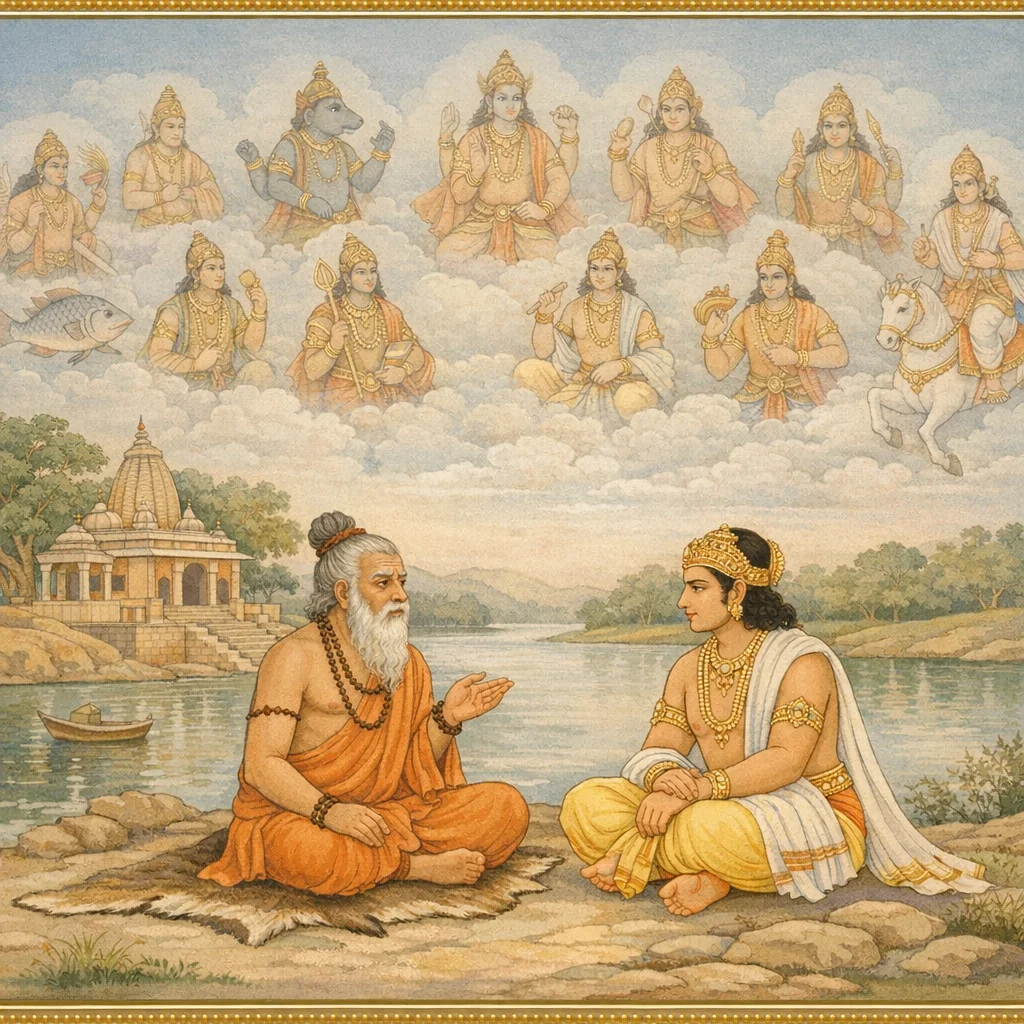
This adhyāya is cast as a dialogue in which Mārkaṇḍeya points out a greatly praised tīrtha on the northern bank of the Narmadā, associated with the name “Jaya-Vārāha.” Bathing there and receiving the darśana of Madhusūdana are said to cleanse sins, with special stress on the power of remembering or reciting the Lord’s ten divine births (daśa-janma). Yudhiṣṭhira then asks what deeds were performed in each of the ten avatāra manifestations, from Matsya to Kalki. Mārkaṇḍeya replies in a compact catalogue: Matsya rescues the submerged Vedas; Kūrma supports the churning of the ocean and steadies the earth; Varāha raises the earth from the nether realm; Narasiṃha destroys Hiraṇyakaśipu; Vāmana subdues Bali through measured strides and cosmic sovereignty; Paraśurāma chastises oppressive kṣatriya rulers and hands the earth to Kaśyapa; Rāma slays Rāvaṇa and restores righteous kingship; Kṛṣṇa descends to remove tyrannical rulers and foretells Yudhiṣṭhira’s success; Buddha is described as a later form that brings social-religious confusion in Kali-yuga; and Kalki is foretold as the tenth birth. The chapter closes by reaffirming that remembrance of the ten births destroys pāpa, weaving tīrtha-māhātmya together with avatāra theology and an ethical warning about decline in the age.
Shlokas
Verse 1
श्रीमार्कण्डेय उवाच । उत्तरे नर्मदाकूले तीर्थं परमशोभनम् । जयवाराहमाहात्म्यं सर्वपापप्रणाशनम्
Śrī Mārkaṇḍeya said: On the northern bank of the Narmadā there is a supremely beautiful tīrtha—the Māhātmya of Jayavārāha—which destroys all sins.
Verse 2
उद्धृता जगती येन सर्वदेवनमस्कृता । लोकानुग्रहबुद्ध्या च संस्थितो नर्मदातटे
He who lifted up the Earth—revered by all the gods—has, out of compassion for the welfare of the worlds, taken his station on the bank of the Narmadā.
Verse 3
तत्र तीर्थे तु यः स्नात्वा वीक्षते मधुसूदनम् । मुच्यते सर्वपापेभ्यो दशजन्मानुकीर्तनात्
Whoever bathes at that tīrtha and beholds Madhusūdana is freed from all sins—even those accumulated and recalled across ten births.
Verse 4
मत्स्यः कूर्मो वराहश्च नरसिंहोऽथ वामनः । रामो रामश्च कृष्णश्च बुद्धः कल्किश्च ते दश
Matsya, Kūrma, and Varāha; then Narasiṃha and Vāmana; Rāma and (Paraśu-)Rāma, Kṛṣṇa, Buddha, and Kalki—these are the ten avatāras.
Verse 5
युधिष्ठिर उवाच । मत्स्येन किं कृतं तात कूर्मेण मुनिसत्तम । वराहेण च किं कर्म नरसिंहेन किं कृतम्
Yudhiṣṭhira said: Revered sir, O best of sages, what did the Lord accomplish as Matsya? What as Kūrma? What deed as Varāha, and what was done as Narasiṃha?
Verse 6
वामनेन च रामेण राघवेण च किं कृतम् । बुद्धरूपेण किं वापि कल्किना किं कृतं वद
What was done as Vāmana, and as Rāma—Rāghava? And what indeed was accomplished in the form of Buddha, and what did Kalki do? Please tell.
Verse 7
एवमुक्तस्तु विप्रेन्द्रो धर्मपुत्रेण धीमता । उवाच मधुरां वाणीं तदा धर्मसुतं प्रति
Thus addressed by the wise son of Dharma, the best of brāhmaṇas then spoke sweet words in reply to that son of Dharma.
Verse 8
श्रीमार्कण्डेय उवाच । मीनो भूत्वा पुरा कल्पे प्रीत्यर्थं ब्रह्मणो विभुः । समर्पयत्समुद्धृत्य वन्दान्मग्नान्महार्णवे
Śrī Mārkaṇḍeya said: Long ago in a former aeon, the Supreme Lord became a Fish; for the satisfaction of Brahmā, he lifted up those Vedas that had sunk in the great ocean and restored them.
Verse 9
अमृतोत्पादने राजन्कूर्मो भूत्वा जगद्गुरुः । मन्दरं धारयामास तथा देवीं वसुंधराम्
O King, at the time of producing the nectar of immortality, the World-Teacher became the Tortoise; he bore Mount Mandara, and likewise supported the goddess Earth.
Verse 10
उज्जहार धरां मग्नां पातालतलवासिनीम् । वाराहं रूपमास्थाय देवदेवो जनार्दनः
Assuming the form of the Boar (Varāha), Janārdana—the God of gods—lifted up the Earth when she had sunk, dwelling in the nether regions of Pātāla.
Verse 11
नरस्यार्द्धतनुं कृत्वा सिंहस्यार्द्धतनुं तथा । हिरण्यकशिपोर्वक्षो विददार नखाङ्कुशैः
Making half His body that of a man and half that of a lion, He tore open Hiraṇyakaśipu’s chest with His hook-like nails.
Verse 12
जटी वामनरूपेण स्तूयमानो द्विजोत्तमैः । तद्दिव्यं रूपमास्थाय क्रमित्वा मेदिनीं क्रमैः
Wearing matted locks and appearing as Vāmana, praised by the best of brāhmaṇas, He then assumed that divine form and strode across the Earth in mighty steps.
Verse 13
कृतवांश्च बलिं पश्चात्पातालतलवासिनम् । स्थापयित्वा सुरान् सर्वान् गतो विष्णुः स्वकं पुरम्
Afterwards, He made Bali a dweller in the regions of Pātāla; and, having firmly re-established all the gods, Viṣṇu returned to His own abode.
Verse 14
जमदग्निसुतो रामो भूत्वा शस्त्रभृतां वरः । क्षत्रियान् पृथिवीपालानवधीद्धैहयादिकान्
Rāma, the son of Jamadagni—becoming the foremost among weapon-bearers—slew the kṣatriya rulers of the earth, such as the Haihayas.
Verse 15
कश्यपाय महीं दत्त्वा सपर्वतवनाकराम् । तपस्तपति देवेशो महेन्द्रेऽद्यापि भारत
Having given the earth—with its mountains, forests, and mines—to Kaśyapa, that Lord of gods still performs austerities on Mount Mahendra even today, O Bhārata.
Verse 16
ततो दाशरथी रामो रावणं देवकण्टकम् । सगणं समरे हत्वा राज्यं दत्त्वा विभीषणे
Then Rāma, son of Daśaratha, slew in battle Rāvaṇa—the thorn in the side of the gods—together with his hosts, and bestowed the kingdom upon Vibhīṣaṇa.
Verse 17
पालयित्वा नयाद्भूमिं मखैः संतर्प्य देवताः । स्वर्गं गतो महातेजा रामो राजीवलोचनः
Having governed the earth with righteous policy, and having satisfied the gods through sacrifices, the radiant lotus-eyed Rāma departed to heaven.
Verse 18
वसुदेवगृहे भूयः संकर्षणसहायवान् । अवतीर्णो जगन्नाथो वासुदेवो युधिष्ठिर
Again, in the house of Vasudeva, the Lord of the universe—Vāsudeva—descended, aided by Saṃkarṣaṇa, O Yudhiṣṭhira.
Verse 19
सोऽवधीत्तव सामर्थ्याद्वधार्थं दुष्टभूभृताम् । चाणूरकंसकेशीनां जरासंधस्य भारत
By your power, O Bhārata, he slew—so as to bring about the destruction of wicked rulers—Cāṇūra, Kaṃsa, Keśin, and Jarāsandha.
Verse 20
तेन त्वं सुसहायेन हत्वा शत्रून्नरेश्वर । भोक्ष्यसे पृथिवीं सर्वां भ्रातृभिः सह संभृताम्
With his strong support, O lord of men, you will slay your enemies and then enjoy the whole earth, well-secured and sustained together with your brothers.
Verse 21
तथा बुद्धत्वमपरं नवमं प्राप्स्यतेऽच्युतः । शान्तिमान्देवदेवेशो मधुहन्ता मधुप्रियः
Likewise, the Unfailing Lord (Acyuta) will attain yet another state—Buddhahood—as the ninth manifestation: peaceful, the God of gods, the slayer of Madhu, and yet the dear one of Madhu, the sweetness of nectar.
Verse 22
तेन बुद्धस्वरूपेण देवेन परमेष्ठिना । भविष्यति जगत्सर्वं मोहितं सचराचरम्
By that God, the Supreme Lord (Paramēṣṭhin), assuming the form of Buddha, the entire world will become deluded—everything, moving and unmoving.
Verse 23
न श्रोष्यन्ति पितुः पुत्रास्तदाप्रभृति भारत । न गुरोर्बान्धवाः शिष्या भविष्यत्यधरोत्तरम्
From that time onward, O Bhārata, sons will not heed their fathers; disciples and even kinsmen will not heed the guru—what is lower will rise above what is higher.
Verse 24
जितो धर्मो ह्यधर्मेण चासत्येन ऋतं जितम् । जिताश्चौरैश्च राजानः स्त्रीभिश्च पुरुषा जिताः
Dharma will be conquered by adharma, and truth (ṛta) will be conquered by falsehood; kings will be overcome by thieves, and men will be overcome by women.
Verse 25
सीदन्ति चाग्निहोत्राणि गुरौ पूजा प्रणश्यति । सीदन्ति मानवा धर्माः कलौ प्राप्ते युधिष्ठिर
Agnihotra rites will decline, worship of the guru will perish, and human codes of dharma will falter when the age of Kali arrives, O Yudhiṣṭhira.
Verse 26
द्वादशे दशमे वर्षे नारी गर्भवती भवेत् । कन्यास्तत्र प्रसूयन्ते ब्राह्मणो हरिपिङ्गलः
In the twelfth—or even the tenth—year, a girl will become pregnant; girls will give birth there. Thus speaks the brāhmaṇa Haripiṅgala.
Verse 27
भविष्यति ततः कल्किर्दशमे जन्मनि प्रभुः
Then the Lord Kalki will arise—in the tenth birth (incarnation).
Verse 28
एतत्ते कथितं राजन्देवस्य परमेष्ठिनः । कारणं दश जन्मनां सर्वपापक्षयंकरम्
Thus, O king, I have told you the cause and account of the Supreme Lord’s ten births, which brings about the destruction of all sins.