Adhyaya 40
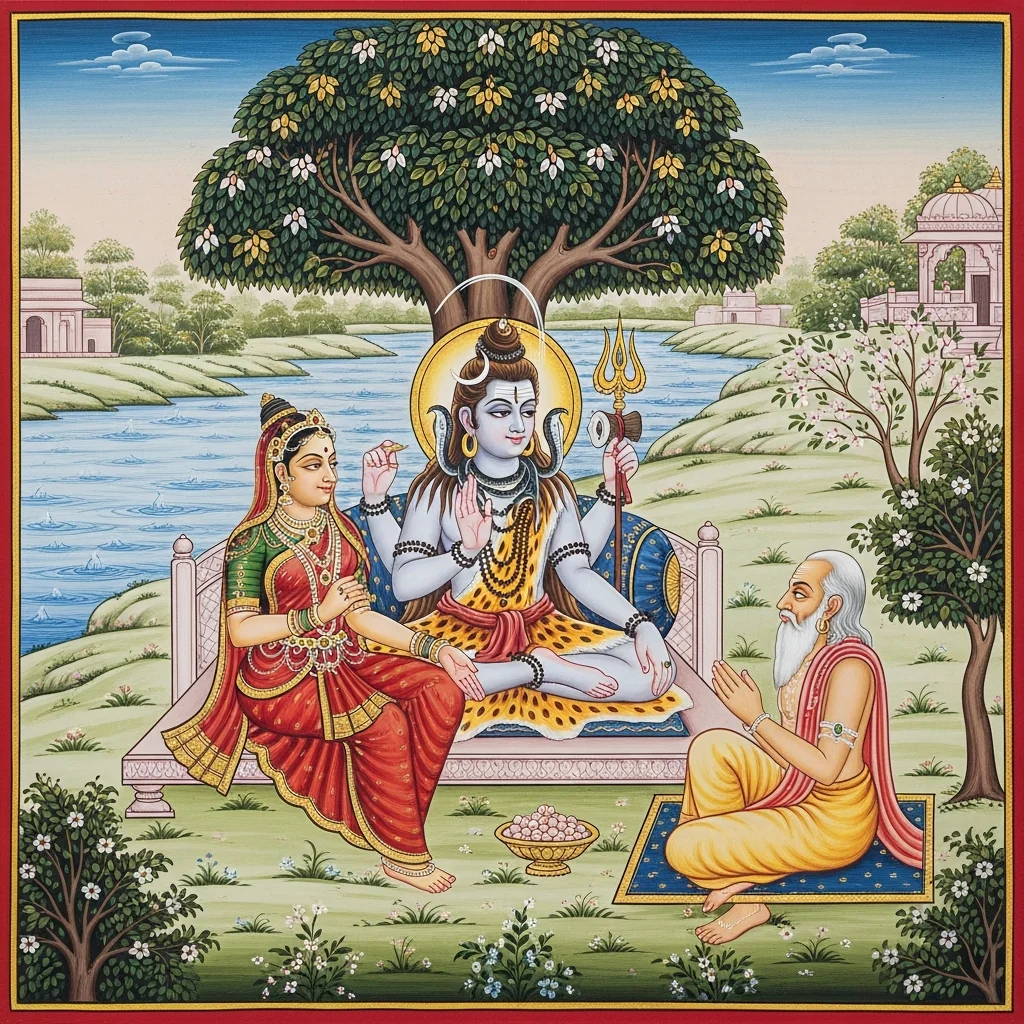
Chapter 40 unfolds as a dialogue in which Mārkaṇḍeya answers Yudhiṣṭhira’s question about an eminent siddha connected with the Karañjeśvara tīrtha. The account is set within primordial genealogy: in the Kṛta-yuga the mind-born sage Marīci is mentioned, followed by Kaśyapa and the lineage framework through Dakṣa’s daughters such as Aditi, Diti, and Danu. From Danu’s line is born a daitya named Karañja, said to bear auspicious marks and to perform severe tapas on the bank of the Narmadā, observing long ascetic disciplines and a regulated diet. Śiva (Tripurāntaka), accompanied by Umā, grants him a boon; Karañja asks that his descendants be inclined toward dharma. After the Lord departs, Karañja establishes a Śiva shrine named after himself—Karañjeśvara. The chapter then offers phalaśruti-style assurances: bathing at the tīrtha removes sins; offerings to ancestors yield merit like an Agniṣṭoma sacrifice; specific austerities (including fasting) lead to Rudra-loka; and death by fire or water at the site is praised as bringing long residence in Śiva’s abode and an auspicious rebirth endowed with learning, health, and prosperity. It concludes by extolling the imperishable merit gained through recitation and hearing, and through reading in the context of śrāddha rites.
Shlokas
Verse 1
श्रीमार्कण्डेय उवाच । ततो गच्छेत्तु राजेन्द्र करञ्जेश्वरमुत्तमम् । यत्र सिद्धो महाभागो दैत्यो लोकेषु विश्रुतः
Śrī Mārkaṇḍeya said: Then, O lord of kings, one should go to the excellent Karañjeśvara, where a greatly fortunate Daitya—renowned in the worlds—attained siddhi.
Verse 2
युधिष्ठिर उवाच । योऽसौ सिद्धो महाभाग तत्र तीर्थे महातपाः । कस्य पुत्रः कथं सिद्धः कस्मिन्काले वद द्विज
Yudhiṣṭhira said: “O greatly fortunate one, that mighty ascetic who became a siddha at that sacred tīrtha—whose son was he? By what means did he attain perfection, and in what time did this occur? Tell me, O brāhmaṇa.”
Verse 3
मार्कण्डेय उवाच । पुरा कृतयुगे राजन्मानसो ब्रह्मणः सुतः । वेदवेदाङ्गतत्त्वज्ञो मरीचिर्नाम नामतः
Mārkaṇḍeya said: “In ancient times, in the Kṛta Yuga, O King, there was one named Marīci—mind-born (mānasa) from Brahmā—who knew the true principles of the Vedas and their Vedāṅgas.”
Verse 4
तस्यापि तपसो राशेः कालेन महतानघ । पुत्रोऽथ मानसो जातः साक्षाद्ब्रह्मेव चापरः
From that very treasury of austerity (tapas), in the course of great time, O sinless one, there was born a mind-born (mānasa) son—another Brahmā, as it were, directly manifest.
Verse 5
क्षमा दमो दया दानं सत्यं शौचमथार्जवम् । मरीचेश्च गुणा ह्येते सन्ति तस्य च भारत
Forbearance, self-restraint, compassion, charity, truthfulness, purity, and straightforwardness—these indeed are the virtues of Marīci, and they were present in him as well, O Bhārata.
Verse 6
एवं गुणगणाकीर्णं कश्यपं द्विजसत्तमम् । ज्ञात्वा प्रजापतिर्दक्षो भार्यार्थे स्वसुतां ददौ
Knowing Kaśyapa—the best of brāhmaṇas—to be thus filled with hosts of virtues, Prajāpati Dakṣa gave him his own daughter in marriage.
Verse 7
अदितिर्दितिर्दनुश्चैव तथाप्येवं दशापराः । यासां पुत्राश्च संजाताः पौत्राश्च भरतर्षभ
Aditi, Diti, and Danu—and likewise ten others besides—O best of the Bharatas; from them were born sons and grandsons, great lineages.
Verse 8
अदितिर्जनयामास पुत्रानिन्द्रपुरोगमान् । जातास्तस्य महाबाहो कश्यपस्य प्रजापतेः
Aditi gave birth to sons led by Indra. These were born of that Prajāpati Kaśyapa, O mighty-armed one.
Verse 9
यैस्तु लोकत्रयं व्याप्तं स्थावरं जङ्गमं महत् । तथान्यस्य महाभागो दनोः पुत्रो व्यजायत
By them the three worlds—great with all that is stationary and moving—were pervaded; and likewise, from another consort there was born a greatly fortunate son of Danu.
Verse 10
सर्वलक्षणसम्पन्नः करञ्जो नाम नामतः । बाल एव महाभाग चचार स महत्तपः
Endowed with every auspicious mark, he was known by the name Karañja. Though still a boy, O noble one, he undertook great austerity.
Verse 11
नर्मदातटमाश्रित्य चातिघोरमनुत्तमम् । दिव्यं वर्षसहस्रं च कृच्छ्रचान्द्रायणं नृप
Resorting to the bank of the Narmadā, O King, he performed an unsurpassed and exceedingly severe discipline—the kṛcchra-cāndrāyaṇa observance—for a thousand divine years.
Verse 12
शाकमूलफलाहारः स्नानहोमपरायणः । ततस्तुष्टो महादेव उमया सहितः किल
Living on vegetables, roots, and fruits, and devoted to bathing rites and fire-offerings, he practiced austerity. Then, it is said, Mahādeva—together with Umā—became pleased.
Verse 13
वरेण छन्दयामास त्रिपुरान्तकरः प्रभुः । भोः करञ्ज महासत्त्व परितुष्टोऽस्मि तेऽनघ
The Lord, the Destroyer of Tripura, sought to gratify him with a boon: “O Karañja, great-souled one, O sinless being—I am pleased with you.”
Verse 14
वरं वृणीष्व ते दद्मि ह्यमरत्वमृते मम
“Choose a boon; I shall grant it to you—except for immortality, which is beyond what I bestow.”
Verse 15
करञ्ज उवाच । यदि तुष्टो महादेव यदि देयो वरो मम । तर्हि पुत्राश्च पौत्राश्च सन्तु मे धर्मवत्सलाः
Karañja said: “If you are pleased, O Mahādeva, and if a boon is to be granted to me, then may my sons and grandsons be devoted lovers of dharma.”
Verse 16
तथेत्युक्त्वा महादेव उमया सहितस्तदा । वृषारूढो गणैः सार्द्धं तत्रैवान्तरधीयत
Saying “So be it,” Mahādeva, accompanied by Umā, then mounted upon the Bull and—together with his gaṇas—vanished right there.
Verse 17
गते चादर्शनं देवे सोऽपि दैत्यो मुदान्वितः । स्वनाम्नात्र महादेवं स्थापयित्वा ययौ गृहम्
When the Deva had departed from sight, that daitya too—filled with joy—established Mahādeva there under his own name, and then went home.
Verse 18
तदाप्रभृति तत्तीर्थं सर्वतीर्थेष्वनुत्तमम् । स्नानमात्रानरस्तत्र मुच्यते सर्वपातकैः
From that time onward, that tīrtha became unsurpassed among all sacred fords. By bathing there alone, a person is freed from every sin.
Verse 19
तत्र तीर्थे तु यः स्नात्वा तर्पयेत्पितृदेवताः । सोऽग्निष्टोमस्य यज्ञस्य फलं प्राप्नोत्यसंशयम्
Whoever bathes at that tīrtha and then offers tarpaṇa to the Pitṛs and the deities attains—without doubt—the fruit of the Agniṣṭoma sacrifice.
Verse 20
अनाशकं तु यः कुर्यात्तस्मिंस्तीर्थे नराधिप । अनिवर्त्या गतिस्तस्य रुद्रलोकं स गच्छति
O king, whoever undertakes a sacred fast at that tīrtha attains an irreversible course; he goes to Rudra’s world.
Verse 21
अथवाग्निजले प्राणान्यस्त्यजेद्धर्मनन्दन । अयुतद्वितयं वस्ते वर्षाणां शिवमन्दिरे
O delight of dharma, or if one relinquishes life in fire or in water, one dwells in Śiva’s abode for twenty thousand years.
Verse 22
ततश्चैव क्षये जाते जायते विमले कुले । वेदवेदाङ्गतत्त्वज्ञः सर्वशास्त्रविशारदः
And when that prior residue is exhausted, one is born in a pure and stainless family—knowing the true purport of the Vedas and the Vedāṅgas, and accomplished in all the śāstras.
Verse 23
राजा वा राजतुल्यो वा जीवेच्च शरदः शतम् । पुत्रपौत्रसमोपेतः सर्वव्याधिविवर्जितः
One becomes a king—or the equal of a king—and lives a full hundred autumns, endowed with sons and grandsons, and free from all diseases.
Verse 24
एवं ते सर्वमाख्यातं पृष्टं यद्यत्त्वयानघ । तीर्थस्य तु फलं तस्य स्नानदानेषु भारत
Thus, O sinless one, I have explained to you everything you asked. And now, O Bhārata, hear the fruit of that tīrtha with regard to bathing and charitable giving.
Verse 25
एतत्पुण्यं पापहरं धन्यं दुःस्वप्ननाशनम् । पठतां शृण्वतां चैव तीर्थमाहात्म्यमुत्तमम्
This supreme tīrtha-māhātmya is meritorious, removes sin, bestows auspiciousness, and destroys evil dreams—for those who recite it and for those who listen to it.
Verse 26
यस्तु श्रावयते श्राद्धे पठेत्पितृपरायणः । अक्षयं जायते पुण्यमित्येवं शङ्करोऽब्रवीत्
But whoever, devoted to the Pitṛs, causes this to be heard at a śrāddha, or recites it—an imperishable store of merit arises. Thus spoke Śaṅkara (Śiva).
Verse 40
। अध्याय
(Here ends the chapter.)