Adhyaya 182
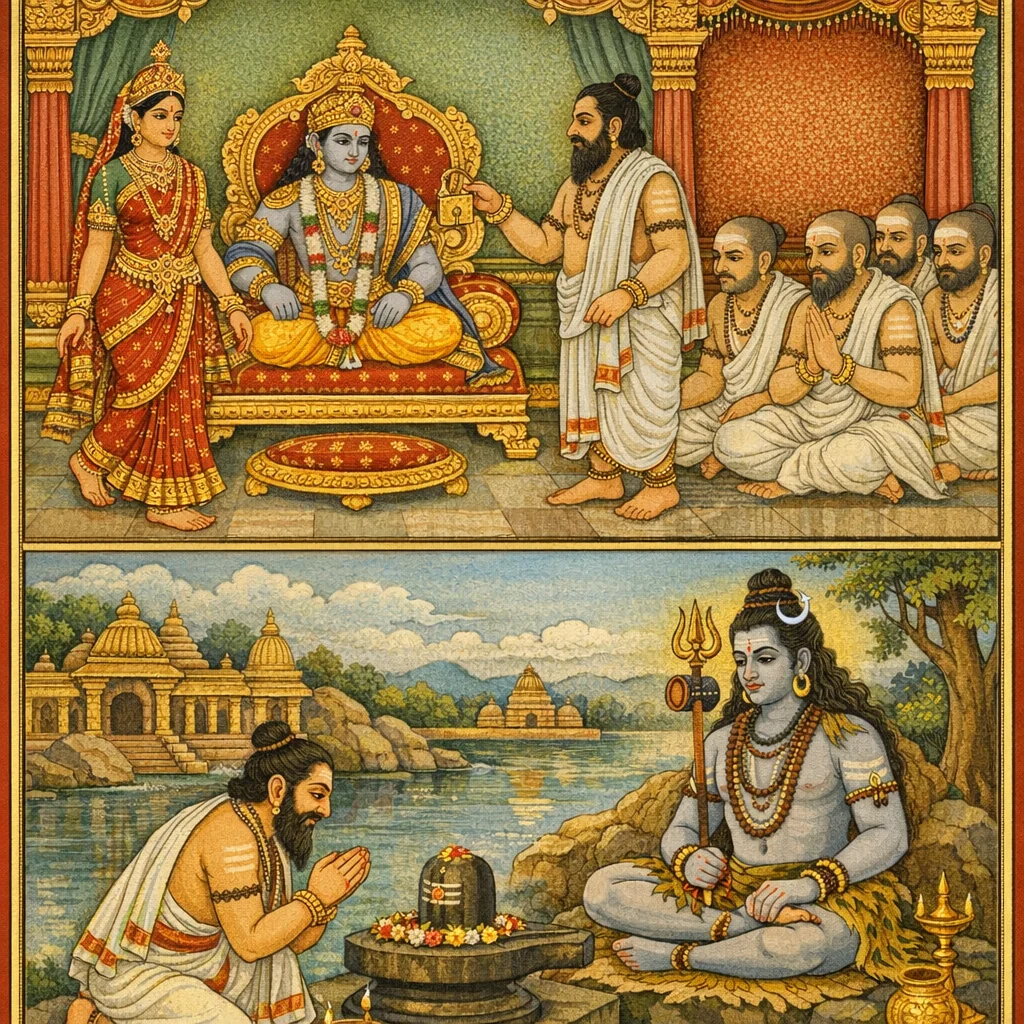
Adhyāya 182, narrated through Mārkaṇḍeya, recounts the origin of Bhṛgukaccha on the northern bank of the Revā. Bhṛgu, accompanied by Śrī/Lakṣmī, approaches the Kūrmāvatāra and seeks permission to found a chāturvidya-based settlement; Kūrma grants assent and foretells a long-enduring city bearing a name connected with him. The kṣetra is then located with auspicious calendrical and astrological detail (Māgha season, favorable lunar conditions) and with topographic markers (north bank, deep waters, association with Koṭitīrtha), followed by a description of varṇa duties within the new community. Conflict arises when Lakṣmī departs for devaloka and entrusts Bhṛgu with a key and lock (kūñcikā-ṭṭāla); upon her return, ownership is disputed. The Brahmins asked to judge remain silent out of fear of Bhṛgu’s anger and propose a procedural rule favoring whoever holds the lock. Lakṣmī responds with a curse that undermines learning, stability, and ethical clarity among the dvijas, blaming greed and the abandonment of truth. Distressed, Bhṛgu propitiates Śaṅkara; Śiva interprets the site as a krodha-sthāna yet assures that future Brahmins will regain learning by divine grace, and he exalts the place as Koṭitīrtha, able to destroy sins. Śiva then declares the rites and merits of the tīrtha: snāna and pūjā yield fruits equal to great sacrifices; tarpaṇa benefits ancestors; abhiṣeka with milk, curd, ghee, and honey grants heavenly residence; gifts and observances during celestial events such as a solar eclipse are praised; and vows, renunciation, even death within the kṣetra lead to auspicious post-mortem outcomes. Śiva proclaims his continual presence there with Ambikā (Soubhāgya-sundarī), while Bhṛgu finally departs for Brahmaloka. The chapter ends by reaffirming the narrative’s purificatory power and its phalaśruti for listeners.
Shlokas
Verse 1
श्रीमार्कण्डेय उवाच । ततो भृगुः श्रिया चैव समेतः कच्छपं गतः । अभिनन्द्य यथान्यायमुवाच वचनं शुभम्
Śrī Mārkaṇḍeya said: Then Bhṛgu, accompanied by Śrī, went to Kacchapa. Having greeted him in the proper manner, he spoke auspicious words.
Verse 2
त्वया धृता धरा सर्वा तथा लोकाश्चराचराः । तथैव पुण्यभावत्वात्स्थितस्तत्र महामते
By you the whole Earth is upheld, and likewise all the worlds—moving and unmoving. And by your holy nature, O great-minded one, you remain firmly established there.
Verse 3
चातुर्विद्यस्य संस्थानं करोमि रमया सह । यदि त्वं मन्यसे देव तदादेशय मां विभो
Together with Ramā, I wish to establish a seat for the fourfold learning. If you approve, O divine one, then command me, O Lord.
Verse 4
कूर्म उवाच । एवमेव द्विजश्रेष्ठ मम नामाङ्कितं पुरम् । भविष्यति महत्कालं ममोपरि सुसंस्थितम्
The Tortoise said: “So indeed, O best of the twice-born, a city bearing my name shall come to be. For a very long time it will remain firmly established above me.”
Verse 5
अचलं सुस्थिरं तात न भीः कार्या सुलोचने । एतच्छ्रुत्वा शुभं वाक्यं कच्छपस्य मुखाच्च्युतम्
“It shall be unmoving and perfectly steady, dear one—O fair-eyed lady, you need not fear.” Hearing these auspicious words that issued from the Tortoise’s mouth…
Verse 6
हृष्टस्तुष्टः श्रिया सार्द्धं पद्मयोनिसुतो भृगुः । अभीचि उदये प्राप्ते कृतकौतुकमङ्गलः
Then Bhṛgu—son of the Lotus-born (Brahmā)—rejoiced and was fully satisfied; together with Śrī (Lakṣmī), when the auspicious moment of Abhīci’s rise arrived, he performed the festive rites of consecration and the auspicious ceremonies.
Verse 7
नन्दने वत्सरे माघे पञ्चम्यां भरतर्षभ । शस्ते तु ह्युत्तरायोगे कुम्भस्थे शशिमण्डले
In the year Nandana, in the month of Māgha, on the fifth lunar day—O bull among the Bharatas—at the auspicious time of the northern course (uttarāyaṇa), with the Moon stationed in Kumbha (Aquarius)…
Verse 8
रेवाया उत्तरे तीरे गम्भीरे चाभिवारुणि । प्रागुदक्प्रवणे देशे कोटितीर्थसमन्वितम्
On the northern bank of the Revā (Narmadā), in a deep and water-abounding tract, in a region sloping toward the east and the waters—endowed with ‘crores of tīrthas’, countless holy fords.
Verse 9
क्रोशप्रमाणं तत्क्षेत्रं प्रासादशतसंकुलम् । अचिरेणैव कालेन तपोबलसमन्वितः । विचिन्त्य विश्वकर्माणं चकार भृगुसत्तमः
That sacred field extended for a krośa and was filled with hundreds of temples. In a short time, endowed with the power of tapas, the excellent sage Bhṛgu, having invoked and contemplated Viśvakarman, caused it to be constructed.
Verse 10
ब्राह्मणा वेदविद्वांसः क्षत्रिया राज्यपालकाः । वैश्या वृत्तिरतास्तत्र शूद्राः शुश्रूषकास्त्रिषु
There the brāhmaṇas were learned in the Vedas; the kṣatriyas protected the realm; the vaiśyas were devoted to their livelihoods; and the śūdras served as attendants to the three higher varṇas.
Verse 11
एवं श्रिया वृतं क्षेत्रं परमानन्दनन्दितम् । निर्मितं भृगुणा तात सर्वपातकनाशनम् । इति भृगुकच्छोत्पत्तिः
Thus the kṣetra, encircled by Śrī—prosperity and auspiciousness—and gladdening supreme bliss, was established by Bhṛgu, dear one, as the destroyer of all sins. Thus ends the account of the origin of Bhṛgukaccha.
Verse 12
मार्कण्डेय उवाच । ततः कालेन महता कस्मिंश्चित्कारणान्तरे । देवलोकं जगामाशु लक्ष्मीरृषिसमागमे
Mārkaṇḍeya said: “Then, after a long time, due to a certain intervening cause, Lakṣmī swiftly went to the world of the gods, at the time of an assembly of sages.”
Verse 13
समर्प्य कुञ्चिकाट्टालं भृगवे ब्रह्मवादिने । पालयस्व यथार्थं वै स्थानकं मम सुव्रत
Handing over the keys and the gate-guardianship to Bhṛgu, the speaker of brahman (true doctrine), she said: “Guard, in full accordance with duty, my abode, O you of excellent vows.”
Verse 14
देवकार्याण्यशेषाणि कृत्वा श्रीः पुनरागता । आजगाम रमा देवी भृगुकच्छं त्वरान्विता
Having completed all the gods’ tasks without remainder, Śrī (Ramā) returned again—swiftly she came to Bhṛgukaccha, filled with urgency.
Verse 15
प्रार्थितं कुञ्चिकाट्टालं स्वगृहं सपरिग्रहम् । भृगुर्यदा तदा पार्थ मिथ्या नास्ति तदा वदत
“The key and the bolt—along with the house as one’s own possession—when Bhṛgu says so, then, O king, declare it then: ‘It is not false.’”
Verse 16
एव विवादः सुमहान्संजातश्च नरेश्वर । ममेति मम चैवेति परस्परसमागमे
Thus, O lord of men, a very great dispute arose, as each party met the other, crying, “Mine! Mine indeed!”
Verse 17
ततः कालेन महता भृगुणा परमर्षिणा । चातुर्विद्यप्रमाणार्थं चकार महतीं स्थितिम्
Then, after a long time, the supreme sage Bhṛgu established a solemn proceeding, intending to set a standard of proof grounded in the fourfold learning.
Verse 18
अस्मदीयं यथा सर्वं नगरं मृगलोचने । चातुर्विद्या द्विजाः सर्वे तथा जानन्ति सुन्दरि
“O doe-eyed beauty, just as this entire city is said to be ours, so do all the dvijas—the twice-born learned in the fourfold knowledge—understand it, O fair one.”
Verse 19
श्रीरुवाच । प्रमाणं मम विप्रेन्द्र चातुर्वण्या न संशयः । मदीयं वा त्वदीयं वा कथयन्तु द्विजोत्तमाः
Śrī said: “O best of Brahmins, the four varṇas are my witnesses—of this there is no doubt. Let the foremost dvijas declare whether it is mine or yours.”
Verse 20
ततः समस्तैर्विबुधैः सम्प्रधार्य परस्परम् । द्विधा तैर्वाक्स्थलं दृष्ट्वा ब्राह्मणा नृपसंहितम्
Then all the learned ones deliberated among themselves; the Brahmins, having examined the case from both sides, rendered a verdict in the king’s assembly.
Verse 21
अष्टादशसहस्राणि नोचुर्वै किंचिदुत्तरम् । अष्टादशसहस्रेषु भृगुकोपभयान्नृप । उक्तं च तालकं हस्ते यस्य तस्येदमुत्तरम्
Eighteen thousand of them spoke no reply at all. And among those eighteen thousand, O king, out of fear of Bhṛgu’s anger, they declared: “The one who holds the bolt in his hand—this is the verdict in his favor.”
Verse 22
एतच्छ्रुत्वा तु सा देवी निगमं नैगमैः कृतम् । क्रोधेन महताविष्टा शशाप द्विजपुंगवान्
Hearing this—this “authoritative ruling” fashioned by the learned—the Goddess, seized by mighty wrath, cursed those eminent Brahmins.
Verse 23
श्रीदेव्युवाच । यस्मात्सत्यं समुत्सृज्य लोभोपहतमानसैः । मदीयं लोपितं स्थानं तस्माच्छृण्वन्तु मे गिरम्
The Goddess Śrī said: “Because, forsaking truth, with minds struck down by greed, you have erased my rightful place—therefore, let them hear my words.”
Verse 24
त्रिपौरुषा भवेद्विद्या त्रिपुरुषं न भवेद्धनम् । न द्वितीयस्तु वो वेदः पठितो भवति द्विजाः
“Learning will endure only for three generations, but wealth will not last even for three men. And, O twice-born, a second Veda will not be studied by you.”
Verse 25
गृहाणि न द्विभौमानि न च भूतिः स्थिरा द्विजाः । पक्षपातेन वो धर्मो न च निःश्रेयभावतः
“Your houses will not be firmly grounded on two levels, nor will your prosperity be steady, O twice-born. Your dharma will proceed by faction and partiality, not with a view to the highest good (niḥśreyasa).”
Verse 26
इष्टो गोत्रजनः कश्चिल्लोभेनावृतमानसः । न च द्वैधं परित्यज्य ह्येकं सत्यं भविष्यति
“Even a beloved kinsman, his mind veiled by greed, will arise. And without abandoning duplicity, a single, steadfast truth will not come to be.”
Verse 27
अद्यप्रभृति सर्वेषामहङ्कारो द्विजन्मनाम् । न पिता पुत्रवाक्येन न पुत्रः पितृकर्मणि
From this day onward, arrogance shall seize all the twice-born. A father will not heed a son’s counsel, nor will a son follow a father’s duties.
Verse 28
अहङ्कारकृताः सर्वे भविष्यन्ति न संशयः । इति शप्त्वा रमादेवी तदैव च दिवं ययौ
All will become driven by ego—of this there is no doubt. Having thus cursed them, Ramā Devī departed at once for heaven.
Verse 29
ततो गतायां वै लक्ष्म्यां देवा ब्रह्मर्षयोऽमलाः । क्रोधलोभमिदं स्थानं तेऽपि चोक्त्वा दिवं ययुः
Then, when Lakṣmī had departed, the stainless gods and brahmarṣis said, “This place is filled with anger and greed,” and they too went to heaven.
Verse 30
गतां दृष्ट्वा ततो देवीमृषींश्चैव तपोधनान् । भृगुश्च परमेष्ठी स विषादमगमत्परम् । प्रसादयामास पुनः शङ्करं त्रिपुरान्तकम्
Seeing that the Goddess had gone, and that the sages rich in austerity had also departed, Bhṛgu, that exalted one, fell into deep sorrow. Then he again sought to propitiate Śaṅkara, the destroyer of Tripura.
Verse 31
तपसा महता पार्थ ततस्तुष्टो महेश्वरः । उवाच वचनं काले हर्षयन् भृगुसत्तमम्
O Pārtha, pleased by great austerity, Maheśvara in due time spoke words that gladdened Bhṛgu, the best of sages.
Verse 32
किं विषण्णोऽसि विप्रेन्द्र किं वा सन्तापकारणम् । मयि प्रसन्नेऽपि तव ह्येतत्कथय मेऽनघ
“Why are you downcast, O best of Brahmins? What is the cause of your distress? Though I am pleased with you, tell Me this, O blameless one.”
Verse 33
भृगुरुवाच । शापयित्वा द्विजान्सर्वान्पुरा लक्ष्मीर्विनिर्गता । अपवित्रमिदं चोक्त्वा ततो देवा विनिर्गताः
Bhṛgu said: “Formerly, after cursing all the twice-born, Lakṣmī departed. Then the gods too departed, declaring, ‘This is impure.’”
Verse 34
ईश्वर उवाच । पुरा मया यथा प्रोक्तं तत्तथा न तदन्यथा । क्रोधस्थानमसंदेहं तथान्यदपि तच्छृणु
Īśvara said: “Just as I declared in former times, so it is—never otherwise. This place is indeed the Seat of Wrath, without doubt; and now hear also another matter concerning it.”
Verse 35
तत्र स्थानसमुद्भूता महद्भयविवर्जिताः । ब्राह्मणा मत्प्रसादेन भविष्यन्ति न संशयः
“There, born of that holy place itself, Brāhmaṇas—freed from great fear—shall arise by My grace; of this there is no doubt.”
Verse 36
वेदविद्याव्रतस्नाताः सर्वशास्त्रविशारदाः । येऽपि ते शतसाहस्रास्त्वरिता ह्यागतास्त्विह
“Those who are learned in the Vedas and disciplines, who have completed vows and sacred baths, and who are expert in all śāstras—even those hundred-thousands have indeed come here in haste.”
Verse 37
अपठस्यापि मूर्खस्य सर्वावस्थां गतस्य च । उत्तरादुत्तरं शक्रो दातुं न तु भृगूत्तम
Even to the unlearned, even to the foolish, and even to one fallen into every condition—Indra cannot grant ever-higher boons; but you, O best of the Bhṛgus, can bestow what is higher still.
Verse 38
कोटितीर्थमिदं स्थानं सर्वपापप्रणाशनम् । अद्यप्रभृति विप्रेन्द्र भविष्यति न संशयः
This place shall be known as Koṭitīrtha, the destroyer of all sins. From this day onward, O foremost of Brāhmaṇas, it shall indeed be so—without doubt.
Verse 39
मत्प्रसादाद्देवगणैः सेवितं च भविष्यति । भृगुक्षेत्रे मृता ये तु कृमिकीटपतंगकाः
By My grace it shall also be frequented and served by hosts of gods. And as for those worms, insects, and flying creatures that die in Bhṛgukṣetra…
Verse 40
वासस्तेषां शिवे लोके मत्प्रसादाद्भविष्यति । वृषखाते नरः स्नात्वा पूजयित्वा महेश्वरम्
By My grace, their dwelling shall be in Śiva’s world. And a man who bathes at Vṛṣakhāta and worships Maheśvara…
Verse 41
सर्वमेधस्य यज्ञस्य फलं प्राप्नोत्यसंशयम् । भृगुतीर्थे नरः स्नात्वा तर्पयेत्पितृदेवताः
…surely attains the fruit of the Sarvamedha sacrifice. Having bathed at Bhṛgutīrtha, a man should offer tarpaṇa to the Pitṛs and the deities.
Verse 42
तस्य ते द्वादशाब्दानि शान्तिं गच्छन्ति तर्पिताः । दधिक्षीरेण तोयेन घृतेन मधुना सह
Thus satisfied, the Pitṛs attain peace for twelve years. (The tarpaṇa may be offered) with water mixed with curd and milk, with ghee, and together with honey.
Verse 43
ये स्नपन्ति विरूपाक्षं तेषां वासस्त्रिविष्टपे । मत्प्रसादाद्द्विजश्रेष्ठ सर्वदेवानुसेवितम्
Those who bathe (and ritually bathe the deity) Virūpākṣa—their abode is in Triviṣṭapa (heaven). By My grace, O best of the twice-born, it is a realm attended by all the gods.
Verse 44
भविष्यति भृगुक्षेत्रं कुरुक्षेत्रादिभिः समम् । मार्तण्डग्रहणे प्राप्ते यवं कृत्वा हिरण्मयम्
Bhṛgukṣetra shall become equal in sanctity to Kurukṣetra and other famed holy fields. When an eclipse of the Sun occurs, one should fashion barley as an offering in gold.
Verse 45
दत्त्वा शिरसि यः स्नाति भृगुक्षेत्रे द्विजोत्तम । अविचारेण तं विद्धि संस्नातं कुरुजाङ्गले
O best of the twice-born, whoever bathes at Bhṛgukṣetra after making the due offering upon the head—know without hesitation that he has truly bathed in Kurujāṅgala (Kurukṣetra).
Verse 46
अहं चैव वसिष्यामि अम्बिका च मम प्रिया । सर्वदुःखापहा देवी नाम्ना सौभाग्यसुन्दरी
I too shall dwell here—together with Ambikā, my beloved. That Goddess, the remover of all sorrows, is renowned by the name Saubhāgyasundarī.
Verse 47
वसिष्यामि तया देव्या सहितो भृगुकच्छके । एवमुक्त्वा स्थितो देवो भृगुकच्छेऽम्बिका तथा
“I shall dwell in Bhṛgukaccha together with that Goddess.” Having spoken thus, the Lord remained in Bhṛgukaccha—and Ambikā too stayed there.
Verse 48
भृगुस्तु स्वपुरं प्रायाद्ब्रह्मघोषनिनादितम् । ऋग्यजुःसामघोषेण ह्यथर्वणनिनादितम्
Then Bhṛgu went to his own city, resounding with Vedic recitation—echoing with the chants of Ṛg, Yajus, and Sāman, and reverberating with Atharvan hymns as well.
Verse 49
तत्र तीर्थे तु यः स्नात्वा वृषमुत्सृजते नरः । स याति शिवसायुज्यमित्येवं शङ्करोऽब्रवीत्
At that tīrtha, the man who bathes and then releases a bull as a sacred gift attains union with Śiva—thus spoke Śaṅkara.
Verse 50
तत्र तीर्थे तु यः स्नात्वा चैत्रे मासि समाचरेत् । दद्याच्च लवणं विप्रे पूज्य सौभाग्यसुन्दरीम्
At that tīrtha, whoever bathes and duly performs the observance in the month of Caitra should give salt in charity to a brāhmaṇa, and worship Saubhāgyasundarī.
Verse 51
गोभूहिरण्यं विप्रेभ्यः प्रीयेतां ललिताशिवौ । न दुःखं दुर्भगत्वं च वियोगं पतिना सह
By giving cows, land, and gold to brāhmaṇas, may Lalitā and Śiva be pleased. Then there will be no sorrow, no ill-fortune, and no separation from one’s husband.
Verse 52
प्राप्नोति नारी राजेन्द्र भृगुतीर्थाप्लवेन च । यस्तु नित्यं भृगुं देवं पश्येद्वै पाण्डुनन्दन
O lord of kings, a woman too attains these blessings by bathing in Bhṛgu-tīrtha. And whoever daily beholds the divine Bhṛgu—O son of Pāṇḍu—
Verse 53
आ ब्रह्मसदनं यावत्तत्रस्थैर्दैवतैः सह । यत्फलं समवाप्नोति तच्छृणुष्व नृपोत्तम
Up to Brahmā’s own abode—together with the deities who dwell there—whatever fruit he attains, listen to that, O best of kings.
Verse 54
सुवर्णशृङ्गीं कपिलां पयस्विनीं साध्वीं सुशीलां तरुणीं सवत्साम् । दत्त्वा द्विजे सर्वव्रतोपपन्ने फलं च यत्स्यात्तदिहैव नूनम्
Having gifted to a Brāhmaṇa—one endowed with all sacred observances—a tawny cow with golden horns, rich in milk, gentle, well-natured, youthful, and with her calf, whatever merit arises from that gift is surely obtained here itself.
Verse 55
समाः सहस्राणि तु सप्त वै जले म्रियेल्लभेद्द्वादशवह्निमध्ये । त्यजंस्तनुं शूरवृत्त्या नरेन्द्र शक्रातिथ्यं याति वै मर्त्यधर्मा
O king, a mortal who, following the warrior’s dharma, gives up the body—whether by dying in water for seven thousand years, or amid twelve fires—attains the honor of being a guest of Śakra (Indra).
Verse 56
आख्यानमेतच्च सदा यशस्यं स्वर्ग्यं धन्यं पुत्र्यमायुष्यकारि । शृण्वंल्लभेत्सर्वमेतद्धि भक्त्या पर्वणि पर्वण्याजमीढस्सदैव
This sacred narrative is ever fame-giving, heaven-bestowing, auspicious, granting progeny, and increasing longevity. One who listens to it with devotion—especially at festival times and sacred occasions—indeed gains all these fruits, O descendant of Ajamīḍha.
Verse 57
संन्यासं कुरुते यस्तु भृगुतीर्थे विधानतः । स मृतः परमं स्थानं गच्छेद्वै यच्च दुर्लभम्
Whoever, in due observance, undertakes saṃnyāsa at Bhṛgutīrtha, upon death attains that supreme abode which is hard to obtain.
Verse 58
एतच्छ्रुत्वा भृगुश्रेष्ठो देवदेवेन भाषितम् । प्रहृष्टवदनो भूत्वा तत्रैव संस्थितो द्विजः
Hearing these words spoken by the God of gods, the foremost of the Bhṛgus became radiant with joy and remained there, that twice-born sage.
Verse 59
तिरोभावं गते देवे भृगुः श्रेष्ठो द्विजोत्तमः । स्वमूर्ति तत्र मुक्त्वा तु ब्रह्मलोकं जगाम ह
When the deity vanished from sight, that excellent Bhṛgu, foremost among the twice-born, casting off his bodily form there, went to Brahmaloka.
Verse 60
भृगुकच्छस्य चोत्पत्तिः कथिता तव पाण्डव । संक्षेपेण महाराज सर्वपामप्रणाशनी
O Pāṇḍava, O great king, the origin of Bhṛgukaccha has been told to you in brief—a sacred account that destroys every sin and affliction.
Verse 61
एतत्पुण्यं पापहरं क्षेत्रं देवेन कीर्तितम् । चतुर्युगसहस्रेण पितामहदिनं स्मृतम्
This holy, sin-destroying kṣetra has been proclaimed by the Deva; and a ‘day of Pitāmaha (Brahmā)’ is remembered as consisting of a thousand cycles of the four yugas.
Verse 62
प्राप्ते ब्रह्मदिने विप्रा जायते युगसम्भवः । न पश्यामि त्विदं क्षेत्रमिति रुद्रः स्वयं जगौ
O Brāhmaṇas, when Brahmā’s day arrives, the yugas arise anew; yet Rudra himself proclaimed: “Even then, this sacred kṣetra does not vanish from my sight.”
Verse 63
यः शृणोति त्विदं भक्त्या नारी वा पुरुषोऽपि वा । स याति परमं लोकमिति रुद्रः स्वयं जगौ
Whoever hears this with devotion—whether woman or man—attains the supreme world; thus Rudra himself proclaimed.
Verse 64
देवखाते नरः स्नात्वा पिण्डदानादिसत्क्रियाम् । यां करोति नृपश्रेष्ठ तामक्षयफलां विदुः
O best of kings, whatever meritorious rite a man performs—such as offering piṇḍas and other sacred observances—after bathing at Devakhāta is known to yield imperishable fruit.
Verse 65
य इमं शृणुयाद्भक्त्या भृगुकच्छस्य विस्तरम् । कोटितीर्थफलं तस्य भवेद्वै नात्र संशयः
Whoever, with devotion, listens to this detailed account of Bhṛgukaccha gains merit equal to that of millions of tīrthas; of this there is no doubt.
Verse 182
अध्याय
Chapter (heading/marker).