Adhyaya 220
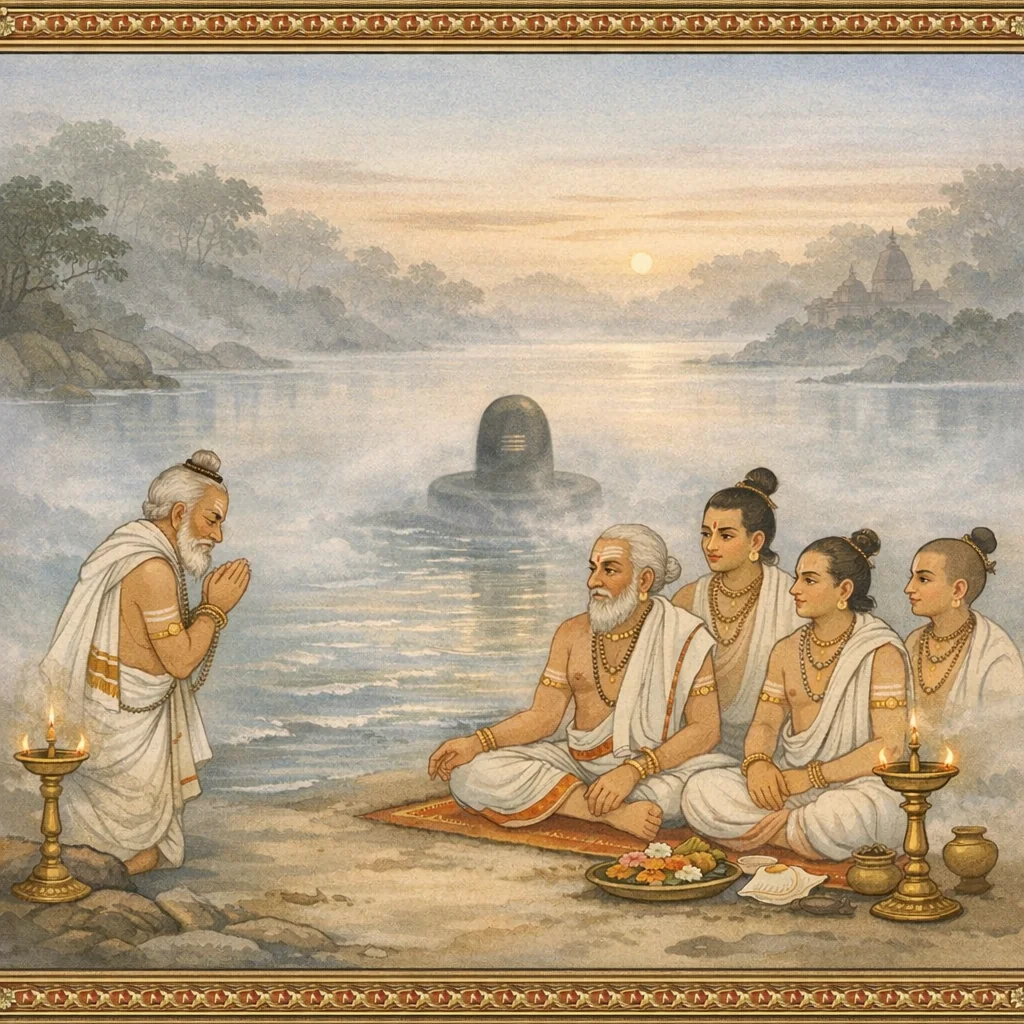
Mārkaṇḍeya directs the royal listener to Lotaneśvara, praised as the supreme Śaiva tīrtha on the northern bank of the Narmadā (Revā), where darśana and worship dissolve accumulated wrongdoing, even from many births. Yudhiṣṭhira, awed by the Narmadā’s purifying power, asks for the single most eminent tīrtha that grants the fruit of all tīrthas. The reply centers on the Revā–Sāgara saṅgama: the ocean is portrayed as reverently receiving the river, and a liṅga is said to arise within the sea, joining Narmadā’s sanctity to liṅga-origin teaching. The chapter then lays out the observance: Kārttika vrata (especially caturdaśī fasting), bathing in the Narmadā, tarpaṇa and śrāddha, night vigil (jāgaraṇa) with Lotaneśvara pūjā, and a morning rite with mantras to invite the ocean and for bathing. A distinctive ethical “test” follows: after bathing, the pilgrim “rolls/turns” (luth-) to discern whether one bears pāpa-karmā or dharma-karmā, then makes a confession-like declaration of past misdeeds before learned brāhmaṇas and lokapāla representations, bathes again, and performs śrāddha properly. The phalaśruti promises Aśvamedha-equivalent merit for saṅgama snāna with Lotaneśvara worship, vast heavenly reward through dāna and śrāddha, and liberation-oriented attainment of Rudra-loka for devoted hearing and recitation.
Shlokas
Verse 1
श्रीमार्कण्डेय उवाच । ततो गच्छेद्धराधीश लोटणेश्वरमुत्तमम् । उत्तरे नर्मदाकूले सर्वपातकनाशनम्
Śrī Mārkaṇḍeya said: Then, O lord of the earth, one should go to the excellent Loṭaṇeśvara on the northern bank of the Narmadā, the destroyer of all sins.
Verse 2
तत्क्षणादेव तत्सर्वं सप्तजन्मार्जितं त्वघम् । नश्यते देवदेवस्य दर्शनादेव तन्नृप
In that very moment, O king, all sin amassed through seven births is destroyed by the mere darśana of the God of gods.
Verse 3
बाल्यात्प्रभृति यत्पापं यौवने चापि यत्कृतम् । तत्सर्वं विलयं याति देवदेवस्य दर्शनात्
Whatever sin was committed from childhood onward, and whatever was done in youth as well—all of it dissolves through the darśana of the God of gods.
Verse 4
युधिष्ठिर उवाच । आश्चर्यभूतं लोकेषु नर्मदाचरितं महत् । त्वया वै कथितं विप्र सकलं पापनाशनम्
Yudhiṣṭhira said: Wondrous among the worlds is the great sacred account of the Narmadā. O brāhmaṇa, you have indeed narrated it as wholly destructive of sin.
Verse 5
यदेकं परमं तीर्थं सर्वतीर्थफलप्रदम् । श्रोतुमिच्छामि तत्सर्वं दयां कृत्वा वदाशु मे
That one supreme tīrtha which grants the fruit of all tīrthas—I wish to hear of it in full. Out of compassion, tell me quickly.
Verse 6
ये केचिद्दुर्लभाः प्रश्नास्त्रिषु लोकेषु सत्तम । त्वत्प्रसादेन ते सर्वे श्रुता मे सह बान्धवैः
Whatever questions are difficult to obtain in the three worlds, O best of the good—by your grace I have heard them all, together with my kinsmen.
Verse 7
एतमेकं परं प्रश्नं सर्वप्रश्नविदां वर । श्रुत्वाहं त्वत्प्रसादेन यत्र यामि सबान्धवः
This is the one supreme question, O best among those who know the answers to all questions—by your grace, having heard it, to what state, or to what place, shall I go together with my kinsmen?
Verse 8
श्रीमार्कण्डेय उवाच । साधुसाधु महाप्राज्ञ यस्य ते मतिरीदृशी । दुर्लभं त्रिषु लोकेषु तस्य ते नास्ति किंचन
Śrī Mārkaṇḍeya said: Well done, well done, O greatly wise one—since your understanding is of this kind, there is nothing in the three worlds that is unattainable for you.
Verse 9
धर्ममर्थं च कामं च मोक्षं च भरतर्षभ । काले काले च यो वेत्ति कर्तव्यस्तेन धीमता
O bull among the Bhāratas, the wise one is he who knows, at the proper times, dharma, artha, kāma, and mokṣa, and accordingly performs what ought to be done.
Verse 10
तस्मात्ते सम्प्रवक्ष्यामि प्रश्नस्यास्योत्तरं शुभम् । यच्छ्रुत्वा सर्वपापेभ्यो मुच्यन्ते भुवि मानवाः
Therefore I shall now declare to you the auspicious answer to this question—hearing it, people upon the earth are freed from all sins.
Verse 11
नर्मदा सरितां श्रेष्ठा सर्वतीर्थमयी शुभा । विशेषः कथितस्तस्या रेवासागरसङ्गमे
Narmadā is the foremost of rivers—auspicious and embodying all tīrthas. Her special greatness is proclaimed at the confluence where Revā (Narmadā) meets the ocean.
Verse 12
आगच्छन्तीं नृपश्रेष्ठ दृष्ट्वा रेवां महोदधिः । प्रणम्य च पुनर्देवीं सङ्गमे रेवया सह
O best of kings, seeing Revā (Narmadā) approaching, the great ocean bowed in reverence; and again, at the confluence, he saluted the Goddess together with Revā.
Verse 13
संचिन्त्य मनसा केयमिति मां वै सरिद्वरा । ज्ञात्वा संचिन्त्य मनसा रेवां लिङ्गोद्भवां पराम्
The best of rivers pondered in his mind, ‘Who is this?’ And then, reflecting, he came to know Revā as the supreme one—born from the (Śiva-)liṅga.
Verse 14
लुठन्वै सम्मुखस्तात गतो रेवां महोदधिः । समुद्रे नर्मदा यत्र प्रविष्टास्ति महानदी
Rolling and coming forward, dear one, the great ocean went out to meet Revā—there where the mighty river Narmadā enters the sea.
Verse 15
तत्र देवाधिदेवस्य समुद्रे लिङ्गमुत्थितम् । लिङ्गोद्भूता महाभागा नर्मदा सरितां वरा
There, in the ocean, a liṅga of the God of gods arose. From that liṅga was born the greatly fortunate Narmadā—the best among rivers.
Verse 16
लयं गता तत्र लिङ्गे तेन पुण्यतमा हि सा । नर्मदायां वसन्नित्यं नर्मदाम्बु पिबन्सदा । दीक्षितः सर्वयज्ञेषु सोमपानं दिने दिने
There she merged into that liṅga; therefore she is indeed most holy. One who dwells always by the Narmadā and continually drinks Narmadā’s water is regarded as initiated for all sacrifices—drinking Soma day after day (in merit).
Verse 17
सङ्गमे तत्र यः स्नात्वा लोटणेश्वरमर्चयेत् । सोऽश्वमेधस्य यज्ञस्य फलं प्राप्नोति मानवः
Whoever bathes at that sacred confluence and worships Loṭaṇeśvara attains the fruit of the Aśvamedha sacrifice.
Verse 18
वाचिकं मानसं पापं कर्मणा यत्कृतं नृप । लोटणेश्वरमासाद्य सर्वं विलयतां व्रजेत्
O king, whatever sin has been committed—by speech, by mind, or by deed—upon reaching Loṭaṇeśvara, all of it dissolves away.
Verse 19
कार्त्तिक्यां तु विशेषेण कथितं शङ्करेण तु । तच्छृणुष्व नृपश्रेष्ठ सर्वपापापनोदनम्
This observance, taught with special emphasis for the month of Kārttikī by Śaṅkara Himself—listen, O best of kings, to that which removes all sins.
Verse 20
सम्प्राप्तां कार्त्तिकीं दृष्ट्वा गत्वा तत्र नृपोत्तम । चतुर्दश्यामुपोष्यैव स्नात्वा वै नर्मदाजले
When Kārttikī has arrived, O best of kings, one should go there; and on the fourteenth lunar day, fasting, one should bathe in the waters of the Narmadā.
Verse 21
संतर्प्य पितृदेवांश्च श्राद्धं कृत्वा यथाविधि । रात्रौ जागरणं कुर्यात्सम्पूज्य लोटणेश्वरम्
Having satisfied the ancestors and the gods, and having performed śrāddha according to rule, one should keep night-long vigil, duly worshipping Loṭaṇeśvara.
Verse 22
सफलं जीवितं तस्य सफलं तस्य चेष्टितम् । पङ्गवस्ते न सन्देहो जन्म तेषां निरर्थकम्
Fruitful is the life of that person; fruitful too are that person’s endeavors. But those who remain crippled in devotion—without doubt—their birth becomes purposeless.
Verse 23
एकाग्रमनसा यैस्तु न दृष्टो लोटणेश्वरः । पिशाचत्वं वियोनित्वं न भवेत्तस्य वै कुले
For those who do not behold Loṭaṇeśvara with one-pointed mind, in that family there will indeed arise piśāca-like states and degraded births.
Verse 24
सङ्गमे तत्र यो गत्वा स्नानं कृत्वा यथाविधि । पुण्यैश्चैव तथा कुर्याद्गीतैर्नृत्यैः प्रबोधनम्
Whoever goes there to the confluence, bathes according to rule, and performs auspicious deeds, should also awaken (the Lord) with hymns and dances.
Verse 25
ततः प्रभातां रजनीं दृष्ट्वा नत्वा महोदधिम् । आमन्त्र्य स्नानविधिना स्नानं तत्र तु कारयेत्
Then, seeing the night turn to dawn, having bowed to the great ocean, one should invoke it and, following the bathing rite, perform the bath there.
Verse 26
ॐ नमो विष्णुरूपाय तीर्थनाथाय ते नमः । सान्निध्यं कुरु मे देव समुद्र लवणाम्भसि । इत्यामन्त्रणमन्त्रः
“Oṁ—obeisance to You who are of Viṣṇu’s form; obeisance to You, Lord of tīrthas. O God, Ocean of salty waters, grant me Your presence.”—Thus is the invocation-mantra.
Verse 27
अग्निश्च तेजो मृडया च देहो रेतोऽधा विष्णुरमृतस्य नाभिः । एवं ब्रुवन् पाण्डव सत्यवाक्यं ततोऽवगाहेत पतिं नदीनाम् । इति स्नानमन्त्रः
“Fire is splendor; by Śiva’s grace the body is sustained; the generative essence is set below; Viṣṇu is the navel of immortality.” Saying thus—the Pāṇḍava’s truthful utterance—one should then immerse in the Lord of rivers. This is the bathing-mantra.
Verse 28
आजन्मशतसाहस्रं यत्पापं कृतवान्नरः । सकृत्स्नानाद्व्यपोहेत पापौघं लवणाम्भसि
Whatever sin a person has committed through hundreds of thousands of births—by a single bath in the salty waters, one casts off that flood of sins.
Verse 29
अन्यथा हि कुरुश्रेष्ठ देवयोनिरसौ विभुः । कुशाग्रेणापि विबुधैर्न स्प्रष्टव्यो महार्णवः
Otherwise, O best of the Kurus, that mighty one—born of the gods—should not be touched at all, not even by the wise with the tip of a kuśa-grass; for he is a vast, unfathomable ocean.
Verse 30
सर्वरत्नप्रधानस्त्वं सर्वरत्नाकराकर । सर्वामरप्रधानेश गृहाणार्घं नमोऽस्तु ते । इति अर्वमन्त्र
You are foremost among all jewels, the very mine and source of all treasures. O Lord, chief among all the immortals—accept this arghya offering; homage to you. Thus is the argha-mantra.
Verse 31
पितृदेवमनुष्यांश्च संतर्प्य तदनन्तरम् । उत्तीर्य तीरे तस्यैव पञ्चभिर्द्विजपुंगवैः
After satisfying the Pitṛs, the gods, and also human beings, then—having come up from the water to that very bank—(he should proceed) together with five eminent brāhmaṇas.
Verse 32
श्राद्धं समाचरेत्पश्चाल्लोकपालानुरूपिभिः । कृत्वाग्रे लोकपालांस्तु प्रतिष्ठाप्य यथाविधि
After that, he should duly perform the śrāddha in a manner befitting the Lokapālas—first establishing the Lokapālas before him according to the prescribed rule.
Verse 33
सम्पूज्य च यथान्यायं तानेव ब्राह्मणैः सह । सुकृतं दुष्कृतं पश्चात्तेभ्यः सर्वं निवेदयेत्
Having duly worshipped them together with the brāhmaṇas, he should then declare and offer over to them everything—his merit and also his demerit.
Verse 34
बाल्यात्प्रभृति यत्पापं कृतं वार्धकयौवने । प्रख्यापयित्वा तेभ्योऽग्रे लोकपालान्निमन्त्रयेत्
Whatever sin has been committed from childhood onward—in youth or in old age—having confessed it before them, he should then invoke the Lokapālas in their presence.
Verse 35
बाल्यात्प्रभृति यत्किंचित्कृतमा जन्मतोऽशुभम् । विप्रेभ्यः कथितं सर्वं तत्सांनिध्यं स्थितेषु मे
Whatever inauspicious act I have done from childhood onward—whatever wrongdoing has arisen from my very birth—all of it I have declared to the brāhmaṇas, while they stand here present before me.
Verse 36
इत्युक्त्वा स लुठेत्पश्चात्तेभ्योऽग्रेण च सम्मुखम् । अनुमान्य च तान्पञ्च पश्चात्स्नानं समाचरेत्
Having spoken thus, he should then prostrate and roll in reverence before them, facing them. Having sought the consent of those five, he should afterward perform the ritual bath.
Verse 37
श्राद्धं च कार्यं विधिवत्पितृभ्यो नृपसत्तम । एवं कृते नृपश्रेष्ठ सर्वपापक्षयो भवेत्
And śrāddha should be performed duly for the Pitṛs, O best of kings. When this is done, O foremost ruler, the destruction of all sins comes to be.
Verse 38
जिज्ञासार्थं तु यः कश्चिदात्मानं ज्ञातुमिच्छति । शुभाशुभं च यत्कर्म तस्य निष्ठामिमां शृणु
But if anyone, seeking true understanding, wishes to know the Self—and to discern what action is auspicious or inauspicious—then listen to this established discipline for that.
Verse 39
स्नात्वा तत्र महातीर्थे लुठमानो व्रजेन्नरः । पापकर्मान्यतो याति धर्मकर्मा व्रजेन्नदीम्
Having bathed at that great sacred ford, a man should proceed, rolling there in devotion; his sinful deeds depart elsewhere, and he becomes devoted to righteous action—then he should go to the river.
Verse 40
पापकर्मा ततो ज्ञात्वा पापं मे पूर्वसंचितम् । स्नात्वा तीर्थवरे तस्मिन्दानं दद्याद्यथाविधि
Then, realizing, ‘My sin has been accumulated from the past,’ even one burdened by sinful deeds—having bathed at that excellent tīrtha—should give charity there according to proper rule.
Verse 41
लोटणेश्वरमभ्यर्च्य सर्वपापैः प्रमुच्यते । अवक्रगमनं गत्वा मुच्यते सर्वपातकैः
By worshipping Loṭaṇeśvara, one is released from all sins; and by going to Avakragamana, one is freed from all grave transgressions.
Verse 42
तस्मात्सर्वप्रयत्नेन ज्ञात्वैवं नृपसत्तम । स्नातव्यं मानवैस्तत्र यत्र संनिहितो हरः
Therefore, O best of kings, knowing this, with every effort people should bathe there—where Hara (Śiva) is present in a special way.
Verse 43
एवं स्नात्वा विधानेन ब्राह्मणान् वेदपारगान् । पूजयेत्पृथिवीपाल सर्वपापोपशान्तये
Thus, after bathing according to the proper rites, O ruler of the earth, one should honour Brāhmaṇas who have mastered the Vedas, for the complete pacification of all sins.
Verse 44
एवं गुणविशिष्टं हि तत्तीर्थं नृपसत्तम । तस्य तीर्थस्य माहात्म्यं शृणुष्वैकमना नृप
Indeed, O best of kings, that tīrtha is endowed with such exceptional qualities. Now, O king, listen with single-pointed attention to the greatness of that holy place.
Verse 45
तत्र तीर्थे नरः स्नात्वा संतर्प्य पितृदेवताः । श्राद्धं यः कुरुते तत्र पित्ःणां भक्तिभावितः
At that tīrtha, having bathed and having satisfied the ancestral deities with offerings, the man who performs śrāddha there—filled with devotion to the Pitṛs—gains their special favour.
Verse 46
दानं ददाति विप्रेभ्यो गोभूतिलहिरण्यकम् । षष्टिवर्षसहस्राणि कोटिर्वर्षशतानि च
He gives gifts to Brāhmaṇas—cows, land, sesame, and gold—and thereby attains merit counted in sixty thousand years and even hundreds of crores of years.
Verse 47
विमानवरमारूढः स्वर्गलोके महीयते । नर्मदासर्वतीर्थेभ्यः स्नाने दाने च यत्फलम्
Mounted upon an excellent celestial vimāna, he is honoured in the world of heaven. Whatever fruit arises from bathing and giving dāna at all the tīrthas of the Narmadā—
Verse 48
तत्फलं समवाप्नोति रेवासागरसङ्गमे । सुवर्णं रजतं ताम्रं मणिमौक्तिकभूषणम्
That very fruit is obtained at the confluence of Revā and the ocean. (There, one offers) gold, silver, copper, and ornaments set with gems and pearls.
Verse 49
गोवृषं च महीं धान्यं तत्र दत्त्वाक्षयं फलम् । शुभस्याप्यशुभस्यापि तत्र तीर्थे न संशयः
At that sacred ford, the gifting of a cow, a bull, land, or grain yields an imperishable reward. For one of auspicious deeds as well as for one of inauspicious deeds, that tīrtha is efficacious—of this there is no doubt.
Verse 50
तत्र तीर्थे नरः कश्चित्प्राणत्यागं युधिष्ठिर । करोति भक्त्या विधिवत्तस्य पुण्यफलं शृणु
O Yudhiṣṭhira, if some person, at that tīrtha, relinquishes life with devotion and according to due rite—then listen to the meritorious fruit that comes from it.
Verse 51
कोटिवर्षं तु वर्षाणां क्रीडित्वा शिवमन्दिरे । वेदवेदाङ्गविद्विप्रो जायते विमले कुले
Having sported for ten million years in Śiva’s temple, one is then born in a pure family as a brāhmaṇa learned in the Vedas and the Vedāṅgas.
Verse 52
पुत्रपौत्रसमृद्धोऽसौ धनधान्यसमन्वितः । सर्वव्याधिविनिर्मुक्तो जीवेच्च शरदांशतम्
He becomes prosperous with sons and grandsons, endowed with wealth and grain; freed from all diseases, he lives for a hundred autumns—the full span of life.
Verse 53
अपि द्वादशयात्रासु सोमनाथे यदर्चिते । कार्त्तिक्यां कृत्तिकायोगे तत्पुण्यं लोटणेश्वरे
Even the merit born of worship at Somanātha during the twelve pilgrimages—especially in Kārttika, when the Kṛttikā constellation is conjoined—that very merit is found at Loṭaṇeśvara.
Verse 54
गया गङ्गा कुरुक्षेत्रे नैमिषे पुष्करे तथा । तत्पुण्यं लभते पार्थ लोटणेश्वरदर्शनात्
O Pārtha, by the mere darśana—sacred sight and visit—of Loṭaṇeśvara one gains the same merit as from pilgrimage to Gayā, the Gaṅgā, Kurukṣetra, Naimiṣa, and Puṣkara as well.
Verse 55
यः शृणोति नरो भक्त्या पठ्यमानमिदं शुभम् । सर्वपापविनिर्मुक्तो रुद्रलोकं स गच्छति
Whoever hears this auspicious account being recited with devotion is freed from all sins and goes to Rudra’s world.