Adhyaya 90
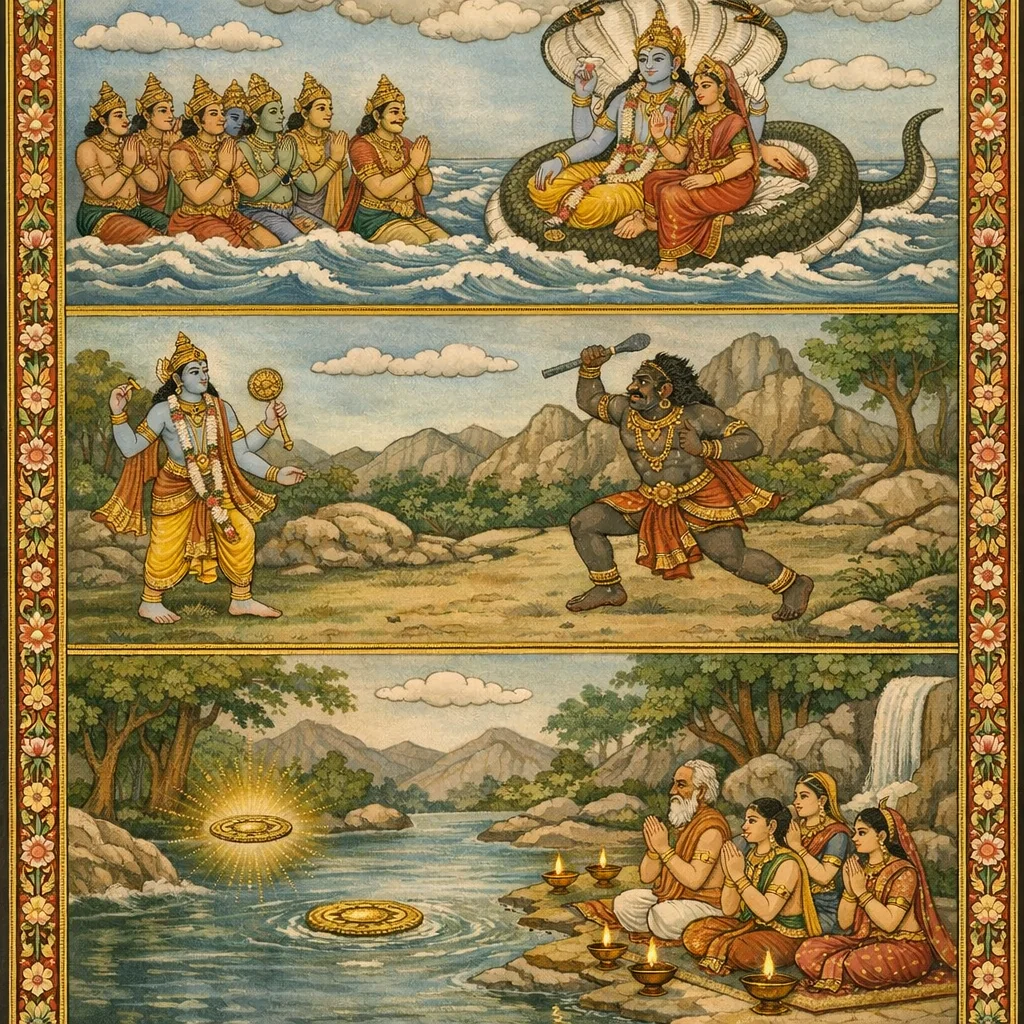
This adhyāya is framed as a dialogue in which Mārkaṇḍeya answers Yudhiṣṭhira’s questions about the origin of Cakratīrtha, the incomparable might of Śrī Viṣṇu, and the merit gained in connection with the Revā/Narmadā. An origin-myth is woven in: the fierce daitya Tālamēgha subdues the devas, who seek refuge first with Brahmā and then with Viṣṇu in the Kṣīroda (ocean of milk), praising him as Jalśāyī, the Lord who rests upon the waters. Viṣṇu agrees to restore cosmic order, rides forth on Garuḍa, and defeats the daitya through an escalating contest of weapons, culminating in the release of the Sudarśana cakra. After the victory, the discus is said to fall into the waters of the Revā near Jalśāyī-tīrtha and become “purified,” thereby establishing the tīrtha’s name and sacred efficacy. The latter half gives ritual guidance: auspicious times (especially Mārgasīrṣa and the bright-fortnight Ekādaśī), devotional restraint, bathing and beholding the deity (darśana), night vigil, circumambulation, offerings, and śrāddha with qualified brāhmaṇas. It further explains the tiladhenu (sesame-cow) donation rite, donor ethics, and the promised post-mortem passage beyond fearful realms, concluding with a phalaśruti that hearing or reciting this chapter brings purification and merit.
Shlokas
Verse 1
श्रीमार्कण्डेय उवाच । रेवाया उत्तरे कूले वैष्णवं तीर्थमुत्तमम् । जलशायीति वै नाम विख्यातं वसुधातले
Śrī Mārkaṇḍeya said: On the northern bank of the Revā there is an unsurpassed Vaiṣṇava sacred ford, renowned on the earth by the name “Jalaśāyī” (He who lies upon the waters).
Verse 2
दानवानां वधं कृत्वा सुप्तस्तत्र जनार्दनः । चक्रं प्रक्षालितं तत्र देवदेवेन चक्रिणा । सुदर्शनं च निष्पापं रेवाजलसमाश्रयात्
After slaying the Dānavas, Janārdana lay asleep there. There the Lord of gods, the wielder of the discus, washed his discus; and by taking refuge in the waters of the Revā, Sudarśana became stainless, freed from sin.
Verse 3
युधिष्ठिर उवाच । चक्रतीर्थं समाचक्ष्व मुनिसंघैश्च वन्दितम् । विष्णोः प्रभावमतुलं रेवायाश्चैव यत्फलम्
Yudhiṣṭhira said: Describe to me Cakratīrtha, revered by hosts of sages—its incomparable glory in relation to Viṣṇu, and the spiritual fruit that comes from the Revā as well.
Verse 4
श्रीमार्कण्डेय उवाच । साधु साधु महाप्राज्ञ विरक्तस्त्वं युधिष्ठिर । गुह्याद्गुह्यतरं तीर्थं निर्मितं चक्रिणा स्वयम्
Śrī Mārkaṇḍeya said: “Well said, well said, O Yudhiṣṭhira of great wisdom—detached in spirit! This tīrtha is more secret than secrets, fashioned by the discus-bearing Lord himself.”
Verse 5
तत्तेऽहं सम्प्रवक्ष्यामि कथां पापप्रणाशिनीम् । आसीत्पुरा महादैत्यस्तालमेघ इति श्रुतः
Now I shall tell you the sin-destroying narrative. Long ago there was a great Dānava, famed by the name Tāla-megha.
Verse 6
तेन देवा जिताः सर्वे हृतराज्या नराधिप । यज्ञभागान् स्वयं भुङ्क्ते अहं विष्णुर्न संशयः
By him all the gods were conquered and their sovereignties were taken away, O king. He himself consumed the portions of the sacrifices, declaring, “I am Viṣṇu—no doubt of it.”
Verse 7
धनदस्य हृतं चित्तं हृतः शक्रस्य वारणः । इन्द्राणीं वाञ्छते पापो हयरत्नं रवेरपि
He stole the heart’s treasure of Dhanada (Kubera) and seized Śakra’s elephant. That sinner even desired Indrāṇī, and the Sun’s jewel-like horse as well.
Verse 8
तालमेघभयात्पार्थ रविरुद्राः सवासवाः । यमः स्कन्दो जलेशोऽग्निर्वायुर्देवो धनेश्वरः
Out of fear of Tāla-megha, O Pārtha, the Sun, the Rudras along with Indra, Yama, Skanda, Varuṇa the lord of waters, Agni, Vāyu, and Kubera the lord of wealth—
Verse 9
सवाक्पतिमहेशाश्च नष्टचित्ताः पितामहम् । गता देवा ब्रह्मलोकं तत्र दृष्ट्वा पितामहम्
Along with Vākpati (Bṛhaspati) and Maheśa, their minds distraught, the gods went to Brahmaloka; there they beheld Pitāmaha (Brahmā).
Verse 10
तुष्टुवुर्विविधैः स्तोत्रैर्वागीशप्रमुखाः सुराः । गुणत्रयविभागाय पश्चाद्भेदमुपेयुषे
Led by Vāgīśa, the gods praised him with many hymns—him who, for the ordering of the three guṇas, later manifests differentiation within creation.
Verse 11
दृष्ट्वा देवान्निरुत्साहान् विवर्णानवनीपते । प्रसादाभिमुखो देवः प्रत्युवाच दिवौकसः
Seeing the gods despondent and pale, O king, the gracious Lord—turning compassionately toward them—spoke in reply to the dwellers of heaven.
Verse 12
ब्रह्मोवाच । स्वागतं सुरसङ्घस्य कान्तिर्नष्टा पुरातनी । हिमक्लिष्टप्रभावेण ज्योतींषीव मुखानि वः
Brahmā said: Welcome, O host of gods. Your former radiance seems to have faded—your faces look like lights dimmed by the harsh power of frost.
Verse 13
प्रशमादर्चिषामेतदनुद्गीर्णं सुरायुधम् । वृत्रस्य हन्तुः कुलिशं कुण्ठितश्रीव लक्ष्यते
The gods’ weapon no longer blazes with its former flames; even the thunderbolt (kuliśa) of Vṛtra’s slayer appears as though its glory has been blunted.
Verse 14
किं चायमरिदुर्वारः पाणौ पाशः प्रचेतसः । मन्त्रेण हतवीर्यस्य फणिनो दैन्यमाश्रितः
How is it that Varuṇa’s irresistible noose, held in his hand, has fallen into a wretched state—like a serpent whose power has been struck down by a mantra?
Verse 15
कुबेरस्य मनःशल्यं शंसतीव पराभवम् । अपविद्धगतो वायुर्भग्नशाख इव द्रुमः
Kubera’s inner anguish seems to proclaim defeat; and Vāyu, cast down from his course, is like a tree with broken branches.
Verse 16
यमोऽपि विलिखन्भूमिं दण्डेनास्तमितत्विषा । कुरुतेऽस्मिन्नमोघोऽपि निर्वाणालातलाघवम्
Even Yama, scraping the earth with his staff whose luster has dimmed, makes his unfailing rod seem light—like a firebrand that has gone out.
Verse 17
अमी च कथमादित्याः प्रतापक्षतिशीतलाः । चित्रन्यस्ता इव गताः प्रकामालोकनीयताम्
And how is it that these Ādityas have grown cool, their splendor wounded? They appear like painted figures—fit to be looked at, yet lacking living force.
Verse 18
तद्ब्रूत वत्साः किमितः प्रार्थयध्वं समागताः । किमागमनकृत्यं वो ब्रूत निःसंशयं सुराः
Therefore tell me, dear ones—what have you come here to request? Declare without hesitation, O gods, what is the purpose of your arrival.
Verse 19
मयि सृष्टिर्हि लोकानां रक्षा युष्मास्ववस्थिता । ततो मन्दानिलोद्भूतकमलाकरशोभिना
In Me indeed rests the creation of the worlds, while in you their protection is established. Therefore—(with splendor like a lotus-bed stirred by a gentle breeze)…
Verse 20
गुरुं नेत्रसहस्रेण प्रेरयामास वृत्रहा । स द्विनेत्रं हरेश्चक्षुः सहस्रनयनाधिकम्
Vṛtra’s slayer (Indra), with his thousand eyes, urged the venerable teacher. Thus Hari’s two-eyed vision was surpassed by the thousand-eyed one.
Verse 21
वाचस्पतिरुवाचेदं प्राञ्जलिर्जलजासनम् । युष्मद्वंशोद्भवस्तात तालमेघो महाबलः
Vācaspati, with folded hands, addressed Brahmā seated upon the lotus: “O revered one, from your own lineage has arisen a tremendously powerful being named Tālamegha.”
Verse 22
उपतापयते देवान्धूमकेतुरिवोच्छ्रितः । तेन देवगणाः सर्वे दुःखिता दानवेन च
Towering high like a blazing comet, he scorches the gods; because of that dānava, all the hosts of devas have fallen into distress.
Verse 23
तालमेघो दैत्यपतिः सर्वान्नो बाधते बली । तस्मात्त्वां शरणं प्राप्ताः शरणं नो विधे भव
That mighty Tālamegha, lord of the daityas, oppresses us all. Therefore we have come to you for refuge—O Ordainer (Brahmā), become our shelter.
Verse 24
ततः प्रसन्नो भगवान् वेधास्तानब्रवीद्वचः
Then the blessed Creator, Vedhā (Brahmā), being pleased, spoke these words to them.
Verse 25
ब्रह्मोवाच । तालमेघेन वो मध्ये बली तेन समः सुराः । विना माधवदेवेन साध्यो मे नैव दानवः
Brahmā said: “Among you, Tālamegha is powerful—indeed he matches the devas in might. Without Mādhava (Viṣṇu), that dānava cannot be subdued by me.”
Verse 26
ततः सुरगणाः सर्वे विरिञ्चिप्रमुखा नृप । क्षीरोदं प्रस्थिताः सर्वे दुःखितास्तेन वैरिणा
Then all the hosts of devas—led by Viriñci (Brahmā), O king—set out for Kṣīroda (the Milk Ocean), all distressed because of that enemy.
Verse 27
त्वरिताः प्रस्थिता देवाः केशवं द्रष्टुकाम्यया । क्षीरोदं सागरं गत्वास्तुवंस्ते जलशायिनम्
Hastening forth, the devas—eager to behold Keśava—went to the Kṣīroda Ocean and there praised the Lord who lies upon the waters.
Verse 28
देवा ऊचुः । जगदादिरनादिस्त्वं जगदन्तोऽप्यनन्तकः । जगन्मूर्तिरमूर्तिस्त्वं जय गीर्वाणपूजित
The devas said: “You are the beginning of the world, yet you are without beginning; you are the end of the world, yet endless. You are the world’s form and also formless. Victory to you, O One worshipped by the gods.”
Verse 29
जय क्षीरोदशयन जय लक्ष्म्या सदा वृत । जय दानवनाशाय जय देवकिनन्दन
Victory to You, O Recliner upon the Milk Ocean; victory to You, ever embraced by Lakṣmī. Victory to You, destroyer of the dānavas; victory to You, O beloved son of Devakī.
Verse 30
जय शङ्खगदापाणे जय चक्रधर प्रभो । इति देवस्तुतिं श्रुत्वा प्रबुद्धो जलशाय्यथ
“Victory to You, O Lord whose hands bear the conch and mace; victory to You, O Master who holds the discus.” Hearing this praise of the devas, the Water-reclining Lord then awoke.
Verse 31
उवाच मधुरां वाणीं मेघगम्भीरनिस्वनाम् । किमर्थं बोधितो ब्रह्मन् समर्थैर्वः सुरासुरैः
He spoke in a sweet voice, deep-sounding like thunderclouds: “O Brahman, for what purpose have you all—gods and demons, though capable—come to awaken and petition Me?”
Verse 32
ब्रह्मोवाच । तालमेघभयात्कृष्ण सम्प्राप्तास्तव मन्दिरम् । न वध्यः कस्यचित्पापस्तालमेघो जनार्दन
Brahmā said: “O Kṛṣṇa, out of fear of Tālamegha we have come to Your abode. O Janārdana, that sinful Tālamegha cannot be slain by anyone else.”
Verse 33
त्वमेव जहि तं दुष्टं मृत्युं यास्यति नान्यथा
“You alone must strike down that wicked one; he will meet death in no other way.”
Verse 34
श्रीकृष्ण उवाच । स्वस्थानं गम्यतां देवाः स्वकीयां लभत प्रजाम् । दुष्टात्मानं हनिष्यामि तालमेघं महाबलम्
Śrī Kṛṣṇa said: “Return to your own realms, O gods, and regain your people. I shall slay that evil-souled, mighty Tālamegha.”
Verse 35
स्थानं ब्रुवन्तु मे देवा वसेद्यत्र स दानवः
“Tell me, O gods, the place where that demon dwells.”
Verse 36
देवा ऊचुः । हिमाचलगुहायां स वसते दानवेश्वरः । चतुर्विंशतिसाहस्रैः कन्याभिः परिवारितः
The gods said: “That lord of demons dwells in a cave of Himācala, surrounded by twenty-four thousand maidens.”
Verse 37
तुरङ्गैः स्यन्दनैः कृष्ण संख्या तस्य न विद्यते । नटा नानाविधास्तत्र असंख्यातगुणा हरे
“O Kṛṣṇa, his horses and chariots are beyond counting. And there are many kinds of performers there, O Hari, possessing countless skills.”
Verse 38
द्विरदाः पर्वताकारा हयाश्च द्विरदोपमाः । महाबलो वसेत्तत्र गीर्वाणभयदायकः
“His elephants are mountain-like, and his horses are comparable to elephants. There dwells that exceedingly powerful one, a giver of fear to the gods.”
Verse 39
श्रुत्वा देवो वचस्तेषां देवानामातुरात्मनाम् । अचिन्तयद्गरुत्मन्तं शत्रुसङ्घविनाशनम्
Hearing the words of those gods, distressed in spirit, the Lord contemplated Garutmān (Garuḍa), the destroyer of the hosts of enemies.
Verse 40
चक्रं करेण संगृह्य गदाचक्रधरः प्रभुः । शार्ङ्गं च मुशलं सीरं करैर्गृह्य जनार्दनः
Grasping the discus in his hand, the Lord—bearer of mace and discus—also took up Śārṅga (his bow), the pestle, and the plough in his hands; thus Janārdana readied himself to protect dharma.
Verse 41
आरूढः पक्षिराजेन्द्रं वधार्थं दानवस्य च । दानवस्य पुरे पेतुरुत्पाता घोररूपिणः
Mounted upon the lord of birds (Garuḍa), he set out to slay the Dānava; and in the Dānava’s city, dreadful portents of terrifying form began to descend.
Verse 42
गोमायुर्गृध्रमध्ये तु कपोतैः सममाविशत् । विना वातेन तस्यैव ध्वजदण्डः पपात ह
A jackal entered among the vultures together with pigeons; and, even without any wind, that very flagstaff fell down.
Verse 43
सर्पसूषकयोर्युद्धं तथा केसरिनागयोः । उन्मार्गाः सरितस्तत्रावहन्रक्तविमिश्रिताः । अकालतरुपुष्पाणि दृश्यन्ते स्म समन्ततः
There was combat between serpents and mongooses, and likewise between lions and elephants. Rivers there flowed off their courses, carrying water mixed with blood; and unseasonal blossoms on trees were seen everywhere.
Verse 44
ततः प्राप्तो जगन्नाथो हिमवन्तं नगेश्वरम् । पाञ्चजन्यश्वसहसा पूरितः पुरसन्निधौ
Then Jagannātha arrived at Himavant, the lord of mountains; and in the very presence of the city, the Pāñcajanya conch was suddenly sounded in full force.
Verse 45
तेन शब्देन महता ह्यारूढो दानवेश्वरः । उवाच च तदा वाक्यं तालमेघो महाबलः
Stirred by that mighty sound, the lord of the Dānavas mounted up; and then the powerful Tālamēgha spoke these words.
Verse 46
तालमेघ उवाच । कोऽयं मृत्युवशं प्राप्तो ह्यज्ञात्वा मम विक्रमम् । धुन्धुमाराज्ञया ह्याशु स्वसैन्यपरिवारितः
Tālamēgha said: “Who is this, come under the sway of death, not knowing my prowess? By Dhundhumāra’s command, quickly—surround him with my own troops!”
Verse 47
बलादानय तं बद्ध्वा ममाग्रे बहुशालिनम्
Seize him by force, bind him, and bring that greatly endowed one before me.
Verse 48
धुन्धुमार उवाच । आनयामि न सन्देहः सुरो यक्षोऽथ किन्नरः । स्यन्दनौघैः समायुक्तो गजवाजिभटैः सह
Dhundhumāra said: “I shall bring him—no doubt—be he a god, a Yakṣa, or a Kinnara, even if he comes with a flood of chariots, together with elephants, horses, and soldiers.”
Verse 49
हृष्टस्ततो जगद्योनिः सुपर्णस्थो महाबलः । गृह्यतां गृह्यतामेष इत्युक्तास्तेन किंकराः
Then the mighty Source of the world, seated upon Garuḍa, rejoiced. Urged by him, his servants cried, “Seize him! Seize him!”
Verse 50
चतुर्दिक्षु प्रधावन्त इतश्चेतश्च सर्वतः । सुपर्णेनाग्निरूपेण दग्धास्ते शलभा यथा
They ran in the four directions, here and there on every side; but Suparṇa, in the form of fire, burned them up—like moths.
Verse 51
धुन्धुमारोऽपि कृष्णेन शरघातेन ताडितः । हतो वक्षःस्थले पापो मृतावस्थो रथोपरि
Struck down by Kṛṣṇa with a crushing volley of arrows, even Dhundhumāra—the sinful one—was pierced in the chest and lay upon his chariot in the state of death.
Verse 52
हाहाकारं ततः सर्वे दानवाश्चक्रुरातुराः । तालमेघस्ततः क्रुद्धो रथारूढो विनिर्गतः । ददृशे केशवं पार्थ शङ्खचक्रगदाधरम्
Then all the dānavas, distressed, raised a great cry of lament. Thereupon Tālamēgha, enraged, came forth mounted on his chariot, and he beheld Keśava—O Pārtha—bearing conch, discus, and mace.
Verse 53
तालमेघ उवाच । अन्ये ते दानवाः कृष्ण ये हताः समरे त्वया । हिरण्यकशिपुप्रख्यानपुमांसो हि तेऽच्युत
Tālamēgha said: “O Kṛṣṇa, the other dānavas whom you slew in battle—those men were famed like Hiraṇyakaśipu, O Acyuta.”
Verse 54
इत्युक्त्वा दानवः पार्थ वर्षयामास सायकैः । दानवस्य शरान्मुक्तान् छेदयामास केशवः
Thus speaking, O Pārtha, the dānava rained down arrows; but Keśava cut apart the shafts discharged by the dānava.
Verse 55
गरुत्मानवधीत्सैन्यमवध्यं यत्सुरासुरैः । कृष्णेन द्विगुणास्तस्य प्रेषिताः स्वशिलीमुखाः
Garuḍa struck down that host deemed invincible even to gods and asuras; and Kṛṣṇa sent forth his own arrows against him in double measure.
Verse 56
द्विगुणं द्विगुणीकृत्य प्रेषयामास दानवः । तानप्यष्टगुणैः कृष्णश्छादयामास सायकैः
Doubling and redoubling, the dānava launched his missiles; yet Kṛṣṇa covered even those with arrows eightfold in number.
Verse 57
ततः क्रुद्धेन दैत्येन ह्याग्नेयं बाणमुत्तमम्
Then the enraged daitya let fly the excellent Āgneya missile, the fire-weapon.
Verse 58
वारुणं प्रेषयामास त्वाग्नेयं शमितं ततः । वारुणेनैव वायव्यं तालमेघो व्यसर्जयत्
He dispatched the Vāruṇa weapon, and then the Āgneya was quenched. Thereafter Tālamēgha released the Vāyavya weapon, countered indeed by the Vāruṇa.
Verse 59
सार्पं चैव हृषीकेशो वायव्यस्य प्रशान्तये । नारसिंहं नृसिंहोऽपि प्रेषयामास पाण्डव
And Hṛṣīkeśa also sent forth the Sārpa weapon to quiet the Vāyavya. Then Nṛsiṃha too dispatched the Nārasiṃha weapon, O Pāṇḍava.
Verse 60
नारसिंहं ततो दृष्ट्वा तालमेघो महाबलः । उत्तीर्य स्यन्दनाच्छीघ्रं गृहीत्वा खड्गचर्मणी
Seeing the Nārasiṃha force, mighty Tālamēgha quickly descended from his chariot, taking up sword and shield.
Verse 61
कृष्ण त्वां प्रेषयिष्यामि यममार्गं सुदारुणम् । इत्युक्त्वा दानवः पार्थ आगतः केशवं प्रति
“Kṛṣṇa, I shall send you to the terribly cruel road of Yama!” Having spoken thus, O son of Pṛthā, the Dānava advanced against Keśava.
Verse 62
खड्गेनाताडयद्दैत्यो गदापाणिं जनार्दनम् । मण्डलाग्रं ततो गृह्य केशवो हृष्टमानसः
The Daitya struck Janārdana—who bore the mace in his hand—with a sword. Then Keśava, his mind uplifted, seized the disc (weapon) by its rim.
Verse 63
जघनोरःस्थले पार्थ तालमेघं महाहवे । जनार्दनस्तदा दैत्यं दैत्यो हरिमहन्मृधे
In that great battle, O Pārtha, Janārdana then struck the Daitya Tālamegha upon the hips and chest; and in the fierce fight the Daitya also struck Hari.
Verse 64
जनार्दनस्ततः क्रुद्धस्तालमेघाय भारत । अमोघं चक्रमादाय मुक्तं तस्य च मूर्धनि
Then Janārdana, enraged, O Bhārata, took up his unfailing discus and released it upon Tālamegha’s head.
Verse 65
निपपात शिरस्तस्य पर्वताश्च चकम्पिरे । समुद्राः क्षुभिताः पार्थ नद्य उन्मार्गगामिनीः
His head fell down; mountains trembled. The oceans were thrown into turmoil, O Pārtha, and the rivers ran out of their proper courses.
Verse 66
पुष्पवृष्टिं ततो देवा मुमुचुः केशवोपरि । अवध्यः सुरसङ्घानां सूदितः केशव त्वया
Then the gods showered flowers upon Keśava. “He who was invincible even to the hosts of the gods has been slain by you, O Keśava!”
Verse 67
स्वस्थाश्चैव ततो देवास्तालमेघे निपातिते । जनार्दनोऽपि कौन्तेय नर्मदातटमाश्रितः
With Tālamegha felled, the gods became at ease. And Janārdana too, O son of Kuntī, took refuge upon the bank of the Narmadā.
Verse 68
क्षीरोदां नर्मदां मत्वा अनन्तभुजगोपरि । लक्ष्म्या समन्वितः कृष्णो निलीनश्चोत्तरे तटे
Regarding the Narmadā as the Milk-Ocean, Kṛṣṇa—accompanied by Lakṣmī—reposed upon Ananta the serpent, concealed on the northern bank.
Verse 69
चक्रं विभीषणं मर्त्ये ज्वालामालासमन्वितम् । पतितं नर्मदातोये जलशायिसमीपतः
That discus—terrifying in the mortal world, wreathed in a garland of flames—fell into the waters of the Narmadā, near the place of the Water‑Reclining Lord (Jalaśāyī).
Verse 70
निर्धूतकल्मषं जातं नर्मदातोययोगतः । तालमेघवधोत्पन्नं यत्पापं नृपनन्दन
By contact with the waters of the Narmadā, the sin that had arisen from the slaying of Tālamegha was shaken off and cleansed, O prince.
Verse 71
तत्स्रवं क्षालितं सद्यो नर्मदांभसि भारत । तदाप्रभृति लोकेऽस्मिञ्जलशायी महीपते
O Bhārata, that outflow was immediately washed away in the waters of the Narmadā. From that time onward, O king, in this world he became renowned as the Lord who reclines upon the waters.
Verse 72
चक्रतीर्थं वदन्त्यन्ये केचित्कालाघनाशनम् । विख्यातं भारते वर्षे नर्मदायां महीपते
Some call it Cakratīrtha; others speak of it as the destroyer of the dense darkness of Time. It is famed throughout Bhārata-varṣa, O king, upon the Narmadā.
Verse 73
तत्तीर्थस्य प्रभावोऽयं श्रूयतामवनीपते । यथाऽनन्तो हि नागानां देवानां च जनार्दनः
Hear now, O lord of the earth, the greatness of that tīrtha: just as Ananta is foremost among the nāgas, and Janārdana supreme among the gods.
Verse 74
मासानां मार्गशीर्षोऽस्ति नदीनां नर्मदा यथा । मासि मार्गशिरे पार्थ ह्येकादश्यां सितेऽहनि
Just as Mārgaśīrṣa is foremost among months, and the Narmadā among rivers, so too, O Pārtha, on the bright eleventh day in the month of Mārgaśīrṣa…
Verse 75
गत्वा यो मनुजो भक्त्या कामक्रोधविवर्जितः । वैष्णवीं भावनां कृत्वा जलेशं तु व्रजेत वै
Whoever goes there with devotion, free from desire and anger, and, cultivating a Vaiṣṇava contemplation, approaches the Lord of the Waters—surely he attains the intended spiritual fruit.
Verse 76
एकभुक्तं च नक्तं च तथैवायाचितं नृप । उपवासं तथा दानं ब्राह्मणानां च भोजनम्
O king, let him observe the discipline of a single meal, and likewise eating only at night (in the evening), and living on food not begged for; also fasting, giving charity, and feeding the Brāhmaṇas.
Verse 77
करोति च कुरुश्रेष्ठ न स याति यमालयम् । यमलोकभयाद्भीता ये लोकाः पाण्डुनन्दन
O best of the Kurus, one who performs these does not go to Yama’s abode. O son of Pāṇḍu, those worlds that tremble from fear of Yama’s realm—
Verse 78
ते पश्यन्तु श्रियः कान्तं नागपर्यङ्कशायिनम् । गोपीजनसमावृत्तं योगनिद्रां समाश्रितम् । विश्वरूपं जगन्नाथं संसारभयनाशनम्
May they behold Śrī’s beloved—He who reclines upon the serpent couch—surrounded by the gopīs, abiding in yogic slumber: the cosmic-formed Lord of the universe, the destroyer of fear born of saṃsāra.
Verse 79
स्नापयेत्परया भक्त्या क्षौद्रक्षीरेण सर्पिषा । खण्डेन तोयमिश्रेण जगद्योनिं जनार्दनम्
With supreme devotion, one should bathe Janārdana—the womb and source of the world—with honey, milk, ghee, and sugar mixed with water.
Verse 80
स्नाप्यमानं च पश्यन्ति ये लोका गतमत्सराः । ते यान्ति परमं लोकं सुरासुरनमस्कृतम्
Those who, free from envy, behold Him being bathed—such devotees go to the supreme realm, revered by gods and asuras alike.
Verse 81
घृतेन बोधयेद्दीपमथवा तैलपूरितम् । रात्रौ जागरणं कृत्वा दैवस्याग्रे विमत्सराः
One should kindle a lamp with ghee, or else one filled with oil; and keeping vigil through the night before the Deity, remain free from envy.
Verse 82
ये कथां वैष्णवीं भक्त्या शृण्वन्ति च नृपोत्तम । ब्रह्महत्यादिपापानि नश्यन्ते नात्र संशयः
O best of kings, those who devoutly listen to the Vaiṣṇava sacred narrative—sins such as brahmin-slaying and the like are destroyed; of this there is no doubt.
Verse 83
प्रदक्षिणन्ति ये मर्त्या जलशायिजगद्गुरुम् । प्रदक्षिणीकृता तैस्तु सप्तद्वीपा वसुंधरा
Those mortals who circumambulate the Jagadguru, the Lord who reclines upon the waters—by them indeed the whole earth with its seven continents is as though circumambulated.
Verse 84
ततः प्रभाते विमले पित्ःन् संतर्पयेज्जलैः । श्राद्धं च ब्राह्मणैस्तत्र योग्यैः पाण्डव मानवाः
Then, on the pure morning, one should satisfy the Pitṛs with water-offerings; and there, O son of Pāṇḍu, one should have the śrāddha performed by qualified brāhmaṇas.
Verse 85
स्वदारनिरतैः शान्तैः परदारविवर्जकैः । वेदाभ्यसनशीलैश्च स्वकर्मनिरतैः शुभैः
(The śrāddha should be done) with brāhmaṇas who are devoted to their own lawful spouses, peaceful in conduct, avoiding another’s wife, engaged in Vedic study, and steadily devoted to their rightful duties—virtuous men.
Verse 86
नित्यं यजनशीलैश्च त्रिसन्ध्यापरिपालकैः । श्रद्धया कारयेच्छ्राद्धं यदीच्छेच्छ्रेय आत्मनः
And (with brāhmaṇas) who are constantly devoted to worship and who observe the three daily sandhyās—one should have the śrāddha performed with faith, if one desires one’s own highest welfare.
Verse 87
ते धन्या मानुषे लोके वन्द्या हि भुवि मानवाः । ये वसन्ति सदाकालं पादपद्माश्रया हरेः
Blessed in the human world—and truly worthy of reverence on earth—are those people who dwell always taking refuge in the lotus-feet of Hari.
Verse 88
जलशायं प्रपश्यन्ति प्रत्यक्षं सुरनायकम् । पक्षोपवासं पाराकं व्रतं चान्द्रायणं शुभम्
They behold the Water-reclining Lord, the leader of the gods, directly before their eyes; and (they undertake) the fortnight-fast, the Pārāka observance, and the auspicious Cāndrāyaṇa vow.
Verse 89
मासोपवासमुग्रं च षष्ठान्नं पञ्चमं व्रतम् । तत्र तीर्थे तु यः कुर्यात्सोऽक्षयां गतिमाप्नुयात्
And the severe month-long fast, the observance of taking food on the sixth day, and the vow of the fifth day—whoever performs these at that sacred tīrtha attains an imperishable state, an unending spiritual destiny.
Verse 90
। अध्याय
(Here ends the chapter.)
Verse 91
एतत्कथान्तरं पुण्यमृषेर्द्वैपायनात्पुरा । श्रुतं हि नैमिषे पुण्ये नारदाद्यैरनेकधा
This sacred supplementary account was formerly heard from the sage Dvaipāyana (Vyāsa). Indeed, in the holy Naimiṣa forest it was heard repeatedly, in many ways, by Nārada and other sages.
Verse 92
इदं परममायुष्यं मङ्गल्यं कीर्तिवर्धनम् । विप्राणां श्रावयन्विद्वान्फलानन्त्यंसमश्नुते
This teaching bestows supreme longevity, auspiciousness, and an increase of good fame. A learned person who recites it for brāhmaṇas attains an endless abundance of merit (puṇya).
Verse 93
बहुभ्यो न प्रदेयानि गौर्गृहं शयनं स्त्रियः । विभक्तदक्षिणा ह्येता दातारं नाप्नुवन्ति च
A cow, a house, a bed, and a woman are not to be given to many recipients. For when these gifts are divided as dakṣiṇā among several, they do not truly reach—nor benefit—the giver.
Verse 94
एकमेतत्प्रदातव्यं न बहूनां युधिष्ठिर । सा च विक्रयमापन्ना दहत्यासप्तमं कुलम्
This is to be given as one, undivided, not to many, O Yudhiṣṭhira. And if such a gift is sold, it burns and brings ruin upon the lineage up to the seventh generation.
Verse 95
यथालाभा तु सर्वेषां चतुर्द्रोणा तु गौः स्मृता । द्रोणस्य वत्सकः कार्यो बहूनां वापि कामतः
According to one’s means, for all givers, a cow is traditionally reckoned as a measure of four droṇas. A calf should be provided at the measure of one droṇa—or, if desired, even more.
Verse 96
यस्मिन्देशे तु यन्मानं विषये वा विचारितम् । तेन मानेन तां कुर्वन्नक्षयं फलमश्नुते
Whatever standard of measure is accepted in a given land or region, one should perform the donation according to that very standard; doing so, one partakes of imperishable merit.
Verse 97
सुखपूर्वं शुचौ भूमौ पुष्पधूपाक्षतैस्तथा । कर्णाभ्यां रत्ने दातव्ये दीपौ नेत्रद्वये तथा
Comfortably, upon pure ground, with flowers, incense, and unbroken rice, one should make the gifts: jewels for the two ears, and lamps for the two eyes as well.
Verse 98
श्रीखण्डमुरसि स्थाप्यं ताभ्यां चैव तु काञ्चनम् । ऊर्ध्वे मधु घृतं देयं कुर्यात्सर्षपरोमकम्
Sandal paste should be placed upon the chest, and gold should likewise be set thereon. Above, honey and ghee should be offered; and mustard-seeds and hair should be arranged as prescribed for the rite.
Verse 99
कम्बले कम्बलं दद्याच्छ्रोण्यां मधु घृतं तथा । यवसं पायसं दद्याद्घृतं क्षौद्रसमन्वितम्
Upon a blanket, one should offer a blanket; at the hips, honey and ghee likewise. One should give fodder and sweet payasa (milk-rice), together with ghee blended with honey.
Verse 100
स्वर्णशृङ्गी रूप्यशिफारुक्मलाङ्गूलसंयुता । रत्नपृष्ठी तु दातव्या कांस्यपात्रावदोहिनी
A cow should be given, her horns adorned with gold, her hooves of silver, and her tail ornamented with gold; her back set with jewels; and she should be one whose milk is drawn into a bronze vessel.
Verse 101
यत्स्याद्बाल्यकृतं पापं यद्वा कृतमजानता । वाचा कृतं कर्मकृतं मनसा यद्विचिन्तितम्
Whatever sin was committed in childhood, or done unknowingly—whether by speech, by deed, or even conceived within the mind—(all this is said to be removed by the purifying observance praised in this Revā section).
Verse 102
जले निष्ठीवितं चैव मुशलं वापि लङ्घितम् । वृषलीगमनं चैव गुरुदारनिषेवणम्
Spitting into water; stepping over a pestle; consorting with a woman of forbidden association; and violating the wife of one’s teacher—(even such grave transgressions are included among the sins said to be purified by the praised observance in this Revā section).
Verse 103
कन्याया गमनं चैव सुवर्णस्तेयमेव च । सुरापानं तथा चान्यत्तिलधेनुः पुनाति हि
Consorting with a maiden, stealing gold, drinking liquor, and other such sins as well—indeed, the tila-dhenu, the ritual gift of a sesame “cow,” is said to purify them.
Verse 104
अहोरात्रोपवासेन विधिवत्तां विसर्जयेत् । या सा यमपुरे घोरे नदी वैतरणी स्मृता
After fasting for a full day and night, according to the proper rite one should complete that gift and send it forth in donation. That gift is remembered as the dreadful river Vaitaraṇī in Yama’s city, for it becomes the means to cross it.
Verse 105
वालुकायोऽश्मस्थला च पच्यते यत्र दुष्कृती । अवीचिर्नरको यत्र यत्र यामलपर्वतौ
Where there are beds of scorching sand and stony ground, there the evil-doer is “cooked” in torment; where the Avīci hell is; where the twin Yāmala mountains stand—those are the fearful regions.
Verse 106
यत्र लोहमुखाः काका यत्र श्वानो भयंकराः । असिपत्त्रवनं चैव यत्र सा कूटशाल्मली
Where crows with iron beaks are, where terrifying dogs are; where the forest of sword-leaves, Asipattravana, is, and where the deceptive thorn-tree Kūṭaśālmalī stands—such horrors are found there.
Verse 107
तान्सुखेन व्यतिक्रम्य धर्मराजालयं व्रजेत् । धर्मराजस्तु तं दृष्ट्वा सूनृतं वक्ति भारत
Passing beyond those regions with ease, he goes to the abode of Dharmarāja. And Dharmarāja, seeing him, speaks kindly words—O Bhārata.
Verse 108
विमानमुत्तमं योग्यं मणिरत्नविभूषितम् । अत्रारुह्य नरश्रेष्ठ प्रयाहि परमां गतिम्
“Here is a supreme and fitting celestial car, adorned with jewels and gems. Ascend it, O best of men, and go forth to the highest state.”
Verse 109
मा च चाटु भटे देहि मैव देहि पुरोहिते । मा च काणे विरूपे च न्यूनाङ्गे न च देवले
When making the gift: “Give it not to a flatterer or a hireling; give it not to a priest who merely officiates; nor to one who is one‑eyed, nor deformed, nor maimed; and not to a devala who serves in a temple for livelihood.”
Verse 110
अवेदविदुषे नैव ब्राह्मणे सर्वविक्रये । मित्रघ्ने च कृतघ्ने च मन्त्रहीने तथैव च
Nor should it be given to a brāhmaṇa ignorant of the Veda, nor to one who sells everything for gain; nor to a slayer of friends, nor to the ungrateful; nor likewise to one devoid of mantra, unfit for Vedic recitation and rite.
Verse 111
वेदान्तगाय दातव्या श्रोत्रियाय कुटुम्बिने । वेदान्तगसुते देया श्रोत्रिये गृहपालके
The gift (of the tiladhenu rite) should be given to a Vedāntin who knows the Veda—one who is a qualified śrotriya, a householder with a family. It may also be given to a Vedāntin’s son, provided he too is a śrotriya and a responsible keeper of the household.
Verse 112
सर्वाङ्गरुचिरे विप्रे सद्वृत्ते च प्रियंवदे । पूर्णिमायां तु माघस्य कार्त्तिक्यामथ भारत
Offer the gift to a brāhmaṇa radiant in every limb, of noble conduct and pleasing speech, O Bhārata—especially on the full-moon day of Māgha, and likewise in the month of Kārttika.
Verse 113
वैशाख्यां मार्गशीर्ष्यां वाषाढ्यां चैत्र्यामथापि वा । अयने विषुवे चैव व्यतीपाते च सर्वदा
Or it may be performed in Vaiśākha, Mārgaśīrṣa, Āṣāḍha, or Caitra; also at the ayanas (solstices), the viṣuvas (equinoxes), and at Vyatīpāta—indeed, at all auspicious times.
Verse 114
षडशीतिमुखे पुण्ये छायायां कुंजरस्य वा । एष ते कथितः कल्पस्तिलधेनोर्मयानघ
At the holy opening of the Ṣaḍaśīti junction, or even in the shade of an elephant, O sinless one, I have told you the complete procedure of the Tiladhenu rite.
Verse 115
व्रजन्ति वैष्णवं लोकं दत्त्वा पादं यमोपरि । प्राणत्यागात्परं लोकं वैष्णवं नात्र संशयः । भित्त्वाशु भास्करं यान्ति नात्र कार्या विचारणा
They go to Viṣṇu’s world, as though setting their foot upon Yama himself. After casting off the life-breath, they attain the Vaiṣṇava realm—of this there is no doubt. Swiftly piercing beyond the sun’s sphere, they proceed onward; no further deliberation is needed.
Verse 116
एतत्ते सर्वमाख्यातं चक्रतीर्थफलं नृप । यच्छ्रुत्वा मानवो भक्त्या सर्वपापैः प्रमुच्यते
Thus, O King, the entire fruit of Cakratīrtha has been explained to you. Hearing it with devotion, a person is released from all sins.