Adhyaya 199
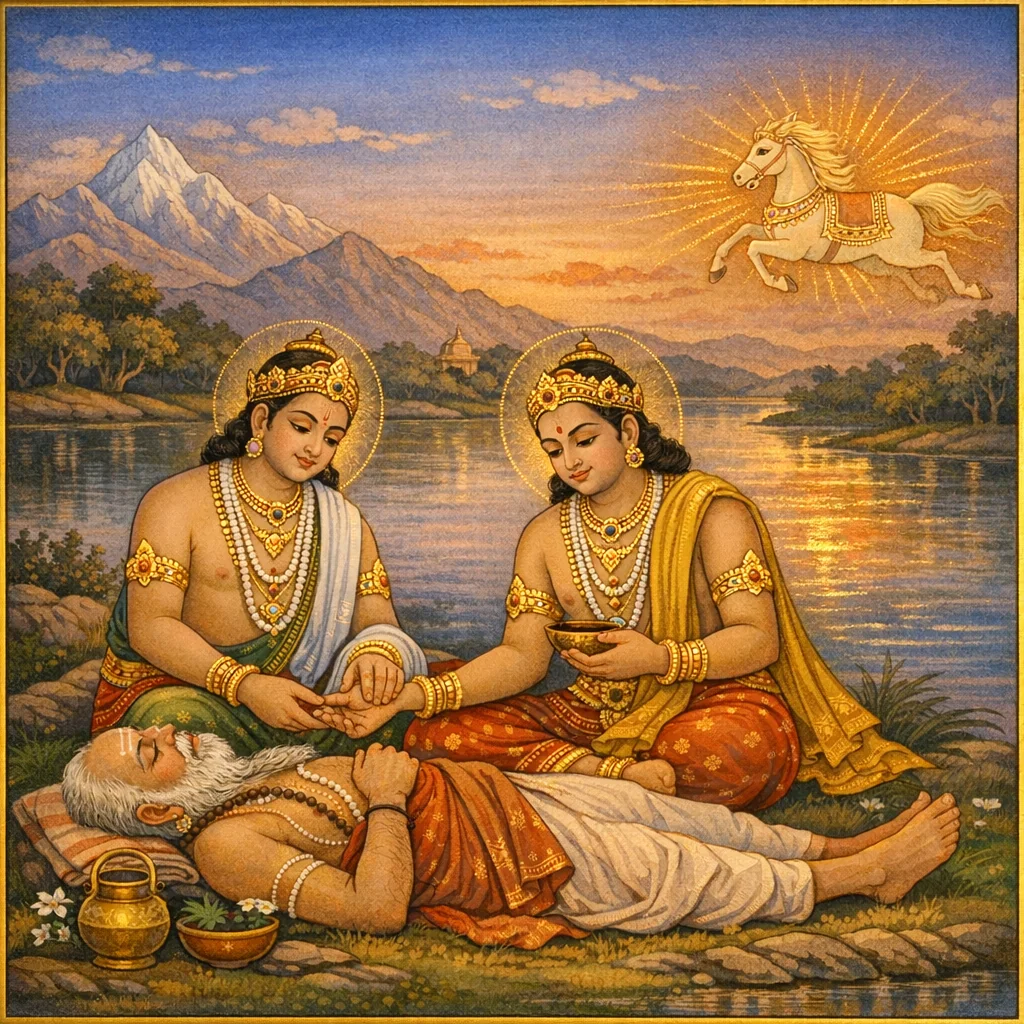
Mārkaṇḍeya continues his catalogue of tīrthas, introducing Aśvinī Tīrtha as an eminent pilgrimage ford, praised as “kāmika” (aimed at fulfilling one’s wishes) and as bestowing siddhi upon living beings. The Aśvin twins (Nā́satyau) are portrayed as exemplary divine physicians who performed great tapas at this ford; by that austerity they became entitled to shares in sacrifice (yajña) and won broad approval among the gods. When Yudhiṣṭhira asks why they are called the Sun’s sons, Mārkaṇḍeya gives a compressed myth: a queen, unable to endure the Sun’s excessive radiance, undertakes severe austerities in a Meru region; the Sun, stirred by desire, assumes a horse-form; conception occurs through the nasal route, and the famed Nā́satyau are born. The chapter then returns to the Narmadā landscape, stating that the twins practiced difficult austerities near Bhṛgukaccha on the riverbank and attained supreme accomplishment. It concludes with a merit statement: one who bathes at this tīrtha and offers tarpaṇa to pitṛs and deities gains beauty and good fortune wherever they are born.
Shlokas
Verse 1
श्रीमार्कण्डेय उवाच । तस्यैवानन्तरं राजन्नाश्विनं तीर्थमुत्तमम् । कामिकं सर्वतीर्थानां प्राणिनां सिद्धिदायकम्
Śrī Mārkaṇḍeya said: “Immediately after that, O King, there is the supreme holy ford called Āśvina—beloved among all tīrthas—bestowing siddhi (spiritual accomplishment) upon living beings.”
Verse 2
तत्र तीर्थेऽश्विनौ देवौ सुरूपौ भिषजां वरौ । तपः कृत्वा सुविपुलं संजातौ यज्ञभागिनौ
At that tīrtha, the two Aśvin gods—fair of form, the foremost of physicians—performed exceedingly vast austerity (tapas), and thus attained a share in the sacrifices (yajñas) as recipients of offerings.
Verse 3
संमतौ सर्वदेवानामादित्यतनयावुभौ । नासत्यौ सत्त्वसंपन्नौ सर्वदुःखघ्नसत्तमौ
Both—sons of Āditya—were approved by all the gods: the Nāsatyas, endowed with noble excellence, the most eminent who destroy every sorrow.
Verse 4
युधिष्ठिर उवाच । आदित्यस्य सुतौ तात नासत्यौ येन हेतुना । संजातौ श्रोतुमिच्छामि निर्णयं परमं द्विज
Yudhiṣṭhira said: “Revered sir, for what reason did the Nāsatyas become sons of Āditya? O brāhmaṇa, I wish to hear the highest determination—the clear account of this.”
Verse 5
मार्कण्डेय उवाच । पुराणे भास्करे तात एतद्विस्तरतो मया । संश्रुतं देवदेवस्य मार्तण्डस्य महात्मनः
Mārkaṇḍeya said: “Dear one, in the Bhāskara Purāṇa I heard this in detail—the account concerning the great-souled Mārtaṇḍa, the God of gods.”
Verse 6
तत्ते संक्षेपतः सर्वं भक्तियुक्तस्य भारत । कथयामि न सन्देहो वृद्धभावेन कर्शितः
All this I shall tell you in brief, O Bhārata, for you are endowed with devotion (bhakti); there is no doubt, though I am worn by the condition of old age.
Verse 7
अतितेजोरवेर्दृष्ट्वा राज्ञी देवी नरोत्तम । चचार मेरुकान्तारे वडवा तप उल्बणम्
Seeing the Sun’s excessive radiance, the divine queen, O best of men, wandered in the forest-regions of Meru, practicing fierce tapas in the form of a mare.
Verse 8
ततः कतिपयाहस्य कालस्य भगवान्रविः । दृष्ट्वा तु रूपमुत्सृज्य परमं तेज उज्ज्वलम्
Then, after some days had passed, the blessed Sun—having beheld the situation—cast off his former appearance, setting aside his supremely blazing radiance.
Verse 9
मनोभववशीभूतो हयो भूत्वा लघुक्रमः । विस्फुरन्ती यथाप्राणं धावमाना इतस्ततः
Overpowered by Manobhava, the god of desire, he became a swift-stepping horse; and she, trembling as her very breath surged, ran about here and there.
Verse 10
हेषमाणः स्वरेणासौ मैथुनायोपचक्रमे । सम्मुखी तु ततो देवी निवृत्ता लघुविक्रमा
Neighing loudly, he set about seeking union; but then the goddess turned to face him and withdrew, swift in her movements.
Verse 11
यथा तथा नासिकायां प्रविष्टं बीजमुत्तमम् । ततो नासागते बीजे संजातो गर्भ उत्तमः
In some manner, the excellent seed entered her nostril; and from that seed lodged in the nose, an excellent conception arose.
Verse 12
जातौ यतः सुतौ पार्थ नासत्यौ विश्रुतौ ततः । सुसमौ सुविभक्ताङ्गौ बिम्बाद्बिम्बमिवोद्यतौ
From that, O Pārtha, were born two sons, famed as the Nāsatyas—perfectly alike, with well-proportioned limbs—like one radiant orb arising from another.
Verse 13
अधिकौ सर्वदेवानां रूपैश्चर्यसमन्वितौ । नर्मदातटमाश्रित्य भृगुकच्छे गतावुभौ । परां सिद्धिमनुप्राप्तौ तपः कृत्वा सुदुश्चरम्
Surpassing all the gods in beauty and endowed with wondrous splendor, both went to Bhṛgukaccha, taking refuge on the bank of the Narmadā; performing severe and difficult austerities, they attained the highest perfection.
Verse 14
तत्र तीर्थे तु यः स्नात्वा तर्पयेत्पितृदेवताः । सुरूपः सुभगः पार्थ जायते यत्र तत्र च
Whoever bathes at that tīrtha and offers tarpana to the Pitṛs and the deities—he, O Pārtha, wherever he may be born, is born handsome and fortunate.
Verse 199
अध्याय
“Adhyāya” — a chapter marker indicating a chapter/section break in the manuscript tradition.