Adhyaya 73
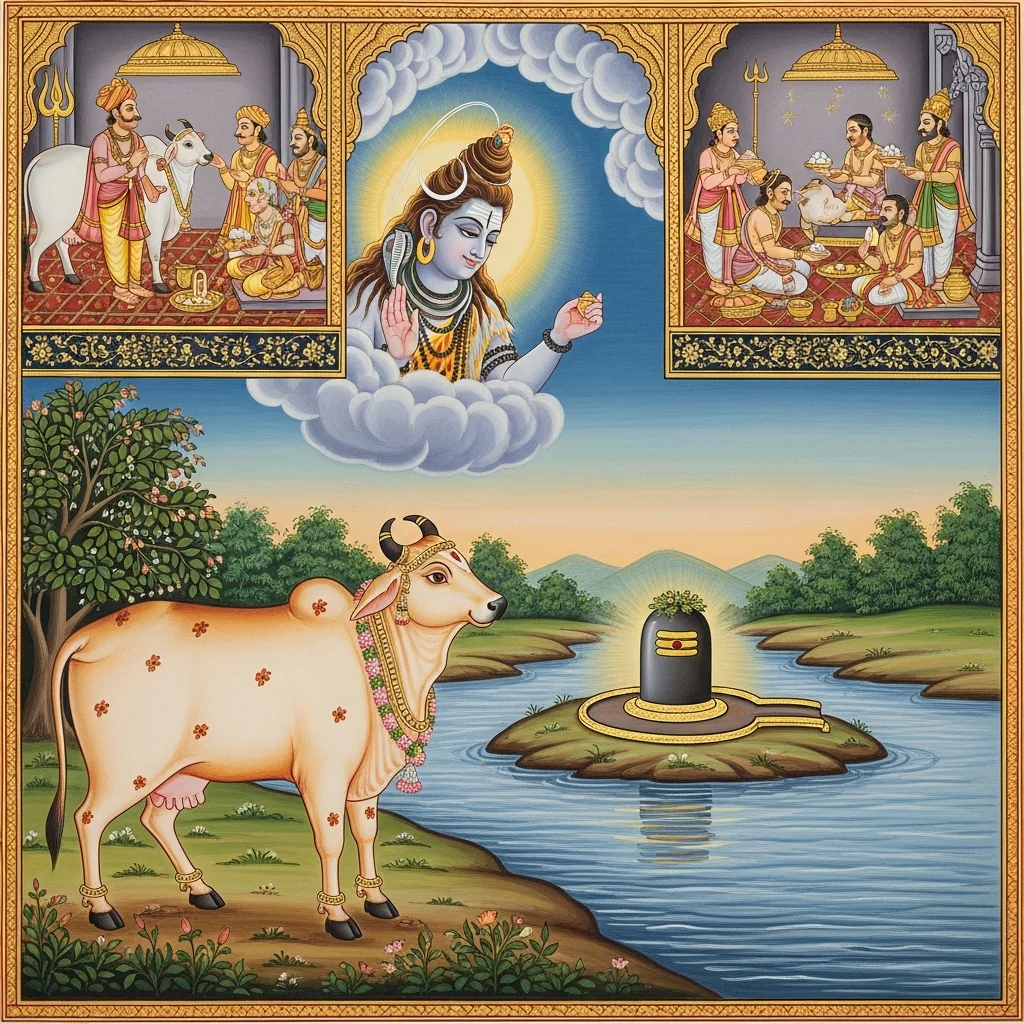
This chapter unfolds as a theological question–response. Yudhiṣṭhira asks Mārkaṇḍeya to explain briefly why a liṅga said to have “emerged from a cow’s body” is established on the southern bank of the Narmadā near Maṇināga, and why it is famed as a destroyer of sin. Mārkaṇḍeya relates that Surabhi/Kapilā, the archetypal cow, performed devotion and deep contemplation of Maheśvara for the welfare of the worlds; Śiva, pleased, manifested and consented to dwell at that tīrtha, making it renowned for swift purification through a single bath. The chapter then lays down ethical norms for ritual giving: the “Gopāreśvara go-dāna” should be done with faith, gifting an eligible cow—adorned with gold/ornaments as prescribed—to a qualified brāhmaṇa, with calendrical notes (such as kṛṣṇa pakṣa caturdaśī/aṣṭamī and special emphasis on Kārttika). It also lists supporting rites: piṇḍadāna for the uplift of a preta, daily Rudra-namaskāra as a dissolver of sin, and vṛṣotsarga (release/donation of a bull) benefiting the pitṛs and granting prolonged honor in Śiva-loka in proportion to the bull’s hairs, followed by auspicious rebirth. The discourse closes by reaffirming the site as Gopāreśvara on the Narmadā’s southern bank, with the liṅga’s extraordinary origin marking the tīrtha’s sanctity.
Shlokas
Verse 1
श्रीमार्कण्डेय उवाच । नर्मदादक्षिणे कूले तीर्थं परमशोभनम् । सर्वपापहरं पार्थ गोपारेश्वरमुत्तमम् । गोदेहान्निःसृतं लिङ्गं पुण्यं भूमितले नृप
Śrī Mārkaṇḍeya said: On the southern bank of the Narmadā there is a supremely beautiful sacred ford, O Pārtha—Gopāreśvara, the most excellent—destroyer of all sins. There, O King, upon the earth lies a holy liṅga that manifested forth from the body of a cow.
Verse 2
युधिष्ठिर उवाच । गोदेहान्निःसृतं कस्माल्लिङ्गं पापक्षयंकरम् । दक्षिणे नर्मदाकूले मणिनागसमीपतः । संक्षेपात्कथ्यतां विप्र गोपारेश्वरसम्भवम्
Yudhiṣṭhira said: Why did that liṅga—issuing from a cow’s body—become a destroyer of sins? Near Maṇināga, on the southern bank of the Narmadā—tell me briefly, O Brāhmaṇa, the origin of Gopāreśvara.
Verse 3
श्रीमार्कण्डेय उवाच । कामधेनुस्तपस्तत्र पुरा पार्थ चकार ह । ध्यायते परया भक्त्या देवदेवं महेश्वरम्
Śrī Mārkaṇḍeya said: Formerly, O Pārtha, Kāmadhenu performed austerities there, meditating with supreme devotion upon Maheśvara, the God of gods.
Verse 4
तुष्टस्तस्या जगन्नाथ कपिलाय महेश्वरः । निःसृतो देहमध्यात्तु अच्छेद्यः परमेश्वरः
Pleased with her, the Lord of the world—Maheśvara—manifested for Kapilā, emerging from the midst of her body as the indivisible Supreme Lord.
Verse 5
तुष्टो देवि जगन्मातः कपिले परमेश्वरि । आराधनं कृतं यस्मात्तद्वदाशु शुभानने
O Goddess, O Mother of the world—O Kapilā, supreme lady—since worship has been performed by you, speak at once, O fair-faced one, and state your wish accordingly.
Verse 6
सुरभ्युवाच । लोकानामुपकाराय सृष्टाहं परमेष्ठिना । लोककार्याणि सर्वाणि सिध्यन्ति मत्प्रसादतः
Surabhī said: For the benefit of the worlds I was created by Parameṣṭhin (Brahmā). By my favor, all the works and aims of beings in the world are accomplished.
Verse 7
लोकाः स्वर्गं प्रयास्यन्ति मत्प्रसादेन शङ्कर । तीर्थे त्वं भव मे शम्भो लोकानां हितकाम्यया
O Śaṅkara, by my grace people may attain heaven. Therefore, O Śambhu, become present for me at this tīrtha, out of a desire for the welfare of the worlds.
Verse 8
तथेति भगवानुक्त्वा तीर्थे तत्रावसन्मुदा । तदाप्रभृति तत्तीर्थं विख्यातं वसुधातले । स्नानेनैकेन राजेन्द्र पापसङ्घं व्यपोहति
Saying, “So be it,” the Blessed Lord joyfully dwelt there at that tīrtha. From that time onward, that sacred place became renowned upon the earth. O lord of kings, by a single bath there one dispels a multitude of sins.
Verse 9
गोपारेश्वरगोदानं यस्तु भक्त्या च कारयेत् । योग्ये द्विजोत्तमे देया योग्या धेनुः सकाञ्चना
Whoever, with devotion, arranges the cow-gift in honor of Gopāreśvara should give to a worthy best of the twice-born a suitable cow together with gold.
Verse 10
सवत्सा तरुणी शुभ्रा बहुक्षीरा सवस्त्रका । कृष्णपक्षे चतुर्दश्यामष्टम्यां वा प्रदापयेत्
One should donate a young white cow—together with her calf—abundant in milk and accompanied by cloth; and one should give it on the fourteenth day of the dark fortnight, or on the eighth.
Verse 11
सर्वेषु चैव मासेषु कार्त्तिके च विशेषतः । दापयेत्परया भक्त्या द्विजे स्वाध्यायतत्परे
In every month—and especially in the month of Kārttika—one should, with supreme devotion, bestow gifts upon a twice-born who is devoted to sacred study (svādhyāya).
Verse 12
विधिना च प्रदद्याद्यो विधिना यस्तु गृह्णते । तावुभौ पुण्यकर्माणौ प्रेक्षकः पुण्यभाजनम्
He who gives according to proper rite, and he who receives according to proper rite—both perform meritorious action; even the onlooker becomes a vessel of merit.
Verse 13
पिण्डदानं प्रकुर्याद्यः प्रेतानां भक्तिसंयुतः । पिण्डेनैकेन राजेन्द्र प्रेता यान्ति परां गतिम्
Whoever performs the piṇḍa-offering for the departed, endowed with devotion—O best of kings—even by a single piṇḍa the spirits of the dead attain the highest state.
Verse 14
भक्त्या प्रणामं रुद्रस्य ये कुर्वन्ति दिने दिने । तेषां पापं प्रलीयेत भिन्नपात्रे जलं यथा
Those who, day after day, bow to Rudra with devotion—their sin dissolves away, like water in a cracked vessel.
Verse 15
तत्र तीर्थे तु यो राजन्वृषभं च समुत्सृजेत् । पितरश्चोद्धृतास्तेन शिवलोके महीयते
O king, whoever there at that sacred ford releases a bull in donation (vṛṣotsarga)—by him the ancestors are uplifted, and he is honored in Śiva’s world.
Verse 16
युधिष्ठिर उवाच । वृषोत्सर्गे कृते तात फलं यज्जायते नृणाम् । तत्सर्वं कथयस्वाशु प्रयत्नेन द्विजोत्तम
Yudhiṣṭhira said: ‘O revered one, O best of Brāhmaṇas—tell me quickly and with care the entire fruit that arises for men when vṛṣotsarga is performed.’
Verse 17
श्रीमार्कण्डेय उवाच । सर्वलक्षणसम्पूर्णे वृषे चैव तु यत्फलम् । तदहं सम्प्रवक्ष्यामि शृणुष्व धर्मनन्दन
Śrī Mārkaṇḍeya said: ‘The fruit that comes from releasing a bull endowed with every auspicious mark—I shall now declare it. Listen, O son of Dharma.’
Verse 18
कार्त्तिके चैव वैशाखे पूर्णिमायां नराधिप । रुद्रस्य सन्निधौ भूत्वा शुचिः स्नातो जितेन्द्रियः
In Kārttika and likewise in Vaiśākha, on the full-moon day, O lord of men—having come into Rudra’s presence, pure, bathed, and self-controlled—
Verse 19
वृषस्यैव समुत्सर्गं कारयेत्प्रीयतां हरः । सांनिध्ये कारयेत्पुत्र चतस्रो वत्सिकाः शुभाः
One should release a bull as a sacred gift, that Hara (Śiva) may be pleased. And in that very presence, O son, one should also provide four auspicious heifer-calves.
Verse 20
दत्त्वा तु विप्रमुख्याय सर्वलक्षणसंयुताः । प्रीयतां च महादेवो ब्रह्मा विष्णुर्महेश्वरः
Having bestowed them—endowed with every auspicious mark—upon a foremost Brāhmaṇa, may Mahādeva be pleased; may Brahmā, Viṣṇu, and Maheśvara also be pleased.
Verse 21
वृषभे रोमसंख्या या सर्वाङ्गेषु नराधिप । तावद्वर्षप्रमाणं तु शिवलोके महीयते
O king, for as many years as there are hairs upon the entire body of a bull, for that very span one is honored and exalted in Śiva’s world.
Verse 22
शिवलोके वसित्वा तु यदा मर्त्येषु जायते । कुले महति सम्भूतिर्धनधान्यसमाकुले
After dwelling in Śiva’s world, when one is born again among mortals, one is born into a great lineage, abounding in wealth and grain.
Verse 23
नीरोगो रूपवांश्चैव विद्याढ्यः सत्यवाक्शुचिः । गोपारेश्वरमाहात्म्यं मया ख्यातं युधिष्ठिर । गोदेहान्निःसृतं लिङ्गं नर्मदादक्षिणे तटे
One becomes healthy, handsome, rich in learning, truthful in speech, and pure. O Yudhiṣṭhira, thus have I proclaimed the greatness of Gopāreśvara: the liṅga that manifested from the body of a cow upon the southern bank of the Narmadā.
Verse 73
। अध्याय
End of the chapter (colophon/closing marker).