Adhyaya 95
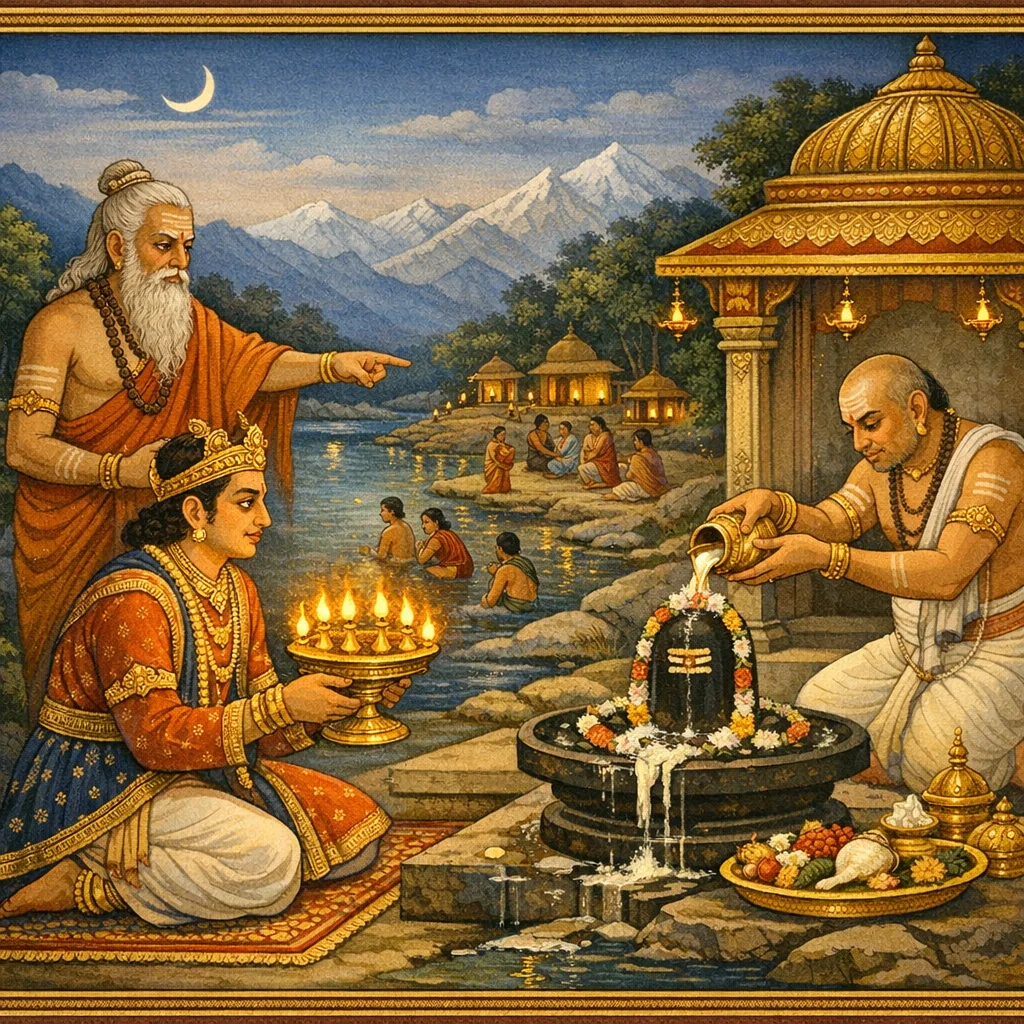
Mārkaṇḍeya instructs the king to go to the eminent Badrikāśrama tīrtha, a supreme sacred ford once praised by Śambhu. The place is linked with Nara–Nārāyaṇa, and a bhakti-joined-with-gnosis attitude is taught: one who is devoted to Janārdana and sees the same Self in all beings—even across social extremes—is pleasing to the Divine. Nara–Nārāyaṇa are said to have founded the āśrama, and Śaṅkara was installed there for the welfare of the worlds; a tri-mūrti-associated liṅga is described as granting heavenly paths and liberation. The chapter prescribes observance: purity, a one-night fast, abandoning rajas and tamas for a sāttvika orientation, and night-vigil on specified lunar dates (aṣṭamī in Madhu-māsa and caturdaśī in either fortnight, with special emphasis on Aśvin). Śiva’s abhiṣeka is detailed with pañcāmṛta—milk, honey, curd, sugar, and ghee. The phala promises closeness to Śiva and Indra-world results for sincere witnesses; even imperfect salutations to Śūlapāṇi loosen bondage, while steady japa of “namaḥ śivāya” makes merit firm. It further outlines śrāddha using Narmadā water, stressing qualified Brahmin recipients and excluding unethical or unfit officiants. Gifts such as gold, food, cloth, cow, bull, land, umbrella, and suitable items are recommended, with heavenly attainment declared. Finally, death at or near the tīrtha (including by water) is said to lead to Śiva’s abode, long residence in divine realms, and eventual return as a capable ruler who remembers the tīrtha and comes again.
Shlokas
Verse 1
श्रीमार्कण्डेय उवाच । ततो गच्छेत्तु राजेन्द्र बदर्याश्रममुत्तमम् । सर्वतीर्थवरं पुण्यं कथितं शंभुना पुरा
Śrī Mārkaṇḍeya said: “Then, O best of kings, one should proceed to the excellent Badaryāśrama—holy and supreme among all tīrthas—whose sanctity was formerly proclaimed by Śambhu (Śiva).”
Verse 2
यश्चैष भारतस्यार्थे तत्र सिद्धः किरीटभृत् । भ्राता ते फाल्गुनो नाम विद्ध्येनं नरदैवतम्
And there, for the sake of the Bhārata, the crown-bearing one attained perfection. Know him as your brother named Phālguna (Arjuna)—a god among men.
Verse 3
नरनारायणौ द्वौ तावागतौ नर्मदातटे । ज्ञानं तस्यैव यो राजन्भक्तिमान्वै जनार्दने
Those two—Nara and Nārāyaṇa—came to the bank of the Narmadā. And, O king, true knowledge belongs to the one who is devoted to Janārdana (Viṣṇu).
Verse 4
समं पश्यति सर्वेषु स्थावरेषु चरेषु च । ब्राह्मणं श्वपचं चैव तत्र प्रीतो जनार्दनः
He who sees with equal vision all beings—both the immovable and the moving—seeing alike even a brāhmaṇa and a dog-eater, in that person Janārdana is pleased.
Verse 5
ऐकात्म्यं पश्य कौन्तेय मयि चात्मनि नान्तरम् । नरनारायणाभ्यां हि कृतं बदरिकाश्रमम्
Behold the oneness of the Self, O son of Kuntī—between Me and the Ātman there is no difference. Indeed, Badarikāśrama was established by Nara and Nārāyaṇa.
Verse 6
स्थापितः शङ्करस्तत्र लोकानुग्रहकारणात् । त्रिमूर्तिस्थापितं लिङ्गं स्वर्गमार्गानुमुक्तिदम्
There Śaṅkara was installed for the welfare of the worlds. The liṅga established by the Trimūrti grants access to the path of heaven and bestows release.
Verse 7
तत्र गत्वा शुचिर्भूत्वा ह्येकरात्रोपवासकृत् । रजस्तमस्तथा त्यक्त्वा सात्त्विकं भावमाश्रयेत्
Having gone there and become pure, one should keep a fast for a single night; casting off rajas and tamas, one should take refuge in a sāttvika disposition.
Verse 8
रात्रौ जागरणं कृत्वा मधुमासाष्टमीदिने । अथवा च चतुर्दश्यामुभौ पक्षौ च कारयेत्
Keeping vigil through the night on the eighth day of Madhu-māsa, or else on the fourteenth lunar day (tithi), one may perform it in both fortnights, bright and dark.
Verse 9
आश्विनस्य विशेषेण कथितं तव पाण्डव । स्नापयेत्परया भक्त्या क्षीरेण मधुना सह
O Pāṇḍava, I have explained to you the special sanctity of the month of Āśvina. At that time one should bathe the Lord (perform abhiṣeka) with supreme devotion, using milk together with honey.
Verse 10
दध्ना शर्करया युक्तं घृतेन समलंकृतम् । पञ्चामृतमिदं पुण्यं स्नापयेद्वृषभध्वजम्
With curd mixed with sugar and adorned with ghee—this is the holy pañcāmṛta; with it one should bathe Vṛṣabhadhvaja (Śiva), for it is greatly meritorious.
Verse 11
स्नाप्यमानं शिवं भक्त्या वीक्षते यो विमत्सरः । तस्य वासः शिवोपान्ते शक्रलोके न संशयः
Whoever, free from envy, beholds with devotion Lord Śiva being bathed (in abhiṣeka), for him there is dwelling near Śiva—indeed in the world of Śakra (Indra); of this there is no doubt.
Verse 12
शाठ्येनापि नमस्कारः प्रयुक्तः शूलपाणिने । संसारमूलबद्धानामुद्वेष्टनकरो हि यः
Even a salutation offered—though with duplicity—to the Trident-bearing Lord becomes a loosener of the knots of those bound at the root of saṃsāra; such is its power.
Verse 13
तेनाधीतं श्रुतं तेन तेन सर्वमनुष्ठितम् । येनौं नमः शिवायेति मन्त्राभ्यासः स्थिरीकृतः
By him all study is truly studied, by him all learning is truly heard, and by him all rites are accomplished—by whom the steady practice of the mantra ‘Oṃ Namaḥ Śivāya’ has been firmly established.
Verse 14
यः पुनः स्नापयेद्भक्त्या एकभक्तो जितेन्द्रियः । तस्यापि यत्फलं पार्थ वक्ष्ये तल्लेशतस्तव
But he who again bathes the Lord with devotion—single-minded and self-controlled—his fruit too, O Pārtha, I shall tell you, even if only in brief.
Verse 15
पीडितो वृद्धभावेन तव भक्त्या वदाम्यहम् । ते यान्ति परमं स्थानं भित्त्वा भास्करमण्डलम्
Pressed by old age, yet speaking because of your devotion, I declare: such devotees attain the supreme abode, piercing beyond the sphere of the Sun.
Verse 16
संसारे सर्वसौख्यानां निलयास्ते भवन्ति च । आश्चर्यं ज्ञातिवर्गाणां धर्माणां निलयास्तु ते
And in the world they become abodes of every happiness. Wondrous indeed—they become refuges for their families and abiding seats of dharma.
Verse 17
सम्पन्नाः सर्वकामैस्ते पृथिव्यां पृथिवीपते । श्राद्धं तत्रैव यः कुर्यान्नर्मदोदकमिश्रितम्
O Lord of the earth, upon this earth they become fulfilled with every desired good. And whoever performs śrāddha right there, with offerings mixed with the waters of the Narmadā—
Verse 18
योग्यैश्च ब्राह्मणैर्राजन्कुलीनैर्वेदपारगैः । सुरूपैश्च सुशीलैश्च स्वदारनिरतैः शुभैः
—(it should be done) with worthy brāhmaṇas, O King: of good lineage, versed in the Vedas, fair in form, well-conducted, devoted to their own wives, and of auspicious character.
Verse 19
आर्यदेशप्रसूतैश्च श्लक्ष्णैश्चैव सुरूपिभिः । कारयेत्पिण्डदानं वै भास्करे कुतपस्थिते
When the Sun is in the auspicious Kutapa time, one should have the offering of piṇḍas performed by worthy brāhmaṇas—born in noble lands, refined in conduct, and of pleasing character—so that the rite becomes truly fruitful.
Verse 20
पित्ःणां परमं लोकं यदीच्छेद्धर्मनन्दन । वर्जयेत्तान्प्रयत्नेन काणान्दुष्टांश्च दाम्भिकान्
O delight of Dharma, if one seeks the supreme realm for the Pitṛs, one should diligently avoid employing the one-eyed, the wicked, and the hypocritical in these sacred rites.
Verse 21
तस्मात्सर्वप्रयत्नेन योग्यं विप्रं समाश्रयेत् । नरकान्मोचयेत्प्रेतान्कुम्भीपाकपुरोगमान्
Therefore, with every effort one should take refuge in a qualified vipra (brāhmaṇa); thereby the departed may be delivered from hells—Kumbhīpāka and the like—that lie before them.
Verse 22
मोक्षो भवति सर्वेषां पित्ःणां नृपनन्दन । विप्रेभ्यः काञ्चनं दद्यात्प्रीयतां मे पितामहः
O prince, liberation comes to all the Pitṛs. One should give gold to brāhmaṇas with the prayer, “May my grandfather be pleased.”
Verse 23
अन्नं च दापयेत्तत्र भक्त्या वस्त्रं च भारत । गां वृषं मेदिनीं दद्याच्छत्रं शस्तं नृपोत्तम
There, with devotion, let him also distribute food and garments, O Bhārata. Let him give a cow, a bull, land, and an excellent umbrella, O best of kings.
Verse 24
स पुमान्स्वर्गमाप्नोति इत्येवं शङ्करोऽब्रवीत् । प्राणत्यागं तु यः कुर्याच्छिखिना सलिलेन वा
“That man attains heaven”—thus spoke Śaṅkara. Moreover, whoever gives up his life—whether by fire or by water—(in this sacred context…)
Verse 25
अनाशकेन वा भूयः स गच्छेच्छिवमन्दिरम् । नरनारायणीतीरे देवद्रोण्यां च यो नृप
…or again by fasting unto death—he goes to Śiva’s abode. And, O king, whoever (meets his end or performs the vowed act) on the bank of the Nara-Nārāyaṇī, at Devadroṇī…
Verse 26
स वसेदीश्वरस्याग्रे यावदिन्द्राश्चतुर्दश । पुनः स्वर्गाच्च्युतः सोऽपि राजा भवति वीर्यवान्
He dwells in the presence of the Lord for as long as fourteen Indras endure; and when he later falls from heaven, he is born again as a mighty king.
Verse 27
सर्वैश्वर्यगुणैर्युक्तः प्रजापालनतत्परः । ततः स्मरति तत्तीर्थं पुनरेवागमिष्यति
Endowed with every sign of sovereignty and virtue, devoted to the protection of his subjects, he then remembers that holy ford—and once again returns to it.
Verse 95
। अध्याय
“Chapter” (Adhyāya): a colophon marker; incomplete as transmitted here.