Adhyaya 104
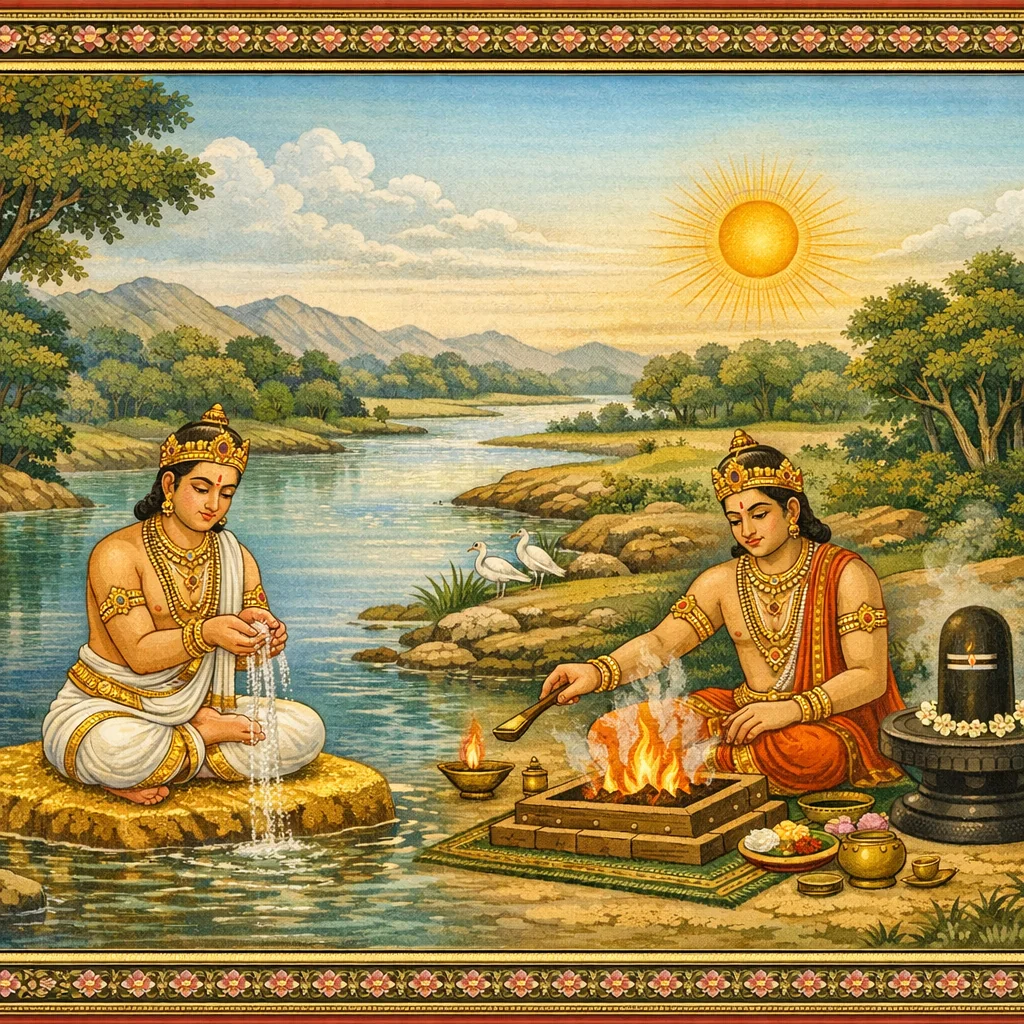
Mārkaṇḍeya instructs a ruler to go to the eminent holy place called Sauvarṇaśilā, famed on the northern bank of the Revā as a remover of all demerit. Located near a saṅgama, it was ritually established in ancient times by groups of sages and is therefore said to be durlabha—hard to obtain—though small in extent, it is a highly potent field of merit. The observance is given in order: bathe at Sauvarṇaśilā; worship Maheśvara; bow to Bhāskara, the Sun; then offer into the sacred fire bilva mixed with ghee, or bilva leaves. A brief prayer is taught, asking that the Lord be pleased and that illness cease. The teaching then turns to dāna: giving gold to a worthy Brahmin is declared equal to the highest fruits of vast gold-gifts and great sacrifices. After death the donor ascends to heaven and remains long in Rudra’s company, then descends to be reborn auspiciously in a pure and prosperous lineage, retaining remembrance of that sacred water.
Shlokas
Verse 1
श्रीमार्कण्डेय उवाच । ततो गच्छेन्महीपालं सौवर्णशिलमुत्तमम् । प्रख्यातमुत्तरे कूले सर्वपापक्षयंकरम्
Śrī Mārkaṇḍeya said: Then, O king, one should go to the excellent Sauvarṇaśilā, renowned upon the northern bank, which brings about the destruction of all sins.
Verse 2
समन्ताच्छतपातेन मुनिसङ्घैः पुरा कृतम् । रेवायां दुर्लभं स्थानं सङ्गमस्य समीपतः
Long ago, hosts of sages made this place sacred on every side through repeated pradakṣiṇā and worship. On the Revā it is a rare and hard-to-attain holy spot, situated close to the Saṅgama.
Verse 3
विभक्तं हस्तमात्रं च पुण्यक्षेत्रं नराधिप । सुवर्णशिलके स्नात्वा पूजयित्वा महेश्वरम्
O lord of men, this meritorious kṣetra is set apart, only a hand’s measure in extent. Having bathed at Suvarṇaśilā and having worshipped Maheśvara (Śiva)…
Verse 4
नत्वा तु भास्करं देवं होतव्यं च हुताशने । बिल्वेनाज्यविमिश्रेण बिल्वपत्रैरथापि वा
Having bowed to the divine Bhāskara (the Sun), one should also offer āhuti into the sacred fire—using bilva fruit mixed with ghee, or else with bilva leaves.
Verse 5
प्रीयतां मे जगन्नाथो व्याधिर्नश्यतु मे ध्रुवम् । द्विजाय काञ्चने दत्ते यत्फलं तच्छृणुष्व मे
“May Jagannātha, the Lord of the world, be pleased with me; may my illness surely be destroyed.” Hear from me the fruit that arises when gold is given as dāna to a twice-born (brāhmaṇa).
Verse 6
बहुस्वर्णस्य यत्प्रोक्तं यागस्य फलमुत्तमम् । तथासौ लभते सर्वं काञ्चनं यः प्रयच्छति
Whatever supreme fruit is declared for a yajña performed with abundant gold, that very fruit in full is obtained by the one who gives gold in charity.
Verse 7
तेन दानेन पूतात्मा मृतः स्वर्गमवाप्नुयात् । रुद्रस्यानुचरस्तावद्यावदिन्द्राश्चतुर्दश
By that gift his ātman is purified; and when he dies, he attains heaven. There he remains an attendant of Rudra for as long as fourteen Indras endure.
Verse 8
ततः स्वर्गावतीर्णस्तु जायते विशदे कुले । धनधान्यसमोपेतः पुनः स्मरति तज्जलम्
Then, descending from heaven, he is born again in a pure and reputable family. Endowed with wealth and grain, he once more remembers that sacred water.
Verse 104
। अध्याय
End of the chapter (adhyāya); here the sacred passage concludes.