Adhyaya 106
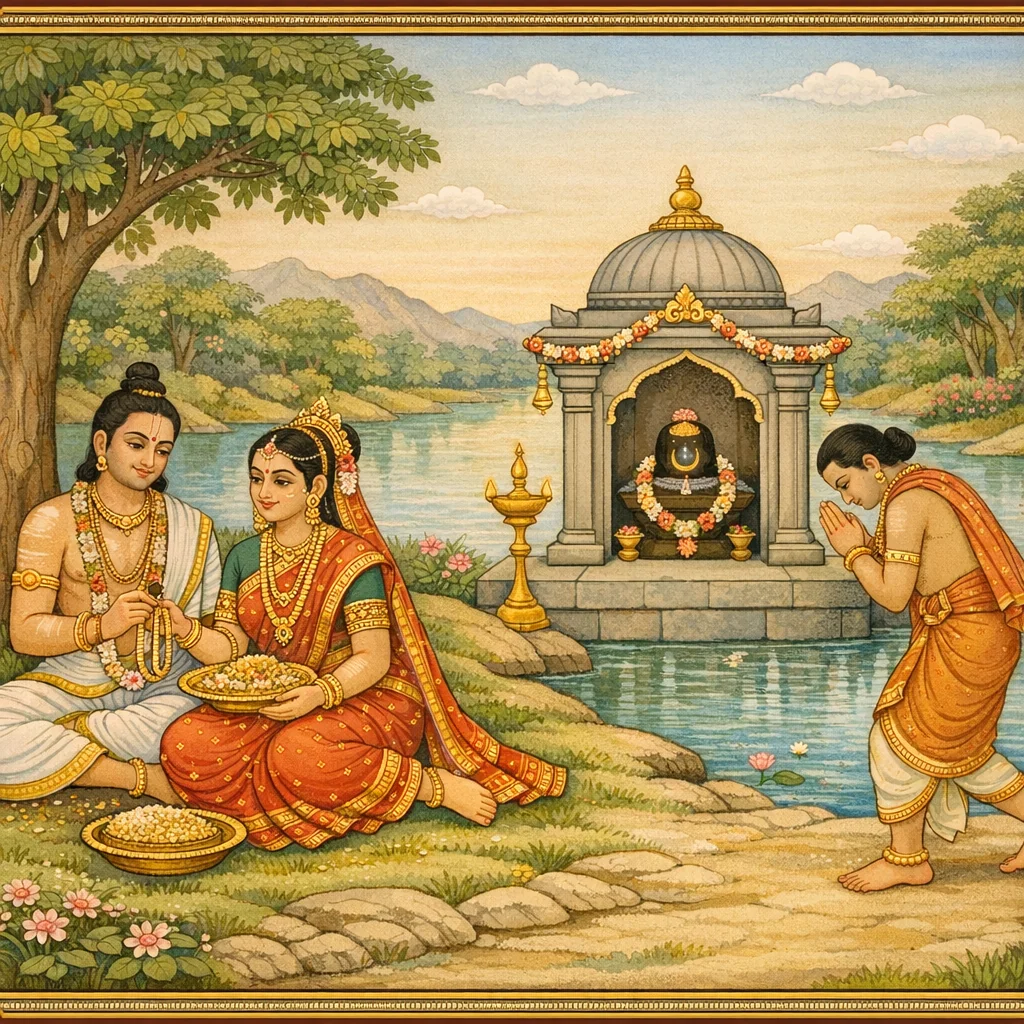
Chapter 106 is a prescriptive tīrtha-māhātmya taught by Mārkaṇḍeya, instructing a king to visit Mahīpāla Tīrtha, praised as supremely beautiful and a giver of saubhāgya (auspicious good fortune). The place is said to benefit women and men alike, especially those afflicted by misfortune, and it enjoins a focused worship of Umā and Rudra. A structured observance is given: disciplined conduct with restraint of the senses, fasting on the third lunar day, and the devotional invitation of a worthy brāhmaṇa couple. They are to be honored with fragrances, garlands, and perfumed garments, and fed with pāyasa and kṛsara; then one should circumambulate and recite a prayer seeking the favor of Mahādeva with his consort, upholding the ideal of non-separation. The chapter contrasts results: neglect leads to prolonged ill-fortune—poverty, sorrow, and infertility across births—whereas correct performance, especially in the bright fortnight of Jyeṣṭha on the third day, grants release from sins and multiplies merit through gifts. It further prescribes honoring a brāhmaṇī and brāhmaṇa as embodiments of Gaurī and Śiva, applying sindūra and kuṅkuma, and donating ornaments, grains, food, and other offerings. The phalaśruti concludes with worldly and salvific rewards: increased merit, superior enjoyment aligned with Śaṅkara, abundant saubhāgya, a son for the childless, wealth for the poor, and Mahīpāla Tīrtha on the Narmadā as a wish-fulfilling sacred site.
Shlokas
Verse 1
श्रीमार्कण्डेय उवाच । ततो गच्छेन्महीपाल तीर्थं परमशोभनम् । सौभाग्यकरणं दिव्यं नरनारीमनोरमम्
Śrī Mārkaṇḍeya said: Then, O king, one should go to a supremely beautiful tīrtha, a sacred ford—a divine place that bestows good fortune, delightful to both men and women.
Verse 2
तत्र या दुर्भगा नारी नरो वा नृपसत्तम । स्नात्वार्चयेदुमारुद्रौ सौभाग्यं तस्य जायते
There, O best of kings, whether an unfortunate woman or a man—after bathing, one should worship Umā and Rudra; then good fortune arises for that person.
Verse 3
तृतीयायामहोरात्रं सोपवासो जितेन्द्रियः । निमन्त्रयेद्द्विजं भक्त्या सपत्नीकं सुरूपिणम्
During the third watch, for a full day and night, fasting and self-controlled, one should devoutly invite a brāhmaṇa of good appearance, together with his wife.
Verse 4
गन्धमाल्यैरलंकृत्य वस्त्रधूपादिवासितम् । भोजयेत्पायसान्नेन कृसरेणाथ भक्तितः
Adorning them with perfumes and garlands, and offering garments made fragrant with incense and the like, one should feed them in devotion with sweet rice (pāyasa) and with kṛsara.
Verse 5
भोजयित्वा यथान्यायं प्रदक्षिणमुदाहरेत् । प्रीयतां मे महादेवः सपत्नीको वृषध्वजः
Having fed them properly according to rule, one should perform circumambulation and recite: “May Mahādeva—Bull-bannered Śiva, together with His consort—be pleased with me.”
Verse 6
यथा ते देवदेवेश न वियोगः कदाचन । ममापि करुणां कृत्वा तथास्त्विति विचिन्तयेत्
“O Lord of gods, just as there is never any separation between You and Your consort, so too—showing compassion to me—let it be thus,” one should contemplate inwardly.
Verse 7
एवं कृते ततस्तस्य यत्पुण्यं समुदाहृतम् । तत्ते सर्वं प्रवक्ष्यामि यथा देवेन भाषितम्
When this has been done, the merit (puṇya) that is proclaimed to arise from it—I shall declare it all to you, exactly as it was spoken by the Lord.
Verse 8
दौर्भाग्यं दुर्गतिश्चैव दारिद्र्यं शोकबन्धनम् । वन्ध्यत्वं सप्तजन्मानि जायते न युधिष्ठिर
Misfortune and an unhappy course, poverty and bondage to sorrow—indeed, even barrenness for seven births—arise (for one who violates this dharma), O Yudhiṣṭhira.
Verse 9
ज्येष्ठमासे सिते पक्षे तृतीयायां विशेषतः । तत्र गत्वा तु यो भक्त्या पञ्चाग्निं साधयेत्ततः
Especially on the third lunar day (tṛtīyā) of the bright fortnight in the month of Jyeṣṭha, whoever goes to that sacred place and, with devotion, undertakes the five-fire austerity there—
Verse 10
सोऽपि पापैरशेषैस्तु मुच्यते नात्र संशयः । गुग्गुलं दहते यस्तु द्विधा चित्तविवर्जितः
—he too is freed from all sins; of this there is no doubt. And whoever burns guggulu resin, free from a divided (wavering) mind,
Verse 11
शरीरं भेदयेद्यस्तु गौर्याश्चैव समीपतः । तस्मिन्कर्मप्रविष्टस्य उत्क्रान्तिर्जायते यदि
Whoever, near Gaurī, pierces (mortifies) the body; if, while engaged in that rite, the ‘departure’ (death) occurs—
Verse 12
देहपाते व्रजेत्स्वर्गमित्येवं शङ्करोऽब्रवीत् । सितरक्तैस्तथा पीतैर्वस्त्रैश्च विविधैः शुभैः
—at the fall of the body, he goes to heaven: thus Śaṅkara declared. With white, red, and likewise yellow garments—various and auspicious—
Verse 13
ब्राह्मणीं ब्राह्मणं चैव पूजयित्वा यथाविधि । पुष्पैर्नानाविधैश्चैव गन्धधूपैः सुशोभनैः
Having duly honored a brāhmaṇī and a brāhmaṇa according to rule, with flowers of many kinds, and with beautifully fragrant perfumes and incense,
Verse 14
कण्ठसूत्रकसिन्दूरैः कुङ्कुमेन विलेपयेत् । कल्पयेत स्त्रियं गौरीं ब्राह्मणं शिवरूपिणम्
He should anoint (them) with neck-ornaments or neck-threads, with sindūra and with saffron (kuṅkuma). He should conceive the woman as Gaurī, and the brāhmaṇa as bearing the very form of Śiva.
Verse 15
तेषां तद्रूपकं कृत्वा दानमुत्सृज्यते ततः । कङ्कणं कर्णवेष्टं च कण्ठिकां मुद्रिकां तथा
Having fashioned representations in their likeness, one then offers gifts: bracelets, ear-ornaments, necklaces, and rings as well,
Verse 16
सप्तधान्यं तथा चैव भोजनं नृपसत्तम । अन्यान्यपि च दानानि तस्मिंस्तीर्थे ददाति यः
O best of kings, whoever gives at that tīrtha the seven kinds of grain, and food, and other gifts as well—
Verse 17
सर्वदानैश्च यत्पुण्यं प्राप्नुयान्नात्र संशयः । सहस्रगुणितं सर्वं नात्र कार्या विचारणा
The merit one would gain from all acts of charity—here one surely attains it. All is multiplied a thousandfold; no further deliberation is needed.
Verse 18
शङ्करेण समं तस्माद्भोगं भुङ्क्ते ह्यनुत्तमम् । सौभाग्यं तस्य विपुलं जायते नात्र संशयः
Therefore he enjoys unsurpassed felicity, equal to Śaṅkara’s. Vast good fortune arises for him—of this there is no doubt.
Verse 19
अपुत्रो लभते पुत्रमधनो धनमाप्नुयात् । राजेन्द्र कामदं तीर्थं नर्मदायां व्यवस्थितम्
O king of kings, at this wish-fulfilling sacred ford established on the Narmadā, the childless obtains a son, and the poor attains wealth.
Verse 106
। अध्याय
Chapter—colophon marker (Adhyāya).