Adhyaya 164
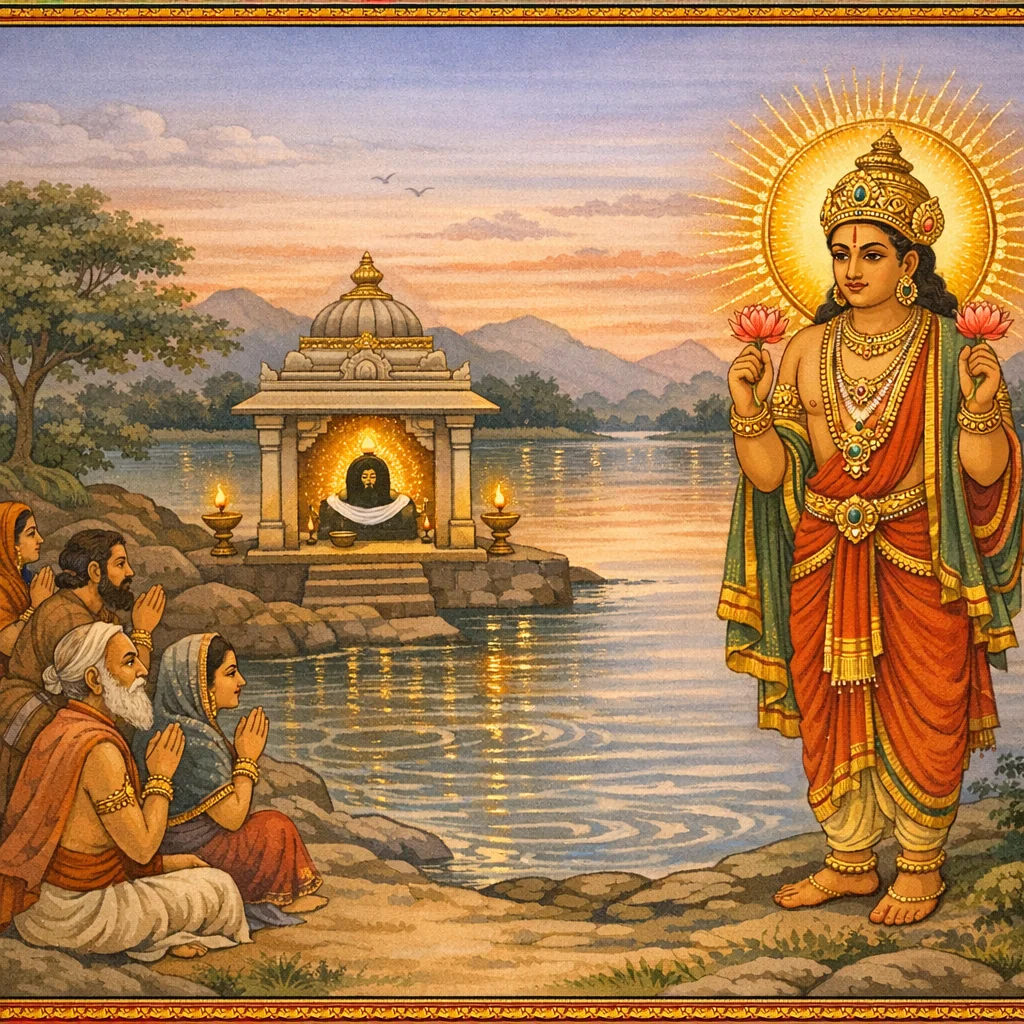
Śrī Mārkaṇḍeya extols an ‘uttama’ pilgrimage site called Sāṃvaura, made unique by the special presence of Bhānu/Sūrya (the Sun), worshiped by devas and asuras alike. The tīrtha is portrayed as a refuge for those crushed by severe suffering—physical impairment, disease-like afflictions, abandonment, and social isolation—described as being “submerged in an ocean of sorrow.” Their protector is Sāṃvauranātha on the bank of the Narmadā, praised as the remover of distress (ārtihā) and destroyer of suffering. A discipline is prescribed: continuous bathing at the tīrtha for one month, together with worship of Bhāskara (the Sun). The merit is magnified through equivalence claims—likened to bathing in the seas of the various directions—and it is declared that sins accumulated in youth, adulthood, and old age are destroyed by bathing alone. Further fruits include freedom from disease, poverty, and separation from what one desires, extending across seven births. Fasting on Saptamī (the seventh lunar day) and offerings such as arghya with red sandal are especially lauded. The waters of the Narmadā are praised as universally sin-destroying, and those who bathe and behold Sāṃvaureśvara are called blessed, with the concluding promise of dwelling in the Sun-world until cosmic dissolution.
Shlokas
Verse 1
श्रीमार्कण्डेय उवाच । ततो गच्छेन्महाराज सांवौरं तीर्थमुत्तमम् । यत्र संनिहितो भानुः पूज्यमानः सुरासुरैः
Śrī Mārkaṇḍeya said: “Then, O great King, one should go to the excellent Sāṃvaura Tīrtha, where Bhānu, the Sun, abides in manifest presence, worshipped by devas and asuras alike.”
Verse 2
तत्र ये पङ्गुतां प्राप्ताः शीर्णघ्राणनखा नराः । दद्रुमण्डलभिन्नाङ्गा मक्षिकाकृमिसंकुलाः
There, those men who have become lame—whose noses and nails have decayed, whose bodies are torn by ring-like eruptions, and who are afflicted by swarms of flies and worms—(come seeking relief).
Verse 3
मातापितृभ्यां रहिता भ्रातृभार्याविवर्जिताः । अनाथा विकला व्यङ्गा मग्ना ये दुःखसागरे
Bereft of mother and father, deprived of brother and wife—helpless, weakened, and disabled—those who are submerged in an ocean of sorrow (find shelter there).
Verse 4
तेषां नाथो जगद्योनिर्नर्मदातटमाश्रितः । सांवौरनाथो लोकानामार्तिहा दुःखनाशनः
Their protector is the Source of the world, dwelling on the bank of the Narmadā—Sāṃvauranātha, the remover of distress for all people, the destroyer of sorrow.
Verse 5
तत्र तीर्थे तु यः स्नात्वा मासमेकं निरन्तरम् । पूजयेद्भास्करं देवं तस्य पुण्यफलं शृणु
At that tīrtha, whoever bathes there and, for one full month without break, worships the god Bhāskara—listen to the meritorious fruit he gains.
Verse 6
यत्फलं चोत्तरे पार्थ तथा वै पूर्वसागरे । दक्षिणे पश्चिमे स्नात्वा तत्र तीर्थे तु तत्फलम्
Whatever fruit is gained by bathing in the holy waters of the north, and likewise in the Eastern Ocean—and similarly by bathing in the southern and western seas—that very fruit is obtained by bathing at that tīrtha.
Verse 7
कौमारे यौवने पापं वार्द्धके यच्च संचितम् । तत्प्रणश्यति सांवौरे स्नानमात्रान्न संशयः
Whatever sin has been accumulated in childhood, youth, and old age is destroyed at Sāṃvaura by mere bathing—of this there is no doubt.
Verse 8
न व्याधिर्नैव दारिद्र्यं न चैवेष्टवियोजनम् । सप्तजन्मानि राजेन्द्र सांवौरपरिसेवनात्
O lord of kings, by resorting to and serving Sāṃvaura, there is neither disease, nor poverty, nor separation from what is dear—for seven births.
Verse 9
सप्तम्यामुपवासेन तद्दिने चाप्युपोषिते । स तत्फलमवाप्नोति तत्र स्नात्वा न संशयः
By fasting on the seventh lunar day, and observing that fast on that day, one surely obtains the promised fruit by bathing there—of this there is no doubt.
Verse 10
रक्तचन्दनमिश्रेण यदर्घ्येण फलं स्मृतम् । तत्र तीर्थे नृपश्रेष्ठ स्नात्वा तत्फलमाप्नुयात्
O best of kings, whatever fruit is declared to arise from offering arghya mixed with red sandalwood—by bathing at that very tīrtha one attains the same fruit.
Verse 11
नर्मदासलिलं रम्यं सर्वपातकनाशनम् । निरीक्षितं विशेषेण सांवौरेण महात्मना
The lovely waters of the Narmadā, destroyers of all sins, were beheld with special reverence by the great-souled one at Sāṃvaura.
Verse 12
ते धन्यास्ते महात्मानस्तेषां जन्म सुजीवितम् । स्नात्वा पश्यन्ति देवेशं सांवौरेश्वरमुत्तमम्
Blessed indeed are those great souls; truly well-lived is their birth: after bathing, they behold the Lord of the gods—Sāṃvaureśvara, the Supreme.
Verse 13
सूर्यलोके वसेत्तावद्यावदाभूतसम्प्लवम्
He dwells in the world of the Sun until the cosmic dissolution of beings.
Verse 164
। अध्याय
“Chapter” (a heading/colophon fragment).