Adhyaya 167
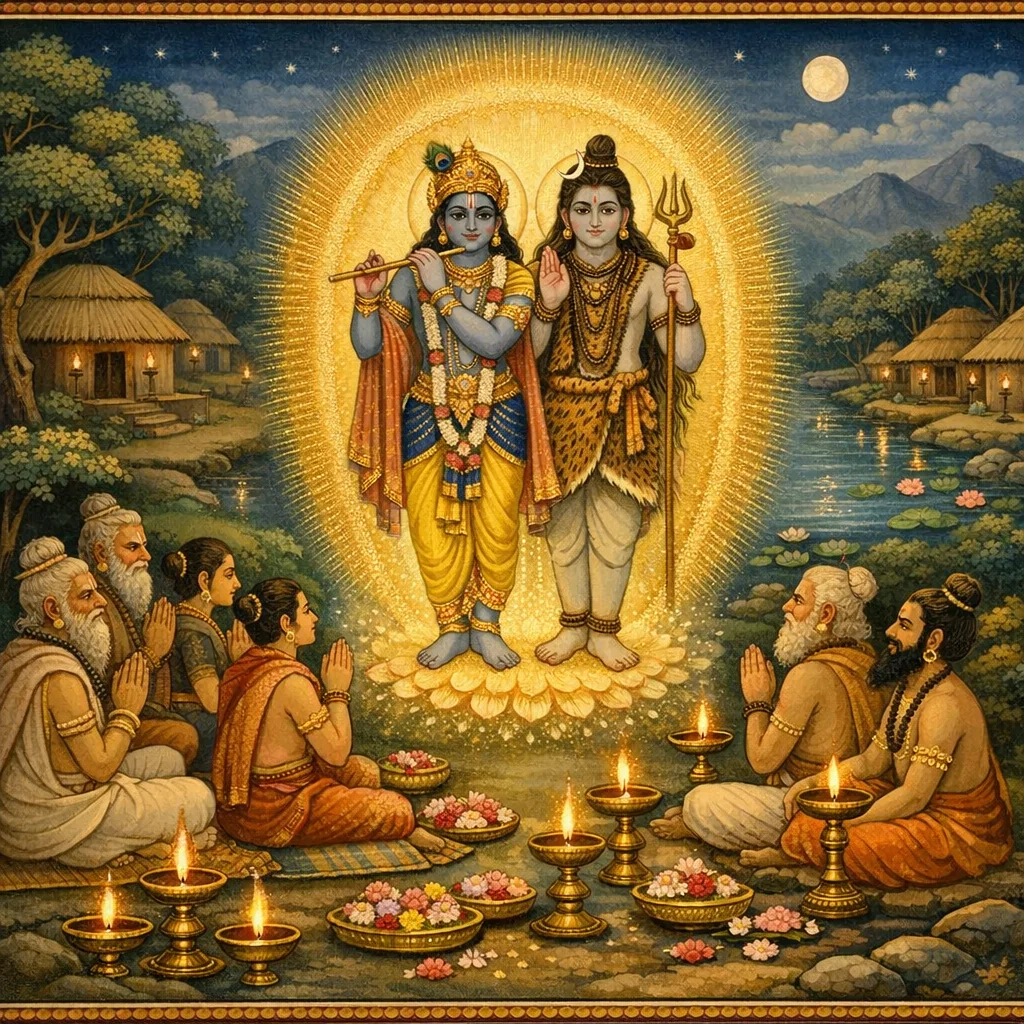
Chapter 167 unfolds as a tīrtha inquiry: Yudhiṣṭhira asks Mārkaṇḍeya to point out a sign-marked riverbank holy place and tell its origin. Mārkaṇḍeya recalls his earlier ascetic dwelling near the Vindhya and Daṇḍaka region, then his return to the southern bank of the Narmadā, where he founds an āśrama inhabited by disciplined brahmacārins, householders, vānaprasthas, and yatis. After long tapas and devotion to Vāsudeva, two boon-bestowing deities—Kṛṣṇa and Śaṅkara—appear to him; he petitions them to abide there forever, youthful and free from illness, with their divine retinues. They consent and become unmanifest, whereupon Mārkaṇḍeya installs Śaṅkara and Kṛṣṇa and establishes their worship at the site. The chapter then gives ritual prescriptions: bathing at the tīrtha and worship of Parameśvara, especially under the name Mārkaṇḍeśvara, alongside honoring Viṣṇu as lord of the three worlds. It details offerings of ghee, milk, curd, honey, Narmadā water, fragrance, incense, flowers, and naivedya, with night-vigil (jāgara) and observance in the bright fortnight of Jyeṣṭha through fasting and pūjā. It also includes śrāddha/tarpaṇa for ancestors, sandhyā worship, Vedic mantra-japa (Ṛg/Yajus/Sāman), and a Rudra-mantra rite: placing a kalaśa to the south of the liṅga and bathing it with “Rudra-ekādaśa” mantras, promising progeny and long life. The phalaśruti concludes that hearing or reciting this account purifies sins and yields liberation-oriented fruits in both Vaiṣṇava and Śaiva terms.
Shlokas
Verse 1
युधिष्ठिर उवाच । नर्मदादक्षिणे कूले त्वच्चिह्नेनोपलक्षितम् । तीर्थमेतन्ममाख्याहि सम्भवं च महामुने
Yudhiṣṭhira said: “O great sage, tell me about this sacred ford on the southern bank of the Narmadā, marked by your sign—describe it to me, and also its origin.”
Verse 2
मार्कण्डेय उवाच । पुरा कृतयुगस्यादौ दक्षिणे गिरिमुत्तमम् । विन्ध्यं सर्वगुणोपेतं नियतो नियताशनः
Mārkaṇḍeya said: “Long ago, at the beginning of the Kṛta Yuga, in the south, I approached the excellent mountain Vindhya—endowed with every virtue—living in discipline and with measured food.”
Verse 3
ऋषिसङ्घैः कृतातिथ्यो दण्डके न्यवसं चिरम् । उषित्वा सुचिरं कालं वर्षाणामयुतं सुखी
Honoured as a guest by gatherings of sages, I dwelt long in the Daṇḍaka forest; and having stayed for a very long time—ten thousand years—I remained content.
Verse 4
तानृषीन् समनुज्ञाप्य शिष्यैरनुगतस्ततः । निवृत्तः सुमहाभाग नर्मदाकूलमागतः
Having taken leave of those sages, and then accompanied by my disciples, I departed, O greatly fortunate one, and came to the bank of the Narmadā.
Verse 5
पुण्यं च रमणीयं च सर्वपापविनाशनम् । कृत्वाहमास्पदं तत्र द्विजसंघसमायुतः
There I established my abode in a place that was holy and delightful, a destroyer of all sins—together with an assembly of twice-born sages.
Verse 6
ब्रह्मचारिभिराकीर्णं गार्हस्थ्ये सुप्रतिष्ठितैः । वानप्रस्थैश्च यतिभिर्यताहारैर्यतात्मभिः
That sacred region was thronged with brahmacārins, firmly established householders, and also forest-dwellers and renunciants—men restrained in diet and self-controlled in mind.
Verse 7
तपस्विभिर्महाभागैः कामक्रोधविवर्जितैः । तत्राहं वर्षमयुतं तपः कृत्वा सुदारुणम्
There, among those fortunate ascetics—free from lust and anger—I performed exceedingly severe austerity for ten thousand years.
Verse 8
आराधयं वासुदेवं प्रभुं कर्तारमीश्वरम् । जपंस्तपोभिर्नियमैर्नर्मदाकूलमाश्रितः
Dwelling upon the bank of the Narmadā, I worshipped Vāsudeva—the Lord, the Creator, the Supreme Ruler—engaged in japa, austerities, and disciplined observances.
Verse 9
ततस्तौ वरदौ देवौ समायातौ युधिष्ठिर । प्रत्यक्षौ भास्करौ राजन्नुमाश्रीभ्यां विभूषितौ
Then those two boon-bestowing gods came there, O Yudhiṣṭhira—manifest to the eyes, radiant like the sun, adorned with Umā and Śrī.
Verse 10
प्रणम्याहं ततो देवौ भक्तियुक्तो वचोऽब्रुवम् । भवन्तौ प्रार्थयामि स्म वरार्हौ वरदौ शिवौ
Then, bowing to those two deities, I spoke in devotion: “I beseech you both—worthy to grant boons, bestowers of boons, auspicious Śivas.”
Verse 11
धर्मस्थितिं महाभागौ भक्तिं वानुत्तमां युवाम् । अजरो व्याधिरहितः पञ्चविंशतिवर्षवत् । अस्मिन्स्थाने सदा स्थेयं सह देवैरसंशयम्
“O greatly blessed ones, grant steadfastness in dharma and the highest devotion. Let me be ageless and free from disease, as if ever twenty-five years old. And may you always abide in this very place, together with the gods—without doubt.”
Verse 12
एवमुक्तौ मया पार्थ तौ देवौ कृष्णशङ्करौ । मामूचतुः प्रहृष्टौ तौ निवासार्थं युधिष्ठिर
When I had spoken thus, O Pārtha, those two deities—Kṛṣṇa and Śaṅkara—delighted, replied to me regarding their abiding presence, O Yudhiṣṭhira.
Verse 13
देवावूचतुः । अस्मिन्स्थाने स्थितौ विद्धि सह देवैः सवासवैः । एवमुक्त्वा ततो देवौ तत्रैवान्तरधीयताम्
The two gods said: “Know that we shall abide in this place, together with the gods and Indra.” Having spoken thus, the two deities then vanished right there.
Verse 14
अहं च स्थापयित्वा तौ शङ्करं कृष्णमव्ययम् । कृतकृत्यस्ततो जातः सम्पूज्य सुसमाहितः
And I, having established those two—Śaṅkara and imperishable Kṛṣṇa—became fulfilled in purpose; then, with a well-collected mind, I worshipped them completely.
Verse 15
तस्मिंस्तीर्थे नरः स्नात्वा पूजयेत्परमेश्वरम् । मार्कण्डेश्वरनाम्ना वै विष्णुं त्रिभुवनेश्वरम्
At that tīrtha, having bathed, a person should worship the Supreme Lord—Viṣṇu, the Lord of the three worlds—who is renowned there by the name “Mārkaṇḍeśvara.”
Verse 16
स गच्छेत्परमं स्थानं वैष्णवं शैवमेव च । घृतेन पयसा वाथ दध्ना च मधुना तथा
By such worship, he attains the supreme abode—both the Vaiṣṇava and the Śaiva realm. (The rite is to be performed) with ghee, with milk, likewise with curd, and also with honey.
Verse 17
नार्मदेनोदकेनाथ गन्धधूपैः सुशोभनैः । पुष्पोपहारैश्च तथा नैवेद्यैर्नियतात्मवान्
O Lord, with Narmadā-water, with splendid fragrances and incense, with offerings of flowers, and likewise with food-offerings—let the self-controlled devotee perform the worship.
Verse 18
एवं विष्णोः प्रकुर्वीत जागरं भक्तितत्परः । स्नानादीनि तथा राजन्प्रयतः शुचिमानसः
In this manner, devoted to bhakti, he should perform a night-vigil for Viṣṇu; and likewise, O King, he should duly perform bathing and the other observances—careful and pure in mind.
Verse 19
ज्येष्ठे मासि सिते पक्षे चतुर्दश्यामुपोषितः । द्वादश्यां कारयेद्देवपूजनं वैष्णवो नरः
In the month of Jyeṣṭha, in the bright fortnight, having fasted on the fourteenth tithi, the Vaiṣṇava man should arrange the worship of the Lord on the twelfth tithi.
Verse 20
एवं कृत्वा चतुर्दश्यामेकादश्यां नरोत्तम । वैष्णवं लोकमाप्नोति विष्णुतुल्यो भवेन्नरः
Having done so—observing the rite on the fourteenth and on the eleventh day, O best of men—he reaches the Vaiṣṇava world, and that man becomes equal to Viṣṇu in glory.
Verse 21
माहेश्वरे च राजेन्द्र गणवन्मोदते पुरे । श्राद्धं च कुरुते तत्र पितॄनुद्दिश्य सुस्थिरः
And in Māheśvara, O lord of kings, he rejoices in the city like one among Śiva’s gaṇas. There, steady in resolve, he also performs śrāddha, intending it for the ancestors.
Verse 22
तस्य ते ह्यक्षयां तृप्तिं प्राप्नुवन्ति न संशयः । नर्मदायां द्विजः स्नात्वा मौनी नियतमानसः
For him, those (ancestors) indeed obtain inexhaustible satisfaction—there is no doubt. Having bathed in the Narmadā, the twice-born, observing silence and controlling his mind, continues the rite.
Verse 23
उपास्य सन्ध्यां तत्रस्थो जपं कृत्वा सुशोभनम् । तर्पयित्वा पितॄन्देवान्मनुष्यांश्च यथाविधि
Remaining there, having duly worshiped the Sandhyā and performed beautiful japa, and having offered tarpaṇa to the ancestors, the devas, and also to human beings—according to rule—the rite is fulfilled.
Verse 24
कृष्णस्य पुरतः स्थित्वा मार्कण्डेशस्य वा पुनः । ऋग्यजुःसाममन्त्रांश्च जपेदत्र प्रयत्नतः
Standing before Kṛṣṇa—or again, before Mārkaṇḍeśa—one should, here, with earnest effort, recite the mantras of the Ṛg, Yajus, and Sāma Vedas.
Verse 25
ऋचमेकां जपेद्यस्तु ऋग्वेदस्य फलं लभेत् । यजुर्वेदस्य यजुषा साम्ना सामफलं लभेत्
Whoever recites even a single ṛc attains the fruit of the Ṛgveda; by a Yajus formula he gains the fruit of the Yajurveda; and by a Sāman chant he gains the fruit of the Sāmaveda.
Verse 26
एकस्मिन्भोजिते विप्रे कोटिर्भवति भोजिता । मृतप्रजा तु या नारी वन्ध्या स्त्रीजननी तथा
When even a single brāhmaṇa is duly fed, it is as though a crore have been fed. And a woman whose children have died, as well as a barren woman, likewise becomes fit to obtain offspring.
Verse 27
रुद्रांस्तु विधिवज्जप्त्वा ब्राह्मणो वेदतत्त्ववित् । लिङ्गस्य दक्षिणे पार्श्वे स्थापयेत्कलशं शिवम्
Having duly recited the Rudra hymns and mantras, a brāhmaṇa who knows the true purport of the Veda should place a sacred Śiva-kalaśa on the right side of the liṅga.
Verse 28
रुद्रैकादशभिर्मन्त्रैः स्नापयेत्कलशाम्भसा । पुत्रमाप्नोति राजेन्द्र दीर्घायुषमकल्मषम्
With the eleven Rudra-mantras, one should bathe the deity using the water from the kalaśa. O best of kings, he obtains a son—long-lived and free from blemish.
Verse 29
मार्कण्डेश्वरवृक्षान्यो दूरस्थानपि पश्यति । ब्रह्महत्यादिपापेभ्यो मुच्यते शङ्करोऽब्रवीत्
By the grace of the Mārkaṇḍeśvara tree, one beholds even what is far away; and one is freed from sins beginning with brahma-hatyā—so Śaṅkara declared.
Verse 30
य इदं शृणुयाद्भक्त्या पठेद्वा नृपसत्तम । सर्वपापविशुद्धात्मा जायते नात्र संशयः
O best of kings, whoever hears this with devotion—or recites it—becomes purified of all sins; of this there is no doubt.
Verse 31
इदं यशस्यमायुष्यं धन्यं दुःखप्रणाशनम् । पठतां शृण्वतां वापि सर्वपापप्रमोचनम्
This bestows fame and long life; it is auspicious and destroys sorrow. For those who recite it—or even hear it—it brings release from all sins.
Verse 167
। अध्याय
Here ends the chapter.