Adhyaya 17
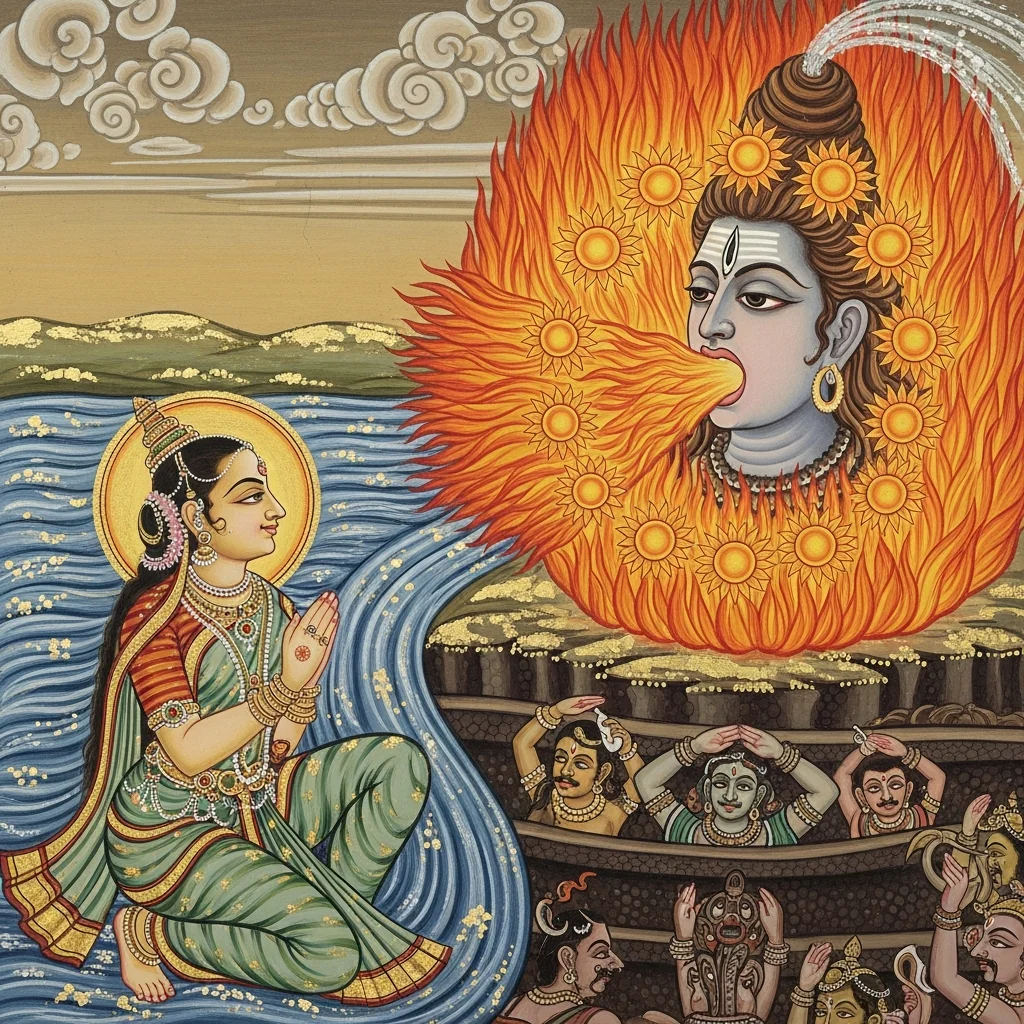
This adhyāya sets forth an intense vision of dissolution within a sage–king dialogue. Mārkaṇḍeya describes the cosmic Lord withdrawing the manifested world (saṃjahāra) as gods and sages offer hymns of praise. The account centers on Mahādeva’s terrifying southern face—blazing eyes, massive fangs, serpentine features, and a devouring tongue—through which the world is imagined to enter dissolution, like rivers merging into the ocean. From that mouth burst fierce flames, followed by a twelvefold solar manifestation (dvādaśa ādityas) that scorches the earth, mountains, oceans, and the subterranean realms, including the seven Pātālas and Nāga-loka. Yet the chapter closes with a note of preservation: amid universal burning and the breaking of great mountain ranges, the Narmadā (Revā) is explicitly remembered as not destroyed, affirming a tīrtha-centered sacred geography.
Shlokas
Verse 1
श्रीमार्कण्डेय उवाच । एवं संस्तूयमानस्तु ब्रह्माद्यैर्मुनिपुंगवैः । ब्रह्मलोकगतैस्तत्र संजहार जगत्प्रभुः
Śrī Mārkaṇḍeya said: “Thus, being praised there by Brahmā and the foremost sages who had reached Brahmaloka, the Lord of the universe then withdrew that manifestation.”
Verse 2
स तद्भीमं महारौद्रं दक्षिणं वक्त्रमव्ययम् । महादंष्ट्रोत्कटारावं पातालतलसंनिभम्
Then the Lord revealed His southern face—terrifying, exceedingly wrathful, imperishable—roaring fiercely with great fangs, resembling the very depths of Pātāla.
Verse 3
विद्युज्ज्वलनपिङ्गाक्षं भैरवं लोमहर्षणम् । महाजिह्वं महादंष्ट्रं महासर्पशिरोधरम्
Its tawny eyes blazed like lightning and fire—Bhairava, hair-raising to behold—bearing a great tongue, great fangs, and wearing mighty serpents upon His head.
Verse 4
महासुरशिरोमालं महाप्रलयकारणम् । ग्रसत्समुद्रनिहितवातवारिमयं हविः
Adorned with a garland of the heads of great asuras, a cause of the great dissolution, it devoured as an offering the winds and waters stored within the ocean.
Verse 5
वडवामुखसङ्काशं महादेवस्य तन्मुखम् । जिह्वाग्रेण जगत्सर्वं लेलिहानमपश्यत
He saw that face of Mahādeva, resembling the Mare’s-mouth fire, licking up the entire universe with the tip of His tongue.
Verse 6
योजनानां सहस्राणि सहस्राणां शतानि च । दिशो दश महाघोरा मांसमेदोवसोत्कटाः
For thousands and hundreds of thousands of yojanas, the ten directions appeared exceedingly dreadful, thick with flesh, fat, and grease.
Verse 7
तस्य दंष्ट्रा व्यवर्धत शतशोऽथ सहस्रशः । सासुरान्सुरगन्धर्वान् सयक्षोरगराक्षसान्
Then His fangs grew by the hundreds and thousands, overpowering Asuras, Devas, Gandharvas, Yakṣas, and Rākṣasas alike.
Verse 8
तस्य दंष्ट्राग्रसंलग्नान्स ददर्श पितामहः । दन्तयन्त्रान्तसंविष्टं विचूर्णितशिरोधरम्
Pitāmaha beheld them impaled upon the tips of those fangs, crushed within the grinding mechanism of the teeth, their necks and heads shattered.
Verse 9
जगत्पश्यामि राजेन्द्र विशन्तं व्यादिते मुखे । नानातरङ्गभङ्गाङ्गा महाफेनौघसंकुलाः । यथा नद्यो लयं यान्ति समुद्रं प्राप्य सस्वनाः
O best of kings, I see the whole world entering that gaping mouth, just as roaring rivers, filled with foam and waves, merge into the sea.
Verse 10
तथा ततं विश्वमिदं समस्तमनेकजीवार्णवदुर्विगाह्यम् । विवेश रुद्रस्य मुखं विशालं ज्वलत्तदुग्रं घननादघोरम्
So too this entire, all-pervading universe—hard to fathom like an ocean teeming with countless lives—entered Rudra’s vast mouth, blazing, fierce, and dreadful with thunderous sound.
Verse 11
ज्वालास्ततस्तस्य मुखात्सुघोराः सविस्फुलिङ्गा बहुलाः सधूमाः । अनेकरूपा ज्वलनप्रकाशाः प्रदीपयन्तीव दिशोऽखिलाश्च
Thereupon, from his mouth burst forth exceedingly dreadful flames—many, smoky, and filled with sparks—of manifold forms and fiery brilliance, as though lighting up all the directions.
Verse 12
ततो रविज्वालसहस्रमालि बभूव वक्त्रं चलजिह्वदंष्ट्रम् । महेश्वरस्याद्भुतरूपिणस्तदा स द्वादशात्मा प्रबभूव एकः
Then the wondrous Maheśvara’s face became garlanded with a thousand sun-like flames, with moving tongues and fangs; and at that time, the One manifested as twelvefold in essence.
Verse 13
ततस्ते द्वादशादित्या रुद्रवक्त्राद्विनिर्गताः । आश्रित्य दक्षिणामाशां निर्दहन्तो वसुंधराम्
Then those twelve Ādityas emerged from Rudra’s mouth; taking refuge in the southern quarter, they began to burn the earth.
Verse 14
भौमं यज्जीवनं किंचिन्नानावृक्षतृणालयम् । शुष्कं पूर्वमनावृष्ट्या सकलाकुलभूतलम्
Whatever earthly life there was—abodes of many kinds of trees and grasses—had already become dry from the earlier lack of rain, and the whole surface of the earth was thrown into distress.
Verse 15
तद्दीप्यमानं सहसा सूर्यैस्तै रुद्रसम्भवैः । धूमाकुलमभूत्सर्वं प्रणष्टग्रहतारकम्
As those Rudra-born suns suddenly blazed forth, all was choked with smoke, and the planets and stars vanished from sight.
Verse 16
जज्वाल सहसा दीप्तं भूमण्डलमशेषतः । ज्वालामालाकुलं सर्वमभूदेतच्चराचरम्
Suddenly the whole sphere of the earth blazed everywhere without remainder; all this moving and unmoving world became engulfed in garlands of flame.
Verse 17
। अध्याय
Chapter — a heading marker (adhyāya).
Verse 18
विशालतेजसा दीप्ता महाज्वालासमाकुलाः । ददहुर्वै जगत्सर्वमादित्या रुद्रसम्भवाः
Blazing with immense radiance and surrounded by towering flames, the Ādityas—born of Rudra—indeed burned the entire universe.
Verse 19
आदित्यानां रश्मयश्च संस्पृष्टा वै परस्परम् । एवं ददाह भगवांस्त्रैलोक्यं सचराचरम्
The rays of the Ādityas met and merged with one another; thus the Blessed Lord burned the three worlds, with all that moves and all that is still.
Verse 20
सप्तद्वीपप्रमाणस्तु सोऽग्निर्भूत्वा महेश्वरः । सप्तद्वीपसमुद्रान्तां निर्ददाह वसुंधराम्
Becoming Fire, Maheśvara expanded to the measure of the seven dvīpas and burned the earth, bounded by the oceans of the seven dvīpas.
Verse 21
सुमेरुमन्दरान्तां च निर्दहुर्वसुधां तदा । भित्त्वा तु सप्तपातालं नागलोकं ततोऽदहत्
Then he burned the earth as far as Sumeru and Mandara; and breaking through the seven pātālas, he thereafter burned the realm of the Nāgas.
Verse 22
भूम्यधः सप्तपातालान्निर्दहंस्तारकैः सह । चचाराग्निः समन्तात्तु निर्दहन्वै युधिष्ठिर
Beneath the earth, burning the seven pātālas along with the stars, the Fire moved everywhere on all sides—indeed, O Yudhiṣṭhira—consuming all.
Verse 23
धम्यमान इवाङ्गारैर्लोहरात्रिरिव ज्वलन् । तथा तत्प्राज्वलत्सर्वं संवर्ताग्निप्रदीपितम्
As if fanned into a blaze with embers, flaming like an iron-dark night, everything thus burst into burning—kindled by the fire of cosmic dissolution.
Verse 24
निर्वृक्षा निस्तृणा भूमिर्निर्निर्झरसरः सरित् । विशीर्णशैलशृङ्गौघा कूर्मपृष्ठोपमाभवत्
The earth became without trees and without grass; streams, lakes, and rivers were gone. Masses of shattered mountain-peaks remained, and it came to resemble the back of a tortoise.
Verse 25
ज्वालामालाकुलं कृत्वा जगत्सर्वं चिदामकम् । महारूपधरो रुद्रो व्यतिष्ठत महेश्वरः
Having filled the entire universe with garlands of flame, turning all the world into blazing cinders, Rudra—bearing a vast and terrible form—stood forth as Maheśvara.
Verse 26
समातृगणभूयिष्ठा सयक्षोरगराक्षसा । ततो देवी महादेवं विवेश हरिलोचना
Then the Goddess—surrounded chiefly by the hosts of the Mothers, along with Yakṣas, serpent-beings, and Rākṣasas—entered into Mahādeva, she whose eyes were lotus-like.
Verse 27
निर्वाणं परमापन्ना शान्तेव शिखिनः शिखा । जगत्सर्वं हि निर्दग्धं त्रिभिर्लोकैः सहानघ
Having reached the supreme quiescence—like the flame of a fire that has gone out—when the entire universe, together with the three worlds, was burnt up, O sinless one.
Verse 28
रुद्रप्रसादान्मुक्त्वा मां नर्मदां चाप्ययोनिजाम् । युगानामयुतं देवो मया चाद्य बुभक्षणात्
By Rudra’s grace, sparing me—and also Narmadā, the womb-unborn—the God of dissolution refrained from consuming us for ten thousand yugas; and even today he does not devour her.
Verse 29
पुरा ह्याराधितः शूली तेनाहमजरामरः । अघमर्षणघोरं च वामदेवं च त्र्यम्बकम्
Formerly the Trident-bearing Lord was worshipped; by that worship I became undecaying and deathless—through the (mantras/forms) Aghamarṣaṇa, Ghora, Vāmadeva, and Tryambaka.
Verse 30
ऋषभं त्रिसुपर्णं च दुर्गां सावित्रमेव च । बृहदारण्यकं चैव बृहत्साम तथोत्तरम्
(He recited) the Ṛṣabha hymn, the Trisuparṇa hymn, the Durgā hymn, and the Sāvitra (Gāyatrī); also the Bṛhadāraṇyaka (Upaniṣad), the Bṛhatsāman, and likewise the ‘Uttara’, the supplementary chant.
Verse 31
रौद्रीं परमगायत्रीं शिवोपनिषदं तथा । यथा प्रतिरथं सूक्तं जप्त्वा मृत्युंजयं तथा
He also repeated the Raudrī hymn, the supreme Gāyatrī, and the Śiva‑Upaniṣad; likewise the Pratiratha‑sūkta; and he chanted as well the Mṛtyuñjaya mantra, the Conqueror of Death.
Verse 32
सरित्सागरपर्यन्ता वसुधा भस्मसात्कृता । वर्जयित्वा महाभागां नर्मदाममृतोपमाम्
The earth—together with its rivers and seas—was reduced to ashes, except for the most blessed Narmadā, who is like nectar itself (amṛta).
Verse 33
महेन्द्रो मलयः सह्यो हेमकूटोऽथ माल्यवान् । विन्ध्यश्च पारियात्रश्च सप्तैते कुलपर्वताः
Mahendra, Malaya, Sahya, Hemakūṭa, Mālyavān, Vindhya, and Pāriyātra—these seven are the famed ‘family mountains’ (kulaparvatas).
Verse 34
द्वादशादित्यनिर्दग्धाः शैलाः शीर्णशिलाः पृथक् । भस्मीभूतास्तु दृश्यन्ते न नष्टा नर्मदा तदा
Mountains, scorched by the twelve suns, stood apart with their rocks shattered; they were seen reduced to ash—yet at that time Narmadā was not destroyed.
Verse 35
हिमवान्हेमकूटश्च निषधो गन्धमादनः । माल्यवांश्च गिरिश्रेष्ठो नीलः श्वेतोऽथ शृङ्गवान्
Himavān and Hemakūṭa; Niṣadha and Gandhamādana; Mālyavān, the foremost of mountains; and also Nīla, Śveta, and Śṛṅgavān—
Verse 36
एते पर्वतरा जानो देवगन्धर्वसेविताः । युगान्ताग्निविनिर्दग्धाः सर्वे शीर्णमहाशिलाः
These kings of mountains, attended by gods and gandharvas, were all scorched by the fire at the end of the age; their mighty rocks were shattered and worn away.
Verse 37
एवं मया पुरा दृष्टो युगान्ते सर्वसंक्षयः । वर्जयित्वा महापुण्यां नर्मदां नृपसत्तम
Thus, in former times I beheld the total dissolution at the end of the age; yet, O best of kings, the supremely meritorious Narmadā alone remained untouched.