Adhyaya 7
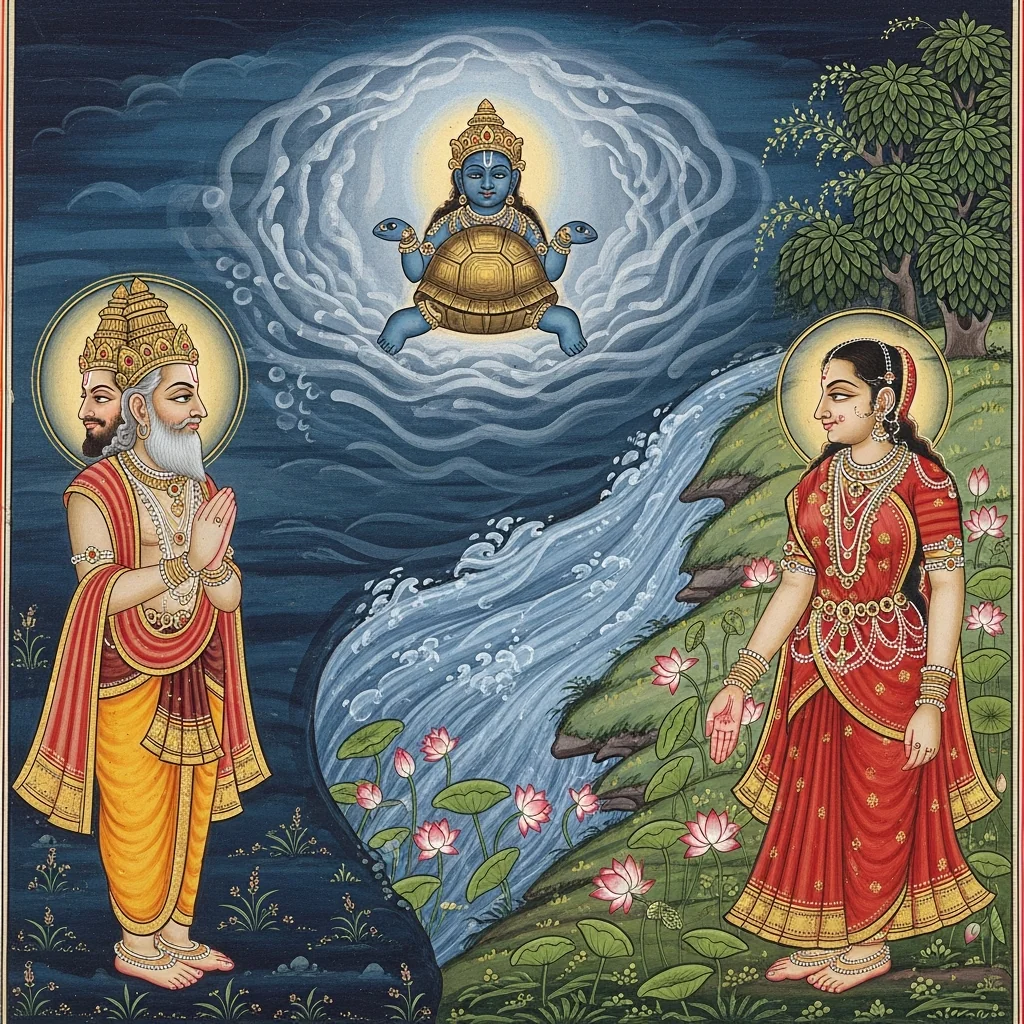
Mārkaṇḍeya depicts a cosmic dissolution: only the ekārṇava, a single dreadful ocean, remains, while all moving and unmoving beings have vanished into darkness. Brahmā, alone upon the waters, beholds a vast radiant Presence in kūrma-rūpa (tortoise form), endowed with supreme, universe-spanning attributes. Brahmā gently rouses and praises the Deity with auspicious stutis in the idiom of the Veda and Vedāṅga, beseeching the re-emission of the worlds previously withdrawn. The Deity rises and releases the three worlds with their orders of beings—devas, dānavas, gandharvas, yakṣas, nāgas, rākṣasas—together with the celestial bodies. The earth is then seen spread out again with mountains, continents, oceans, and the boundary of Lokāloka. Within this renewed geography comes the riverine theophany: Devī Narmadā (Revā) manifests as a divinely adorned woman emerging from the waters, praised and approached with reverence. The chapter ends with a phalaśruti-like assurance that studying or hearing this account of the kūrmya manifestation removes sins (kilbiṣa).
Shlokas
Verse 1
श्रीमार्कण्डेय उवाच । पुनरेकार्णवे घोरे नष्टे स्थावरजंगमे । सलिलेनाप्लुते लोके निरालोके तमोद्भवे
Śrī Mārkaṇḍeya said: Again, when the dreadful single ocean (of dissolution) arose and all moving and unmoving beings had perished—when the world was flooded with water, lightless, and born of darkness—
Verse 2
ब्रह्मैको विचरंस्तत्र तमीभूते महार्णवे । दिव्यवर्षसहस्रं तु खद्योत इव रूपवान्
There, in that great ocean turned into darkness, Brahmā alone wandered—for a thousand divine years—shining like a firefly.
Verse 3
शेते योजनसाहस्रमप्रमेयमनुत्तमम् । द्वादशादित्यसंकाशं सहस्रचरणेक्षणम्
He lay there, extending for a thousand yojanas—immeasurable and unsurpassed—radiant like twelve suns, with a thousand feet and a thousand eyes.
Verse 4
प्रसुप्तं चार्णवे घोरे ह्यपश्यत्कूर्मरूपिणम् । तं दृष्ट्वा विस्मयापन्नो ब्रह्मा बोधयते शनैः
And in that dreadful ocean he saw him asleep in the form of a tortoise. Seeing him, Brahmā was filled with wonder and gently tried to awaken him.
Verse 5
स्तुतिभिर्मंगलैश्चैव वेदवेदांगसंभवैः । वाचस्पते विबुध्यस्व महाभूत नमोऽस्तु ते
With auspicious hymns born of the Veda and its limbs, Brahmā praised: “O Lord of Speech, awaken! O Great Being, salutations to You.”
Verse 6
तवोदरे जगत्सर्वं तिष्ठते परमेश्वर । तद्विमुञ्च महासत्त्व यत्पूर्वं संहृतं त्वया
Within Your belly the entire universe abides, O Supreme Lord. Therefore, O Great Being, release that which You formerly withdrew into Yourself.
Verse 7
अध्याय
“Chapter” (Adhyāya).
Verse 8
स निशम्य वचस्तस्य उत्थितः परमेश्वरः । समुद्गिरन् स लोकांस्त्रीन् ग्रस्तान् कल्पक्षये तदा
Hearing his words, the Supreme Lord rose up; and at the dissolution of the aeon, He then brought forth again the three worlds that had been swallowed up.
Verse 9
देवदानवगन्धर्वाः सयक्षोरगराक्षसाः । सचन्द्रार्कग्रहाः सर्वे शरीरात्तस्य निर्गताः
Gods, Dānavas, and Gandharvas—together with Yakṣas, Nāgas, and Rākṣasas—and even the Moon, the Sun, and the planets: all of them emerged from His body.
Verse 10
ततो ह्येकार्णवं सर्वं विभज्य परमेश्वरः । विस्तीर्णोपलतोयौघां सरित्सरविवर्धिताम्
Then Parameśvara divided the single, all-encompassing ocean, and He set in order the earth’s wide spread of waters—swollen with rivers and lakes, with broad reaches of rocks and rushing torrents.
Verse 11
पश्यते मेदिनीं देवः सवृक्षौषधिपल्वलाम् । हिमवन्तं गिरिश्रेष्ठं श्वेतं पर्वतमुत्तमम्
The God beheld the earth—endowed with trees, healing herbs, and marshy waters—and He saw Himavān, the foremost of mountains, and the excellent Śveta Mountain.
Verse 12
शृङ्गवन्तं महाशैलं ये चान्ये कुलपर्वताः । जंबुद्वीपं कुशं क्रौञ्चं सगोमेदं सशाल्मलम्
He saw Śṛṅgavān, the great mountain, and the other clan-mountains as well; and He saw Jambūdvīpa, Kuśa, Krauñca, Gomeda, and Śālmala—the great dvīpas.
Verse 13
पुष्करान्ताश्च ये द्वीपा ये च सप्तमहार्णवाः । लोकालोकं महाशैलं सर्वं च पुरतः स्थितम्
He saw the dvīpas reaching as far as Puṣkara, and the seven great oceans; and Lokāloka, the vast mountain—everything stood before Him.
Verse 14
चतुःप्रकृतिसंयुक्तं जगत्स्थावरजंगमम् । युगान्ते तु विनिष्क्रान्तमपश्यत्स महेश्वरः
Maheśvara beheld the world of moving and unmoving beings—constituted of the fourfold elements of nature—emerging again at the end of the age.
Verse 15
विप्रकीर्णशिलाजालामपश्यत्स वसुंधराम् । कूर्मपृष्ठोपगां देवीं महार्णवगतां प्रभुः
The Lord beheld the Earth, strewn with a web of scattered rocks; and He saw the Goddess Earth resting upon the back of the Tortoise, set within the great ocean.
Verse 16
तस्मिन् विशीर्णशैलाग्रे सरित्सरोविवर्जिते । नानातरंगभिन्नोद आवर्तोद्वर्तसंकुले
There, upon the shattered mountain-peaks—devoid of rivers and lakes—the waters were broken by many kinds of waves, crowded with whirlpools and surging eddies.
Verse 17
नानौषधिप्रज्वलिते नानोत्पलशिलातले । नानाविहंगसंघुष्टां मत्स्यकूर्मसमाकुलाम्
He beheld that river-region blazing with many healing herbs, with rocky beds strewn with diverse lotuses—resounding with flocks of many birds, and teeming with fish and tortoises.
Verse 18
दिव्यमायामयीं देवीमुत्कृष्टाम्बुदसन्निभाम् । नदीमपश्यद्देवेशो ह्यनौपम्यजलाशयाम्
The Lord of the gods saw the River as a Goddess—formed of divine māyā, like a splendid cloud—an incomparable reservoir of sacred waters.
Verse 19
मध्ये तस्याम्बुदश्यामां पीनोरुजघनस्तनीम् । वस्त्रैरनुपमैर्दिव्यैर्नानाभरणभूषिताम्
In her midst he saw a cloud-dark maidenly form—full-hipped and full-bosomed—clad in incomparable divine garments and adorned with many ornaments.
Verse 20
सनूपुररवोद्दामां हारकेयूरमण्डिताम् । तादृशीं नर्मदां देवीं स्वयं स्त्रीरूपधारिणीम्
Her anklets rang out loudly; she was adorned with necklaces and armlets—such was Narmadā, the Goddess herself, who of her own will assumed a woman’s form.
Verse 21
योगमायामयैश्चित्रैर्भूषणैः स्वैर्विभूषिताम् । अव्यक्ताङ्गीं महाभागामपश्यत्स तु नर्मदाम्
He beheld Narmadā, the most blessed—adorned with her own wondrous ornaments born of yogic māyā; her limbs were subtly revealed, beyond ordinary perception.
Verse 22
अर्धोद्यतभुजां बालां पद्मपत्रायतेक्षणाम् । स्तुवन्तीं देवदेवेशमुत्थितां तु जलात्तदा
Then, rising from the water, he saw a youthful maiden with arms half raised, lotus-petal eyes, praising the Lord of lords among the gods.
Verse 23
विस्मयाविष्टहृदयो ह्यहमुद्वीक्ष्य तां शुभाम् । स्नात्वा जले शुभे तस्याः स्तोतुमभ्युद्यतस्ततः
My heart, overcome with wonder on seeing that auspicious one, I then bathed in her holy waters and prepared to praise her.
Verse 24
अर्चयामास संहृष्टो मन्त्रैर्वेदांगसंभवैः । सृष्टं च तत्पुरा राजन्पश्येयं सचराचरम्
Joyful, he worshipped with mantras born of the Vedas and their limbs; and he beheld, O King, the creation as it once was—moving and unmoving alike.
Verse 25
सदेवासुरगन्धर्वं सपन्नगमहोरगम् । पश्याम्येषा महाभागा नैव याता क्षयं पुरा
I behold this world with its gods, asuras, and gandharvas, with serpents and great nāgas; this most blessed sacred Power had never gone to destruction in former times.
Verse 26
महादेवप्रसादाच्च तच्छरीरसमुद्भवा । भूयो भूयो मया दृष्टा कथिता ते नृपोत्तम
And by Mahādeva’s grace—she having arisen from his very body—I have beheld her again and again; thus have I related it to you, O best of kings.
Verse 27
प्रादुर्भावमिमं कौर्म्यं येऽधीयन्ते द्विजोत्तमाः । येऽपि शृण्वन्ति विद्वांसो मुच्यन्ते तेऽपि किल्बिषैः
O best of the twice-born, those who study this account of the Kūrma manifestation—and even the learned who merely listen to it—are indeed freed from sins.