Adhyaya 177
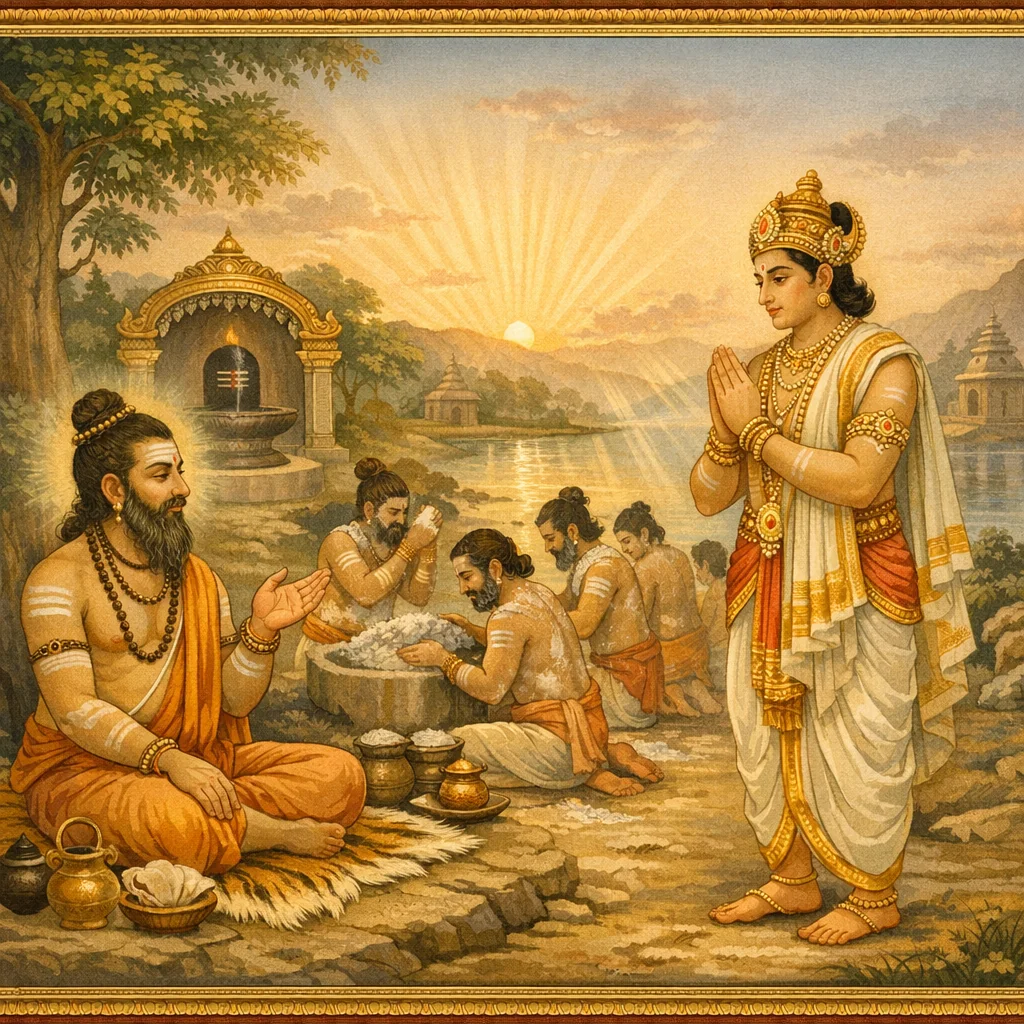
The chapter unfolds as a didactic dialogue in which Mārkaṇḍeya instructs Yudhiṣṭhira about Bhūtīśvara, an eminent tīrtha whose mere darśana diminishes pāpa. Its name is explained through an origin tale: Śiva (Śūlin) performed uddhūlana, the smearing of sacred ash, at that very spot. It then turns to ritual guidance: bathing at Bhūtīśvara—especially on occasions connected with Puṣya in one’s natal asterism and on amāvāsyā—is said to bring expansive benefit for the uplift of ancestors. A focused phala sequence is given for aṅga-guṇṭhana, the application of ash: each ash-particle that clings to the body corresponds to prolonged honor in Śiva’s realm. Bhasma-snāna is praised as a superior purification, and a ranked taxonomy of snānas is introduced: āgneya, vāruṇa, brāhmya, vāyavya, and divya. Mārkaṇḍeya defines them as ash-bath, water-immersion, bathing with the “Āpo hi ṣṭhā” formula, cow-dust bathing, and bathing upon sighting the sun—whose merit is equated with bathing in Gaṅgā-water. The conclusion integrates outer practice with inner discipline: snāna and Īśāna-pūjā yield external and internal purity; japa cleanses sin, and dhyāna leads toward the infinite. A Śiva-stotra presents a non-anthropomorphic theological vision, and the tīrtha’s fruit for those who bathe there is compared to the merit of an Aśvamedha-yajña.
Shlokas
Verse 1
श्रीमार्कण्डेय उवाच । भूतीश्वरं ततो गच्छेत्सर्वतीर्थेष्वनुत्तमम् । दर्शनादेव राजेन्द्र यस्य पापं प्रणश्यति
Śrī Mārkaṇḍeya said: “Then one should go to Bhūtīśvara, unsurpassed among all tīrthas. O king, by mere darśana (holy sight) there, one’s sin is destroyed.”
Verse 2
तत्र स्थाने पुरा पार्थ देवदेवेन शूलिना । उद्धूलनं कृतं गात्रे तेन भूतीश्वरं तु तत्
“In that very place long ago, O Pārtha, the Lord of Lords, bearer of the trident, smeared sacred ash upon His body. Therefore that place is indeed called Bhūtīśvara.”
Verse 3
पुष्ये वा जन्मनक्षत्रे अमावास्यां विशेषतः । भूतीश्वरे नरः स्नात्वा कुलकोटिं समुद्धरेत्
“Especially on the day of amāvasyā (new moon)—or in Puṣya, or on one’s birth-star—whoever bathes at Bhūtīśvara uplifts a crore of family-lines.”
Verse 4
तत्र स्थाने तु यो भक्त्या कुरुते ह्यङ्गगुण्ठनम् । तस्य यत्फलमुद्दिष्टं तच्छृणुष्व नराधिप
In that sacred place, whoever with devotion performs the anointing and covering of the limbs with sacred ash—listen, O ruler of men, to the fruit declared for that act.
Verse 5
यावन्तो भूतिकणिका गात्रे लग्नाः शिवालये । तावद्वर्षसहस्राणि शिवलोके महीयते
As many particles of sacred ash as cling to one’s body in Śiva’s abode, for that many thousands of years one is honored in Śiva’s world.
Verse 6
सर्वेषामेव स्नानानां भस्मस्नानं परं स्मृतम् । पुराणैरृषिभिः प्रोक्तं सर्वशास्त्रेष्वनुत्तमम्
Among all forms of bathing, the bath of ash (bhasma-snānā) is remembered as the highest—taught by the Purāṇas and the sages, and unsurpassed in all śāstras.
Verse 7
एककालं द्विकालं वा त्रिकालं चापि यः सदा । स्नानं करोति चाग्नेयं पापं तस्य प्रणश्यति
Whoever regularly performs the Āgneya bath—once a day, twice, or even three times—has his sin destroyed.
Verse 8
दिव्यस्नानाद्वरं स्नानं वायव्यं भरतर्षभ । वायव्यादुत्तमं ब्राह्म्यं वरं ब्राह्म्यात्तु वारुणम्
Better than the ‘divine bath’ is the Vāyavya bath, O bull among the Bhāratas. Better than Vāyavya is the Brāhmya bath; and superior to Brāhmya is the Vāruṇa bath.
Verse 9
आग्नेयं वारुणाच्छ्रेष्ठं यस्मादुक्तं स्वयम्भुवा । तस्मात्सर्वप्रयत्नेन ह्याग्नेयं स्नानमाचरेत्
The Āgneya bath is superior to the Vāruṇa bath, for it was taught by Svayambhū (Brahmā). Therefore, with every effort, one should perform the Āgneya bath.
Verse 10
युधिष्ठिर उवाच । आग्नेयं वारुणं ब्राह्म्यं वायव्यं दिव्यमेव च । किमुक्तं श्रोतुमिच्छामि परं कौतूहलं हि मे
Yudhiṣṭhira said: “The Āgneya, Vāruṇa, Brāhmya, Vāyavya, and also the Divine bath—what is taught about these? I wish to hear, for my curiosity is great.”
Verse 11
मार्कण्डेय उवाच । आग्नेयं भस्मना स्नानमवगाह्य च वारुणम् । आपोहिष्ठेति च ब्राह्म्यं वायव्यं गोरजः स्मृतम्
Mārkaṇḍeya said: “The Āgneya bath is bathing with sacred ash; the Vāruṇa bath is by immersion in water. The Brāhmya bath is performed by reciting ‘Āpo hi ṣṭhā…’; and the Vāyavya bath is remembered as cow-dust, the dust raised by a cow’s hoof.”
Verse 12
सूर्ये दृष्टे तु यत्स्नानं गङ्गातोयेन तत्समम् । तत्स्नानं पञ्चमं प्रोक्तं दिव्यं पाण्डवसत्तम
And the bathing performed upon beholding the Sun is equal to bathing in the waters of the Gaṅgā. That is declared the fifth bath—the Divine, O best of the Pāṇḍavas.
Verse 13
तस्मात्सर्वप्रयत्नेन स्नात्वा भूतीश्वरे तु यः । पूजयेद्देवमीशानं स बाह्याभ्यन्तरः शुचिः
Therefore, with every effort, whoever bathes at Bhūtīśvara and worships the Lord Īśāna becomes pure—outwardly and inwardly.
Verse 14
तत्र स्थाने तु ये नित्यं ध्यायन्ति परमं पदम् । सूक्ष्मं चातीन्द्रियं नित्यं ते धन्या नात्र संशयः
And those who, in that holy place, constantly meditate on the Supreme State—subtle and beyond the senses—are truly blessed; of this there is no doubt.
Verse 15
मुक्तितीर्थं तु तत्तीर्थं सर्वतीर्थेष्वनुत्तमम् । दर्शनादेव यस्यैव पापं याति महत्क्षयम्
That tīrtha is indeed called Muktitīrtha, unsurpassed among all sacred fords. By its very sight alone, one’s sin is greatly destroyed.
Verse 16
जायते पूजया राज्यं तत्र स्तुत्वा महेश्वरम् । जपेन पापसंशुद्धिर्ध्यानेनानन्त्यमश्नुते
By worship there, sovereignty arises; by praising Maheśvara there, one gains auspicious fulfillment. By japa comes purification from sin, and by meditation one attains the Infinite.
Verse 17
ॐ ज्योतिः स्वरूपमनादिमध्यमनुत्पाद्यमानमनुचार्यमाणाक्षरम् । सर्वभूतस्थितं शिवं सर्वयोगेश्वरं सर्वलोकेश्वरं मोहशोकहीनं महाज्ञानगम्यम्
Oṃ—I adore Śiva whose very nature is Light; without beginning or middle, unborn and imperishable; present within all beings; Lord of all yogas, Lord of all worlds; free from delusion and sorrow, and attainable through great knowledge.
Verse 18
तत्र तीर्थे तु यो गत्वा स्नानं कुर्यान्नरेश्वर । अश्वमेधस्य यज्ञस्य फलं प्राप्नोति मानवः । एवम्भूतं न जानन्ति मोक्षापेक्षणिका नराः
O lord of men, whoever goes to that tīrtha and performs bathing obtains the fruit of the Aśvamedha sacrifice. Yet people who long for liberation do not recognize such a marvelous truth.
Verse 177
अध्याय
“Adhyāya” — a chapter marker, the sacred division/colophon element in the manuscript stream.