Adhyaya 193
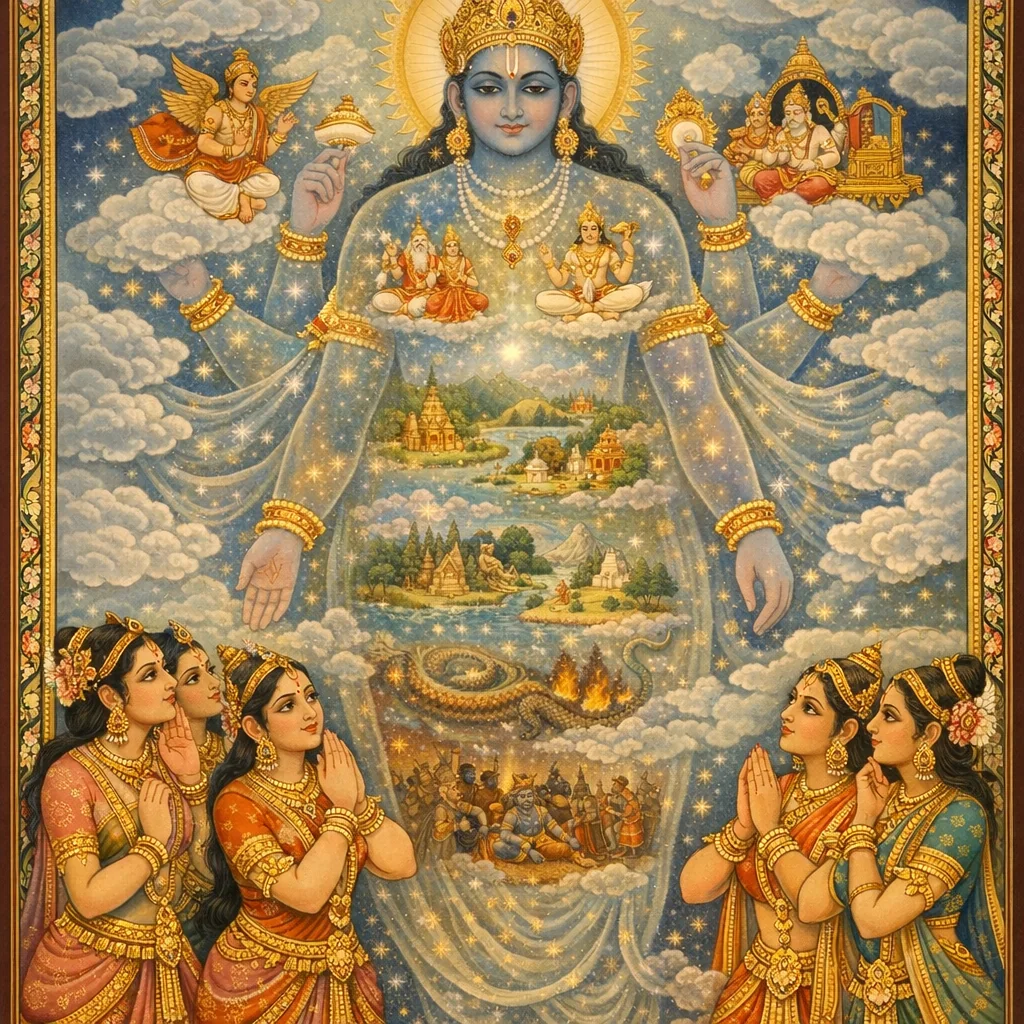
Chapter 193 presents a theological discourse through the narration of Śrī Mārkaṇḍeya. A group of apsarases—especially Vasantakāmā and Urvaśī—repeatedly bow and petition Nārāyaṇa for a direct vision of his cosmic form, affirming that his earlier teaching has already clarified the doctrine they sought. Nārāyaṇa grants their request by revealing that all worlds and beings abide within his own body. The vision is described in detail, listing divine orders—Brahmā, Indra, the Rudras, Ādityas, and Vasus—along with semi-divine classes such as yakṣas, gandharvas, and siddhas, and then humans, animals, plants, rivers, mountains, oceans, islands, and the celestial sphere, all seen within him. The apsarases respond with extended hymns, praising him as the substratum of the elements and senses, the one knower and perceiver, and the source in whom all beings participate as partial aspects. Overwhelmed by the intensity and vastness of the revelation, they ask that the cosmic form be withdrawn. Nārāyaṇa reabsorbs the manifestation, teaches that all beings are his portion, and urges an equal vision (samatā) toward gods, humans, and animals. The chapter concludes, in Mārkaṇḍeya’s voice to a king, that meditation on Keśava present in all beings supports liberation, and that hostility and other divisive moods fade when the world is understood as constituted by Vāsudeva.
Shlokas
Verse 1
श्रीमार्कण्डेय उवाच । इत्युक्तेऽप्सरसः सर्वाः प्रणिपत्य पुनः पुनः । ऊचुर्नारायणं देवं तद्दर्शनसमीहया
Śrī Mārkaṇḍeya said: When this had been spoken, all the apsarases bowed down again and again, and then addressed Lord Nārāyaṇa, yearning for the vision of Him.
Verse 2
वसन्तकामाप्सरस ऊचुः । भगवन्भवता योऽयमुपदेशो हितार्थिना । प्रोक्तः स सर्वो विज्ञातो माहात्म्यं विदितं च ते
The apsarases (Vasantakāmā) said: O Blessed Lord, the instruction you have given for our welfare has been fully understood; and your greatness, too, has become known to us.
Verse 3
यत्त्वेतद्भवता प्रोक्तं प्रसन्नेनान्तरात्मना । दर्शितेयं विशालाक्षी दर्शयिष्यामि वो जगत्
Whatever you have spoken with a gracious inner spirit—O wide-eyed Lady—has been shown to me; and I shall show you the universe.
Verse 4
तत्रार्थे सर्वभावेन प्रपन्नानां जगत्पते । दर्शयात्मानमखिलं दर्शितेयं यथोर्वशी
Therefore, for that purpose, O Lord of the world—unto those who have surrendered with their whole being—reveal your entire Self, just as you revealed it to Urvaśī.
Verse 5
यदि देवापराधेऽपि नास्मासु कुपितं तव । नमस्ते जगतामीश दर्शयात्मानमात्मना
Even if there has been an offense against the gods, if you are not angered with us—salutations to you, O Lord of the worlds—then reveal yourself by your own power.
Verse 6
नारायण उवाच । पश्यतेहाखिलांल्लोकान्मम देहे सुराङ्गनाः । मधुं मदनमात्मानं यच्चान्यद्द्रष्टुमिच्छथ
Nārāyaṇa said: Behold here, O celestial maidens, all the worlds within my body—and behold Madhu, and Madana, and my own Self, and whatever else you wish to see.
Verse 7
श्रीमार्कण्डेय उवाच । इत्युक्त्वा भगवान्देवस्तदा नारायणो नृप । उच्चैर्जहास स्वनवत्तत्राभूदखिलं जगत्
Śrī Mārkaṇḍeya said: Having spoken thus, the Blessed Lord Nārāyaṇa then laughed aloud, O King; and there, the entire universe came into manifestation, as if resonating with that sound.
Verse 8
ब्रह्मा प्रजापतिः शक्रः सह रुद्रैः पिनाकधृक् । आदित्या वसवः साध्या विश्वेदेवा महर्षयः
There were seen: Brahmā, Prajāpati, Śakra (Indra), and the bearer of the Pināka (Śiva) along with the Rudras; the Ādityas, the Vasus, the Sādhyas, the Viśvedevas, and the great seers.
Verse 9
नासत्यदस्रावनिलः सर्वशश्च तथाग्नयः । यक्षगन्धर्वसिद्धाश्च पिशाचोरगकिन्नराः
There were seen the Nāsaṭyas and Dasras (the Aśvins), Anila the Wind, and all the celestial rulers, as well as the Fires; Yakṣas, Gandharvas, and Siddhas; and also Piśācas, Nāgas, and Kinnaras.
Verse 10
समस्ताप्सरसो विद्याः साङ्गा वेदास्तदुक्तयः । मनुष्याः पशवः कीटाः पक्षिणः पादपास्तथा
They beheld all the Apsarases; the sciences and knowledges; the Vedas with their limbs and their teachings; humans, animals, insects, birds, and likewise the trees.
Verse 11
सरीसृपाश्चाथ सूक्ष्मा यच्चान्यज्जीवसंज्ञितम् । समुद्राः सकलाः शैलाः सरितः काननानि च
Within Him they beheld reptiles and subtle creatures, and whatever else is known as living beings—along with all the oceans, the mountains, the rivers, and the forests.
Verse 12
द्वीपान्यशेषाणि तथा तथा सर्वसरांसि च । नगरग्रामपूर्णा च मेदिनी मेदिनीपते । देवाङ्गनाभिर्देवस्य देहे दृष्टं महात्मनः
Within the body of that great Lord they saw all the continents and islands, and all lakes as well; and the earth—filled with cities and villages, O Lord of the Earth—was beheld by the divine maidens within the body of the God, the great-souled One.
Verse 13
नक्षत्रग्रहताराभिः सुसम्पूर्णं नभस्तलम् । ददृशुस्ताः सुचार्वङ्ग्यस्तस्यान्तर्विश्वं रूपिणः
They saw the vault of the sky filled completely with constellations, planets, and stars—those graceful-limbed ones beholding the entire universe within Him, the One whose form is the cosmos.
Verse 14
ऊर्ध्वं न तिर्यङ्नाधस्ताद्यदान्तस्तस्य दृश्यते । तमनन्तमनादिं च ततस्तास्तुष्टुवुः प्रभुम्
When no limit of Him could be seen—neither above, nor across, nor below—then they praised that Lord, infinite and without beginning.
Verse 15
मदनेन समं सर्वा मधुना च वराङ्गनाः । ससाध्वसा भक्तिपराः परं विस्मयमागताः
All those exquisite maidens—together with Madana and Madhu—filled with holy awe, devoted in bhakti, were overcome by supreme wonder.
Verse 16
वसन्तकामाप्सरस ऊचुः । पश्याम नादिं तव देव नान्तं न मध्यमव्याकृतरूपपारम् । परायणं त्वां जगतामनन्तं नताः स्म नारायणमात्मभूतम्
The Apsarases Vasantā and Kāma said: “O God, we see neither Your beginning nor Your end, nor even a middle—Your form’s far shore is unmanifest. You are the supreme refuge of the worlds, the Infinite. We bow to Nārāyaṇa, the very Self of all.”
Verse 17
महीनभोवायुजलाग्नयस्त्वं शब्दादिरूपस्तु परापरात्मन् । त्वत्तो भवत्यच्युते सर्वमेतद्भेदादिरूपोऽसि विभो त्वमात्मन्
You are earth, sky, wind, water, and fire; You are the forms beginning with sound—O Supreme who is both beyond and within all. From You, O Acyuta, all this arises; and as differentiation and its many modes, You appear—yet You are the all-pervading Self, O Lord.
Verse 18
द्रष्टासि रूपस्य परस्य वेत्ता श्रोता च शब्दस्य हरे त्वमेकः । स्रष्टा भवान् सर्वगतोऽखिलस्य घ्राता च गन्धस्य पृथक्शरीरी
You alone, O Hari, are the seer of form, the knower, and the hearer of sound. You are the creator, all-pervading through all existence; and You are the smeller of fragrance—dwelling in distinct bodies.
Verse 19
सुरेषु सर्वेषु न सोऽस्ति कश्चिन्मनुष्यलोकेषु न सोऽस्ति कश्चित् । पश्वादिवर्गेषु न सोऽस्ति कश्चिद्यो नांशभूतस्तव देवदेव
Among all the gods there is none; among human worlds there is none; among animals and other classes of beings there is none—who is not a portion of You, O God of gods.
Verse 20
ब्रह्माम्बुधीन्दुप्रमुखानि सौम्य शक्रादिरूपाणि तवोत्तमानि । समुद्ररूपं तव धैर्यवत्सु तेजः स्वरूपेषु रविस्तथाग्निः
O gentle Lord, the exalted forms beginning with Brahmā, the ocean, and the moon—along with forms such as Śakra—are Your noble manifestations. Among the steadfast, Your form is the ocean; among embodiments of radiance, Your form is the sun, and likewise fire.
Verse 21
क्षमाधनेषु क्षितिरूपमग्र्यं शीघ्रो बलवत्सु वायुः । मनुष्यरूपं तव राजवेषो मूढेषु सर्वेश्वर पादपोऽसि
O Lord of all: among those endowed with forbearance, You are the supreme form of Earth—steadfastness itself; among the strong and swift, You are the Wind, the very power of speed. When You appear in human guise, You wear the attire of a king; and for the deluded, O Sovereign, You stand like a tree—silent and unmoved—bearing their ignorance.
Verse 22
सर्वानयेष्वच्युत दानवस्त्वं सनत्सजातश्च विवेकवत्सु । रसस्वरूपेण जलस्थितोऽसि गन्धस्वरूपं भवतो धरित्र्याम्
O Acyuta: in every path of crooked conduct You appear as the daṇava-like impulse; yet among the discerning You are Sanatsujāta—ever-ancient wisdom. As taste itself You abide in water, and as fragrance You abide in the earth.
Verse 23
दृश्यस्वरूपश्च हुताशनस्त्वं स्पर्शस्वरूपं भवतः समीरे । शब्दादिकं ते नभसि स्वरूपं मन्तव्यरूपो मनसि प्रभो त्वम्
You are the visible form as fire; You are the form of touch within the moving wind. Sound and its subtle field are Your form in the sky (ether); and within the mind, O Lord, You are the very object to be contemplated.
Verse 24
बोधस्वरूपश्च मतौ त्वमेकः सर्वत्र सर्वेश्वर सर्वभूत । पश्यामि ते नाभिसरोजमध्ये ब्रह्माणमीशं च हरं भृकुट्याम्
As pure awareness, You are the one reality within understanding, present everywhere—O Lord of all beings. I behold Brahmā in the lotus of Your navel, and I see Īśa—Hara (Śiva)—at Your brow.
Verse 25
तवाश्विनौ कर्णगतौ समस्तास्तवास्थिता बाहुषु लोकपालाः । घ्राणोऽनिलो नेत्रगतौ रवीन्दु जिह्वा च ते नाथ सरस्वतीयम्
The Aśvins abide in Your ears; the guardians of the worlds stand established in Your arms. Wind is Your sense of smell; Sun and Moon are set in Your eyes; and Sarasvatī herself, O Lord, is Your tongue.
Verse 26
पादौ धरित्री जठरं समस्तांल्लोकान् हृषीकेश विलोकयामः । जङ्घे वयं पादतलाङ्गुलीषु पिशाचयक्षोरगसिद्धसङ्घाः
Your feet are the Earth; Your belly contains all the worlds—thus do we behold You, O Hṛṣīkeśa. We ourselves are in Your shanks, and at the soles and toes are hosts of piśācas, yakṣas, nāgas, and siddhas.
Verse 27
पुंस्त्वे प्रजानां पतिरोष्ठयुग्मे प्रतिष्ठितास्ते क्रतवः समस्ताः । सर्वे वयं ते दशनेषु देव दंष्ट्रासु देवा ह्यभवंश्च दन्ताः
In Your virile creative power stands Prajāpati upon the pair of Your lips; all sacrificial rites are established in You. We all are in Your teeth, O God; in Your fangs the devas abide—and even the teeth themselves are divine powers.
Verse 28
रोमाण्यशेषास्तव देवसङ्घा विद्याधरा नाथ तवाङ्घ्रिरेखाः । साङ्गाः समस्तास्तव देव वेदाः समास्थिताः सन्धिषु बाहुभूताः
All Your hairs are hosts of gods; the lines upon Your feet are the Vidyādharas, O Lord. The Vedas with all their limbs are wholly established in You, O Deva—resting in Your joints, which become like mighty arms supporting the whole.
Verse 29
वराहभूतं धरणीधरस्ते नृसिंहरूपं च सदा करालम् । पश्याम ते वाजिशिरस्तथोच्चैस्त्रिविक्रमे यच्च तदाप्रमेयम्
Your earth-bearing power is Varāha, the Boar; Your ever-terrible form is Narasiṃha. We behold also Your horse-headed form, lofty and exalted, and Your immeasurable stride as Trivikrama.
Verse 30
अमी समुद्रास्तव देव देहे मौर्वालयः शैलधरास्तथामी । इमाश्च गङ्गाप्रमुखाः स्रवन्त्यो द्वीपाण्यशेषाणि वनादिदेशाः
Within Your divine body are these oceans, and likewise the mountain ranges and the bearers of peaks. These flowing rivers beginning with the Gaṅgā, and all the continents, forests, and regions—everything abides in You.
Verse 31
स्तुवन्ति चेमे मुनयस्तवेश देहे स्थितास्त्वन्महिमानमग्र्यम् । त्वामीशितारं जगतामनन्तं यजन्ति यज्ञैः किल यज्ञिनोऽमी
O Lord, these sages—dwelling here in embodied life—praise Your supreme greatness. You, the endless Ruler of all worlds, are indeed worshipped by the sacrificers through sacred rites.
Verse 32
त्वत्तोहि सौम्यं जगतीह किंचित्त्वत्तो न रौद्रं च समस्तमूर्ते । त्वत्तो न शीतं च न केशवोष्णं सर्वस्वरूपातिशयी त्वमेव
From You arises whatever is gentle in this world, and from You too arises what is fierce, O One of all forms. From You come neither cold nor heat as separate powers—for You alone transcend and encompass every form of existence.
Verse 33
प्रसीद सर्वेश्वर सर्वभूत सनातनात्मपरमेश्वरेश । त्वन्मायया मोहितमानसाभिर्यत्तेऽपराद्धं तदिदं क्षमस्व
Be gracious, O Lord of all, indwelling Self of every being, supreme Lord beyond all. Deluded in mind by Your māyā, whatever offence we have committed against You—please forgive it.
Verse 34
किं वापराद्धं तव देवदेव यन्मायया नो हृदयं तवापि । मायाभिशङ्किप्रणतार्तिहन्तर्मनो हि नो विह्वलतामुपैति
O God of gods, what offence could truly be Yours—when by Your māyā our hearts are drawn even away from You? O Destroyer of the distress of the surrendered, fearing this māyā our minds indeed fall into agitation.
Verse 35
न तेऽपराद्धं यदि तेऽपराद्धमस्माभिरुन्मार्गविवर्तिनीभिः । तत्क्षम्यतां सृष्टिकृतस्तवैव देवापराधः सृजतो विवेकम्
If no offence can truly touch You, yet if an offence has been committed against You by us who have strayed onto wrong paths—let it be forgiven. O Creator of the world, even this ‘offence’ is bound up with the discernment You bestow in creation.
Verse 36
नमो नमस्ते गोविन्द नारायण जनार्दन । त्वन्नामस्मरणात्पापमशेषं नः प्रणश्यतु
Salutation upon salutation to You—Govinda, Nārāyaṇa, Janārdana. By the remembrance of Your Name, may all our sin, without remainder, be destroyed.
Verse 37
नमोऽनन्त नमस्तुभ्यं विश्वात्मन्विश्वभावन । त्वन्नामस्मरणात्पापमशेषं नः प्रणश्यतु
Salutations to You, O Ananta; salutations to You, O Soul of the universe, O Sustainer of the universe. By remembrance of Your Name, may all our sin be utterly destroyed.
Verse 38
वरेण्य यज्ञपुरुष प्रजापालन वामन । त्वन्नामस्मरणात्पापमशेषं नः प्रणश्यतु
O Most Adorable One, O Person of the sacrifice, O Protector of creatures, O Vāmana—by remembrance of Your Name, may all our sin be completely destroyed.
Verse 39
नमोऽस्तु तेऽब्जनाभाय प्रजापतिकृते हर । त्वन्नामस्मरणात्पापमशेषं नः प्रणश्यतु
Salutations to You, O Lotus-naveled One, O Hari who fulfills the work of Prajāpati. By remembrance of Your Name, may all our sin be utterly destroyed.
Verse 40
संसारार्णवपोताय नमस्तुभ्यमधोक्षज । त्वन्नामस्मरणात्पापमशेषं नः प्रणश्यतु
Salutations to You, O Adhokṣaja, the boat that carries beings across the ocean of worldly existence. By remembrance of Your Name, may all our sin be destroyed without remainder.
Verse 41
नमः परस्मै श्रीशाय वासुदेवाय वेधसे । स्वेच्छया गुणयुक्ताय सर्गस्थित्यन्तकारिणे
Homage to the Supreme—Śrīśa, Vāsudeva, the all-disposing Creator—who, by His own free will, assumes the guṇas and brings about creation, preservation, and dissolution.
Verse 42
उपसंहर विश्वात्मन्रूपमेतत्सनातनम् । वर्धमानं न नो द्रष्टुं समर्थं चक्षुरीश्वर
Withdraw, O Soul of the universe, this eternal form. As it expands, our eyes are no longer able to behold it, O Lord.
Verse 43
प्रलयाग्निसहस्रस्य समा दीप्तिस्तवाच्युत । प्रमाणेन दिशो भूमिर्गगनं च समावृतम्
O Acyuta, Your radiance is like that of a thousand fires at the time of dissolution. By its vast measure, the directions, the earth, and even the sky are all enveloped.
Verse 44
न विद्मः कुत्र वर्तामो भवान्नाथोपलक्ष्यते । सर्वं जगदिऐकस्थं पिण्डितं लक्षयामहे
We do not know where we stand; only You, O Protector, are perceived. We behold the entire universe gathered into a single place, as though compacted into one mass.
Verse 45
किं वर्णयामो रूपं ते किं प्रमाणमिदं हरे । माहात्म्यं किं नु ते देव यज्जिह्वाया न गोचरे
How can we describe Your form, O Hari, and what measure could encompass it? What indeed is Your greatness, O God, when it does not come within the range of the tongue (of speech)?
Verse 46
वक्तारो वायुतेनापि बुद्धीनामयुतायुतैः । गुणनिर्वर्णनं नाथ कर्तुं तव न शक्यते
Even if there were speakers as many as the winds, endowed with intellects by tens of millions, O Lord, still Your qualities could not be fully enumerated.
Verse 47
तदेतद्दर्शितं रूपं प्रसादः परमः कृतः । छन्दतो जगतामीश तदेतदुपसंहर
This very form has been shown—you have bestowed the highest grace. Now, O Lord of the worlds, of Your own accord, withdraw this manifestation.
Verse 48
मार्कण्डेय उवाच । इत्येवं संस्तुतस्ताभिरप्सरोभिर्जनार्दनः । दिव्यज्ञानोपपन्नानां तासां प्रत्यक्षमीश्वरः
Mārkaṇḍeya said: Thus praised by those Apsarās, Janārdana—the Lord—became directly manifest before them, for they were endowed with divine knowledge.
Verse 49
विवेश सर्वभूतानि स्वैरंशैर्भूतभावनः । तं दृष्ट्वा सर्वभूतेषु लीयमानमधोक्षजम्
The Nourisher of beings entered all creatures through His own portions. Seeing Adhokṣaja merging into all beings, they were struck with awe.
Verse 50
विस्मयं परमं चक्रुः समस्ता देवयोषितः । स च सर्वेश्वरः शैलान्पादपान्सागरान्भुवम्
All the celestial women were filled with the utmost wonder. And that Lord of all—who contains mountains, trees, oceans, and the earth—continued His withdrawal into the cosmos.
Verse 51
जलमग्निं तथा वायुमाकाशं च विवेश ह । काले दिक्ष्वथ सर्वात्म ह्यात्मनश्चान्यथापि च
That All-Self entered into water, into fire, into wind, and into space; and likewise into time and into the directions—indeed, He pervaded all as the universal Self, and also in other modes of His own being.
Verse 52
आत्मरूपस्थितं स्वेन महिम्ना भावयञ्जगत् । देवदानवरक्षांसि यक्षीविद्याधरोरगाः
Abiding in His own Self-form, He sustained and manifested the world by His inherent majesty—(including) the gods, the dānavas, the rākṣasas, the yakṣiṇīs, the vidyādharas, and the serpents.
Verse 53
मनुष्यपशुकीटादिमृगपश्वन्तरिक्षगाः । येऽन्तरिक्षे तथा भूमौ दिवि ये च जलाश्रयाः
Humans, beasts, insects, and other creatures; animals and beings that move in the mid-air—those who dwell in the sky, likewise on the earth, those in heaven, and those who take refuge in the waters.
Verse 54
तान्विवेश स विश्वात्मा पुनस्तद्रूपमास्थितः । नरेण सार्धं यत्ताभिर्दृष्टपूर्वमरिन्दम
That Universal Self entered into them all; then, assuming that very form again—O subduer of foes—He appeared as formerly seen by those celestial women, together with the man.
Verse 55
ताः परं विस्मयं जग्मुः सर्वास्त्रिदशयोषितः । प्रणेमुः साध्वसात्पाण्डुवदना नृपसत्तम
All those celestial women were struck with the utmost wonder; pale-faced from awe, they bowed down—O best of kings.
Verse 56
नारायणोऽपि भगवानाह तास्त्रिदशाङ्गनाः
Then the Blessed Lord Nārāyaṇa spoke to those celestial maidens.
Verse 57
नारायण उवाच । नीयतामुर्वशी भद्रा यत्रासौ त्रिदशेश्वरः । भवतीनां हितार्थाय सर्वभूतेष्वसाविति
Nārāyaṇa said: “Let the gracious Urvaśī be led to where that Lord of the gods is. For your welfare, know that He is present within all beings.”
Verse 58
ज्ञानमुत्पादितं भूयो लयं भूतेषु कुर्वता । तद्गच्छध्वं समस्तोऽयं भूतग्रामो मदंशकः
“Again, knowledge has been generated, and dissolution into the elements has been brought about. Therefore go forth: this entire multitude of beings is a portion of Me.”
Verse 59
अहमद्यात्मभूतस्य वासुदेवस्य योगिनः । अस्मात्परतरं नास्ति योऽनन्तः परिपथ्यते
I am the inner Self of Vāsudeva, the Yogin; there is nothing higher than this—He who is endless is realized as the supreme refuge.
Verse 60
तमजं सर्वभूतेशं जानीत परमं पदम् । अहं भवत्यो देवाश्च मनुष्याः पशवश्च ये । एतत्सर्वमनन्तस्य वासुदेवस्य वै कृतम्
Know Him—the Unborn, the Lord of all beings—as the supreme abode. I, you celestial ladies, the gods, humans, and the animals—indeed all this—is truly the work of Vāsudeva, the Endless.
Verse 61
एवं ज्ञात्वा समं सर्वं सदेवासुरमानुषम् । सपश्वादिगुणं चैव द्रष्टव्यं त्रिदशाङ्गनाः
Knowing thus, you should behold all as equal—gods, asuras, and humans alike—along with beings such as animals and the rest, together with their various qualities. So must you see, O celestial maidens.
Verse 62
मार्कण्डेय उवाच । इत्युक्तास्तेन देवेन समस्तास्ताः सुरस्त्रियः । प्रणम्य तौ समदनाः सवसन्ताश्च पार्थिव
Mārkaṇḍeya said: “Thus addressed by that deity, O king, all those celestial women bowed to the two of them; and, their pride subdued, they departed.”
Verse 63
आदाय चोर्वशीं भूयो देवराजमुपागताः । आचख्युश्च यथावृत्तं देवराजाय तत्तथा
Taking Urvaśī again, they approached the king of the gods and reported to him exactly what had occurred, just as it happened.
Verse 64
मार्कण्डेय उवाच । तथा त्वमपि राजेन्द्र सर्वभूतेषु केशवम् । चिन्तयन्समतां गच्छ समतैव हि मुक्तये
Mārkaṇḍeya said: “So you too, O best of kings, contemplate Keśava in all beings. Proceed in equanimity, for equanimity itself leads to liberation.”
Verse 65
राजन्नेवं विशेषेण भूतेषु परमेश्वरम् । वासुदेव कथं दोषांल्लोभादीन्न प्रहास्यसि
“O king, when you thus distinctly perceive the Supreme Lord Vāsudeva present in beings, how could you not cast off faults such as greed and the like?”
Verse 66
सर्वभूतानि गोविन्दाद्यदा नान्यानि भूपते । तदा वैरादयो भावाः क्रियतां न तु पुत्रक
“O king, when all beings are understood as none other than Govinda, then dispositions such as enmity and the rest are not to be entertained—never, my child.”
Verse 67
इति पश्य जगत्सर्वं वासुदेवात्मकं नृप । एतदेव हि कृष्णेन रूपमाविष्कृतं नृप
“Thus, O king, behold the entire world as having Vāsudeva as its very self. Indeed, O king, this very form (truth) has been revealed by Kṛṣṇa.”
Verse 68
परमेश्वरेति यद्रूपं तदेतत्कथितं तव । जन्मादिभावरहितं तद्विष्णोः परमं पदम्
“That reality which is spoken of as ‘the Supreme Lord’—that very form has been described to you. It is free from conditions such as birth and the rest; that is Viṣṇu’s supreme abode.”
Verse 69
संक्षेपेणाथ भूपाल श्रूयतां यद्वदामि ते । यन्मतं पुरुषः कृत्वा परं निर्वाणमृच्छति
Now, O protector of the earth, hear in brief what I say to you: adopting this understanding, a person attains the supreme nirvāṇa.
Verse 70
सर्वो विष्णुसमासो हि भावाभावौ च तन्मयौ । सदसत्सर्वमीशोऽसौ महादेवः परं पदम्
For everything is, in sum, Viṣṇu; both being and non-being are pervaded by Him. He is the Lord of all—of the real and the unreal alike—He, Mahādeva, is the supreme state.
Verse 71
भवजलधिगतानां द्वन्द्ववाताहतानां सुतदुहितृकलत्रत्राणभारार्दितानाम् । विषमविषयतोये मज्जतामप्लवानां भवति शरणमेको विष्णुपोतो नराणाम्
For those who have fallen into the ocean of worldly becoming, battered by the winds of opposites and weighed down by the burden of protecting son, daughter, and spouse—who are drowning in the treacherous waters of sense-objects with no boat—there is one refuge: the ‘boat’ of Viṣṇu.
Verse 193
अध्याय
Chapter (Adhyāya).