Adhyaya 148
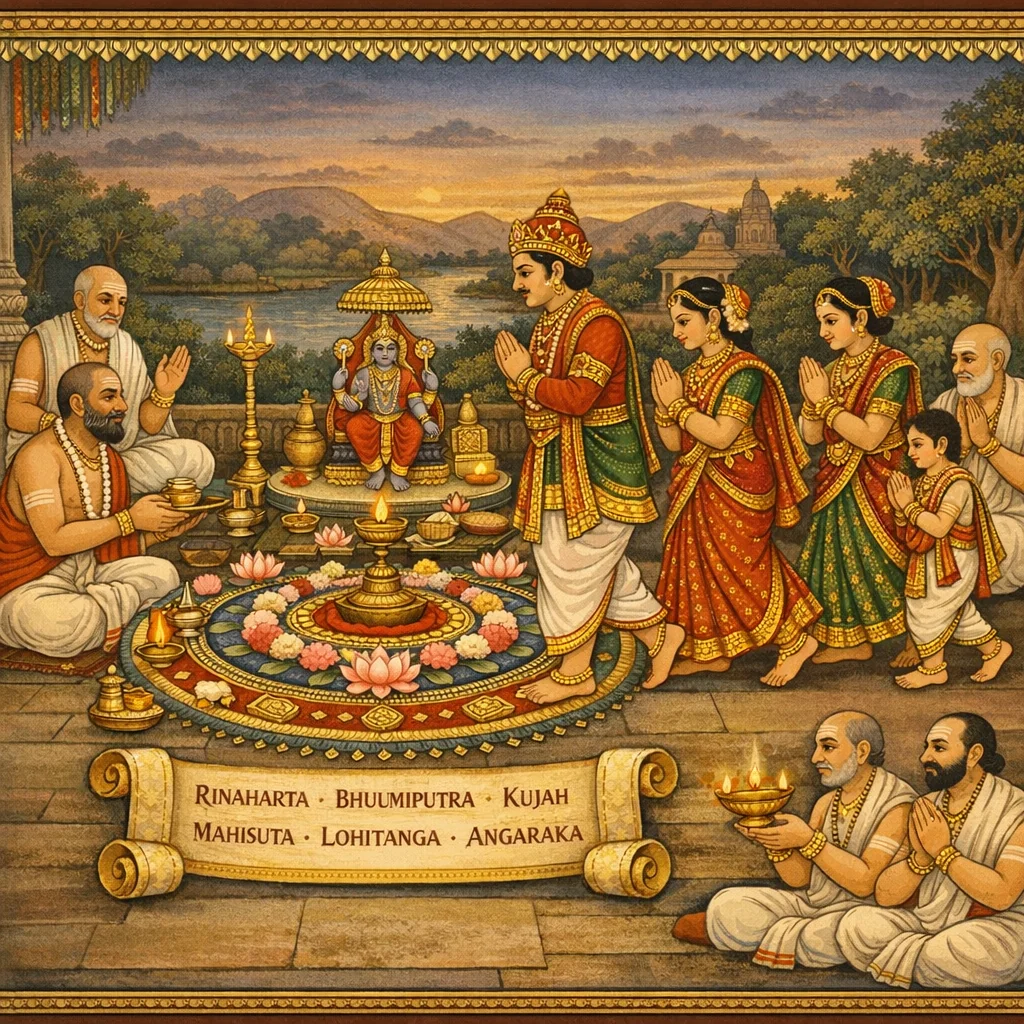
Mārkaṇḍeya directs a king to go to an Āṅgāraka-associated Śiva-tīrtha on the northern bank of the Narmadā, praised as a place where sins diminish (pāpa-kṣaya). The chapter prescribes a time-bound vrata focused on Caturthī and Tuesday (the Caturthī–Āṅgāraka day), stressing firm resolve (saṅkalpa), bathing at sunset, and sustained sandhyā-upāsanā. It then lays out a detailed pūjā: establishing the rite on a sthaṇḍila, applying red sandal, worship in lotus/maṇḍala fashion, and invoking Kuja/Āṅgāraka by epithets such as Bhūmiputra and Svedaja. Arghya is offered in a copper vessel with red-sandal water, red flowers, tila, and rice. Dietary rules are given—avoid sour and salty foods, favoring gentle and wholesome fare. The observance may be expanded with a golden image as one can afford, multiple karakas set by direction, auspicious sounds of śaṅkha/tūrya, and honoring a qualified brāhmaṇa marked by learning, vows, and kindness. Gifts include a red cow and a red bull, followed by circumambulation, family participation, apology and closing rites, and dismissal. The phalaśruti promises beauty and prosperity across many lives, a post-mortem abode called Āṅgāraka-pura, divine enjoyments, and ultimately righteous kingship, health, and long life.
Shlokas
Verse 1
श्रीमार्कण्डेय उवाच । ततो गच्छेन्महीपाल तीर्थमङ्गारकं शिवम् । उत्तरे नर्मदाकूले सर्वपापक्षयंकरम्
Śrī Mārkaṇḍeya said: Then, O King, one should go to the sacred Aṅgāraka-Śiva tīrtha on the northern bank of the Narmadā, which brings about the destruction of all sins.
Verse 2
चतुर्थ्यङ्गारकदिने संकल्प्य कृतनिश्चयः । स्नायादस्तं गते सूर्ये सन्ध्योपासनतत्परः
When the fourth lunar day (caturthī) coincides with Tuesday (Aṅgāraka’s day), one should make a solemn vow with firm resolve. After the sun has set, one should bathe and remain devoted to the worship of the twilight Sandhyā rites.
Verse 3
पूजयेल्लोहितं भक्त्या गन्धमाल्यविभूषणैः । संस्थाप्यस्थण्डिले देवं रक्तचन्दनचर्चितम्
With devotion one should worship the Red One (Kuja/Aṅgāraka) using fragrances, garlands, and ornaments, having installed the deity upon a purified ground-altar (sthaṇḍila) and anointed him with red sandal paste.
Verse 4
अङ्गारकायेति नमः कर्णिकायां प्रपूजयेत् । कुजाय भूमिपुत्राय रक्ताङ्गाय सुवाससे
In the central pericarp (karṇikā) one should worship, offering salutations with the mantra ‘Obeisance to Aṅgāraka.’ He is Kuja, the Son of Earth—red-limbed and fair-robed.
Verse 5
हरकोपोद्भवायेति स्वेदजायातिबाहवे । सर्वकामप्रदायेति पूर्वादिषु दलेषु च
On the petals beginning with the eastern one and so on, one should worship with these invocations: “Born of Hara’s wrath,” “Born of sweat,” “Mighty-armed,” and “Bestower of all desires.”
Verse 6
एवं सम्पूज्य विधिवद्दद्यादर्घ्यं विधानतः । भूमिपुत्र महावीर्य स्वेदोद्भव पिनाकिनः
Having thus worshipped in due form, one should then offer arghya according to the prescribed rule, saying: “O Son of Earth, O great in prowess, O sweat-born one of the Pinākin (Śiva)!”
Verse 7
अङ्गारक महातेजा लोहिताङ्ग नमोऽस्तु ते । करकं वारिसंयुक्तं शालितंदुलपूरितम्
O Aṅgāraka of mighty splendor, O red-limbed one—obeisance to you. (Offer) a water-filled vessel (karaka) packed with grains of śāli rice.
Verse 8
सहिरण्यं सवस्त्रं च मोदकोपरि संस्थितम् । ब्राह्मणाय निवेद्यं तत्कुजो मे प्रीयतामिति
Along with gold and cloth, placing it upon sweet modakas, it should be presented to a brāhmaṇa, praying: “May Kuja be pleased with me.”
Verse 9
अर्घं दत्त्वा विधानेन रक्तचन्दनवारिणा । रक्तपुष्पसमाकीर्णं तिलतंदुलमिश्रितम्
Having offered arghya according to rule with water scented by red sandal, (one should offer it) strewn with red flowers and mixed with sesame and rice grains.
Verse 10
कृत्वा ताम्रमये पात्रे मण्डले वर्तुले शुभे । कृत्वा शिरसि तत्पात्रं जानुभ्यां धरणीं गतः
Having arranged it in a copper vessel within an auspicious circular maṇḍala, one should place that vessel upon the head and, on the knees, bow down to the earth.
Verse 11
मन्त्रपूतं महाभाग दद्यादर्घ्यं विचक्षणः । ततो भुञ्जीत मौनेन क्षारतिलाम्लवर्जितम्
O noble one, the wise should offer the arghya purified by mantra. Thereafter, one should eat in silence, avoiding alkaline foods, sesame, and sour items.
Verse 12
स्निग्धं मृदुसमधुरमात्मनः श्रेय इच्छता । एवं चतुर्थे सम्प्राप्ते चतुर्थ्यङ्गारके नृप
O king, one who seeks one’s own highest good should offer what is unctuous, tender, and pleasantly sweet. Thus, when the fourth lunar day arrives—especially when Caturthī falls on Tuesday (Aṅgāraka)—this is the proper observance.
Verse 13
सौवर्णं कारयेद्देवं यथाशक्ति सुरूपिणम् । स्थापयेत्ताम्रके पात्रे गुडपीठसमन्विते
One should commission a golden image of the deity, as far as one’s means allow, fashioned in a beautiful form; and place it in a copper vessel set upon a pedestal of jaggery.
Verse 14
गन्धपुष्पादिभिर्देवं पूजयेद्गुडसंस्थितम् । ईशान्यां स्थापयेद्देवं गुडतोयसमन्वितम्
Worship the deity—seated upon jaggery—with fragrances, flowers, and the like. Then, in the north-east (Īśāna) direction, establish the deity together with jaggery-water as an accompaniment.
Verse 15
कासारेण तथाग्नेय्यां स्थापयेत्करकं परम् । रक्ततन्दुलसंमिश्रं नैरृत्यां वायुगोचरे
Likewise, in the south-east (Āgneya) one should set an excellent ritual water-pot, filled with kāsāra, a sweet offering. In the south-west (Nairṛta), within the domain of Vāyu, one should place (the pot/setting) mixed with red rice-grains.
Verse 16
स्थापयेन्मोदकैः सार्धं चतुर्थं करकं बुधः । सूत्रेण वेष्टितग्रीवं गन्धमाल्यैरलंकृतम्
The wise person should place a fourth ritual pot together with modakas. Its neck should be wrapped with a thread, and it should be adorned with perfumes and garlands.
Verse 17
शङ्खतूर्यनिनादेन जयशब्दादिमङ्गलैः । रक्ताम्बरधरं विप्रं रक्तमाल्यानुलेपनम्
With the resounding of conches (śaṅkha) and musical instruments, and with auspicious cries of victory and the like, honor a brāhmaṇa clad in red garments, adorned with red garlands and red unguents.
Verse 18
वेदिमध्यगतं वापि महदासनसंस्थितम् । सुरूपं सुभगं शान्तं सर्वभूतहिते रतम्
(Invite and seat that brāhmaṇa) either in the middle of the altar-space or upon a great seat—handsome, gracious, tranquil, and devoted to the welfare of all beings.
Verse 19
वेदविद्याव्रतस्नातं सर्वशास्त्रविशारदम् । पूजयित्वा यथान्यायं वाचयेत्पाण्डुनन्दन
O son of Pāṇḍu, having duly honored one trained in Vedic learning, purified by vows and sacred bathing, and skilled in all śāstras, one should then request him to recite the sacred texts according to proper rule.
Verse 20
रक्तां गां च ततो दद्याद्रक्तेनानडुहा सह । प्रीयतां भूमिजो देवः सर्वदैवतपूजितः
Then one should gift a red cow, together with a red bull: “May the Earth-born deity be pleased”—that deity worshiped by all the gods.
Verse 21
विप्रं प्रदक्षिणीकृत्य पत्नीपुत्रसमन्वितः । पितृमातृसुहृत्सार्द्धं क्षमाप्य च विसर्जयेत्
Having circumambulated the brāhmaṇa, together with one’s wife and son—and along with one’s father, mother, and friends—one should ask forgiveness and then respectfully take leave.
Verse 22
एवं कृतस्य तस्याथ तस्मिंस्तीर्थे विशेषतः । यत्पुण्यं फलमुद्दिष्टं तत्ते सर्वं वदाम्यहम्
Thus, regarding that act performed—especially at this tīrtha—I shall now tell you in full the declared meritorious fruit (puṇya-phala) of it.
Verse 23
सप्त जन्मानि राजेन्द्र सुरूपः सुभगो भवेत् । तीर्थस्यास्य प्रभावेन नात्र कार्या विचारणा
O best of kings, for seven births one becomes handsome and fortunate. Such is the power of this tīrtha—there is no need for doubt or debate here.
Verse 24
अकामो वा सकामो वा तत्र तीर्थे मृतो नरः । अङ्गारकपुरं याति देवगन्धर्वपूजितः
Whether desireless or desire-driven, a man who dies at that tīrtha goes to Aṅgāraka-pura, honored and worshiped by gods and Gandharvas.
Verse 25
उपभुज्य यथान्यायं दिव्यान्भोगाननुत्तमान् । इह मानुष्यलोके वै राजा भवति धार्मिकः
Having duly enjoyed, in accordance with dharma, incomparable divine pleasures, one is then born here in the human world indeed as a righteous king.
Verse 26
सुरूपः सुभगश्चैव सर्वव्याधिविवर्जितः । जीवेद्वर्षशतं साग्रं सर्वलोकनमस्कृतः
Handsome and fortunate, free from all diseases, he lives a full hundred years and more—revered by all people.
Verse 148
। अध्याय
Chapter end (adhyāya marker).